Showing posts with label WW1 WW2 propaganda posters. Show all posts

February 29, 2012

WW2 PROPAGANDA: WAR OF WORDS Part 4 Secrets of Propaganda Techniques

The most powerful and deadly weapon of World War II was capable of bringing about the complete obedience of millions of people without firing a single shot. That weapon was propaganda and it revolutionized the way in which wars were fought then and now.

World War II was one of the greatest conflagrations of all time when tens of millions of people around the world perished in battles, and from persecution and annihilation. In the years just prior to World War II, Hitler was not only mobilizing his military forces, but had already embarked on elaborate propaganda campaigns aimed at winning the support of the German people in his accession to power. He relied heavily on the unquestioning acceptance of his leadership and complete indoctrination of the people to his ideology. In Nazi Germany these factors instigated terrifying results that began with Kristallnacht, and led to the extermination of millions of people which comprised the Jews, the Poles, the Slavic, the Roma and many other nationalities. Stalin has been described as the mirror image of Hitler but was a character infinitely more sinister, whose mastery of political subterfuge reached draconian levels. He applied the same propaganda techniques to cultivate support of the Soviet people but relied on the use of brute terror and intimidation to sustain his power.


During WWII propaganda was produced at such a prolific rate that it required the formation of virtual armies of propagandists churning out a staggering volume of messages in every conceivable format. Many examples of their work have survived to this day and provide invaluable insight into the techniques used to disseminate the messages. Propaganda served a dual purpose by emphasizing its benevolent intentions, exemplified by appeals for public safety and encouraging the war effort, as well as functioning as an instrument of psychological warfare against the enemy.

Propaganda earned its bad reputation during World War II, but it was Edward Bernays, who recognizing its commercial applications, combined the principles of crowd psychology with the theories of psychoanalysis founded by his uncle, Sigmund Freud. Though Bernays was not the first to expound on the theories of the "herd instinct" he became known as the "father of public relations" for introducing the concept to the United States after the end of World War II.

The following is a synopsis of some of the techniques used by propagandists in an attempt to mold public thoughts, emotions, and opinions, as well as to deceive and slander the enemy.


White Propaganda
This type of propaganda usually consists of a one-sided argument that is delivered in a much gentler manner than other types of propaganda. Though it is benign in its message it is no less manipulative in its objectives.


Black Propaganda


presents itself as being derived from one source when in fact it had originated from another.
During WWII forces frequently employed this tactic to conceal their true identity during the course of military operations in an effort to confuse and deceive the enemy.


Grey propaganda

presents the enemy with the most difficulty as its source and validity cannot be determined. The tactics involve the dissemination of two diametrically opposed claims. The objective is to make the enemy believe claim A is true. It is immediately followed by claim B which is completely contradictory and succeeds to refute its own validity by the inclusion of an informal fallacy. It is then expected that the enemy will choose claim A.

During WWII, Allied airplanes airdropped German newspapers "Nachrichten fur die Truppe" (News for the Troops) over German-occupied areas, in an effort to undermine their military operations. Though the German soldiers were quite aware of the fact that the newspapers were dropped from Allied planes, it instilled a degree of doubt or uncertainty among them regarding the validity of the newspaper and the true identity of its carrier. Gray propaganda is one whose source cannot be confirmed.


Appeal to Fear


is a technique readily understood but rarely recognized as such because the techniques used are both elaborate and covert. Joseph Goebbels was able to instill panic and fear in the German people merely by citing the work of Theodore Kaufman's "Germany Must Perish!" which claimed that the Allies were intent on planning the extermination of the German people.


Bandwagon


is a technique most often used during election campaigns in an effort to persuade voters to choose the "winning side". Both Hitler and Stalin employed this tactic in an effort to rally their nations. The message clearly implied that theirs was an inevitable victory, and served as an invitation to those who have not already joined them to do so now.


The Big Lie


resorts to continuously describing a complex matter and using it to justify some kind of action. Hitler did just that at the end of WWI, when he denounced the Treaty of Versailles as the instrument with which Britain and the United States despoiled Germany. By combining some elements of truth with wild conjecture, Hitler was able to perpetuate the "Stab in the Back" myth. Hence Germany's aggressive remilitarization.


Black and White Fallacy


quite simply refers to the presentation of only two choices, and the claim that you are either "with us" or "against us". Statements of this genre have been used by virtually every nation and in times of war is particularly effective when it appeals to national patriotism.


Common Man


This technique attempts to persuade the target audience that the propagandist shares the views of the common people, because they are also just "plain folks". The message is written in a manner that appeals to and solicits their confidence, and is achieved by the use of ordinary, or vernacular language sometimes accompanied by mannerisms associated with the group. Hitler employed this technique combined with that of the "Big Lie" (see video in Part 2).


Cult of Personality


is created when an individual manipulates mass media in an effort to construct a heroic image of himself, reinforced through effusive praise. The success of this propaganda is evident by the conspicuous absence of opposition, or challenge to the person's authority.


Demonizing the Enemy

This propaganda targeted individuals and groups who belonged to different nationalities, ethnicities, religions, and race, and condemned them as either grotesque evil monsters, or subhuman. Germany used the term "untermenschen" to describe not only the Jews, but ethnic Poles, Russians, Czechs, among many others. It combined the use of name-calling to reinforce negative images in the minds of the German people. Needless to say it was a tactic employed by all sides during the war.


The US army produced an effective propaganda campaign to encourage young Americans to enlist in the army. To those who are familiar with vintage American cinema, this poster depicts a stylized version of King Kong abducting Fay Wray, as the analogy for the Nazi conquest of Europe. The drawing of the German military helmet, and wooden club carved with the word "Culture" was meant to offend the German people by equating them with savages despite their pretensions of cultural superiority. American propaganda used the same propaganda techniques in demonizing the Japanese.


Disinformation

involved the omission or introduction of false information to deter or mislead the enemy. It was a technique successfully applied by both sides of the war in an effort to advance their military objectives. The most rousing example is the ploy used to misdirect the German armies just prior to the Allied Invasion of Normandy. Churchill's ingenious use of disinformation was able to convince German armies that Britain was going to invade along the coast of Calais which seemed logical to the enemy since it was the shortest span across the Channel.


Euphoria

is the method by which the propagandist organizes large-scale events, such as parades with marching soldiers, bands, and music or rallies which are used as a bandstand for patriotic, emotional speeches. In any case the atmosphere of celebration lends to the happiness, and euphoria of the target audience making them more receptive to manipulation.


Fear, Uncertainty and Doubt

This technique involves the introduction of information that is negative, false, or uncertain, in the effort to undermine the credibility of the peoples' beliefs, directly to civilians as well as military personnel.


Flag Waving

is an attempt to justify the beliefs and actions of any group, by associating it with acts of patriotism, such as flag-waving. The target audience would then be more inclined to support the group because of its patriotic fervor.


Half Truth

is a deceptive technique which combines various elements of lies with kernels of truth making the statement difficult to refute or challenge. Other tactics might entail the use of improper punctuation or double meaning. The objective is to misrepresent the truth, evade or assign blame.


Labelling

is used by the propagandist to establish credibility of certain claims or ideals. The label, or word selected to promote the ideal is meant to be sufficiently vague or harmless, so as to conceal the true nature of its objectives. Hitler's reference to the word "lebensraum" is a perfect example. It was only when Hitlers armies embarked on the conquest and subjugation of Europe, that the world came to understand the true meaning of lebensraum. Synonyms for the word "lebensraum" litter the pages of history. For example the term "Manifest Destiny" was used by American pioneers who considered themselves as God's chosen people sent to tame the wilderness of the North American continent.


"Managing the News"


This technique employs the use of classical conditioning with the intention of "Staying on Message". It was defined by Adolf Hitler who wrote "The most brilliant propagandist technique will yield no success unless one fundamental principle is borne in mind constantly - it must confine itself to a few points and repeat them over and over." This technique can be considered the staple of propagandists the world over and has not abated since the end of the war.


Name Calling

Propagandists apply this tactic with the intention of arousing fears and prejudices among members of the target audience, usually with the expectation that it will precipitate opposition or instigate hatred against a group, or its beliefs and ideas. The technique is used to establish "name-calling" as a substitute for intelligent reasoning and reliance on facts. The Band Wagon technique may also be included to ensure that errant individuals fall into line.


Oversimplification

Like many other techniques this one does not require definition, however the fact remains that some people fail to recognize that they have been manipulated in this manner. The propagandist relies quite heavily on simple statements and generalities to explain complex and controversial issues, all with the intention of swaying public perception and opinion.

Repetition

is one of the most important tools of the propagandist, as the repetition of slogans and claims ensures that the audience will remember them and eventually accept them as facts. It is not uncommon that slogans from WWII continue to circulate today, attesting to the immense power of propaganda over the world long after the initial war has ended.


Scapegoating


The objective of the propagandist is to deflect criticism from a government or organization by assigning blame to an external group or individual, on the basis of its nationality, ethnicity or religion. Such propaganda permits the leadership to avoid taking any responsibility for political, economic and social problems, and distracts the public by channeling their outrage to predetermined targets. The following is an election poster of the Nazi party depicting the image of a serpent (representing the Jews) who were blamed for Germany's humiliation as a result of the Treaty of Versailles.


Slogans

incorporate the tools of Labelling and Stereotyping and are essentially appeals to public emotions. The effectiveness of slogans largely depend upon the skill of the propagandist in creating short, memorable phrases that support popular ideas which are always emphasized by repetition.


Stereotyping


is a technique used by the propagandist to arouse the emotions of the target against a perceived enemy. By selecting a scapegoat, the propagandist associates them with a slanderous label, and the expectation is that the population at large will react to them with fear and loathing. This construct of lies and half-truths are heaped upon the nation, or group, further reinforced with images exaggerating the racial features of "the enemy".


Selective Truth

is the foundation of a successful propaganda campaign. It entails choosing certain words or ideas at the exclusion of others, and attempts to present them as facts. Richard Crossman, who was British Deputy Director of the Psychological Warfare Division of Supreme HQ Allied Expeditionary Force during WWII, expressed it perfectly, "The art of propaganda is not telling lies, but rather selecting the truth you require and giving it mixed up with some truths the audience wants to hear."


Virtue Words
were used by the propagandist as an instrument to connect positive values to their leader and/or mission. Words such as "Peace", "Truth", "Freedom" and "Victory" were used during WW2 by the Allies to bolster the spirit of the fighting men and their determination to win the war. It also functioned as a tool of psychological warfare which was used to erode enemy morale.

WW2 Poster Allied Unity


CONCLUSION


Today we are under the illusion that we understand propaganda but in reality that is not the case. Our parents and grandparents who had suffered the horrors of two world wars, and who were subjected to a barrage of propaganda in those years can attest to its power to persuade and destroy. The use of propaganda in our day is feeble by comparison.

At the very start of WWII, the British government printed over two million copies of these posters, with the objective of encouraging the British public to remain calm, and "keep a stiff upper lip." They were printed, put into storage but were never distributed. Other slogans printed on the same background were, "Your Courage, Your Cheerfulness, Your Resolution Will Bring Us Victory" and "Freedom is in Peril", and "Keep Calm and Carry On".


February 28, 2012

WW2 PROPAGANDA: WAR OF WORDS Part 3 Soviet Propaganda


Stalin speech on November 7, 1941 (with English subtitles) (00:06:48m)


Stalin - the very name continues to evoke controversy today. He rose to power on a wave of deception and murder and became one of the most feared and dangerous despots of all time. Throughout the thirty years of his reign, Stalin was responsible for the deaths of millions of people yet the Russian people revered him as a father-figure and demi-god. It is astonishing to note that some Russians today still praise his legacy.

It is not difficult to perceive how this demon rose to the heights of demagoguery.  Stalin was among the progenitors of the 1918 October Revolution
driven by the theories of Marxist-Leninism. It appealed to and galvanized a nation through slogans idealizing the struggle of the "proletariat" against the oppressive masters of imperialism and capitalism. However it only replaced one power elite with the tyranny  of another.


The above video documented Stalin's address on November 7, 1941 to the Soviet military forces, in the wake of their overwhelming losses to the "German brigands". The Nazis had spearheaded Operation Barbarossa in June of that year in an ambitious campaign to conquer the Soviet Union and though they had achieved initial successes it would be short-lived. 

The above Soviet propaganda poster appealed to the patriotic sentiment of the nation by referring to the legendary victories of the Russian armies; in wars against the Teutonic Knights in the Battle of the Ice in April 1242, against the Prussians in 1760 when Russians captured Berlin during the Seven Years' War,  and the pivotal October Revolution, in which the government was overthrown and power seized by the Bolsheviks.  It proclaimed that Russian victory would again be achieved despite the assault of the Nazi German hordes. In this illustration a Russian soldier slays a German soldier who is depicted as a demon (made apparent by the addition of little horns on his helmet) and a sluggard (by the lack of any weapon except that of a bottle of alcohol.)


This Soviet poster speaks for itself. It depicts
comical images of Hitler and his generals running for their lives from the approaching convoy of Soviet tanks. It was meant not only to demoralize and ridicule the Wehrmacht but assert Soviet confidence that military fortunes were shifting in their favor. In the early stages of this war, German forces succeeded in penetrating Russian-occupied territories through eastern Poland and the Baltic states and captured Leningrad and then Smolensk. By autumn 1941 the Germans were poised to attack Moscow but the onset of a Russian winter literally froze them in their tracks.  It was then that Stalin was ready to launch a fierce counteroffensive with troops he had called in from Siberia and the Far East, supported by an ample supply of new tanks and weapons. The battles ensued for four more long years until the Red Army was able to defeat the Nazis all the way back to Berlin.


In this poster Hitler was portrayed as a miniature version of "Napoleon" and bearing a tiny pistol which was hopelessly inadequate against the butt of a big Russian rifle. The implicit message was that Hitler would suffer the same humiliating defeat as Napoleon. The background shadow of a farmer's pitchfork with the date 1812 referred to the Patriotic War during which Napoleons armies attempted to conquer Russia. It was an historic battle of epic proportions but which ended with catastrophic results and the decimation of Napoleons' Grand Armee. The caricature of Hitler holding a shredded document represented the Non-Aggression Pact signed between Germany and Russia just prior to the outbreak of WWII - an outright condemnation of Germany as the aggressor.


The caption of this "Defend the city of Lenin" was an attempt to rally the support of the Russian people in the defence of their "fatherland" from the German invasion. It depicted two Russian military men who symbolized the Red Army of the army and naval forces, accompanied by the a poor farmer and his wife - symbols of the "proletariat". All four stood united against imperialist invaders in the struggle to defend Leningrad and the military-industrial complex. It was as much an ideological war as it was a military one, defending the city which was named after the leader of the October Revolution.


The caption roughly translated means "Join the army of front-line women! Women at arms are soldiers, helpers, and friends!"  When Germany attacked the Soviet Union in June 1941 thousands of Soviet women volunteered to enlist in the Red Army but were initially turned away by government officials.  It was not long afterwards that they were permitted to enlist, serving primarily in medical and auxiliary capacities. Eventually Russian women were deployed; as pilots, machine gunners, tank crew members and snipers and bore their share of the burden of WW2, or what came to be known as the Great Patriotic War. Of the 800,000 Russian women who served in the Red Army, about 200,000 received military decorations and in time 89 women would receive the highest decoration of the country, the Hero of the Soviet Union. This was in sharp contrast to the role that German women played during WWII. German culture and tradition was such that women were expected to remain in the home and pursue their roles as wife and mother. German women did indeed receive medals from the Reich but it was to reward them for having the most children possible.


This poster entitled, "Set Europe Free" (1944) was the work of the famous Russian artist, Viktor Koretskij who produced many striking, iconic images that were used by Russian propagandists.  Europe, represented here by the image of a courageous and stoic woman has just been liberated from Nazi bondage. Though it is barely perceptible, the shackles on her wrists bear the engravings of Nazi swastikas.  The combined military power of the allies, as illustrated by the swords bearing the flags of Britain, the United States, and the Soviet Union share in her liberation, although not equally.  The Russian sword is significantly larger alluding to the fact that Russia employed more military resources and suffered heavier casualties than that of the other allies' combined.

This poster designed by Viktor Deni in November 1920 was entitled "Comrade Lenin Cleanses the Earth of Filth" Lenin is depicted as sweeping (purging) the world of elements opposed to communist ideology; the imperialists, the capitalists and the Jews. This image belies the reality of the Red Terror. Anyone daring to oppose the Bolsheviks was arrested, tortured and subjected to summary executions. Prisons were overflowing with men and women deemed as "enemies of the state". Lenin claimed that the real terror emanated from British imperialists and their allies, such as Yudenich (a commander of the Russian Imperial Army and leader of the anti-communist White movement during the Russian Civil War), Kolchak (a Russian naval commander who became the supreme ruler of the counter-revolutionary anti-communist White forces) and Marshal Jozef Pilsudski (Poland's Chief of State from 1918-22) who was largely responsible for regaining Poland's independence in 1918 after 123 years of national oblivion. When Stalin reached power in 1924 his own brand of terror far exceeded that of Lenin's.


This photo taken in the 1930s is an example of the kind of propaganda used by the Stalinist regime. The top photo showed the image of Nikolai Yezhov walking with Stalin. Yezhov was head of the NKVD, an ardent Bolshevik and close confidant. He was arrested and put on trial for suspicion of plotting to assassinate Stalin. Though he pleaded innocence he was sentenced to death and was executed in 1940 in one of Stalin's Great Purges. The bottom photo shows that the image of Yezhov had been airbrushed out, a common practice of the time. Moreover,Stalin had declared him damnatio memoriae, which entailed the complete eradication of the name Yezhov, and the very memory that he ever existed.


Bearing similarity to that of Nazi Germany, the Russian government had installed a department named Glavlit, to take over all state media and control its dissemination through censorship and propaganda. Publication of all books, newspapers and the like, as well as radio and TV broadcasting came under ts harshest scrutiny. All undesirable information was vigorously censored and history was virtually rewritten, by the elimination or fabrication of information, to comply with the demands of the communist elite.


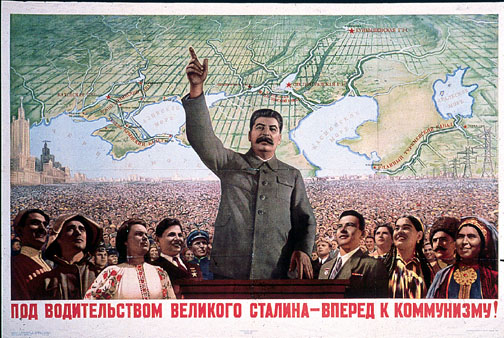
The caption proclaimed, "Under the Leadership of the Great Stalin - Forward to Communism" depicting Stalin at the helm of the vast empire stretching farther than the eye can see. He was portrayed as a beloved saviour and father-figure. To Russians who had grow up during his regime, they came to believe that the nation and the people would collapse without him. He commanded devotion, respect and even love from a people who were terrorized with the fear that they would be subjected to his murderous reprisals if they failed to demonstrate a sufficient degree of fawning. Like Lenin, Stalin created this cult of personality around himself to establish unquestioned authority over, and obedience by the masses. After Lenin's death his image still figured prominently in propaganda posters, along that of Stalin. That Lenin's embalmed body was put on perpetual display seemed almost to evoke the myth of "sainthood", given the evidence of an uncorruptible body.(In January of 2011, the United Russia party set up a website inviting the Russian people to vote on whether Lenin should be buried. Two-thirds of the respondents voted "yes" however no definitive action has been taken.)


This poster depicts a large raised hand which overshadows and contains the hands and faces of what constitute the masses. It undeniably affirmed the complete authority that Stalin exercised over the Russian people. The poster`s message, "Soviet Hands - We'll execute the plan for the great works." which reinforced communist ideology and extolled the value of workers as the "vanguard" in the business of nation-building. The reality however was quite different. In 1922 the industrial production in Russia reached only 22% of what it had been at the start of WWI. Through Stalin's intervention a marked recovery was achieved but not without considerable reduction in public consumption so that re-investment of capital could be directed toward industrial development. Central to Stalins policies was a ruthless expropriation of wealth from the kulaks. By 1933, workers' incomes plummeted to one-tenth of what it had been in 1926. Criminals and political prisoners were forced into unpaid labor, and between 1930 and 1932, over 520 factories had been constructed.


NEXT


February 26, 2012

WW2 PROPAGANDA: WAR OF WORDS Part 1 Introduction

HE'S WATCHING YOU


Propaganda is one of those terms which we all understand but fail to define adequately. Most people would describe propaganda as the deceptive manipulation of information used to influence public opinion and attitudes, however the same can also be said of commercial advertising, marketing and public relations. The Oxford Dictionary defines propaganda as "information, especially of a biased or misleading nature, used to promote a political cause or point of view". While accurate it oversimplifies a subject that is far more complex than we realize.

Even the experts cannot agree amongst themselves. David Welch, Director of the Center for the Study of Propaganda and War (University of Kent, United Kingdom) defined propaganda as a tactic by which belligerents deal with each other in a war of ideas. The Cold War was a continuation of these ideological battles as opposed to the "hot war" that was the conflagration of WWII.

Elizabeth Drew, a distinguished American journalist and author explained that "Propaganda has a bad name, but its root meaning is simply to disseminate through a medium, and all writing therefore is propaganda for something. It's a seeding of the self in the consciousness of others."

Luis Van Isschot, working on his post-doctoral thesis at City University of New York described propaganda as "the manipulation of public opinion to garner support for a particular movement" that makes "systematic use of information and disinformation to project and convince people of a certain point of view."

Margaret Peacock, Assistant Professor of History at the University of Alabama stated that "It's open for debate.  At its essence propaganda is about the selling of an idea, political ideology, economic systems or a way to view the universe....[and] has an impact in the way that people live their lives."

The etymology of propaganda has had a rather neutral and innocuous beginning. It is a derivative of the word "propagate" meaning to flourish and multiply, and possessed none of the negative connotations with which it is associated today. The word was first used by the Catholic Church in 1622 when Pope Gregory XV established the congregatio de propaganda fide, a congregation of cardinals whose mission it was to defend the faith (and the Pope's authority) from Protestants trying to undermine the Vatican. It might be of interest to know that the Congregatio now has a Facebook page.

Historians assert that the term propaganda first gained its notoriety during World War I when the British government began a furtive campaign to demonize Germany in the eyes of the world. It was the first time that Germans were described as destructive "barbarians" and "Huns".  (It was a British response to German propaganda activities already in operation at the time.)

The above image was a WWI propaganda poster depicting the execution of Edith Cavell
who was a British nurse working for the British Secret Intelligence Service. She risked her own life to save the lives of many British, French and Belgian soldiers during WWI and helped over 200 Allied soldiers escape from Nazi-occupied Belgium. Cavell was found out and arrested by the German authorities on August 3, 1915 and charged with harboring Allied soldiers. She was court-martialled, found guilty of treason and executed by a German firing squad on October 12, 1915. News of her execution received worldwide press, and instigated public outrage. The British War Propaganda Bureau used the tragic end of her life as fodder to produce the most virulent propaganda against the Germans. It was one of the most effective and successful propaganda campaigns of World War I. 

In an effort to establish credibility, the British government manipulated the content of newspapers, books, pamphlets, film, and recruitment posters. But the most effective technique of all was the dissemination of details regarding the German atrocities committed during the Invasion of Belgium in 1914. The "Report of the Committee on Alleged German Outrages" (i.e.Bryce Report 1915) described the details of the systematic rape and murder of Belgian women and children and included the testimony of over 1,000 witnesses. The document, published by a committee of distinguished British lawyers and historians, made headlines around the world and was translated into thirty languages. Though the report contained factual information, many of the atrocities mentioned turned out to be fictitious. (It is noteworthy that many of the British propaganda tactics were utilized by Adolf Hitler during World War II.)

WWI Propaganda depicting barbaric hordes of Germans
The practice of propaganda is as old as the history of warfare. Case in point is an ancient treatise, "The Art of War" written by Sun Tzu (544-496 BC) who was a famous Chinese military general. It is the oldest and most successful book ever written on the subject of military strategy and its sage advice has been sought after by great military leaders throughout the ages, including the likes of Mao Zedong and General Douglas MacArthur. Among the tactics described in its chapters, Sun Tzu advised that "supreme excellence" cannot be attained by physical battle but rather by "breaking the enemy's resistance without fighting". This is the very essence of war propaganda.

Origin and date unknown. Likely to represent strategies of The Art of War

Great thinkers of the late nineteenth and early twentieth centuries were intrigued by the power of propaganda though the term was not yet part of the lexicon. Gustave Le Bon (1841-1931)was a French social psychologist and sociologist whose work on the subject of crowd psychology attracted the attention of researchers studying the effect of media on social groups. His book "The Crowd: A Study of the Popular Mind" (1896) was instrumental in the development of the field of group dynamics. Among his assertions was that, "It's easier to dominate a people by exciting their passions than by looking after their interests." This premise among others was plagerized by Hitler in his book "Mein Kampf". Even Mussolini was known to have kept a copy of Le Bon's book nearby. William Trotter (1872-1939), a famous British surgeon wrote his book "Instincts of the Herd in War and Peace" published just before the outbreak of World War I. Trotter was referred to as "Le Bon's popularizer in English" because of the strong similarity of his writings. The following photo taken of crowds in Nazi Germany in 1935, provides an example of one of Le Bon's theory regarding group behaviour. He wrote that "when it is wanted to stir up a crowd for a short space of time...it is necessary that the crowd should have been previously prepared by certain circumstances.." This preparation involved tactics aimed at inducing crowds to near levels of hysteria. (N.B. We employ these methods today usually at political rallies, talk shows, and rock concerts.)
.
Germans greeting Hitler 1935
Charles Darwin wrote in his book "The Descent of Man" (1871), that "it is worthy of remark that a belief constantly inculcated during the early years of life, whilst the brain is impressible, appears to acquire almost the nature of an instinct; and the very essence of an instinct is that it is followed independently of reason."  The large-scale brainwashing of young "impressible" minds in the Hitler Youth, and Italian fascist groups are prime examples of this.


The Italian Balilla and Vanguards
The young boys in the photo were members of the Italian Balilla and Vanguards, a para-military fascist youth organization founded shortly after Italian dictator Benito Mussolini came to power in 1922. The group was named "Baililla" to honor the memory of a young Italian boy who lived in Genoa in 1746, then occupied by Austria. Balilla threw a rock at the Austrian artillery inciting a mob riot that spread throughout the city and succeeded in driving the Austrians out. These young "Baillas" did not carry weapons nor receive military training. But they were "inculcated" with fascist ideology, taught to march and were drilled in certain platoon maneuvers. During the period 1927-1928 there were over 250,000 young fellows "enlisted" in the corps. Once they reached the age of twenty there were conscripted into regular military service.

Joseph Conrad (an ethnic Pole whose real name was Jozef Teodor Konrad Korzeniowski) is regarded as one of the greatest "English" novelists of all time. In his book, "Lord Jim" (1900) Conrad expounded on the power of a single word - "He who wants to persuade should put his trust not in the right argument, but in the right word. The power of sound has always been greater than the power of sense."

The image of the poster to the right was a Nazi campaign message in 1938 urging German voters to vote "Ja" (yes).
It was effective not only for its graphic imagery but the use just one word and and appealed to "bandwagon" psychology of the masses.


Regardless of its messages or formats, the greatest power of propaganda is in its ability to transcend time and place. Sixty-seven years have passed since the end of WWII and much of Nazi propaganda continues to circulate today, though many people are oblivious to it.  In addition to media, there are propagandist slogans, racist and hate propaganda (including ethnic jokes) and stories fabricated by Nazi Germany which have been passed around by word of mouth.


The success of all propaganda relies with one basic tenet, and that is, "a lie told often enough becomes the truth." Leaders throughout history including Vladimir Lenin, Jozef Stalin, Adolf Hitler and George W. Bush have all attested to its effectiveness.


NEXT