March 27, 2012

GREAT POLISH GENERALS OF WW2: Wladyslaw Sikorski

General Wladyslaw Sikorski

"When the sun is higher, Sikorski is nearer."

Wladyslaw Sikorski was the personification of the hopes
of the Polish people for a free and independent Poland.
The struggle for Poland's liberation had been a very long and arduous one. At the end of WWI Poland finally
regained its independence after having been virtually erased from the map for 123 years. 

Sikorski had been at the forefront of the struggle. With an educational background in engineering and military tactics he became actively involved in a number of Polish underground organizations; in 1907 Sikorski joined the underground Polish Socialist Party; in 1908 he organized the secret Zwiazek Walki Czynnej ( Combat Association) and two years later, the Zwiazek Strzelecki (Rifleman's Association). The objective was to instigate an uprising against the Russian empire, one of the partitioners.  The creation of the latter association while approved by a statute of the Austrian authorities, were Polish paramilitary troops, formed illegally.  At the outbreak of WWI, there were over 8,000 "members" dispersed among 200 groups. Many of them joined the Polish Legions. During WWI Sikorski was the chief head of the military section of the Supreme National Committee and then as commissioner he was responsible for recruitment to the Polish Legions in Krakow, the latter organization created by Jozef Pilsudski.

Związek Strzelecki -  Rifleman's Association

No sooner had WWI come to an end that the Polish-Soviet war (1919-21) broke out over the tenuous question of Poland's newly established borders. By that time Sikorski had become a high-ranking officer of the Polish army, and had led successful battles capturing the ancient city of Lwow, and Przyemsyl.  The Soviet forces were confident of achieving an easy victory but were very surprised by the
unexpected.  In what has been termed "Miracle at the Vistula", Polish forces under Sikorski's command succeeded in utterly defeating the Bolshevik advance towards Warsaw, giving Pilsudski the time needed to organize a counter-offensive.

Polish Soldiers displaying captured Soviet banners
Aftermath of Battle of Warsaw - Soviet-Polish War

Sikorskis' forces successfully penetrated deep into Latvia and Belarus, heaping further humiliation upon the defeated Russians. General Sikorski was hailed as the beloved hero of Poland and was decorated with Poland's highest honour, the Virtuti Militari Medal.

During the inter-war period Sikorski had succeeded Pilsudski as the Commander-in-Chief of the Polish Armed Forces (April 1921), and also became Chief of the Polish General Staff. For the next several years he rose to very high government ranks. From December 1922 to May 26, 1923 he served as Poland's Prime Minister as well as Minister of Internal Affairs.

Charles de Gaulle WW I
During this period Sikorski garnered immense respect from and support of the Polish people. He established various reforms, and built a viable foreign policy that received international approval through the League of Nations. Moreover, the United Kingdom, France, and the United States all recognized the legitimacy of Poland's new frontiers, won during the Russian-Polish war.

Sikorski had made significant strides in strengthening Polish-French cooperation. It was instrumental in laying the foundations that led to Poland's victory during the Polish Soviet War.  The French Military Mission to Poland provided the military organization and logistical assistance vital to the nascent Polish armies. Among the French officers involved in the mission was the future General Charles de Gaulle. 


Polish Badge KOP
From 1923-24 Sikorski held the position of Chief Inspector of Infantry. And the following year, under Prime Minister Wladyslaw Grabski, Sikorski served as Minister of Military Affairs, guiding the modernization of the Polish military.   He created the Border Protection Corps (Korpus Ochrony Pogranicza) a military formation to defend Polands' eastern borders from attacks of Soviet armies. From 1925-1928 Sikorski became Commander of the Military Corp District VI in Lwow, a city of great historical importance imbued with a rich Polish and Jewish cultural heritage.


Polish soldiers KOP
Despite these contributions, Sikorski was dismissed from public service in 1928 by Pilsudski and was
transferred to the Reserves; (Sikorski had joined the anti-Pilsudski movement and opposed the semi-dictatorial regime of the Sanacja.) For the next few years Sikorski had withdrawn from politics altogether and spent his time in Paris working with officials of the Ecole Superieure de Guerre and writing numerous books and articles about the scale of future warfare. Sikorski was a visionary and a pioneer of the theory of the "blitzkrieg". His publications were carefully scrutinized by several countries, in particular by Soviet Russia.

Nazi Blitzkrieg Sept 1, 1939
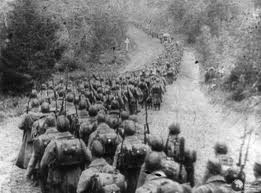
Soviet infantry invading Poland Sept 17, 1939
The rapid militarization by the Nazi Wehrmacht were to bring these theories to fruition. On 1st September 1939 Germany invaded Poland in a "lightning war" overrunning her armies with overwhelming numbers and fire power.  Seventeen days later Soviet armies invaded Poland from the east -  the culmination of a secret pact by Hitler and Stalin to partition Poland and destroy the very foundations of her existence. To the world it appeared that Poland had collapsed.  But Poland was not yet lost. 


Wladylsaw Sikorski had returned to Poland in 1938 ready to be of service however he was refused a military command by then Commander-in-Chief, Marshal Edward Rydz-Smigly (successor to Pilsudski). Thousands of Polish armed forces had escaped the German onslaught. By the end of the month, Sikorski too had evacuated Poland escaping through a perilous route from Romania to Paris.  Sikorski was at once officially installed as the Prime Minister-in-exile and Commander-in-Chief of the Polish forces, joining President-in-exile Wladyslaw Raczkiewicz, and Stanislaw Mikolajczyk.


Despite the fall of Poland, Sikorski was recognized by the West as the legitimate head of the Polish government-in-exile. Through his strong leadership he was instrumental in maintaining the cohesion of the Polish government and Armed Forces, and distinguished himself as Poland's most ardent and outspoken advocate.

But Poland was not without its armies. Though thousands of Polish armed forces had evacuated Poland, they remobilized on French soil. The Polish Highland Brigade was created and immediately deployed to defend French borders. Meanwhile the Polish Air Force was being equipped with 86 aircraft among four squadrons (amid highly questionable logistics controlled by the French authorities); and the Polish Independent Carpathian Brigade was formed in French-mandated Syria. In all there were roughly 80,000 Polish troops in France ready to fight. At the time Poland was the third largest ally.


But with the Fall of France, Polish forces evacuated once again - this time to England. On June 19, 1940 Prime Minister Sikorski met with Winston Churchill, and pledged to provide Polish forces to fight alongside those of Britain. By August, Sikorski and Churchill signed the Polish-British Military Agreement calling for the creation, and training of the Polish Armed Forces.  Most renowned were the Polish pilots who fought in the Battle of Britain the summer of 1940, and whose pilots scored the highest ratio of kills. Most famous was the 303 squadron (the Kosciuszko squadron).  At this juncture, Poland became the second largest ally, with troops stationed in Great Britain and the Middle East.

General Sikorski and Churchill inspecting Polish Troops in Scotland


When Germany invaded the Soviet Union in June 1941 in Operation Barbarossa, the dynamics of the war changed significantly. Churchill had been hoping for just such an outcome to curry favor with the Soviets, an ally upon whom the British relied to win the war against the Nazi scourge. It also presented ominous changes to Poland's relationship with Britain, and especially that with Russia. It came as no surprise to Sikorski. He was a pragmatic strategist and knew what the outcome meant. Seeing no other alternative he succumbed to pressure from the British Foreign Office and opened negotiations with the Russians.


In July 1941 General Sikorski and Ivan Maisky agreed to re-establish diplomatic relations between Poland and Russia and by mid-August, the Sikorsky-Maisky Pact was officially signed.  The Soviets abrogated the Molotov-Ribbentrop Pact of August of 1939 as null and void, and agreed to the release of tens of thousands of Polish prisoners of war on the basis of an "amnesty" , a condition which was an absurdity considering that Soviets were the aggressors. (The evacuation was fraught with numerous obstacles and took place under the most arduous conditions. Thousands of Poles perished. Those who survived and made it to the Middle East were eventually formed into the 2nd Polish Corps under the command of General Wladyslaw Anders.)

Signing of Sikorski-Maisky Agreement July 1941

Amid the huge numbers of incoming Polish refugees, there was a conspicuous void.  Many thousands of Polish officers never showed up, and their absence could not yet be explained.  Sikorski was relentless in his attempt to resolve the mystery, but no avail. Stalin provided only flimsy excuses. He assured Sikorski and Anders that all the Polish soldiers had been released but that the Soviets may have "lost track" of some of them in Manchuria.


L-R General Anders, General Sikorski, Stalin, Kujbyszewie

The horrifying truth was discovered in April 1943 when Nazi German forces found the mass graves in Katyn Forest, twelve miles west of Smolensk, Russia.  Thousands upon thousands of bodies had been exhumed and examined. They were the remains of the Polish Officers who had disappeared and who had been executed by the Soviet NKVD in 1940, upon Stalin's order.

Russian-Polish relations had always been fragile, but now had reached the breaking point. On April 16, General Sikorski fervently demanded an investigation by the International Red Cross. Ten days later Stalin broke off diplomatic ties with Poland, and in a futile attempt to create a smoke screen, accused the Polish government-in-exile of cooperating with Nazi Germany. (Russian governments have since refused to admit Stalin's culpability for the massacre, that is, until the 1990s).

Exhumed bodies of Polish Officers massacred at Katyn Forest, Russia

Another very contentious issue between Russia and Poland dealt with the subject of Polands eastern border. Stalin had long intended that the border be draw along the Curzon Line, which would sever one third of Poland's vast territory.  Sikorski fiercely argued in defense of maintaining Poland's pre-war borders and refused to yield to any pressures. But in the end Poland was betrayed by its closest allies - Great Britain and the United States,  both of whom gave Stalin whatever he wanted in exchange for his alliance. (Read about Yalta Conference)
Crash of Sikorski's Liberator July 4, 1943

On July 4, 1943 the Liberator plane carrying Sikorski and several other passengers plunged into the sea sixteen
seconds after takeoff from Gibraltar. All the passengers except for the pilot were killed. The cause of the crash was attributed to "engine trouble".  However, a Soviet conspiracy has never been ruled out. 


In fact, there were several incidences prior to the fatal crash, in which Sikorski's plane had been tampered with  Sikorski was very outspoken and a threat to the new Anglo-American-Soviet alliance, all the more reason for Stalin to want Sikorski out of the way.  His death marked a turning point not only for Polish-Anglo relations, but the future of the Polish nation and its people.  Sikorski's successor, Stanislaw Mikolajcyzak was considered "persona non grata" and possessed none of the influence nor diplomacy that Sikorski wielded so successfully.  To Churchill and Roosevelt, handing Poland over to Stalin became as easy as childs play.

Sikorski's death came as a terrible blow to a nation which hoped and prayed for freedom and independence. Poland's national newspaper, Biuletyn Informacyjny published the news to a grief-stricken country and set July 15, 1943 as a national day of mourning.

The memory of Sikorski is still very much alive in the soul of the Polish people. Since Sikorski's tragic death, statues and monuments of him have been erected throughout the world to preserve his memory.  Among the many centres and institutes there is also:  the Sikorski Institute, in London, England; a memorial plaque at Gibraltar dedicated to Sikorski; a statue of Sikorski on Portland Place in London, a stone monument on the grounds of Place Polonaise, in Toronto, Canada, and a seated sculpture of Sikorski (as a young man) at Inowroclaw, Poland. Even a film was produced in 1948, entitled, "The Enemy" and in 2003 the Polish Sejm declared the 60th anniversary of Sikorski's death as "Year of General Sikorski".

That Sikorski's name continues to be omitted from Western history is cause for concern.  It is of vital importance for historical accuracy to include the details about Poland, in particular the story of a great man and a great general who had much to teach by example. May the world come to recognize the name Sikorski and understand the true meaning of honour and greatness.

Statue of General Sikorski
Portland Place, London


General Sikorskis' Medals

Order of the White Eagle (awarded posthumously, 1943)
Commander's Cross of the Order of the Virtuti Militari
Grand Cross of the Order of Polonia Restituta
Order of the Cross of Grunwald, 1 Class (awarded posthumously 1946)
Cross of Valour (4x)
Gold Cross of Merit
Grand Officer of the Order of Leopold (Belgium)
Grand Cross of the Order of the White Lion (Czechoslovakia)
Cross of Libery, Class I and II, (Estonia)
Grand Cross of the Legion of Honour (France)
War Cross (Norway - awarded posthumously August 1943)


NEXT
GENERAL WLADYSLAW ANDERS
(click on name)


March 26, 2012

GREAT POLISH GENERALS OF WW2: Introduction


When asked who were the greatest allied generals of World War II, most people would immediately think of Patton, Eisenhower, MacArthur, Montgomery, among others. And rightly so. Their brilliant strategies paved the way towards impressive victories for which they will forever be remembered and glorified.

During World War II all eyes were on the superpowers - the United States, Great Britain, and the Soviet Union but the war was not won by a handful of generals. Many other Allied Generals equally meritorious of recognition had made invaluable contributions to the allied war effort. Beneath the veneer were veritable legions of smaller armies of great soldiers led by generals who served with every bit of courage, military brilliance, and greatness, but whose names have since been forgotten.

Poland was one such nation. Polish military officers of WWII, and the men who followed them have become legendary for their ability to wage battle against even the most powerful of foes. It has always been so. Napoleon Bonaparte had once remarked upon seeing the Polish Legions in battle, that the power of 1,000 Polish soldiers was like that of 10,000 men, so fierce was their motivation to fight and win, whatever the odds.

German troops march into Warsaw- Invasion of Poland 1939
Germans march into Warsaw WW2
When Germany invaded Poland on September 1, 1939, they expected the Poles to surrender in a matter of days, if not a week. But the Soviet invasion on the 17th of September made it imperative for Polish armies to withdraw immediately. Though Poland was jointly occupied in the west and east, and Warsaw had capitulated on September 29th, multitudes of Polish armed forces had re-assembled on foreign soil to continue to do battle against the enemy. To the world, Poland had been conquered. But to the Polish armies, the battle was just beginning.


Numerous Polish generals had served Poland with great distinction in both world wars, including the Polish-Soviet War. This special series focuses on four of Poland's greatest generals of WWII, the battles they fought, (both on and off the battlefields), their struggles, and the men whom they led to victory.

SIKORKSI, ANDERS, MACZEK, and SOSABOWSKI were Polish Generals during World War II. What made them so great lay beyond immediate perception. History has taught us a standard that a great general is one who has been able to conquer, subdue, and destroy the multitudes of peoples. But true greatness does not portend invasion and destruction, but rather the ability to face calamity head on and fight against it with valor and honour.

Unbeknowst to much of the world, the Polish made very significant contributions to assisting the allies towards victory. Their names and the names of their beloved leaders will forever be remembered, as their monuments stand in testament to their Greatness. The following are a few of the other Polish Generals whose valor and self-sacrifice have earned them admiration and respect. (Please note that there will be four other posts in this series.)


POLISH GENERALS OF VALOR


Gen.Wladyslaw Bortnowski
Wladyslaw Bortnowski (1891-1966) was one of the highest ranking generals in the Polish army during WWII. He commanded the Pomorze army, and managed to save a large number of his troops from enemy fire, withdrawing southwards with them to take part in the Battle of Bzura in the September Defensive wars. Initially, the Polish forces achieved success but ultimately failed under a barrage of German counter-attacks. Bortnowski was heavily wounded and taken prisoner by the Germans. He survived the Nazi POW camps and was liberated in 1945.

Awards and Decorations: Virtuti Militari (Silver Cross); Commander of Legion of Honour (France); Cross of Independence, Commander's Cross with Star of Polonia Restituta; Cross of Valor (4x) and Gold Cross of Merit.


General Antoni Chrusciel
Antoni Chruściel(1895-1960) was commander of the Polish underground forces which fought in the Warsaw Uprising of 1944, as well as the Chief of Staff of the Armia Krajowa (Home Army). Chrusciel and General "Bor" Komorowski had ordered the full mobilization of troops on August 1st at 17:00 hours. The objective to liberate Warsaw, and all of Poland ended tragically 63 days later. Despite promises by the British and American allies to provide assistance and military intervention to the Polish insurgents, none ever came. Chrusciel was captured by the Germans and spent the rest of the war in POW camps until liberation in 1945.

Awards and Decorations: Knight's Cross of Order of Virtuti Militari; Gold Cross of Order of Virtuti Militari; Silver Cross of Order of Virtuti Militari; Grand Cross of the Order of Polonia Restitua; Cross of Independence; Cross of Valor (4x); Gold Cross of Merit; Armia Krajowa Cross; Medal of Ten Years of Regained Independence Commemorative Medal for War 1918-21; Bronze Medal of Valor (2x); and the Yser Medal (Belgium).


Gen. Boleslaw Bronislaw Duch
Boleslaw Bronislaw Duch (1885-1980) was a Major General. When Poland was invaded in 1939, Duch was able to evade capture by the enemy and withdrew to western Europe, where he served in France as commander of the Polish 1st Grenadier Division in 1940, the 1st Rifle Brigade of the 1st Polish Corps in Scotland (1942-43), and the 3rd Carpathian Infantry Division of the 2nd Polish Corps (1943-46).

Awards and Decorations: Knight's Cross of Order of Virtuti Militari; Gold Cross of Order of Virtuti Militari; Silver Cross of Order of Virtuti Militari; Commander's Cross with Star of the Polonia Restituta, Cross of Merit with Swords, Cross of Valour (8x), Cross of Independence, Gold Cross of Merit with Swords, Gold; Cross of Merit, Military Cross, and Inter-Allied Medal.


Emil August "Nil" Fieldorf Polish General WW2
Emil August "Nil" Fieldorf
Emil August "Nil" Fieldorf (March 20, 1895 - February 24, 1953) was a Brigadier General and Deputy Commander-in-Chief of the Armia Krajowa (Home Army). During the invasion of Poland, he commanded his regiment but was defeated by the Germans on the night of September 8-9, 1939. He attempted to escape, dressed in civilian clothing but was arrested at the Slovak border and interned. Several weeks later he escaped and joined the Polish army in France. After several months he made a perilous circuitous route back to Poland and joined the Polish Underground. A year later he was given command of the Kedyw (Special Operations executive). He planned and instigated the successful assassination of Nazi SS Franz Kutschera on February 2 1944. After the tragic collapse of the Warsaw Uprising, Fieldorf was arrested by Soviet NKVD and sent to a labor camp. At the time the Soviets did not know his real identity and had released him in 1947. But he was recaptured in 1948 as a result of a false offer of "amnesty" subjected to a mock trial. He was executed on April 16, 1952.

Awards and Decorations: Gold Cross of Order of Virtuti Militari; Silver Cross of Order of Virtuti Militari; Cross of Independence; Knight's Cross of the Order of Polonia Restituta; Cross of Valour (4x); Gold Cross of Merit; and Merit Forces Central Lithuania.The Order of the White Eagle was conferred posthumously in 2006.


General Michal Tadeusz Karaszewicz-Tokarzewski  - Polish General WW2
 Michal T. Karaszewicz-Tokarzewski
Michal Tadeusz Karaszewicz-Tokarzewski (January 5, 1839-May 22, 1964) was a General who founded the resistance movement "Polish Victory Service". During the September Campaign of 1939 he commanded the Operation group of the Armia Pomorze (Pomeranian Army). He fought in the Battle of Bzura and the Defense of Warsaw, serving as second-in-command of Armia Warszawa, under the command of General Juliusz Rommel. At the end of September he became commanding officer of the "3rd Lwow area of the ZWZY" but was arrested and imprisoned by the Soviet NKVD. After his release from prison in 1941, Michal was given command of the "6th Infantry Division" of the Polish Army in Russia, that came to be known as "Ander's Army". From March 1943 until the following year he served as second-in-command of the Polish Army in the East, and in 1944 became commander of the 3rd Polish Corps formed in Egypt. After the war he remained in London in exile.

Awards and Decorations: Commander of the Virtuti Militari Order; Commander of the Order of Polonia Restituta; Cross of Independence with Swords; Cross of Valor (4x); Gold Cross of Merit with Swords (2x);and the Order of the White Eagle (conferred posthumously in 1964).


General Tadeusz Pełczyński - Polish General WW2
General Tadeusz Pełczyński
Tadeusz Pełczyński (February 14, 1892-January 3, 1985) was a General, intelligence officer and Chief of the Polish General Staff, Section II (Military Intelligence). He was also Chief of Staff, and Deputy Commander of the ZWZ Armia Krajowa (Home Army). Pelczynski commanded numerous sabotage operations conducted by special Kedyw units which succeeded in destroying thousands of enemy targets, including railway lines and transport vehicules of the German Wehrmacht. He took part in the Warsaw Uprising, but five weeks into the fighting he was gravely wounded when the PKO bank on Swietokrzyska Street was bombed. When the Uprising came to an end, Pelczynski was taken prisoner by the Germans and interned at concentration camps at Langwasser and at Colditz. He was liberated by the allies in 1945. Pelcyznski's greatest contribution to the war effort occurred just shortly before WWII broke out. It was his wish that the Enigma Secret (which the Poles had cracked) should be smuggled out of the country and given to the British as a gift. Had it not been for the Polish contribution, the war might have been lost.Gordon Welchman, former mathematician-cryptologist of Britain's Bletchley Park wrote thus: "Ultra would never have gotten off the ground if we had not learned from the Poles, in the nick of time, the details both of the German military [Enigma Machine] and of the operating procedures that were in use."

Awards and Decorations:  Gold Cross of Order of the Virtuti Militari; Silver Cross of Order of Virtuti Militari; Cross of Independence; Officer's Cross of the Order of Polonia Restituta; Cross of Valour (3x); Gold Cross of Merit; and Home Army Cross.


General Ludomił Antoni Rayski - Polish pilot and Officer WW2
General Ludomił Antoni Rayski
Ludomił Antoni Rayski (1892-1977) was a Polish pilot, engineer and military officer. During the interwar years he served as Commander of the Polish Air Force and was instrumental in the modernization of Polish military aviation. He also served in the Austro-Hungarian Army, Polish Legion, French Air Force, French Foreign Legion and Royal Air Force. Despite his illustrious military career he was a controversial figure. Thrust into circumstances beyond his control, he refused to submit to allegations of wrong-doing.

After the joint German-Soviet invasion of Poland, Rayski along with many other high-ranking officers evacuated and headed for France through Romania and Hungary. Many Polish soldiers and officers never made it to France as they were captured and interned. When Rayski finally arrived in France he reported to General Zajac, ready for duty in the PAF, but was flatly refused. Apparently, Rayski and many other Polish officers were made scapegoats for the Polish defeat in the September Campaign. In protest, he wrote a memo to all the Polish officers criticizing the matter. Polish Command ordered him to report for duty at Carisay, but when Rayski refused he was court martialled and sentenced to ten months imprisonment for insubordination. The sentence was not carried out but instead Rayski was demoted and left without a job.

Though he attempted to volunteer for active duty elsewhere he was rejected, first by the French L'Armee de l'Air, and then by the Finnish Air Force after they had employed him only briefly. After the German invasion of France, Rayski escaped to England along with many other Polish forces, but met with more tribulation, and was interned at Rothesay on the Isle of Bute, in Scotland. After two months he was released and was permitted to transport planes for the allies between Asia and North Africa.
With the tragic accident of General Sikorski on July 4, 1943, the new commander, General Kazimierz Sosnkowski allowed Rayski to return to active service. At the same time Sosnkowski resumed the court martial proceedings and in the following year after a trial by jury, Rayski was finally acquitted of all charges and the verdict declared him not guilty. Throughout his service with the RAF, Rayski flew a total of 1,519 hours of combat. However, he was never given back his rank as General.

Awards and Decorations: Silver Cross of the Virtuti Militari; Commander's Cross with Star of the Order of Polonia Restituta; Officer's Cross with Star of the Order of Polonia Restituta; Cross of Independence; Cross of Valor (4x); Gold Cross of Merit (2x); Warsaw Uprising Cross; Order of the Cross of the Eagle Class II (Estonia); Officer of the Legion of Honour (France); Distinguished Service Order (UK); Air Force Cross (UK); Italy Star (UK); Gallipoli Star (Ottoman Empire); Field Pilot Badge; and Badge for wounds and injuries (3x).


Józef Ludwik Zając Polish General WW2
Józef Ludwik Zając
Józef Ludwik Zając (1891-1963) was a Polish pilot and General. He had graduated from Jagiellonian University with a PhD in philosophy in 1915. In 1912 he joined the Riflemen's Association and enrolled in an officer's training program. During World War I he commanded several regiments of the famous Polish Legions, and joined the Blue Army of General Jozef Haller.  Zajac fought in the latter phase of the Polish-Soviet War and became Chief of Staff of the Operational Group "Wisla" of several Polish army divisions.

During the interwar period he attended the military college in France, Ecole Superieure de Guerre and in 1924 he was promoted to Brigade General.  By February 1939 he had replaced General Ludomil Rayski as Commander of the Polish Air Force. Zajac was a firm proponent of the theory of air superiority in which he placed greater emphasis on fighter planes than bombers, but there was no time to exploit these ideas. When WW2 broke out, Zajac escaped and made his way to France. When France was invaded he evacuated to England and was appointed Deputy Commander of the Polish 1 Corps. The following year he was commander of the Polish Air Force in the Middle East, then promoted to Division General. He served also as Deputy Commander of the Polish Army in the Middle East until 1943.  At the end of WW2 he settled in Edinburgh where he earned another PhD in philosophy and devoted his life work to academia. During his career he published numerous books on the subject of psychology, military science, as well as his memoirs.

Honours and Awards: Silver Cross of the Order of Virtuti Militari; Commander's Cross of the Order of Polonia Restituta; Officer's Cross of the Order of Polonia Restituta; Cross of Independence; Cross of Valor (4x); Gold Cross of Merit with Swords; Merit of the Forces in Central Lithuania; Military Merit Cross (Austro-Hungary); Companion of the Order of the Bath (UK); and the Chevalier of the Legion of Honour (France).


Elzbieta Zawacka Brigadier General- Poland WW2
Brg. Gen.Elzbieta Zawacka
Elżbieta "Zo" Zawacka (March 19, 1909 - January 10, 2009) graduated from the University of Poznan majoring in mathematics and worked as a teacher. At the same time she was working secretly as an instructor for an underground paramilitary organization for women, the Przysposobienie Wojskowe Kobiet (PWK). When World War II broke out she became the Commander of the the PWK and led the defence of the city of Lwow.  A month later she joined the Silesian branch of the ZWZ and the following year relocated to Warsaw to begin working as a courier transporting documents from nazi-occupied Poland to London and back. She also organized routes for the other couriers. She was appointed Deputy of Zagroda, the Department of Foreign Communication of the Home Army. Zawacka was retained as SOE agent for England and travellied across perilous routes through Germany, France, and Spain to Gibraltar. From there she was transported by plane to London where she commenced intensive training in parachute jumping. On September 10, 1943 she was dropped into Poland and was the only woman to have been a member of the famous Cichociemni. Zawacka fought in the Warsaw Uprising in 1944.After Warsaw surrendered, she relocated to Krakow and continued her underground activities. In 1945, she joined an anti-communist organization called Freedom and Independence but resigned soonafter to commence a teaching position.

In 1951 Zawacka was arrested and tortured by the notorious Soviet Urzad Bezpieczenstwa (Security Service of the Ministry of Internal Affairs). She was sentenced to 10 years imprisonment for treason and espionage but sentence was commuted and she was freed in 1955.

Henceforth she resumed her academic studies enrolling at Gdansk University for a doctorate degree, Zawacka became a tenured professor at the Institute of Pedagogy at Mikołaj Kopernik University in Toruń where she founded the department of Andragogy. During the 1980s she participated in the Solidarnosc movement.

On May 3, 2006 President Lech Kaczynski promoted Elzbieta Zawacka to rank of Brigadier General of the Polish Army. She was the second and last women in the history of the Polish Army to have received such an honour.

Awards and Decorations:  Order of the White Eagle; Order of Virtuti Militari; Silver Cross (2x); Cross of Valor (5x); Commander's Cross with Star of the Order of Polonia Restituta; Officer's Cross with Star of the Order of Polonia Restituta; Gold Cross of Merit with Swords; Home Army Cross; Army Medal; Medal Pro Memoria.


Polish Greatness Poland First to Fight


NEXT:
GENERAL WLADYLSAW SIKORSKI
(click on name)


February 29, 2012

WW2 PROPAGANDA: WAR OF WORDS Part 4 Secrets of Propaganda Techniques

The most powerful and deadly weapon of World War II was capable of bringing about the complete obedience of millions of people without firing a single shot. That weapon was propaganda and it revolutionized the way in which wars were fought then and now.

World War II was one of the greatest conflagrations of all time when tens of millions of people around the world perished in battles, and from persecution and annihilation. In the years just prior to World War II, Hitler was not only mobilizing his military forces, but had already embarked on elaborate propaganda campaigns aimed at winning the support of the German people in his accession to power. He relied heavily on the unquestioning acceptance of his leadership and complete indoctrination of the people to his ideology. In Nazi Germany these factors instigated terrifying results that began with Kristallnacht, and led to the extermination of millions of people which comprised the Jews, the Poles, the Slavic, the Roma and many other nationalities. Stalin has been described as the mirror image of Hitler but was a character infinitely more sinister, whose mastery of political subterfuge reached draconian levels. He applied the same propaganda techniques to cultivate support of the Soviet people but relied on the use of brute terror and intimidation to sustain his power.


During WWII propaganda was produced at such a prolific rate that it required the formation of virtual armies of propagandists churning out a staggering volume of messages in every conceivable format. Many examples of their work have survived to this day and provide invaluable insight into the techniques used to disseminate the messages. Propaganda served a dual purpose by emphasizing its benevolent intentions, exemplified by appeals for public safety and encouraging the war effort, as well as functioning as an instrument of psychological warfare against the enemy.

Propaganda earned its bad reputation during World War II, but it was Edward Bernays, who recognizing its commercial applications, combined the principles of crowd psychology with the theories of psychoanalysis founded by his uncle, Sigmund Freud. Though Bernays was not the first to expound on the theories of the "herd instinct" he became known as the "father of public relations" for introducing the concept to the United States after the end of World War II.

The following is a synopsis of some of the techniques used by propagandists in an attempt to mold public thoughts, emotions, and opinions, as well as to deceive and slander the enemy.


White Propaganda
This type of propaganda usually consists of a one-sided argument that is delivered in a much gentler manner than other types of propaganda. Though it is benign in its message it is no less manipulative in its objectives.


Black Propaganda


presents itself as being derived from one source when in fact it had originated from another.
During WWII forces frequently employed this tactic to conceal their true identity during the course of military operations in an effort to confuse and deceive the enemy.


Grey propaganda

presents the enemy with the most difficulty as its source and validity cannot be determined. The tactics involve the dissemination of two diametrically opposed claims. The objective is to make the enemy believe claim A is true. It is immediately followed by claim B which is completely contradictory and succeeds to refute its own validity by the inclusion of an informal fallacy. It is then expected that the enemy will choose claim A.

During WWII, Allied airplanes airdropped German newspapers "Nachrichten fur die Truppe" (News for the Troops) over German-occupied areas, in an effort to undermine their military operations. Though the German soldiers were quite aware of the fact that the newspapers were dropped from Allied planes, it instilled a degree of doubt or uncertainty among them regarding the validity of the newspaper and the true identity of its carrier. Gray propaganda is one whose source cannot be confirmed.


Appeal to Fear


is a technique readily understood but rarely recognized as such because the techniques used are both elaborate and covert. Joseph Goebbels was able to instill panic and fear in the German people merely by citing the work of Theodore Kaufman's "Germany Must Perish!" which claimed that the Allies were intent on planning the extermination of the German people.


Bandwagon


is a technique most often used during election campaigns in an effort to persuade voters to choose the "winning side". Both Hitler and Stalin employed this tactic in an effort to rally their nations. The message clearly implied that theirs was an inevitable victory, and served as an invitation to those who have not already joined them to do so now.


The Big Lie


resorts to continuously describing a complex matter and using it to justify some kind of action. Hitler did just that at the end of WWI, when he denounced the Treaty of Versailles as the instrument with which Britain and the United States despoiled Germany. By combining some elements of truth with wild conjecture, Hitler was able to perpetuate the "Stab in the Back" myth. Hence Germany's aggressive remilitarization.


Black and White Fallacy


quite simply refers to the presentation of only two choices, and the claim that you are either "with us" or "against us". Statements of this genre have been used by virtually every nation and in times of war is particularly effective when it appeals to national patriotism.


Common Man


This technique attempts to persuade the target audience that the propagandist shares the views of the common people, because they are also just "plain folks". The message is written in a manner that appeals to and solicits their confidence, and is achieved by the use of ordinary, or vernacular language sometimes accompanied by mannerisms associated with the group. Hitler employed this technique combined with that of the "Big Lie" (see video in Part 2).


Cult of Personality


is created when an individual manipulates mass media in an effort to construct a heroic image of himself, reinforced through effusive praise. The success of this propaganda is evident by the conspicuous absence of opposition, or challenge to the person's authority.


Demonizing the Enemy

This propaganda targeted individuals and groups who belonged to different nationalities, ethnicities, religions, and race, and condemned them as either grotesque evil monsters, or subhuman. Germany used the term "untermenschen" to describe not only the Jews, but ethnic Poles, Russians, Czechs, among many others. It combined the use of name-calling to reinforce negative images in the minds of the German people. Needless to say it was a tactic employed by all sides during the war.


The US army produced an effective propaganda campaign to encourage young Americans to enlist in the army. To those who are familiar with vintage American cinema, this poster depicts a stylized version of King Kong abducting Fay Wray, as the analogy for the Nazi conquest of Europe. The drawing of the German military helmet, and wooden club carved with the word "Culture" was meant to offend the German people by equating them with savages despite their pretensions of cultural superiority. American propaganda used the same propaganda techniques in demonizing the Japanese.


Disinformation

involved the omission or introduction of false information to deter or mislead the enemy. It was a technique successfully applied by both sides of the war in an effort to advance their military objectives. The most rousing example is the ploy used to misdirect the German armies just prior to the Allied Invasion of Normandy. Churchill's ingenious use of disinformation was able to convince German armies that Britain was going to invade along the coast of Calais which seemed logical to the enemy since it was the shortest span across the Channel.


Euphoria

is the method by which the propagandist organizes large-scale events, such as parades with marching soldiers, bands, and music or rallies which are used as a bandstand for patriotic, emotional speeches. In any case the atmosphere of celebration lends to the happiness, and euphoria of the target audience making them more receptive to manipulation.


Fear, Uncertainty and Doubt

This technique involves the introduction of information that is negative, false, or uncertain, in the effort to undermine the credibility of the peoples' beliefs, directly to civilians as well as military personnel.


Flag Waving

is an attempt to justify the beliefs and actions of any group, by associating it with acts of patriotism, such as flag-waving. The target audience would then be more inclined to support the group because of its patriotic fervor.


Half Truth

is a deceptive technique which combines various elements of lies with kernels of truth making the statement difficult to refute or challenge. Other tactics might entail the use of improper punctuation or double meaning. The objective is to misrepresent the truth, evade or assign blame.


Labelling

is used by the propagandist to establish credibility of certain claims or ideals. The label, or word selected to promote the ideal is meant to be sufficiently vague or harmless, so as to conceal the true nature of its objectives. Hitler's reference to the word "lebensraum" is a perfect example. It was only when Hitlers armies embarked on the conquest and subjugation of Europe, that the world came to understand the true meaning of lebensraum. Synonyms for the word "lebensraum" litter the pages of history. For example the term "Manifest Destiny" was used by American pioneers who considered themselves as God's chosen people sent to tame the wilderness of the North American continent.


"Managing the News"


This technique employs the use of classical conditioning with the intention of "Staying on Message". It was defined by Adolf Hitler who wrote "The most brilliant propagandist technique will yield no success unless one fundamental principle is borne in mind constantly - it must confine itself to a few points and repeat them over and over." This technique can be considered the staple of propagandists the world over and has not abated since the end of the war.


Name Calling

Propagandists apply this tactic with the intention of arousing fears and prejudices among members of the target audience, usually with the expectation that it will precipitate opposition or instigate hatred against a group, or its beliefs and ideas. The technique is used to establish "name-calling" as a substitute for intelligent reasoning and reliance on facts. The Band Wagon technique may also be included to ensure that errant individuals fall into line.


Oversimplification

Like many other techniques this one does not require definition, however the fact remains that some people fail to recognize that they have been manipulated in this manner. The propagandist relies quite heavily on simple statements and generalities to explain complex and controversial issues, all with the intention of swaying public perception and opinion.

Repetition

is one of the most important tools of the propagandist, as the repetition of slogans and claims ensures that the audience will remember them and eventually accept them as facts. It is not uncommon that slogans from WWII continue to circulate today, attesting to the immense power of propaganda over the world long after the initial war has ended.


Scapegoating


The objective of the propagandist is to deflect criticism from a government or organization by assigning blame to an external group or individual, on the basis of its nationality, ethnicity or religion. Such propaganda permits the leadership to avoid taking any responsibility for political, economic and social problems, and distracts the public by channeling their outrage to predetermined targets. The following is an election poster of the Nazi party depicting the image of a serpent (representing the Jews) who were blamed for Germany's humiliation as a result of the Treaty of Versailles.


Slogans

incorporate the tools of Labelling and Stereotyping and are essentially appeals to public emotions. The effectiveness of slogans largely depend upon the skill of the propagandist in creating short, memorable phrases that support popular ideas which are always emphasized by repetition.


Stereotyping


is a technique used by the propagandist to arouse the emotions of the target against a perceived enemy. By selecting a scapegoat, the propagandist associates them with a slanderous label, and the expectation is that the population at large will react to them with fear and loathing. This construct of lies and half-truths are heaped upon the nation, or group, further reinforced with images exaggerating the racial features of "the enemy".


Selective Truth

is the foundation of a successful propaganda campaign. It entails choosing certain words or ideas at the exclusion of others, and attempts to present them as facts. Richard Crossman, who was British Deputy Director of the Psychological Warfare Division of Supreme HQ Allied Expeditionary Force during WWII, expressed it perfectly, "The art of propaganda is not telling lies, but rather selecting the truth you require and giving it mixed up with some truths the audience wants to hear."


Virtue Words
were used by the propagandist as an instrument to connect positive values to their leader and/or mission. Words such as "Peace", "Truth", "Freedom" and "Victory" were used during WW2 by the Allies to bolster the spirit of the fighting men and their determination to win the war. It also functioned as a tool of psychological warfare which was used to erode enemy morale.

WW2 Poster Allied Unity


CONCLUSION


Today we are under the illusion that we understand propaganda but in reality that is not the case. Our parents and grandparents who had suffered the horrors of two world wars, and who were subjected to a barrage of propaganda in those years can attest to its power to persuade and destroy. The use of propaganda in our day is feeble by comparison.

At the very start of WWII, the British government printed over two million copies of these posters, with the objective of encouraging the British public to remain calm, and "keep a stiff upper lip." They were printed, put into storage but were never distributed. Other slogans printed on the same background were, "Your Courage, Your Cheerfulness, Your Resolution Will Bring Us Victory" and "Freedom is in Peril", and "Keep Calm and Carry On".