Showing posts with label Battle of Monte Cassino. Show all posts

May 17, 2018

MAY 17 - DAILY CHRONICLES OF HISTORY

MAY 17

1943

"Dam Busters" was the code name given to the men of the Royal Air Force No. 617 Squadron whose mission it was to attack and destroy German dams. The "bouncing bombs" they deployed were especially made for this mission, Operation Chastise. The RAF succeeded in breaching the Möhne and Edersee Dams causing disastrous flooding of the Ruhr and Eder valleys, though the Sorpe Dam sustained only minor damage. The bombing of the Mohne caused a breach of about 250 feet wide by 292 feet deep (76 metres wide x 89 metres deep). Around 330 million tons of water poured into the western Ruhr region, and reached a height of 32.5 feet (10 metres), moving at a rate of 15 mph (24 km/h) deluged the valleys. Among the destruction were factories, mines, roads, railways and bridges, as well as a few homes. Also destroyed were two hydroelectric power stations. Of the 1,600 civilians drowned, 600 were Germans and 1,000 mainly Soviet forced-labourers. German production resumed but could not be restored to normal until September.


1944

Battle of Monte Cassino:  The Polish II Corps launched their second attack on Monte Cassino. Under constant artillery and mortar fire from the strongly fortified German positions and with little natural cover for protection, the fighting was fierce and often times hand-to-hand. With their line of supply threatened by the Allied advance in the Liri valley, the Germans decided to withdraw from the Cassino heights to the new defensive positions on the Hitler Line.   In the early morning of May 18, the 2nd Polish Corps linked up with the British 78th Division up in the Liri valley 2 miles (3.2 km) west of Cassino town.  Meanwhile,  on the Cassino high ground the survivors of the second Polish offensive were so battered that "it took some time to find men with enough strength to climb the few hundred yards to the summit."  A patrol of Polish 12th Podolian Cavalry Regiment finally made it to the summit and raised a Polish flag over the ruins. Total Allied Casualties was 55,000.  Immediately after the cessation of fighting at Monte Cassino, the Polish Government in Exile (in London) created the Monte Cassino campaign cross to commemorate the Polish part in the capture of the strategic point.  Also during this time, Feliks Konarski, a famous Polish song-writer, wrote his moving anthem "Czerwone maki na Monte Casssino", translated to English, "The Red Poppies of Monte Cassino"  to honor the memory of the Polish soldiers that died fighting this Battle. At the end of World War Two, the Poles erected a Polish Cemetery at Monte Cassino on the slope of the mountain.


May 11, 2018

MAY 11 - DAILY CHRONICLES OF HISTORY

MAY 11

1943

Szmul Zygielbojm committed suicide on this day to protest the indifference of the Allied governments in the face of the Holocaust.  Zygielbojm was a Jewish-Polish socialist politician, leader of the Bund, and a member of the National Council of the Polish Government in Exile. After Poland was invaded by Germany on September 1, 1939,  he returned to Warsaw to join the defense committee during the Siege of Warsaw, and participated in the defense of the city.  When the Nazis occupied Warsaw, they demanded 12 hostages from the population to prevent further resistance.  A city official, suggested that they give Ester Iwinska as a hostage, but Zygielbojm volunteered to take her place.  Upon his release, the Nazis placed him as a member of the Judenrat. (The Judenrat was a Jewish council created by the Nazis whose members were ordered to create a ghetto within Warsaw, and carry out internal administration according to Nazi directives)  Zygielbojm was openly opposed to the order,and escaped to Belgium.  In early 1940, he spoke before the Labour and Socialist International in Brussels, describing the initial stages of persecution of the Jews.  After the Nazis invaded Belgium in May 1940, he escaped to France, and shortly after, fled to the U.S. He spent more than a year trying to convince Americans of the perilous situation facing Jews in Nazi-occupied Poland. In March 1942, he went to London and joined the National Council of the Polish Government in Exile. He was only one of two Jewish members (the other was the Zionist Ignacy Schwarzbart). He continued to speak publicly about the fate of the Polish Jews, attended a meeting of the British Labour Party and gave a speech which was broadcast on BBC Radio on June 2, 1942.  Before his suicide, Zygielbojm produced a booklet, titled, "Stop Them Now. German Mass Murder of Jews in Poland". It was his final attempt to make the world acknowledge the plight of the Jews in Europe.  The following is an excerpt from this booklet: "....I must mention here that the Polish population gives all possible help and sympathy to the Jews. The solidarity of the population in Poland has two aspects: first it is expressed in the common suffering and secondly in the continued joint struggle against the inhuman occupying Power. The fight with the oppressors goes on steadily, stubbornly, secretly, even in the ghetto, under conditions so terrible and inhuman that they are hard to describe or imagine.... The Polish and Jewish population keep in constant touch, exchanging newspapers, views and instructions. The walls of the ghetto have not really separated the Jewish population from the Poles. The Polish and the Jewish masses continue to fight together for common aims, just as they have fought for so many years in the past..."


1944

Battle of Monte Cassino: It one of the bloodiest battles of World War II. In a series of four battles the Allies eventually broke through the impenetrable German strongholds on their way to Rome, and victory. The first assault was launched at 23:00 on May 11 to 12, 1944 on Cassino. A multi-national force - British, Americans, Poles, New Zealanders, South Africans, and the French, launched a massive artillery bombardment - 1,060 guns on the German Eighth Army front,  and 600 guns on the Fifth Army front. In just half an hour, the Allied assault was in full motion, and Allied troops succeeded in making the crossing, though American units made little progress. Point 593 on Snakeshead Ridge was taken by the Poles, but was recaptured by German paratroops. The fighting between Polish and German forces continued for three days, with heavy losses on both sides. The 2nd Polish Corps lost 281 officers and 3,503 other ranks in assaults against Oberst Ludwig Heilmann's 4th Parachute Regiment, then called off further attacks. The Germans succeeded in driving off attacks with just eight hundred troops.  By the morning of May 12, the Polish infantry divisions were met with "such devastating mortar, artillery and small-arms fire that the leading battalions were all but wiped out."


1945

German units cease fire: Although the military commanders of most German forces obeyed the order to surrender issued by the (Oberkommando der Wehrmacht (OKW)—the German Armed Forces High Command), not all commanders did so. The largest contingent were Army Group Centre under the command of Generalfeldmarschall Ferdinand Schörner who had been promoted to Commander-in-Chief of the Army on April 30, in Hitler's last will and testament. On May 8, Schörner deserted his command and flew to Austria; the Soviet Army sent overwhelming force against Army Group Centre in the Prague Offensive, forcing German units in Army Group Centre to capitulate by May 11. The other forces which did not surrender on May 8 eventually, and sporadically surrendered.


1960

Adolf Eichmann was captured in Argentina by the Israeli secret service. After Germany's defeat in 1945, Eichmann fled to Austria. He lived there until 1950, when he moved to Argentina using false papers. Information collected by the Mossad, Israel's intelligence agency, confirmed Eichmann's location in 1960. A team of Mossad and Shin Bet agents captured Eichmann and brought him to Israel to stand trial on 15 criminal charges, including war crimes, crimes against humanity and crimes against the Jewish people. During the trial, Eichmann did not deny the veracity of the Holocaust or his role in organizing it, but claimed that he was simply following orders in a totalitarian Führerprinzip system. Found guilty on all charges, he was sentenced to death by hanging and executed on June 1, 1962


January 17, 2018

JANUARY 17 - DAILY CHRONICLES OF HISTORY

JANUARY 17

1732

Stanisław II Augustus (dob) was the last King of Poland, Grand Duke of Lithuania and the last monarch of the united Polish–Lithuanian Commonwealth (1764–95). He remains a controversial figure in Polish history. Recognized as a great patron of the arts and sciences and an initiator and firm supporter of progressive reforms, he is also remembered as the last king of the Commonwealth whose election was marred by Russian involvement. He is criticized primarily for his failure to stand against the partitions, and thus to prevent the destruction of Poland.


1937

The People's Party (SL) voted in favour of a general peasant strike. The SL decided that if the Polish government did not meet their demands a general peasant strike would be introduced. Participants in the Congress signed an appeal which demanded democratization of the country, amnesty for politicians sentenced in the Brest trials, and changes in the Constitution. The strike was prepared by Stanisław Mikołajczyk, and by Wincenty Witos, who dispatched his advice and instructions from Czechoslovakia. (Note: In 1926 Witos' government was overthrown by a coup d'etat by Marshal Pulsudski. Witos was arrested and imprisoned, and then lived in exile in Czechoslovakia until 1939.)


1944

The Battle of Monte Cassino began in Italy: Also known as the Battle for Rome, it was a disastrous series of four assaults by the Allies against the Winter Line in Italy held by Axis forces during the Italian Campaign. The intention was to break through to Rome. From January 17 to May 18, multi-national Allied forces launched four offenses in the attempt to break through the impenetrable Nazi defences. The Germans held positions at the Rapido-Gari, Liri and Garigliano valleys and some of the surrounding peaks and ridges, forming the Gustav Line and the Monte Cassino Line. In the last phase of the battle, Allied troops consisting of twenty divisions (including Polish troops of the 2nd Polish Corp) attacked along a twenty mile front. Though the Germans were finally driven from their positions, the Allied victory came with devastating casualties of over 55,000 men, while Germans troops suffered about 20,000 killed and wounded.


 1945

Warsaw was so-called "liberated" by the Soviets: Over 200,000 Poles had died during the Warsaw Uprising and 800,000 had been deported to the General Government, the Reich or to the Nazi German concentration camps. According to Polish statistics, approximately 174,000 people remained hiding in the rubble.


Russian army liberated Budapest: From occupation to liberation the Jewish population of Budapest was reduced from 200,000 to 70,000 in the ghetto, and about 20,000 housed in specially marked houses outside the ghetto having been granted diplomatic protection by neutral politicians, including Raoul Wallenberg, who issued Protective Passports on behalf of the Swedish Legation, and Carl Lutz, who did the same via the Swiss Government. Of those that were deported (most of them to a concentration camp on the Austrian border), the vast majority were liberated by the advancing Red Army.


1983

Pope John Paul II prayed for end to martial law in Poland: In his second trip to Poland, Pope John Paul met with the communist leaders and bluntly told them to end martial law and restore Solidarity. In a 15 minute speech broadcast live throughout Poland, the Pope urged Jaruzelski to resume good relations with the West, and above all with the US where so many Poles live. The Pope added that such a renewal " is indispensable for maintaining the good name of Poland to the world, as well as finding a way out of the internal crisis and sparing the sufferings of so many sons and daughters of the nation, my compatriots." On the second day of the Pontif's visit, he visited Krakow where he prayed at the Wawel Cathedral, where the heart of King Jan Sobieski is enshrined.


1985

Mother Superior Matylda Getter was recognized on this day as Righteous Among Nations, by Yad Vashem. Getter was a Catholic nun in the Franciscan Sisters of the Family of Mary in Warsaw and social worker in pre-war Poland. When the Nazis occupied Poland during WW2, she cooperated with the famous Irena Sendler and the Żegota resistance organization in saving the lives of hundreds of Jewish children from the Warsaw Ghetto (between 250 and 550 children). She risked her life and the lives of her Sisters by sheltering the children in her orphanages. She hired adults to work with them, cared for the children, and hid them in the Order's various educational institutions.


July 25, 2012

PRIVATE WOJTEK: THE POLISH WARRIOR BEAR

Animals have figured prominently as instruments of warfare dating as far back as 2,500 B.C. Proof of this can be seen in ancient Sumerian art illustrating war scenes in which teams of horses appear to be pulling wagons. By 1,600 B.C. and with the development of harnesses and bridles, chariot warfare became common in the Ancient East, a region which today is the Middle East. During the Second Punic War in 218 B.C, Hannibal used elephants which had been trained to serve as mounts and to transport heavy equipment. These animals were highly valued, and were even used by Japanese and Allied troops during WW2.


Throughout history there has been a virtual menagerie of animals used either as auxiliary military units, or sacrificed as a sort of "weapons delivery system". During WW2 the Russians used dogs strapped with explosives to attack enemy troops. The United States even tested "Bat Bombs", that is, little bats strapped with tiny incendiary devices which were rigged to explode at a given time. The idea was actually tested in the U.S. but was deemed unfeasible and therefore scrapped. Many animal species have been an integral part of military battles throughout the ages, and most of them were considered dispensable, with the exception of horses of course.

No doubt there have been more than a few famous horses who became war heroes, most notably Sergeant Reckless, a Mongolian mare, who served with the United States Marine Corps during the Korean War. A special edition of Life Magazine in 1997, featured her name among the top 100 American heroes of all time, among the likes of George Washington, Thomas Jefferson, Abraham Lincoln, and Martin Luther King, to name a few.

But the most famous of all warrior animals is one which served during World War II - a Syrian brown bear who became a hero and international celebrity. He was adopted by the 2nd Polish Corps when he was just a cub, and was given the name Wojtek. Eventually he was enlisted into the Polish army, and given the rank of Private.


This is Wojtek's story.


Wojtek as a cub doted upon by Polish soldiers

WW2 Iran bear cub Wojtek plays with Polish soldierIn 1942 near Hamadan, in northwestern Iran, a local boy found an orphaned bear cub wandering alone in the Alborz Mountains. It is not certain what happened to his mother.It is possible that some hunters had shot her. The young lad brought the furry little cub, barely a year old, to a nearby Polish army base, to trade him for a couple of tins of meat. The Polish soldiers were overjoyed to receive him and named the bear cub, Wojtek, which in Polish means, Smiling Warrior. Since Wojtek was still too young to eat solid food, he was fed milk from an empty vodka bottle, and as he grew was fed a rich diet of fruit, marmelades, honey, and syrup. The Polish soldiers treated Wojtek like one of the boys, and enjoyed wrestling with him whenever time permitted. Eventually Wojtek was treated with rewards such as beer and cigarettes (the latter of which he merely swallowed). He even learned to greet his army buddies with a military salute! Wojtek's mere presence, his cleverness, and his playfulness boosted the morale of the entire unit.


WW2 Private Wojtek the bear plays with Polish soldier

PRIVATE WOJTEK BOARDING THE SHIP WITH 2ND POLISH CORP
Private Wojtek boarding ship


Wherever the Polish army was dispatched, Wojtek travelled with them - to Iraq, Syria, Palestine and Egypt. Amid a convoy of 120 trucks, one truck was always reserved just for Wojtek who often travelled in a specially constructed crate. However on April 14, 1944, while the Polish soldiers were getting ready to board a ship headed to Naples (to join the British 8th Army fighting in the Battle of Monte Cassino) they were confronted with an unexpected bureaucratic glitch. The port officials in Alexandria, Egypt refused to allow Wojtek on board, citing that wild animals were prohibited and that only soldiers were permitted aboard.  After some quick thinking and persuasive arguments, the Polish unit succeeded in acquiring the necessary documentation from Cairo headquarters authorizing Wojtek to join the Polish Army and thus accompany them aboard. In addition to a rank and service number, Private Wojtek even had a pay book! By 1944, Wojtek reached full maturity, standing at 1.82 meters in height ( 6 feet) and weighing 220 kilograms (485 pounds). Private Wojtek was not merely a beloved mascot but a genuine working soldier in the Polish Army. It was evident that Wojtek actually thought himself as human!

WW2 Private Wojtek in Jeep - Polish Army 2nd Polish Corp
Private Wojtek in army jeep
WW2 2nd Polish Corps - Polish soldier wrestling with Private Wojtek
Wrestling with Private Wojtek

During the Battle of Monte Cassino, Private Wojtek was put to work helping to load 6.5" artillery shells onto trucks to be delivered to the Polish troops in the field. His contributions did not go unnoticed. Headquarters created an official emblem for the 22nd Transport Company of the 2nd Polish Corps, depicting the graphic image of a bear carrying an artillery shell. Such an emblem was a rare homage rarely, if ever, extended to any man. The Polish participation in the Battle of Monte Cassino was one of the most tragic during WW2. Fighting was fierce and deadly. Thousands of Polish soldiers were killed in battle. Private Wojtek survived it. At the end of WW2, Polish army units, including the 22nd Artillery Supply Company were sent to the UK where eventually they were disbanded.Very few Poles returned to their beloved homeland, which became occupied by the communist regime. Instead they opted to remain in England, or dispersed throughout the world - to the U.S., Canada, Australia, South Africa and elsewhere.


After years of enjoying his freedom, and sharing a unique camaraderie with his army buddies, Wojtek's service to the Polish Army came to an end, and he faced the remainder of his life confined in the Edinburgh Zoo. Though parting from his beloved army buddies was a sad moment, it did not mark the end of what was a lifetime friendship. Many of the Polish soldiers visited Wojtek whenever they could and their mere presence, and the sound of Polish being spoken, did much to perk up Wojtek's mood. One Polish soldier even jumped the fence to greet Wojtek and play with him. Wojtek's fame spread far and wide and he became an instant celebrity appearing as a regular guest on the BBC children's program, "Blue Peter". In December of 1963, Wojtek died at the age of 22. There are several memorials honoring Wojtek, a truly remarkable bear and courageous soldier - plaques at the Edinburgh Zoo, at the Imperial War Museum, and at the Canadian War Museum in Ottawa. There is even a sculpture created by artist David Harding which is on display at the Sikorski Museum in London and a carved wooden sculpture on display at Weelsby Woods in Grimbsy. Wojtek has never been forgotten and is remembered with pride and affection. In an interview with Scotsman.com in 2008, Polish veteran Augustyn Karolewski described Wojtek as a playful and gentle creature:

 "He was like a big dog - no one was scared of him." 

In March 2009, the Scottish Parliament organized a reception to honour Wojtek. And every Remembrance Day, Scottish people gather in the Polish Memorial Garden in Redbraes (a burrough of Bonnington, near Leith in Edinburgh). Many of them carry teddy bears (later donated to charities for sick children.)

Remember Wojtek.


Suggested Links


April 25, 2012

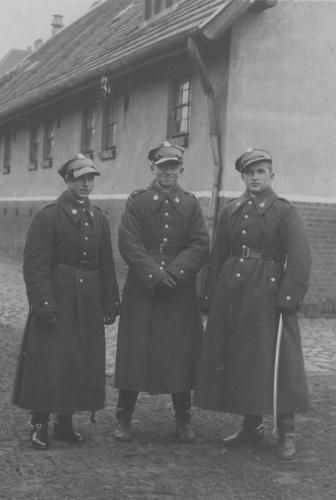
WW2 MILITARY UNIFORMS OF THE POLISH ARMED FORCES


POLISH UNIFORMS


WW2 uniform of Polish Infantry - Private (1939)

POLISH INFANTRY WW2 marching in formation
POLISH INFANTRY WW2

Polish Infantry - Private (1939)

01  wz. 1939 "rogatywka" garrison cap
02  wz. 1937 "rogatywka" field cap
03  wz. 1937  steel helmet
04  wz. 1936  jacket
05  dog tag
06  WST wz. 1932 gas mask in a tarpaulin bag
07  personal dressing
08  leather ammo pouches
09  wz. 1933 breadbag
10  leather main belt
11  wz. 1938 canteen
12  wz. 1928 bayonet cover
13  folding shovel in a leather cover
14  wz. 1933 backpack with blanket
15  standard army biscuit
16  wz. 1931 mess kit
Polish troops (just before WW2) note French gas mask canisters
17  spoon + fork kit
18  owijacze - belts of cloth used instead of socks
19  boots
20  GR-31 grenade - frag
21  GR-31 grenade - concussion
22  7,92 mm Mauser 1898a rifle
23  7,92 mm ammo clips
24  wz.1924 bayonet
25  wire cutting shears


Polish Infantry 1939 September Campaign
Polish Infantry 1939

Polish mountain infantry -  Parade of Podhale Rifles circa 1936
Polish mountain infantry -  Parade of Podhale Rifles circa 1936

Militlary Uniforms  - Polish Soldiers - Ceremonial Parade of Podhale Rifles Regiment
Polish Soldiers of Podhale Rifles Regiment


 Military Uniforms - Polish Soldiers - Parade of Podhale Rifles Regiment
Polish Soldiers of the Podhale Rifles Regiment -background High Tatras Mountains
(notice the icepick?)

Edelweiss cloth insignia on field uniforms of Polish Podhale Rifles
Cloth insignia on field uniforms of Polish Podhale Rifles


Es steht ein kleines, kleines Edelweiß
auf einer steilen, steilen Felsenhöh! 

There is a small, small edelweiss
on a steep, steep rocky heights!

Not a Nazi Swastika - it is Highlander Cross badge worn on the collars of the Podhale Rifles Regiment until 1945
Highlander Cross badge worn on the collars of the Podhale Rifles Regiment until 1945


The traditional symbols of the Podhale Rifles regiment are the edelweiss and the Mountain Cross, the latter which has been part of the folk culture of the Polish mountain regions. It has no relation whatsoever to the Nazi swastikas of the NSDAP.  In fact the Mountain Cross pre-dates the rise of the Nazi party.


Franciszek Kosibor in his uniform of Podhale Rifles-1939 Defensive War Poland WW2
Franciszek Kosibor in his uniform of Podhale Rifles-1939 Defensive War


WW 2 Military Uniform of Polish Uhlan 1939


Polish Uhlan (1939)

01  wz. 1937 "rogatywka" field cap
02  wz. 1932  forage cap
Military Uniform of Polish Uhlan WW2
Polish Uhlan
03  "Adrian" French steel helmet
04  wz. 1936 jacket
05  wz. 1931 canteen
06  dog tag
07  leather ammo pouches for Mauser ammo
08  main belt
09  RSC gas mask with canister
10  wz. 1924 bayonet cover
11  folding shovel in a leather cover
12  boots with spurs
13  wz. 1931 mess kit
14  personal dressing
15  wz. 1934 cavalry sabre
16  7,92mm Mauser 1898a rifle
17  wz. 1924 bayonet
18  7,92 mm ammo clips
19  fork + spoon kit


WW2 Military Uniform - Polish Rogatywka - Insignia of Colonel
(Photo: Rogatywka with Polish coat of arms and pulkownik is the rank insignia of a Colonel.)


"Rogatywka" is the Polish name for an asymmetrical, peaked,four-pointed military cap. "Rog" is a derivative of the word and means "horn". No other army in the world has such a cap. There are two types of caps, the hardened version, indicated by "Mk.1935, is olive green with black peak and is worn in full gala uniforms; its rim color marks the unit type. The soft version was worn before WWII and during the period of the PRL, but was withdrawn after 1990. Unlike most military forces, Polish soldiers do not decorate their caps with military insignia, but rather with the Polish White Eagle, which is the Polish Coat of Arms. Rim colors have specific meanings as follows;


Navy blue – generals, mechanized troops, law corps and National Honour Guard
Orange – units dedicated to honor historical panzer troops, scouts
Dark green – rocket forces, artillery, anti-aircraft units
Black – engineering units, cadets
Cornflower – HQs, radio services
Cherry – medics
Scarlet – Military Police
Violet – chaplains
Yellow – headquarters, 1st Warsaw Mechanized Division, 1st Warsaw Armoured Division


    WW2 Military Uniform Czapka of a wachtmeister of 1st Uhlan Regiment of Polish Legion
    Czapka of a wachtmeister of 1st Uhlan Regiment of Polish Legion

    CZAPKA is the Polish word for a cap.  It was the headgear of 19th century Polish cavalry and was quite high and consisted of a four-pointed cap emblazoned with the regimental insignia on the front.  Sometimes feathers or rosettes were added.


    painting of 19th century Polish Uhlan on horse
    painting of 19th century Uhlan

    WW2 military uniforms - group of Polish Uhlans
    Polish Uhlans

    Polish Uhlans in riding formation 1939 Poland
    Polish Uhlans in riding formation 1939 Poland


    WW2 military uniform - Polish Cavalry Officer 1939


    Polish Cavalry Officer (1939)

    01  wz.1935 "rogatywka" garrison cap
    Polish Cavalry Officer - Lt. Col Wladyslaw Anders - before 1939
    Polish Cavalry Officer - Lt. Col Władysław Anders before 1939
    02  wz.1923 forage cap
    03  round cap of the 3rd Cavalry Regiment
    04  wz.1937 "rogatywka" field cap
    05  wz.1936 officers' garrison jacket,
    insignia of the 6th Uhlan Regiment on collar tabs
    06  memorial badge of the 21st Uhlan Regiment
    07  dog tag
    08  wz.1936 officers' field jacket
    09  9mm wz.1935 "Vis" pistol
    10  personal dressing
    11   wz.1936 officers' main belt
    12  leather holster for the wz.1935 pistol
    13  officers' boots with spurs
    14  officers' field bag, B-type
    15  binoculars
    16  strap for wz.1935 pistol
    17  wz.1921/22 officers' sabre


    Panoramic photographb of Polish Cavalry in full charge ( before WW2)
    Polish Cavalry - maneuvers before outbreak of WW2


    WW2 Military Uniform - Private, 1st Grenadier Division, Polish Army in France (1940)


    Private, 1st Grenadier Division, Polish Army in France (1940)


    Officers of Polish Army at Camp Coetquidan, France1940
    Polish soldiers Camp Coetquidan, France1940
    01  Model 1919 beret
    02  Model 1918 French forage cap
    03  French Model 1915 "Adrian" helmet
    04  Polish "rogatywka" cap
    05  ammo clip
    06  ammo pack
    07  leather webbing
    08  Model 1916 ammo pouches
    09  Model 03/14 main belt
    10  8 mm Berthier 1892 carbine
    11  Model 1938 privates' jacket
    12  Model 1922 trousers
    13  Model 1935 gas mask with leather bag
    14  calendar
    15  Model 1893 backpack
    16  blanket
    17  Model 1935 mess kit
    18  Model 1935 cup
    19  canteen
    20  Model 1917 boots
    Polish Army in France recruitment poster-Armia Polska w Francja centrum rekrutacyjne 1940


    Hieronim Dekutowski in Polish Army, France 1940
    Hieronim Dekutowski in Polish Army, France 1940

    Hieronim Dekutowski- Polish Army WW2
    Hieronim Dekutowski- Polish Army WW2

    Hieronim Dekutowski (noms de guerre "Zapora", "Odra", "Rezu", "Stary", "Henryk Zagon") was an Officer of the Polish Armed forces fighting in the Western front, and was a legendary Cichociemni and guerilla commander of the Armia Krajowa (Home Army). After the so-called "Soviet liberation" of Poland, Dekutowski went into hiding from the Soviet NKVD and Urząd Bezpieczeństwa (UB). On February 5, 1945, Abram Tauber, the Jewish commander of the UB in Chodel invited four members of the Polish underground to his headquarters.  Tauber had previously been rescued from the Nazis by Polish AK units, and often sought refuge at the "Zapora" compound.   But when the Polish men arrived at the station Tauber ordered them to be tied up and single-handedly shot them one after another.   In retaliation, Dekutowski attacked and destroyed the UB station in Chodel. The incident sparked an anti-Soviet uprising in the region.


    WW2 Military Uniform -Private, Polish Army in the USSR (1941)

    General Sikorski inspects Polish troops Buzuluk, Russia Dec 1941
    General Sikorski inspects Polish troops Buzuluk, Russia Dec 1941


    Private, Polish Army in the USSR (1941)

    01  wz.1937 "rogatywka" field cap
    02  Model 1937 overcoat
    03  main belt
    04  Model 1904 ammo pouches
    05  felt boots
    06  tarpaulin gloves
    07  7,62 mm Tokarev SVT-40 rifle


    Polish Army in USSR 1941-42
    Polish Army in USSR 1941-42


    Polish Army parade at Buzułuku - USSR December 1941
    Polish Army parade at Buzułuku - USSR December 1941

    Military exercise in Polish camp at Tockoje- Russia 1941-1942
    Military exercise in Polish camp at Tockoje- Russia 1941-1942

    General Anders and General Sikorski at reviewing stand inspecting Polish troops in USSR 1941
    General Anders and General Sikorski at reviewing stand inspecting Polish troops in USSR 1941


    WW2 Military Uniform -Major, Polish Air Force in the UK (1940-45)


    Famous Polish Ace Pilot F/0 Miroslaw Feric
    F/0 Miroslaw Feric -Ace Pilot
    Major, Polish Air Force in the UK (1940-45)

    01  RAF officer's cap with Polish wz.1936 air force eagle
    02  RAF officer's jacket, Polish major insignia on the collar
    tabs, British Flight Lieutenant insignia on the sleeves.
    03  Officers' trousers
    04  Shoes
    05  Briefcase
    06  Silver Cross of the Virtuti Militari Cross
    07  Infantry Officer's School Badge
    08  Observer badge
    09  British Navigator's wings 

    Polish Ace Pilots - Jan Zumbach on the left - Spitfire plane
    Polish Ace Pilots - Jan Zumbach on the left


    Polish Pilots - France 1940
    Polish Pilots - France 1940

    WW2 - Polish Pilots - Division 315 ‘Dębliński’ - Aug 14, 1942 Divisional Day (UK)
    Division 315 ‘Dębliński’ - Aug 14, 1942 Divisional Day (UK)
    Polish 301 Bombing Division - inspected by King George VI and General Sikorski
    Polish 301 Bombing Division


    Photo:  (Aug 20, 1940) Bramcote, UK. Officers inspecting Polish bombing squadrons in formation.
    First row L-R; Lieutenant Colonel Roman Rudkowski-the first commanding officer of the Division 301, General Władysław Sikorski, King George VI, and Captain A. Davidson, Station Leader.


    General Sikorski awards Silver Cross of Virtuti Militari to ace Polish pilot Jan Zumbach Dec. 23, 1940
    General Sikorski awards Silver Cross of Virtuti Militari to ace pilot Jan Zumbach Dec. 23, 1940

    WW2 Polish Pilots (background is famous the PZL 37 Los Polish bomber )
    Polish Pilots (background is famous the PZL 37 Los Polish bomber )


    WW2 Polish Ace Pilots - Kosciuszko Squadron-Battle of Britain 1940
    Polish Ace Pilots - Kosciuszko Squadron-Battle of Britain 1940

    WW2 Military uniform GENERAL WLADYSLAW SIKORSKI
    GENERAL WLADYSLAW SIKORSKI


    WW2 Poland - Polish Soldiers Battalion Chlopskie
    Polish Soldiers Battalion Chlopskie


    Partisan of the Peasant Battalions (Bataliony Chlopskie) Poland 1942

    01  wz.1937 "rogatywka" cap
    02  jacket
    03  trousers
    04  boots
    05  improvised armband
    06  9 mm MP-40 SMG


    Bataliony Chlopskie was a resistance movement and partisan organisation created in the mid 1940s by
    the Stronnictwo Ludowe, (Polish People's Party), an agrarian political party.  By 1944 it was partially integrated with the Armia Krajowa (Home Army). At its peak it had 175,000 members. Their first major action was during the Zamosc Uprising in 1942 when the Germans expelled the Poles, expropriated their farmland and and gave it to German settlers. After several major battles, the Germans stopped the expulsions.


    WW2 Poland - Battalion Chlopskie "Odwet"
    Battalion Chlopskie "Odwet"
    WW2  Commander of Battalion Chlopskie Franciszek Kaminski
    Commander of Battalion Chlopskie Franciszek Kaminski


    WW2 Military uniform - Major, 1st Polish Armoured Division (UK) 1942-43


    Major, 1st Polish Armoured Division (UK) 1942-43

    WW2  1st Polish Armoured Div - Regimental Day
    1st Polish Armoured Div - Regimental Day
    01  British forage cap with a Polish wz.1940 military eagle and major's insignia
    02  British officer's jacket
    03  British trousers
    04  Officer's belt
    05  Shirt and Tie
    06  Officers' boots
    07  Black shoulder strap of 1st Armoured Div
    08  1st Armoured Division Badge
    09  Banners of 1st Independent HMG Batallion
    10  1st HMG Batallion's honorary cord

    Photo:   Haddington 29.04.1943 The colour of the 10th Dragoons during the celebrations of the regimental day of the 10th Mounted Rifles.


    WW2 July 1944 England - 1st Polish AD in training
    July 1944 England 1st Polish AD in training

    WW2 (L) General Stanislaw Maczek communicating on radio
    (L) General Stanislaw Maczek

    WW2 Military uniform General Stanislaw Maczek
    General Stanislaw Maczek


    WW2 Military uniform uniform - 2nd Lt, 1st Infantry Division, Polish People's Army (USSR) 1943


    2nd Lt, 1st Infantry Division, Polish People's Army (USSR) 1943

    WW2 Poland - 1st Polish (Peoples) Army Parade January 19, 1944
    1st Polish (Peoples) Army Parade January 19, 1944
    01  wz. 1937 field "rogatywka" cap
    02  Model 1936 drill jacket, wz.1943 military
    eagle on the buttons
    03  Soviet breeches
    04  Model 1935 officer's belt
    05  synthetic leather holster for Nagant revolver
    06  synthetic leather map pouch
    07  leather boots
    08  Adrianoy compass
    09  binoculars
    10  7,62 mm PPSh-41 SMG
    11  decorations: Cross of the Valorous,
    "Zasluzonym na Polu Chwaly" medal


    WW2 Polish soldiers of the  Polish People's Army  - Polish White Eagle on tank
    Polish People's Army
    Polish soldiers of the 24th Self-Propelled Artillery Regiment.
     (Vehicle may be an SU-85) Polish eagle moderated.

    Polish soldiers of the  Soviet-backed 1st Tadeusz Kościuszko Infantry Division-July 28-30 1943
    Polish soldiers of the  1st Tadeusz Kościuszko Infantry Division-Soviet backed July 28-30 1943

    Polish soldiers of the Soviet backed 1st Polish Army Jan 1945 so-called liberation of Warsaw
    Polish soldiers of the Soviet backed 1st Polish Army Jan 1945 so-called liberation of Warsaw

    Polish soldiers in Berlin May 1945
    Polish soldiers in Berlin May 1945


    WW2 Military uniform - solider of Warsaw Uprising - Poland 1944
    partisan military uniform Zoska Battalion Warsaw Uprising 1944 Poland WW2
    Zoska Battalion Warsaw Uprising

    Soldier of the Warsaw Uprising 1944

    01  German "Gladiator" helmet
    02  Wehrmacht sweatshirt in "Sumpftarnmuster" camp
    03  Polish wz.1933 main belt
    04  Polish breeches
    05 German pre-1939 boots
    06  Ak (Home Army) armband
    07  9 mm Sten Mk II SMG
    08 German ammo pouches for MP-38/40 mags


    Photo of Zoska Battalion: Left to Right: Polish resistance fighters Wojciech Omyla, Juliusz Bogdan Deczkowski, and Tadeusz Milewski in captured German uniforms and Kar98k rifles, Warsaw, Poland, 5 Aug 1944.

    WW2 Poland - Warsaw Uprising - Little Boy - Polish Scout
    Polish scout Warsaw Uprising


    Polish Scouts Armia Krajowa Warsaw Uprising 1944
    Polish Scouts Armia Krajowa Warsaw Uprising 1944


    Polish Insurgents column - Warsaw Uprising 1944
    Polish Insurgents column - Warsaw Uprising 1944

    Armia Krajowa - Polish Home Army - Warsaw Uprising 1944
    Home Army - Warsaw Uprising


    WW2 Military Uniform - Lieutenant, 1st Polish Airborne Brigade, Battle of Arnhem 1944


    Lieutenant, 1st Polish Airborne Brigade, Arnhem 1944

    WW2 1st Polish Independent Parachute Brigade # 5 - Cichociemni

    1st Polish Independent Parachute Brigade # 5


    01  British beret with Polish eagle and rank insignia
    02  "Denison smock" Mk I Jacket
    03  "Oversmock" vest
    04  Officers' boots
    05  trousers from M37 Battle dress
    06  British map pouch
    07  captured German ammo pouch
    used as a cover for a flashlight
    08  webbing, belt and holster for
    Enfield No2 revolver
    09  9mm Sten Mk II SMG
    10  AT Mk II airborne helmet

    WW2 Standard 1st Polish Parachute Brigade
    Standard 1st Polish Parachute Brigade


    WW2 Polish Uniforms Polish paratroopers 1st Polish Independent Parachute Brigade

    Polish paratroopers during field exercises Scotland, Kingcraig circa 1943. These men were elite special operations troops who were called "Cichociemni" the dark and silent ones. Of 2,413 candidates, only 605 men were able to complete the training successfully, but 579 qualified for air missions.

    WW2 Cichociemni  in training (elite special operations Polish paratroopers)
    Cichociemni  in training (elite special operations Polish paratroopers)

    Paratroopers of the 1st Polish Independent Parachute Brigade - Market Garden
    Paratroopers of the 1st Polish Independent Parachute Brigade - Market Garden

    Allied Paratroopers and 1st Polish Independent Parachute Brigade - Market Garden
    Allied Paratroopers and 1st Polish Independent Parachute Brigade - Market Garden

    Field Marshall Montgomery inspect 1st Polish Independent Parachute Brigade
    Field Marshall Montgomery inspect 1st Polish Independent Parachute Brigade

    General Stanislaw Sosabowski  at Driel  (Battle of Arnhem)
    General Stanislaw Sosabowski  at Driel  (Battle of Arnhem)

    General Stanislaw Sosabowski  Commander of the 1st Polish Independent Parachute Brigade

    General Stanislaw Sosabowski
    Commander of the 1st Polish Independent Parachute Brigade


    WW2 Military Uniform - Private, 1st Polish Army, Kolberg March 1945


    Private, 1st Polish Army, Kolberg March 1945

    01  wz.1937 field "rogatywka" cap
    02  Soviet M 1940 helmet with Polish wz.1943 military eagle
    03  Model 1937 overcoat
    Destruction of Kolberg 1945
    Kolberg 1945
    04  Model 1936 tarpaulin jacket, infantry banners on the collar tabs
    05  M 1935 drill trousers
    06  owijacze (leggings)
    07  Soviet main belt
    08  boots
    09  German M-09 ammo pouches
    10  pot
    11  self-made spoon
    12  7,62 Mosin 1891/30 rifle with bayonet
    13  F-1 grenade
    14  RPG-1 anti-tank grenade
    15  oiler for the Mosin rifle
    16  Maxim HMG ammo belt container
    17  canteen 


    Polish soldiers - Kolberg 1945
    Polish soldiers - Kolberg 1945


    Military Uniform - Major, maintenance units of the 1st Polish Armoured Division (Germany 1945)


    Major, maintenance units of the 1st Polish Armoured Division (Germany 1945)

    01  M 37/40 battle dress, maintenance units banners on the collar tabs
    WW2 1st Polish Armoured Division 10th Mounted Rifles Regiment at Haddington 29.4.1943. Regimental Day
    1st Polish Armoured Division
    02  black shoulder strap of 1st Armoured Div
    03  1st Arm Div badge
    04  Silver Cross of the Virtuti Militari Cross
    05  M 37 webbing
    06  11,43 mm Colt M1911 pistol
    07  Officers' boots
    08  leather vest
    09  drivers' gloves
    10  armoured units' training helmet
    11  AT Mk II motorcycle helmet
    12  Mk II helmet
    13 leggings

    Photo at right: the 10th Mounted Rifles Regiment at Haddington 29.4.1943. Regimental Day


    1st Polish Armoured Division Aug 1944 (Sherman Tank)
    1st Polish Armoured Division Aug 1944 (Sherman Tank)

    1st Polish Armoured Division 1944 (Normandy)
    1st Polish Armoured Division 1944 (Normandy)
    WW2 1st Polish Armoured Division
    1st Polish Armoured Division


    Polish Navy

    Presentation of new Polish Naval Officers to President on Oct 15, 1936 Warsaw Castle
    Presentation of new Polish Naval Officers to President on Oct 15, 1936 Warsaw Castle

    Polish sailors in UK 1943
    Polish sailors in UK 1943


    Illustration of Polish sailor's uniform WW2
    Illustration of Polish sailor's uniform WW2

    King George VI reviews Polish naval regiment (UK)

    Polish Naval Commander RearAdmiral Jozef Unrug (1930 ranked Captain)
    Polish Naval Commander RearAdmiral Jozef Unrug (1930 ranked Captain)

    Jozef Unrug Polish Vice Admiral
    Jozef Unrug Polish Vice Admiral

    WW2 Military Uniform - 2nd Lt., AAA of the 2nd Polish Corps (Italy 1945)


    WW2 Polish Soldiers -  2nd Polish Corps and Mascot - Wojtek the cub bear
    2nd Polish Corps with Wojtek the cub bear
    2nd Lt., AAA of the 2nd Polish Corps (Italy 1945)

    01  M40 battle dress, AAA colors of the collar tabs
    02  American woollen shirt
    03  M40 overcoat
    04  M42 beret
    05  boots
    06  M37 breadbag
    07  dog tags
    08  ribbons of the Monte Cassino Cross
    09  2nd Polish Corps Artillery memorial badge
    10  Polish-English pocket dictionary
    11  Propaganda leaflet

    WW2 emblem of 22nd Artillery Supply company of 2nd Polish Corps - Wojtek the Bear
    Official Emblem Wojtek

    Wojtek was more than a mascot. He grew up to become an official soldier of the 2nd Polish Corp - the 22nd Artillery Supply Company.  He carried heavy loads of ammo for his unit.


    Polish Soldiers 2nd Polish Corps Monte Cassino, Italy 1944
    Polish Soldiers 2nd Polish Corps Monte Cassino, Italy 1944

    An Illustration of soldiers of 2nd Polish Corps Monte Cassino Italy 1944
    An Illustration of soldiers of 2nd Polish Corps Monte Cassino Italy

    Soldiers of 2nd Polish Corps charging up Phantom Hill - Monte Cassino 1944
    Soldiers of 2nd Polish Corps charging up Phantom Hill - Monte Cassino

    General Anders salutes soldiers of 2nd Polish Corps
    General Anders salutes soldiers of 2nd Polish Corps

    General Wladsylaw Anders - Commander of 2nd Polish Corps
    General Wladsylaw Anders - Commander of 2nd Polish Corps


    Polish White Eagle