
History is filled with tales of great, heroic warriors of epochs long ago. Among them were Alexander the Great, whose empire spanned from the Ionian Sea to Asia Minor, was much lauded in life as after his death for being the greatest military mastermind the world had ever known. His desire was to reach the "ends of the world and the Great Outer Sea". Hannibal was a Carthaginian military commander whose most famous battle was the Second Punic War (218 to 202 BC). He led his armies in a spectacular march across the Alps, conquered Italy and consolidated his control over the Roman heartland for the next fifteen years. And Julius Caesar, whose conquest of Gaul reached all the way to the North Sea. In 55 B.C. he conducted the first invasion of Britain, a victory which ranked him as the greatest military leader in the ancient world.
But fate took its turn with each one: when Alexander the Great attempted to invade India in 326 BC, a mutiny of his own troops forced him to turn back. He died three years later never having realized his ultimate goal - the conquest of Arabia. His great empire rapidly disintegrated, and following a series of civil wars, it was transformed into a number of states ruled by his generals. Hannibal met his nemesis years later when a Roman counter-invasion forced him back to Carthage (where he was defeated by Cipio) at the Battle of Zama. On the 14th of March, 44 BC, Julius Caesar was assassinated by 60 senatorial conspirators, an event which marked the beginning of the demise of the Roman Republic.
These and many other brilliant military masterminds continue to fascinate the world, and have since been a source of awe and inspiration not only to historians but military leaders of each era. Alexander the Great, Hannibal, and Caesar have been lauded, among others, as "gifted strategists" by men such as Napoleon Bonaparte and Duke of Wellington. In fact, military academies today still teach many of their brilliant tactics
But in the realm of war stories, there is but one great story which has always been omitted. It does not dwell on the victories of any one leader, but rather on the succession of victories by a lineage of great and noble warriors. The greatest army ever assembled in the history of mankind was an elite branch of the Polish cavalry. They quickly developed into one of the most formidable armies throughout Europe. During the Middle Ages they struck fear into the hearts of their enemies. Their conquests surpassed that of any predecessor and their military prowess was supreme and undefeated for over 200 years.
THEY WERE THE POLISH WINGED HUSSARS
The first recorded evidence of hussars can be found in Polish treasury books dated 1500. Initially these troops were considered only light cavalry and were composed mainly of foreign mercenaries, called "Racowie", (in Polish) meaning "from the Serbian state of Ras". By 1503 the Polish Sejm (Polish Parliament) decreed the formation of hussar units in the Kingdom of Poland. What began with a fledging regiment of three banners of Hungarian mercenaries quickly expanded as Polish citizens enlisted in droves. This Polish-Serbian-Hungarian regiment was at first a light cavalry and fought in wars during the early 16th century, most notably at Orsza (1514) and Obertyn (1541). However their participation was initially relegated to one of lesser importance. But by the mid-1500s during the "transitional period" they were transformed into heavier-armed hussars and it was not until the 1570s that the Polish Hussars finally came into their full glory. This was the Golden era, when the Polish-Lithuanian Commonwealth had become one of the largest, most powerful and most populated nation in all of Europe.
To describe the Polish Hussars as an elite branch of the cavalry would be an understatement. Most of them were recruited from wealthier Polish and Lithuanian nobility, and were referred to as the "szlachta". Each "towarzysz", or "comrade" was responsible in assembling his own "poczet" or retenue, and several of these were combined to form a hussar banner or company. In the meantime, during the 16th century, the hussars in Hungary had replaced their heavy wooden shields with full body metal armour. After the election of Stephen Batory as King of Poland (1575) and later acceptance of him as Grand Duke of Lithuania (1576), Batory re-organized the hussars of his Royal Guard to be equipped along the same lines as those of the Hungarian regiments, and equipped his men with long lances as their primary weapon. By the 1590s this transformation to heavy armor was all but complete and the Polish regiment became known as the "husaria".
FAMOUS BATTLES
Battle of Lubiszew
 |
| King Stefan Batory |
Battle of Byczyna
 |
| Sigismund III Vassa |
In the Battle of Byczyna (January 24, 1588) the Archduke led his army to positions east of Byczyna on the royal road leading into Poland. With him were 5,400 infantry and 600 cavalry and he felt confident that his position on the Hapsburg side of the border would be secure enough that the Polish army would not be likely to cross it. Polish soldiers under the command of Jan Zamoyski numbered only 2,300 infantry but had 3,700 cavalry.
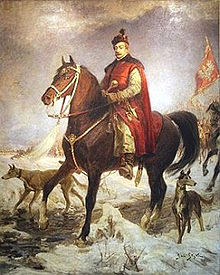 |
| Hetman Jan Zamoyski |
The Polish Hussars played a major part in this battle (even though the infantry was in the forefront).The battle was a bloody one and resulted in a rapid retreat by Maximillian's army, which took refuge in Byczyna. The Germans suffered very heavy casualties and lost their artillery and guns to the Poles who were poised to use them against the town. But before the Poles could attack, Maxmilian surrendered and was taken prisoner.
Battle of Kokenhausen
One of the greatest victories of the Polish Hussars took place on June 23, 1601 in the Battle of Kokenhausen. Despite overwhelming numbers, Polish forces were able to defeat the Swedish army. In early March about 2,000 Swedish troops led by Carl Carlsson Gyllenhielm, had blockaded the town of Koknese (located on the Daugava River, between Riga and Daugavpils, currently in Latvia) and on the 1st of April had taken the town. However, they were unable to take the inner castle as it was defended by a Polish garrison. By May 11, Polish reinforcements arrived, and under the command of Krzysztof Mikolay "the Thunderbolt" Radziwill, laid siege to the town. By mid-June Polish ranks grew from less than 1,000 to over 4,000 troops. At the same time, Polish forces reinforced nearby strongholds and took to harassing the Swedish units. A Swedish relief force of about 5,000 soldiers arrived on the morning of June 23rd and attempted to break the Polish encirclement.
 The field of battle was raised along the shore of the Daugava for a distance of approximately one and a half kilometers, to a width of about half a kilometer -with the side adjacent to the river being quite steep and gradually sloping towards the field. Gyllenhielm's army consisted of 900 infantry, 4,000 cavalry and 17 cannons. Radiziwell gave orders to 500 of his men to maintain the siege, and he led the remaining troops afield consisting of 3,000 men, of which 400 were infantry, as well as 1,000 Polish hussars, and 9 cannons. The Poles successfully broke through the Swedish right flank and defeated their attempt to maneuver a counterattack.
Battle of Kircholm
The Battle of Kircholm, one of the major battles in the Polish-Swedish War, was fought on September 27, 1605, (or the 17th according to the Old calendar then in use in Protestant countries). The hussars launched a devastating charge against the enemy which ended the battle in the decisive victory of the Polish-Lithuanian forces. It is remembered and celebrated to this day as one of the greatest triumphs of the Polish Hussars.. The battle was decided in all of 20 minutes!
On the eve of battle Swedish forces and that of the Commonwealth assembled near the town of Kircholm (which is about 18km SE of current day Riga, Latvia). The Swedish forces under the command of Charles IX numbered 10,800 men and 11 cannons, and were reinforced by several thousand German and Dutch mercenaries, as well as a few hundred Scots, greatly outnumbering the Commonwealth forces.
 |
| Jan Karol Chodkiewicz |
Even with numerical superiority the Swedes were at a severe disadvantage. Their troops were less well-trained (though armed with pistols and carbines), had a poorer breed of horses, and were tired after having marched throughout the night in torrential rains. Other the other hand, the Polish-Lithuanian forces were well-rested, confident that their cavalry was superbly trained and were heavily armed with lances. Most came from the Grand Duchy of Lithuania and about 200 from the Polish Crown, the remainder of which were either mercenaries or close personal allies of Chodkiewicz. Among these forces were also a small number of Tatars and Polish-Lithuanian cossack horses used mostly for reconnaissance.
The Swedish soldiers were deployed in a checkboard formation in which infantry assembled into 7 or 8 widely spaced blocks, with intersecting fields of fire while the flanks were covered by Swedish and German cavalry, and cannons positioned ahead of the cavalry. In contrast, the Polish-Lithuanian forces were deployed in the traditional format: the left wing, commanded by Dabrowa, was significantly stronger, while the right wing under the leadership of Pawel Jan Sapieha consisted of a smaller number of Hussars while at the centre were 300 Hussars led by Chodkiewicz, as well as a powerful formation of reiters dispatched by the Duke of Courland.
Despite the 1:3 disadvantage of Chodkiewicz forces, he used a feint to lure the Swedish forces from their high position. Thinking that the Commonwealth forces were retreating, the Swedish army was ordered to attack and began to give chase, spreading out their formations as they advanced. This is precisely what Chodkiewicz had planned and at the precise moment, the Commonwealth infantry launched a full-blown attack on the approaching enemy. At this point the Hussars assumed battle formations and charged on the Swedish left flank. At the same time about 300 Polish-Lithuanian Hussars charged the Swedish infantry in the centre to prevent them from interfering with their cavalry action on both of their flanks. Chodkiewicz then ordered his left wing and all reserves to attack the opposing right flank of the enemy.
The Swedish reiters were driven back on both wings and the infantry in the centre was attacked from three sides simultaneously. The Swedish forces turned and ran off in a panic, their whole army having collapsed. It was at this point that the Swedes had suffered their heaviest casualties. Defeat was devastating and complete. Swedish forces had lost more than half, and perhaps as much as two-thirds of their men. Their largest number of losses occurred while retreating in the dense forests and marshes: 8,000 dead or wounded, and 500 captured. The Poles and Lithuanians were fierce warriors and spared few opponents. Commonwealth losses were only about 100 dead and 200 wounded, though the Hussars had lost many of their trained battle horses. That they suffered fewer casualties was largely due to the incredible speed of their victories, not to mention that their horses had also been a shield and protection to the riders.
 |
| Polish Hussars depicted in the Battle of Kircholm |
 |
| 1630 painting of Battle of Kircholm, Pieter Snayers |
The Swedish king henceforth abandoned the siege of Riga, relinquished his control of northern Latvia and Estonia, made a complete withdrawal and sailed back to Sweden across the Baltic Sea. Irregardless, the Commonwealth was not capable of exploiting their victory to the fullest owing to the limited financial resources at hand. There was not enough money for military supplies, and for incidentals such as food and fodder for their horses, nor to replace the many horses killed in battle. As a result their military campaign faltered. In 1611 a truce was signed, but by 1617 war broke out again and four years later Gustavus Adolphus, the new Swedish king, succeeded in retaking the city of Riga after a brief siege.
The Battle of Klushino
The Battle of Klushino was fought during the Polish-Muscovite War between the forces of the Polish-Lithuanian Commonwealth and Russia. It took place on July 4, 1610 near the village of Klushino (near Smolensk).
 |
| Stanislaw Zolkiewski |
The Russian army, under the command of Prince Dmitry Shuisky, was heading towards the besieged fortress of Smolensk when they were intercepted by Polish forces. Soon after dawn the Poles attempted an attack but lost the element of surprise as the Russians had been able to fortify their positions in advance. In the opening stages of battle, the Polish Hussars engaged in repeated and ferocious attacks against Russian positions but without success. According to a witness, Samuel Maskiewicz, the hussars had charged about 8 or 10 times. The battle was extremely hard fought throughout the early part of the campaign, largely due to the barriers on the battlefield: it was divided by a high fence which permitted the Polish hussars to charge only through a narrow gap.
 Nevertheless, so fierce were the hussars that many of the Russian foreign mercenaries began deserting and joined the Polish forces. That event, and the fact that a large number of native Russians also began deserting their posts, greatly diminished the morale of the remaining Russian forces. Eventually, the Russian cavalry launched a counterattack but were heavily mauled by the Polish hussars. After a brief melee, the Russians broke ranks and fled in panic, suffering extensive losses.
In the meantime, the remaining Russian forces maintained their position on the right wing but they too were overpowered by the Poles. The foreign troops on the left wing continued to put up a strong resistance for several hours but they retreated when the Polish infantry and cannons arrived. It was in their retreat that the Russian forces suffered the heaviest of casualties. There were however a large number of foreign troops who were able to make a relatively safe retreat under the protection of their long infantry pikes and find refuge in their camps. But in the meantime Polish-Lithuanian forces had surrounded two enemy camps as well as the mercenary camps in the forest. Though the Russians still had one fortified camp with able-fighting men, having larger numbers were no consolation to them in the face of the invincible Polish Hussars.
"Then when there were no more of the German infantrymen harassing us by the hedge, a few troops of our cavalry, joining together, charged the foreign cavalry with pikes - those who still had them - sabers and broadswords, They, deprived of protection of the Russian soldiers and cavalry, unable to resist, began escaping back into their camp. But there too our men rode after, and hitting and hacking drove them through their own camp." (from Zolkiewskis' memoirs)
Zolkiewski wielded his negotiating skills as deftly as his military tactics. He succeeded in procuring a surrender from the foreign mercenaries, who had already abandoned the Russians, as well as obtain their agreement to withdraw and not enlist again with the Russian Tsardom against the Polish-Lithuanian Commonwealth. Several hundred of them chose to switch sides and voluntarily enlisted with the Commonwealth forces. The Polish-Lithuanian forces were able to achieve victory with ease, due largely to the poor structure of command and coordination of the Russian forces.
The main Russian army retreated whereupon Polish forces, already exhausted from battle, took to looting the Russian camps for their spoils of war - gold, silver, furs, military equipment, all Muscovite artillery, and the several war trophies such as flags and banners.
Following one victory, Zolkiewski turned towards Tsarovo, whose commander, Walujew, unilaterally surrendered after learning about the defeat of his comrades at Klushino. Shortly after battle, the Russian Tsar Vasily IV was ousted by the boyars and Zolkiewski and his troops marched into Moscow with little opposition. The high-ranking Russian boyars proclaimed Polish prince Wladyslaw Zygmuntowicz the new Tsar of Russia. Though he claimed the title from 1610 to 1634 he never assumed the Russian throne.
The Russian fortress of Smolensk was taken on June 3, 1611 following a 20-month long siege. The Polish forces suffered only 400 casualties, while the Russian casualties were 5,000 men killed or wounded.
Battle of Trzciano
The Battle of Trzciano, one of the many during the Polish-Swedish War, was fought on June 17, 1629. In addition to the Polish forces of Sigismund III, led by field crown hetman Stanislaw Koniecpolski, were imperial troops sent from emperor Ferdinand II to aid the Polish king (Sigismund III). The latter troops were under the command of Hans Georg von Arnim-Boitzenburg and Ernst Georg Sparr. From June to August they fought against the Swedish forces commanded by King Gustav II Adolf, who supported the Protestant Lutherans of Germany and northern Europe. In the end the battle ended in a stalemate and acceptance of a truce by Sigismund III.
Sigismund III - of Swedish descent, and Catholic, was king of both Sweden and the Polish-Lithuanian Commonwealth. He sought to maintain the crown of Sweden despite being rejected by the Swedish people.He also wanted the crown of Russia. As fate would have it, Sigismund's uncle Karl instead became king of Sweden, having assumed the throne with the assistance of Russia. However, Sigismund III's plans were considerably more ambitious. He attempted to gain control of the lucrative trade routes in the Baltic Sea and repeatedly requested that Swedish king Gustav Adolph abdicate his throne as a requisite for a truce and peace negotations. Gustav refused and battles and skirmishes ensued for a number of years.
Sigismund III Vasa received military support from emperor Ferdinand II, consisting of 5,000 infantry, and reiters. Reinforcements arrived in Prussia by late spring 1629 and led by General von Arnim and by Ernst Georg Sparr, set up camp near Graudenz (Grudziądz). Gustav Adolf had arrived in May. On June 17th, 1629 several skirmishes broke out at Honigfelde, situated south of Sztum. Gustav Adolph's army, positioned there, totalled 4,000 cavalry and 5,000 infantry all poised to fight against the Imperial and Polish forces.
 |
| Hetman Koniecpolski |
When Gustav II Adolf learned that the Polish-Imperial forces were in the proximity, he ordered the troops of the Count from the Rhine to continue marching. However, the Rhein count did not follow his orders and instead maintained his position at Honigfelde. In the meantime Koniecpolski had hordered his cossacks to advance through the forest NW of Sadowe, and his Hussars engaged in another flanking manoeuvre behinds the hills SE of Honigfelde. The last to reach the battlefied were Von Arnims reiters, which immediately formed into battle order to attack the Swedes from the front.
As the Polish forces approached, the Swedish leather cannons began firing, and the Rheincount ordered his arquebuisers to attack them. (Both cossacks and arquebuisers were mobile cavalry possessing good firepower but the Germans arquebuisers soon gained the upper hand and began pushing the outnumbered cossacks back towards the forest. At this moment, the Polish Hussars arrived from their flanking manoeuvres. A few of whom had fought the Swedish artillery (and the 60 to 80 musketeers supporting them) but the majority of Polish Hussars advanced and charged upon the engaged arquebuisers.
As the Hussars charged their flank and rear, the arquebuisers position quickly collapsed and they fled in disorder towards the north to join the rest of their army. Gustav II Adolf then arrived and helping to regroup the Rheincount, ordered a charge with the Battalion (Zakarias Paulis, and Reinhold Anreps Finnish squadrons). Much of the Battalion were so demoralised by the flight of the rearguard that they too joined the flight. Gustav II Adolf and the remaining cavalry were left alone to face the pursuing cossacks. The cossacks almost captured Gustav, but managed to escape when one of his men, Erik Soop, after having shot the attacker, threw off his harness over his head, and joined the other members of the cavalry in safety. As they approached the village of Straszewo, the situation became critical. Field marshall Wrangel was able to achieve only momentary advantage - allowing Gustav II Adolf enough time to reorganize some of the fleeing squadrons for re-entry into battle. Once again von Arnim's cuirassiers and Konieckpolski's hussars engaged in a full charge and once again the Swedes were thrown back. The Swedes proceeded to withdraw to Pulkowitz where the Gardescuirassiers and Streiff's squadron had taken up defensive positions, while their infantry and artillery continued towards Neudorf, taking up defensive positions at a river crossing. During their retreat, they were hotly pursued, but as they neared Pulkowitz, the Streiffs squadron began a counterattack, thereby relieving the beleaguered troops.
The Swedes and Poles had reached a deadlock, until von Arnim once again caught up with his cuirassiers and turned the battle against the Swedes. Again the Swedes withdrew, this time to Neudorf where their infantry and artillery had taken up positions. From there the Swedes were able to easily hold off the tired Polish-Imperial cavalry until nightfall. The next day was without event, and the Swedes were able to withdraw and make their way to Marienburg.
During the battle, 300 Poles were killed. Casualties suffered by the Swedish cavalry were higher, about 600 killed and 200 captured by the Poles, including many high ranking officers. Despite these losses the Swedish infantry remained somewhat intact.
Koniecpolski's troops launched further attacks on July 15th and on August 9th, both of which were repelled. The battle had come to an end, and a truce called.
Battle of Khotyn
In one of the most famous battles of the Polish-Lithuanian Commonwealth occurred on November 11, 1673 when forces under Hetman Jan Sobieski defeated the Ottoman Empire led by Hussain Pasha. It reversed the misfortunes of the previous year and permitted Sobieski to win the royal election and become King of Poland.
The Turks had under their command about 35,000 troops and 120 guns, but were no match for Polish-Lithuanian forces at 30,000 strong. In battle, the rockets of Kazimerz Siemienowicz were used against the enemy to great success. It lead to a resounding victory which allowed the Poles to abrigate the unfavorable Peace of Buczacz. It set the stage for the role Sobieski would play in the Battle of Vienna.
 |
| Kazimierz Siemienowicz |
 |
| Khotyn Fortress in what is now western Ukraine |
Battle of Lwow
The Battle of Lwow took place near the city of Lwow, (currently in Western Ukraine) on August 24, 1675 between the Polish-Lithuanian Commonwealth and the Ottoman Empire.
In the summer of 1675, 20,000 Turkish troops under the command of Ibrahim Shyshman crossed the Polish border and began a rapid march towards Lwów along the banks of the Dnister. The army was composed mainly of Turkish infantry and cavalry with numerous Tatar detachments. In order to face this assault, Polish King Jan III Sobieski commanded that his troops take positions in and around Lwów, while more reinforcements arrived. Upon hearing of the increased concentration of troops the Turkish commander sent a detachment of about 10,000 men of the Tatar forces to try to stop it. The Polish king assembled about 6,000 men, of whom 1,700 where Hussars. The remaining army consisted of infantry, dragoons and light cavalry.
By early morning on August 24th, Polish reconnaissance units observed Turkish columns quickly approaching the city of Lwow from the direction of the village of Gliniany (currently Hlyniany). The main road leading to the city passed through this area, a plain surrounded by swamps on both sides. Just before reaching Lwow the road passed through hilly terrain. Sobieski predicted that the Tatars would have to reach the road by either of the two narrow valleys located nearby.

The Tatars arrived on the plain at noon - precisely as Sobieski had predicted. The Turkish commander was convinced that a large group of Hussars were hiding in the woods on the hills, and he ordered his cavalry to reach the road through one of the ravines. The Polish infantry ambushed them and pushed the Turks back by a counter-attack of light cavalry. Meanwhile, Sobieski ordered all troops that had been guarding other approaches towards Lwow, to join the main forces advancing along the road.
 |
| Michal Kazimierz Radziwill |
The Hussars, numbering 1700-strong were joined by three banners (that is, 300 men) of the Lithuanian light cavalry under the command of Hetman Michal Kazimierz Radziwill. Sobieski ordered the cavalry group to advance through the unguarded western gorge. The ravine was relatively narrow making it impossible for the Turks to outflank the Polish and Lithuanian cavalry while on the move. Upon reaching the plain, Sobieski commanded his troops to form a battle line and ordered a cavalry charge which he led personally.
In less than 30 minutes the battle was over. The Turkish lines were broken and its infantry surrounded, with their cavalry in full retreat.
The pursuit lasted until the dusk.
Battle of Vienna
The Battle of Vienna was the most important of all the battles in Europe in the 17th century and marked a crucial turning point in the balance of power between European Christendom and the Ottoman Empire. For 300 years the struggle between the Ottoman and Habsburgs dynasties ensued as the Turks swept across the continent and conquered territories throughout southwestern Asia, North Africa and central and southeastern Europe. Vienna had long been coveted by the Ottoman Empire as the means to control the trade routes through Europe - from the Black Sea to Western Europe, and from the eastern Mediterranean to Germany, and with it the world.
 |
| Map of Vienna Fortifications |
The second siege came on July 14th, 1683 when the Ottoman army invaded Vienna and on the same day demanded their surrender. The troops and citizens of Vienna refused to capitulate and instead began to burn down many of their houses in the effort to create a clearing from which they could easily fire upon the approaching Turks. However the Turkish commander Pasha was able to overcome this problem by ordering his troops to dig long lines of trenches into the city, thereby providing adequate cover for his advancing armies. The Ottomans had 300 good cannons, but none were able to penetrate the massive city walls, so instead they dug tunnels under the city walls and blew them up with large quantities of black gun powder. To further extend hardships, the Ottomans cut the food supply into Vienna. However the greatest danger to the Viennese troops was that of fatigue, so much so, that the commander Ernst Rudiger von Starhemberg ordered any soldier who was found asleep on watch to be shot.
By September 6th, the Polish army led by King Jan III Sobieski had crossed the Danube river 30 km north-west of Vienna at Tulln. There he joined the Imperial forces and troops from Saxony, Bavaria, Baden, Franconia and Swabia. (French troops of Louis XIV declined to provide assistance, and used the opportunity to attacks cities in Alsace and parts of Germany.)
 During the early part of September, over 5,000 Ottoman sappers descended upon the outer walls of the city, and one by one blew up large portions of the walls: the Burg bastion, the Lobel bastion, and the Burg ravelin, creating enormous gaps in the wall 12 m in width. (Ottoman forces totalled 30,000 to 40,000 men while the Habsburg-Polish armies totalled 84,400.) The Austrians desperately tried to circumvent the bombardment by digging their own tunnels to no avail. In a matter of days the Ottomans managed to breach the city walls and occupy the Burg ravelin and the Nieder Wall. Now the Austrians had to prepare for a fight in Vienna itself.
Meanwhile, above ground, the Polish infantry had already launched a massive assault on the Ottoman right flank and after twelve hours of fighting, the Poles held the high ground on the right. The Holy League cavalry had been watching the infantry battle for the entire day, all the while waiting for the order to attack. Finally at about 5:00 pm, King Sobieski gave the command and the cavalry attacked in four group formations. The first was Austrian-German, and the other three were Polish. Twenty thousand horsemen charged down those hills, a maneuver planned and led by the King of Poland. He was at the head of 3,000 Polish Winged Hussars. In the confusion, the cavalry headed straight for the Ottoman camps, while the remaining Vienna garrison sallied out of its defenses and joined in the assault.
The Ottoman troops were exhausted and demoralised following their failure to capture the city. The arrival of the cavalry, in particular the Polish Hussars, were instrumental in turning the tide of battle against the Ottomans, sending them into retreat to the south and east. With the intervention of the cavalry, it took less than three hours to win the Battle. It saved not only Vienna but all of Europe.
Casualties for the Ottoman forces were very high; at least 15,000 killed and wounded, and at least 5,000 men captured. The Habsburg-Polish forces sufferred casualties of 4,500 killed and wounded.
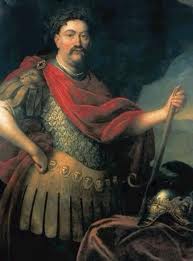
After the battle, Sobieski paraphrased Julius Caesar's famous quote by saying "Venimus, Vidimus, Deus vincit"
"We came, We saw, God conquered"
source:
Wikipedia


