Showing posts with label Battle of Normandy. Show all posts

March 29, 2012

GREAT POLISH GENERALS OF WW2: Stanislaw Wladyslaw Maczek

General Stanislaw Maczek "Baca"

"Baca" (Shepherd)

Each year the people of Breda in The Netherlands celebrate Liberation Day. It is a solemn event to commemorate the fallen soldiers who sacrificed their lives to liberate them from Nazi occupation in World War II. Among the heroes were also Polish soldiers who served under General Stanislaw Wladyslaw Maczek in the 1st Polish Armoured Division. At the center of the city stands a monument and a museum dedicated to the memory of General Maczek and his men.

General Maczek was one of the most successful Polish commanders of World War II, and greatly respected by Allied Command, as well as by enemy rank and file. Maczek was referred to by his men as "Baca", a Galician name, which translated means "Shepherd". For Maczek the only thing that surpassed his determination to win the war was his great concern for his troops. The feeling was mutual. There was no greater tribute to a General than this.

Stanislaw Maczek was born in Lwow (Lviv) on March 31, 1892. The famous Polish city is now part of the Ukraine, but was then in Austro-Hungarian Galicia. Maczek's roots stem from Croatian extraction, though distant. His cousin was a Croatian politician by the name of Vladko Macek.

Stanislaw Maczek had been attending Lwow University, majoring in Polish Philology but had to interrupt his studies when World War I broke out. He intended to enlist in the Polish Legions and serve under the command of Marshal Jozef Pilsudski, but he was instead drafted into the Austro-Hungarian army. After undergoing a brief period of officer training, he was sent to the Italian Front as NCO of the Tyrolean Regiment of the K.u.K. (kaiserlich und koniglich, which means "Imperial and Royal"). He was promoted twice, first to Second Lieutenant, and by the end of the war, to Lieutenant. Maczek was the only Polish battalion commander in the Austro-Hungarian alpine division - a testament of the degree of his caliber and distinction.

November 11, 1918 marked the end of the World War I, and the re-emergence of Poland as a nation after 123 years of oblivion. Maczek immediately traveled to Krosno (near the southern tip of Poland) where he joined the new Polish army. He was appointed commander of a battalion and launched an offensive against troops of the West Ukrainian People's Republic for control over the city of Lwow. The battle lasted from November 1st, 1918 until May 22, 1919 and escalated into the Polish-Ukrainian War. It end with a Polish victory.


Polish Supreme Command defending Lwow 1918

In spring of 1919 Maczek was given a new commission as commander of the 4th Infantry Division of Lotna Kompania, a unit which he created and organized, modeled after the elite German Sturmbataillone of World War I. Maczek's division was almost completely motorized and armed with heavy machine guns and composed of battle-hardened troops from the Krosno battalion - men whose combat experience exceeded that of other Polish soldiers at the time. They functioned in the capacity of "firefighters" by reinforcing weak spots in the defensive lines, but earned their distinction from winning fierce battles for the cities of Drohobycz, Stanislawow, Buczacz and the capital city, Stryj (now in the Ukraine).

When fighting ended, Maczek had been promoted to rank of major with seniority and assigned to the post of staff officer in the Polish 2nd Army under General Iwazkiewicz' command however the position was ill-suited to his temperament and exceptional abilities. After numerous requests to his superiors, he was finally given a command of a front-line unit. The timing was ill-fated. The Polish-Soviet War had already begun resulting in the defeat of the 2nd Polish Army by Semyon Budyonny's Soviet 1st Cavalry army.

On the heels of this defeat, Maczek immediately formed another battalion composed of new recruits, and despite the lack of sufficient training, led his troops to the front as "firefighters" wherever they were needed. They served as rearguard for the Polish troops at Mosty Wielkie, then joined the 1st Cavalry Division under the command of Polish General Juliusz Rommel, participated in attacks on the city of Warez, conducted a counter-assault on the rear of advancing Cossacks, and ultimately won the Battle of Komarow. (The latter was one of the biggest cavalry battles of the Polish-Soviet war since 1813.) With the signing of the Treaty of Riga, hostilities came to an end. Though Maczek's battalion was disbanded shortly thereafter, it had been officially named after him.


Emblem 10th Motorized Cavalry Br.
During the interwar period Maczek opted out of university studies and chose to pursue his career in the military. Between 1921 and 1938, he had served as commander over several different divisions, studied at the Higher Military School in Warsaw, and was rapidly promoted thereafter to the rank of Lieutenant-Colonel, and then to Colonel.

Just a year before World War II broke out, Maczek was given the command of Poland's first fully-motorized army, the 10th Motorized Cavalry Brigade, nicknamed the "Black Brigade". In September 1939 his Brigade was attached to the Krakow Army and fought in defense of the voivodeships of Lesser Poland and Silesia. From the very first day of war, his troops went into battle equipped with only light tanks, tankettes and only one artillery battery of only eight heavy cannon.

  
Polish Officers with General Maczek - "Black Brigade" 1939


Maczek's Polish 10th Motorized Brigade - TKS Tankettes 1939


The Battle of Jordanow took place on the second day when Maczek's troops faced the entire German XVII Corps of General Eugen Beyer and succeeded in shielding the southern flank of Polish armed forces along the Beskides (mountain ranges). Maczek's brigade, supported by just a few battalions of Border Guards and troops of National Defence managed to face down three German Panzer Divisions: the 4th Light Division under the command of General Alfred Ritter Von Hubicki, the 2nd Panzer Division under the command of General Rudolf Veiel; and the 3rd Mountain Division under the command of General Eduard Dietl.

Despite the overwhelming power of the Nazi Blitzkrieg, Maczek's Brigade fought against them for five days and succeeded in slowing down the German advance until it came to a virtual crawl. The Germans could not even manage to exceed ten kilometers distance per day, even with their superior numbers and war materiel.
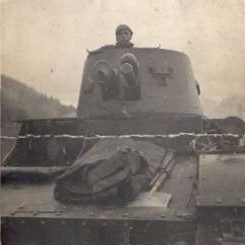
Marian Machocki-Vickers Mark E Type B light tank

The terrain gave a significant advantage to Maczek and his brigade, who were very experienced and skilled in mountain warfare. Not only did they manage to halt German attacks but they launched some counter-attacks as well. However, German forces eventually succeeded in breaking through the front of the Krakow Army, which was positioned just north of the Brigade's position. Maczek and his troops then had to be pulled out of the front line.

The Brigade defended the bridges and fords in Lesser Poland, and eventually reached Lwow where they rendez-voused with the city's defence forces. They merged to form a mobile reserve which fought in the Battle for Lwow, thus allowing other Polish troops to withdraw towards the Romanian Bridgehead. However, their plans were shattered by the unexpected invasion of Poland on September 17, 1939 by Soviet forces from the east.

After only two days of fighting, Edward Rydz-Smigly, Marshal of Poland, ordered the Maczek and his brigade to cross the border into Hungary but they were immediately interned by the Hungarian government and the Brigade was reduced by half. Nevertheless, the Brigade had the great distinction of having been the only Polish unit not to have lost a single battle in 1939.

Amid many other Polish forces, Maczek and his troops made their way to France where they re-assembled the Polish armies. He was promoted to Brigadier-General and given the command of the Polish military camp at Coetquidan. During this time, Maczek presented the French with a report detailing German Blitkrieg tactics, and containing his recommendations for possible evasive maneuvers. However, the French chose to completely disregard the report.

Maczek sought to preserve the integrity of his Brigade by regrouping them into two separate camps, at Paimpont and at Campeneac in order to prevent the possible conscription of them to other infantry divisions. The soldiers of the Polish 10th Armoured Cavalry Brigade were highly-trained, skilled, and ready to fight, yet they received little by the way of equipment and no more than disdain from French Command.

Polish 10th Armoured Cavalry Brigade-organized in France

It wasn't until March of 1940 that the French supplied Maczeks' troops with equipment, albeit obsolete in quality and insufficient in quantity. By May Hitlers' armies invaded France merely by crossing over the Maginot Line. Only then was French Command willing to give Maczek all the equipment that he had asked for, provided that his Brigade enter battle immediately. It was an unreasonable request because the equipment was new and there was no time to train the Polish soldiers to use them properly. Under the circumstances General Maczek chose the best option; he assembled a small force composed of his best soldiers to lead the way, anticipating that the remainder of the troops would follow suit.

On June 6, 1940, Maczek's Brigade was equipped with only one tank battalion, two motorized cavalry squadrons, one anti-tank battery, and one anti-aircraft battery, the sum of which was grossly insufficient to fight against German armoured divisions. The Polish brigade was attached to the French 4th Army positioned near Reims and was given the mission to protect its left flank. The Poles attacked German forces in Champaubert-Montgivroux, but managed to cover only one French infantry division. The Brigade had no choice but to retreat and join the rest of the French troops.

Polish attack Montbard
On the night of June 16th, the Poles launched a surprise attack on the town of Montbard over the Burgundy Canal. The Germans were caught completely unprepared, and many were taken prisoner. However, victory was short-lived. The Polish brigade by that time was fighting alone with no French reinforcements whatsoever (French troops had either been routed or were in retreat). The Polish unit was utterly decimated, completely surrounded and without fuel.

Two days later, Maczek destroyed all the machinery that was unusable, and withdrew with his troops on foot. In order to pass through enemy lines, Maczek split his brigade into smaller groups, and traveled a winding path way all the way through Vichy France, North Africa, and Portugal to Great Britain.

Once on British soil, Maczek reassembled the Polish army to be put into active service. But oddly British Command had different ideas. They were intent on sending Polish troops to defend the Scottish coastline between Aberdeen and Edinburgh and between Montrose and Dundee. The notion was impractical and once Maczek and Sikorski intervened, the British abandoned the plan, finally being convinced of the feasibility of a Polish armoured unit.

After years of training and preparation the 1st Polish Armoured Division was formed in February 1942. They were a strong and viable force to contend with, and equipped with state-of-the-art Churchill and M4 Sherman tanks.


1st Polish Division
By the end of July 1944, they were called to fight in one of the greatest battles of World War II - the Battle of Normandy. On August 8 the Polish Division, attached to 1st Canadian Army, launched Operation Totalize. The mission was to break through German defenses south of Caen, and precipitate the complete collapse of the entire German front. This battle was called the Falaise Gap.

In two consecutive incidences, the Polish unit came under friendly fire by Allied aircraft, but still managed to achieve a brilliant victory against the Nazi's - in the battles for Mont Ormel, Hill 262 and the town of Chambois. The 1st Armoured Polish Division, along with the US 385th infantry battalion, and British and Canadian troops, destroyed approximately 570 enemy tanks and other vehicles, 100 guns, and captured 5,500 Germans. Polish Casualties were about 450 KIA and 100 tanks lost.

Field Marshall Montgomery described the battle. In his words,


"Under Falaise we locked the Germans
like they were in a bottle,
and the Polish Armoured Division
was the cork in this bottle."
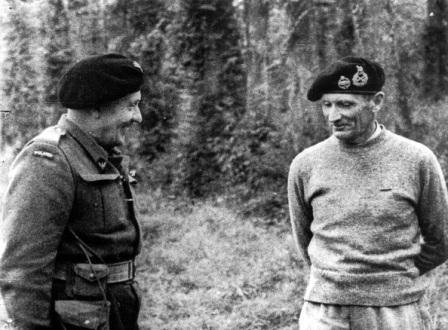

General Maczek and General Montgomery

General Maczek with General Eisenhower


Trapped in the Chambois pocket were 14 German Wehrmacht and SS divisions.  Maczek and his men were given the vital mission of closing the Chambois pocket to prevent the Germans from using it as an escape route, and successfully destroyed enemy positions.

Following this decisive victory, Maczek's Division spearheaded attacks across the battlefields of France, Belgium, the Netherlands, and at last, Germany.  The Polish troops liberated Ypres, Ghent and Passchendale in Belgium.


Maczek led a brilliant outflanking manoeuvre, and after a tough fight, succeeded in freeing the city of Breda. What made it so remarkable is that there were no civilian casualties. (In gratitude, the people of Breda granted General Maczek Dutch citizenship after the war.)

 
Polish troops liberated town of Breda Oct 1944- General Maczek
Polish troops liberated town of Breda Oct 1944

Maczek's moment of glory came when his troops captured the German port of Wilhelmshaven and accepted the surrender of the entire German garrison, including 200 vessels of Hitler's navy, the Kriegsmarine.


Wilhelmshaven German Base


Maczek led the 1st Armoured Division to the very end of the war, and was promoted to Major-General in recognition of his outstanding service and leadership. After Germany had capitulated, Maczek took command of the Polish I Corps, followed by a command of all the Polish forces in the UK until 1947, when they were officially demobilized.

After the war, Maczek opted to remain in Britain like many other Polish officers and soldiers. The communist regime in Poland had stripped him of Polish citizenship and declared him to be persona non grata. But more astounding was the fact that the British government treated Maczek with considerable disdain, claiming that he was not considered an "Allied" soldier, and therefore not eligible for combattant rights and a military pension. Consequently, he had no choice but to work as a bartender until the 1960s at an Edinburg hotel.

In 1989 an official public apology was issued by the Prime Minister Mieczyslaw Rakowski, of the Communist Polish government. Maczek was decorated with Poland's highest medal, the Order of the White Eagle.

Lieutenant General Stanislaw Maczek passed away on December 11, 1994 at the age of 102. In accordance with his wishes, he was laid to rest among the graves of his soldiers at the Polish military cemetery at Breda.


HONOURS AND AWARDS


POLAND


Order of the White Eagle (1994)

Gold Cross of the Order of Virtuti Miltari

Silver Cross of the Order of Virtuti Militari

Knight's Cross of the Order of Virtuti Militari

Commander's Cross of the Order of Polonia Restituta

Grand Cross of the Order of Polonia Restituta

Cross of Valour

Gold Cross of Merit with Swords


THE NETHERLANDS

Commander of the Order of Orange-Nassau


BELGIUM

Grand Officer of the Order of the Crown with Palms

Croix de Guerre avec palmes (Belgium)


FRANCE

Medaille commemorative de la guerre 1939-1944

Commandeur de la Legion d'Honneur

Croix de Guerre avec palmes


UNITED KINGDOM

Commander of the Order of the Bath

Companion of the Order of the Bath (military)

Distinguished Service Order


Dutch Poster Thanking Polish Armies


NEXT


June 6, 2011

D-Day: The Invasion of Normandy: Sights and Sounds

 DAY 6/6/44


D-Day will forever be remembered by the world. It was the greatest - the largest amphibious invasion in the history of mankind. 


On Tuesday, June 6, 1944 at 6:30 British Double Summertime (GMT+2) over 160,000 Allied troops landed on the beaches of Normandy. They were supported by over 5,000 ships manned by more than 195,000 Allied naval and merchant navy personnel and accompanied by 13,000 aircraft. This was Operation Neptune. The first phase was an airborne assault launched shortly after midnight in which over 24,000 British, American, Canadian and Free French troops, which was followed by the amphibious landing beginning at 06:30 hours.

Troops from the United States, United Kingdom, Free France, Canada, Australia, New Zealand, Belgium, Czechoslovakia, Greece, the Netherlands, Norway and, little known to many people, the Polish troops of the 1st Armoured Division, took part in this massive Operation which ultimately freed Fortress Europe from the Nazi scourge.


D-Day Polish Army, Brutus Fortitude operation (00:03:39m)


Eisenhower statement, in case of failure
Just before the start of the invasion, General Eisenhower gave an historic speech to the Allied Expeditionary Force.

His opening words were, "You are about to embark upon the great crusade, toward which we have striven these many months......" 

Despite the enormous magnitude of this Operation, there existed a unspoken yet palpable trepidation that the invasion might not succeed.  For in his pocket, General Eisenhower had prepared a statement to be read in the event that the invasion failed. It was dated July 6 in error.


General Dwight D. Eisenhower's D-Day Speech


George Hicks, London Bureau Chief for the Blue Network (later to become ABC) was aboard the Allied communications ship, the U.S.S. Ancon, and gave an eye-witness radio report of the D Day invasion on the 7th of June, 1944.  Click here to listen


The Invasion was slated to begin on June 5th but bad weather postponed the Operation.  There were only a few days each month suitable to launch an attack, that is, during a full moon and high tide. The illumination of navigational landmarks were vital for the airborne landing divisions, and the latter made it possible for landing craft to maneuver safely and avoid defensive obstacles beneath. There was a full moon on June the 6th however overcast skies limited the field of vision of Allied air support.


Due to bad weather conditions, the Germans had a false sense of security believing that the Allied invasion would be delayed. They had no idea that the invasion was already underway. Though the Allied Expeditionary Force was a formidable presence indeed, its landing troops  faced horrendous fire from the German defenses.

By June 6th, 1944 the German troops were solidly entrenched - 157 divisions in the Soviet Union,  6 in Finland,  12 in Norway,  6 in Denmark, 9 in Germany, 21 in the Balkans, 26 in Italy,  and 59 in France, Belgium and the Netherlands.  However, according to German statistics, their divisions in the east were greatly depleted due to heavy fighting, and by spring 1944 the average personnel was roughly half of its original size.

What made the German defenses so invincible was their interlocking firing style, a tactic which permitted them to protect areas that were under heavy fire. Moreover, the Germans had, during the past four years, constructed impenetrable concrete bunkers, atop the cliffs and hills from which their machine gunners had clear views of the beaches.


German tobrouk manning MG-42 machine guns.
Rommel, assigned to command the Normandy coast, fortified German positions along the Atlantic Wall with tank top turrets, laid hundreds of thousands of mines along the littoral, and flooded the meadows to impede the Allied advance.  German power was indeed a force to contend with. Between Barfleur and Le Havre, the Germans had at least six coastal artillery batteries: located at Merville, Long-sur-Mer, Pointe du Hoc, Maisy, Azeville, and Crisbecq. From these positions, German gunners were able to fire at a range of 30 kilometers.


50mm German gun near Merville battery
The Atlantic Wall, as outlined in the map above, was a virtual German fortress comprising of a web of radar tracking stations, many of them defended with 88 mm anti-aircraft guns.  From the Norwegian coast all the way to Spain, the Germans not only had radar stations but also "listening" stations: between Cherbourg, Vire and Le Havre, there were 1 identification radar, 2 "Freya" type radars, 5 long-range coastal radars,  7 mid-range radars,  and 14 "Wurzburg" giant radars.


German sentinel watching the horizon
The Germans knew of the impeding invasion though not the exact time - nor place.  Nevertheless, German armoured and infantry divisions were dug in and waiting. German Command believed that the Invasion would begin at the Pas-de Calais area - the shortest route from the British mainland. This belief was due entirely to Operation Fortitude, Churchill's ingenious plan by which the Allied forces staged fake military activity in the south-east England, using inflatable tanks and wooden guns and warships as props. From the perspective of German reconnaissance aircraft, they looked quite real. In addition to this, Allied intelligence fed misinformation to the enemy that the Allied units were under the command of the feared General Patton. The Germans fell for it. 


It was vital to the success of the Allied invasion that the Germans believed that the invasion would begin at Pas-de-Calais, the consequence of which was to delay the full brunt of their military presence on the Normandy beachhead.


Under the command of Admiral Sir Bertram Ramsay of the Allied Naval Expeditionary Force, the Allied armada comprised of warships from eight different navies including that of Poland. In all there were 6,939 vessels: 1,213 warships,  4,126 transport vessels, 736 ancillary craft and 864 merchant vessels.  The flotilla was divided into two task forces:  Western, under the command of Rear-Admiral Alan G. Kirk, and Eastern, under the command of Rear-Admiral Sir Philip Vian.

Leo Pikulski was part of the Polish contingent which fought on the Normandy Beaches, together with the First Canadian Corps and at the Battle of Falaise.


HMS X-24
In Operation Gambit, British X class submarines (midget submarines) HMS X20 and HMS X23 were already in position on June 4th, 1944.  Their mission was to provide navigational aids to incoming Allied troops: an 18-foot telescopic mast with a light shining to seaward, a radio beacon and echo sounder tapping out a message for the minelayers approaching 'Sword' and 'Juno' beaches.

The main thrust of Operation Neptune was to ensure the isolation of invasion routes and beaches from any intervention by the Kriegsmarine, the Germany Navy. According to the Royal Navy Home Fleet, the threat was two-fold: a surface attack by German vessels coming from Scandinavian ports and the Baltic Sea and that of U-boats transferred from the Atlantic. However, German warships were seriously damaged and fuel supplies cut by a third. As for the latter, few U-boats were spotted by the RAF air surveillance. In any event, the Royal Navy was fully capable of repelling any enemy attack, and had mined the Kiel Canal area while the RAF maintained a cordon well west of Land's end.

The HMS Ramillies and Warspite and the monitor HMS Roberts were old battleships used to suppress shore batteries located east of the Orne; cruisers targeted shore batteries at Ver-sur-Mer and Moulineaux; eleven destroyers provided local fire support.  In addition, there were modified landing-craft: 8 "Landing Craft Gun", each having two 4.7-inch guns; 4 "Landing Craft Support" with automatic cannon; 8 Landing Craft Tank, each with a single salvo of 1,100 5-inch rockets; 8 Landing Craft Assault (Hedgerow), each with twenty-four bombs intended to detonate beach mines prematurely. Twenty-four Landing Craft Tank carried "Priest" self-propelled howitzers which also fired while they were on the run-in to the beach.  The Allies had similar arrangements at other beaches.

During D Day there was minimal naval contact - four German torpedo boats launching eighteen torpedoes sank the Norwegian destroyer Svenner off the coast of Sword beach but missed the battleships HMS Warspite and HMS Ramillies. Immediately after having fired, the enemy vessels veered away and escaped into a smoke screen. A great debt of gratitude goes to ULTRA, whose intelligence work discovered the location of German channels through their own minefields, and thus the Allies were able to limit their losses. Unfortunately,the USS Corry sank off the coast of Utah, as well as the USS PC-1261, a 173-foot patrol craft; three LCTs and two LCIs.)

The mission of Naval operations was to provide cover for transport vessels from the threat of enemy ships, submarines and aircraft. More importantly, their purpose was to support Allied landings by launching continuous bombardment of enemy positions ashore, to suppress shore defenses as well as to break up enemy concentrations as the troops began to move inland.


Normandy veteran remembers D-Day invasion (00:06:45m)

The amphibious landings were particularly vulnerable to very strong German counterattacks and depended on the establishment of a secure lodgement in order to expand the beachhead and build up a sufficient force capable of breaking out.  During this most critical period, Allied bombers were the key to slowing down the German's ability to prepare and launch counterattacks. Their main targets were bridges, roads and the eastern and western flanks of landing areas. The U.S. 82nd and 101st Airborne Divisions were assigned to objectives west of Utah Beach while the British 6th Airborne Division were assigned to similar objectives on the eastern flank; and 530 Free French paratroopers from the British Special Air Service Brigade were assigned to objectives in Brittany (from 5 June to August.)

East of the landing area, the open, flat, floodplain between the Orne and Dives Rivers was an ideal position from which the Germans could launch counterattacks.  However, the landing area and floodplain were separated by the Orne River, which flowed northeast from Caen into the bay of the Seine and the only crossing of the Orne River north of Caen was 7 kilometres (4.5 mi) from the coast, near Bénouville and Ranville. The crossing was vital to the Germans as well as to the Allies:  to the Germans, it provided the only route for a flanking attack on the beaches from the east, and to the Allies, the crossing was vital for any attack on Caen from the east.

The tactical objectives of the British 6th Airborne Division were to capture intact the bridges of the Bénouville-Ranville crossing, defend the crossing against the inevitable armoured counter-attacks,  destroy German artillery at the Merville battery which threatened Sword Beach, and destroy five bridges over the Dives River to further restrict movement of ground forces from the east.

Shortly after midnight on June 6, 1944,  paratroopers of the 3rd and 5th Parachute Brigades, including the 1st Canadian Parachute Battalion, began landing and immediately encountered elements of the German 716th Infantry Division.  At dawn the Battle Group von Luck of the 21st Panzer Division counterattacked from the south on both sides of the Orne River. By this time the paratroopers had established a defensive perimeter surrounding the bridgehead. Casualties were heavy on both sides but the airborne troops held. By afternoon, they were received reinforcements of commandos of the 1st Special Service Brigade.


By the end of D-Day, 6th Airborne had accomplished each of its objectives. For several days, both British and German forces took heavy casualties as they struggled for positions around the Orne bridgehead.  On June 10th, the German 346th Infantry Division succeeded in breaking through the eastern edge of the defensive line but finally, British paratroopers were able to overwhelm the panzergrenadiers (Battle of Bréville on 12 June). The Germans did not post a threat to the bridgehead again and the 6th Airborne remained on the line until it was evacuated in early September.

Over 13,000 American paratroopers of the U.S. 82nd and 101st Airborne Divisions landed from 12 troop carrier groups of the IX Troop Carrier Command.  These courageous men were less fortunate in completing their mission.  In order to maintain the element of surprise, the drops were planned to approach Normandy from the west however various factors affected their plans. That the drop was to commence under the cover of night, was itself a serious impediment, and a tactic not used again during the war.  The result was that about 45 % of the units were scattered over a wide area and unable to rally.  Moreover, landing zones were not effectively marked by the early pathfinder teams, and the most serious impediment was the unreliability of the Rebecca/Eureka transponding radar beacons to guide in the C-47 Skytrains.


America the Story of the US:  D-Day Invasion (00:03:07)


Between the hours of 00:48 and 01:40 three regiments of 101st Airborne paratroopers were the first to be air dropped, quickly followed by the 82nd Airborne's drops between 01:51 and 02:42.  Each operation was a massive undertaking requiring about 400 C-47 aircraft.  Just before dawn, two glider landings brought in anti-tank guns and support troops for each division. By the evening on D-Day, two additional glider landings brought in two battalions of artillery and 24 howitzers to the 82nd Airborne. Additional glider operations on 7 June delivered the 325th Glider Infantry Regiment to the 82nd Airborne, and two large supply parachute drops that date were ineffective. After 24 hours, only 2,500 troops (a third)of the 101st and 2,000 of the 82nd were under the control of their divisions. The dispersal of the American airborne troops, however, had the effect of confusing the Germans and fragmenting their response. Moreover, the defensive flooding created by German units, at least in the early stages, posed an advantage to American troops, protecting their southern flank. For the next several days paratroopers continued to roam and fight behind enemy lines, many of them consolidated into small groups. Many of them rallied with NCOs or junior officers, and comprised a mix of soldiers from different companies, battalions, regiments, and even divisions. 

The first town to be liberated during the invasion was Sainte-Mère-Église in the early morning hours of June 6th, 1944, by the troops of the 82nd Division. The Allied troops stormed the beaches of Normandy at  Sword -  Juno - Gold -  Omaha - Utah.   Of 73,000 Americans who landed, 23,250 were on Utah beach; 34,250 on Omaha; and 15,500 were airborne units. British (61,715) and Canadian (21,400) troops landed - more precisely, 24,970 on Gold beach, 21,400 on Juno, 28,845 on Sword, and 7,900 airborne troops.  On D Day, Allied aircraft flew 14,674 sorties, and lost 127 planes. 

During the airborne landings on D Day, 2,395 aircraft and 867 gliders were used by the RAF and USAAF.  Of the thousands of Allied Vessels in operation on June 6th, included 1,213 naval combat ships, 4,126 landing ships and craft, 736 ancillary craft and 864 merchant vessels.  Of the 195,700 personnel assigned to Operation Neptune, 52,889 were American, 112,824 were British and the remaining 4,988 from other Allied countries (including Poland). By the end of June 11th (that is D + 5), about 326,547 troops, 54,186 vehicles and 104,428 tons of supplies had landed on the beaches of Normandy. Casualties were very heavy except for Sword where in comparison, British infantry suffered light casualties and at Utah where 197 men were killed of a total of 23,000 troops that landed there.  By a twist of fate, the 4th Infantry Division had landed at the wrong place at Victor Sector instead of Tare Green and Uncle Red Sectors. Those soldiers met with minimal German opposition and by afternoon they were able to rendezvous with the 101st Airborne and advance inland quickly.  

By the days end about 10,000 Allied troops were killed or wounded in action.  Total German casualties on D-Day are not known but have been estimated between 4,000 and 9,000 men. During the Battle of Normandy,  the Allies suffered 209,000 casualties with about 37,000 ground forces killed, and another 16,714 killed from Allied air forces. Of these casualties, 83,045 were from the 21st Army Group comprising British, Canadian and Polish ground forces) and 125,847 from US ground forces.  The Allies captured 200,000 prisoners of war.  Allied naval losses for June 1944 included 24 warships and 35 merchantmen or auxiliaries sunk and an additional 120 vessels damaged. German casualties on D-Day are not known but have been estimated between 4,000 and 9,000 men.  Roughly 200,000 German troops were killed or wounded during the Battle of Normandy.  The fighting around the Falaise Pocket in August 1944, resulted in German casualties of approximately 90,000 including prisoners. There are 27 war cemeteries which hold the remains of over 110,000 remains of soldiers who fought during the Battle of Normandy:  77,866 German,  9,386 American, 17,769 British, 5,002 Canadians and 650 Poles.


 Winston S.Churchill - We Shall Fight on the Beaches (00:02:25m)


VISIT ALSO
 REMEMBRANCE: D DAY


Sources:  Wikipedia The Memory Project: Stories of the Second World War (Leo Pikulski) BBC History - Voices of D Day The US National Archives and Records Administration (Eisenhower Statement) Radio News The D-Day and Normandy Fellowship (D Day Memories) Preparations of the Normandy Landing - Operation Fortitude D-Day Museum Atlantic Wall in Normandy Internet Archive - Old Time Radio  


Suggested Links: The Battle of Normandy: Minute by Minute X Class Submarine Eye-witness memories of World War II (D Day Normandy and beyond) Polish hero honoured 66 years later Invasion of Normandy A Civilian's View Naval History and Heritage Command(USA)  Rundstedt report on Allied Invasion of Normandy


 Special Mention: The National D Day Memorial in Bedford, Virginia