Showing posts with label Blitzkrieg. Show all posts

March 29, 2012

GREAT POLISH GENERALS OF WW2: Stanislaw Wladyslaw Maczek

General Stanislaw Maczek "Baca"

"Baca" (Shepherd)

Each year the people of Breda in The Netherlands celebrate Liberation Day. It is a solemn event to commemorate the fallen soldiers who sacrificed their lives to liberate them from Nazi occupation in World War II. Among the heroes were also Polish soldiers who served under General Stanislaw Wladyslaw Maczek in the 1st Polish Armoured Division. At the center of the city stands a monument and a museum dedicated to the memory of General Maczek and his men.

General Maczek was one of the most successful Polish commanders of World War II, and greatly respected by Allied Command, as well as by enemy rank and file. Maczek was referred to by his men as "Baca", a Galician name, which translated means "Shepherd". For Maczek the only thing that surpassed his determination to win the war was his great concern for his troops. The feeling was mutual. There was no greater tribute to a General than this.

Stanislaw Maczek was born in Lwow (Lviv) on March 31, 1892. The famous Polish city is now part of the Ukraine, but was then in Austro-Hungarian Galicia. Maczek's roots stem from Croatian extraction, though distant. His cousin was a Croatian politician by the name of Vladko Macek.

Stanislaw Maczek had been attending Lwow University, majoring in Polish Philology but had to interrupt his studies when World War I broke out. He intended to enlist in the Polish Legions and serve under the command of Marshal Jozef Pilsudski, but he was instead drafted into the Austro-Hungarian army. After undergoing a brief period of officer training, he was sent to the Italian Front as NCO of the Tyrolean Regiment of the K.u.K. (kaiserlich und koniglich, which means "Imperial and Royal"). He was promoted twice, first to Second Lieutenant, and by the end of the war, to Lieutenant. Maczek was the only Polish battalion commander in the Austro-Hungarian alpine division - a testament of the degree of his caliber and distinction.

November 11, 1918 marked the end of the World War I, and the re-emergence of Poland as a nation after 123 years of oblivion. Maczek immediately traveled to Krosno (near the southern tip of Poland) where he joined the new Polish army. He was appointed commander of a battalion and launched an offensive against troops of the West Ukrainian People's Republic for control over the city of Lwow. The battle lasted from November 1st, 1918 until May 22, 1919 and escalated into the Polish-Ukrainian War. It end with a Polish victory.


Polish Supreme Command defending Lwow 1918

In spring of 1919 Maczek was given a new commission as commander of the 4th Infantry Division of Lotna Kompania, a unit which he created and organized, modeled after the elite German Sturmbataillone of World War I. Maczek's division was almost completely motorized and armed with heavy machine guns and composed of battle-hardened troops from the Krosno battalion - men whose combat experience exceeded that of other Polish soldiers at the time. They functioned in the capacity of "firefighters" by reinforcing weak spots in the defensive lines, but earned their distinction from winning fierce battles for the cities of Drohobycz, Stanislawow, Buczacz and the capital city, Stryj (now in the Ukraine).

When fighting ended, Maczek had been promoted to rank of major with seniority and assigned to the post of staff officer in the Polish 2nd Army under General Iwazkiewicz' command however the position was ill-suited to his temperament and exceptional abilities. After numerous requests to his superiors, he was finally given a command of a front-line unit. The timing was ill-fated. The Polish-Soviet War had already begun resulting in the defeat of the 2nd Polish Army by Semyon Budyonny's Soviet 1st Cavalry army.

On the heels of this defeat, Maczek immediately formed another battalion composed of new recruits, and despite the lack of sufficient training, led his troops to the front as "firefighters" wherever they were needed. They served as rearguard for the Polish troops at Mosty Wielkie, then joined the 1st Cavalry Division under the command of Polish General Juliusz Rommel, participated in attacks on the city of Warez, conducted a counter-assault on the rear of advancing Cossacks, and ultimately won the Battle of Komarow. (The latter was one of the biggest cavalry battles of the Polish-Soviet war since 1813.) With the signing of the Treaty of Riga, hostilities came to an end. Though Maczek's battalion was disbanded shortly thereafter, it had been officially named after him.


Emblem 10th Motorized Cavalry Br.
During the interwar period Maczek opted out of university studies and chose to pursue his career in the military. Between 1921 and 1938, he had served as commander over several different divisions, studied at the Higher Military School in Warsaw, and was rapidly promoted thereafter to the rank of Lieutenant-Colonel, and then to Colonel.

Just a year before World War II broke out, Maczek was given the command of Poland's first fully-motorized army, the 10th Motorized Cavalry Brigade, nicknamed the "Black Brigade". In September 1939 his Brigade was attached to the Krakow Army and fought in defense of the voivodeships of Lesser Poland and Silesia. From the very first day of war, his troops went into battle equipped with only light tanks, tankettes and only one artillery battery of only eight heavy cannon.

  
Polish Officers with General Maczek - "Black Brigade" 1939


Maczek's Polish 10th Motorized Brigade - TKS Tankettes 1939


The Battle of Jordanow took place on the second day when Maczek's troops faced the entire German XVII Corps of General Eugen Beyer and succeeded in shielding the southern flank of Polish armed forces along the Beskides (mountain ranges). Maczek's brigade, supported by just a few battalions of Border Guards and troops of National Defence managed to face down three German Panzer Divisions: the 4th Light Division under the command of General Alfred Ritter Von Hubicki, the 2nd Panzer Division under the command of General Rudolf Veiel; and the 3rd Mountain Division under the command of General Eduard Dietl.

Despite the overwhelming power of the Nazi Blitzkrieg, Maczek's Brigade fought against them for five days and succeeded in slowing down the German advance until it came to a virtual crawl. The Germans could not even manage to exceed ten kilometers distance per day, even with their superior numbers and war materiel.
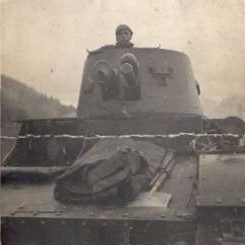
Marian Machocki-Vickers Mark E Type B light tank

The terrain gave a significant advantage to Maczek and his brigade, who were very experienced and skilled in mountain warfare. Not only did they manage to halt German attacks but they launched some counter-attacks as well. However, German forces eventually succeeded in breaking through the front of the Krakow Army, which was positioned just north of the Brigade's position. Maczek and his troops then had to be pulled out of the front line.

The Brigade defended the bridges and fords in Lesser Poland, and eventually reached Lwow where they rendez-voused with the city's defence forces. They merged to form a mobile reserve which fought in the Battle for Lwow, thus allowing other Polish troops to withdraw towards the Romanian Bridgehead. However, their plans were shattered by the unexpected invasion of Poland on September 17, 1939 by Soviet forces from the east.

After only two days of fighting, Edward Rydz-Smigly, Marshal of Poland, ordered the Maczek and his brigade to cross the border into Hungary but they were immediately interned by the Hungarian government and the Brigade was reduced by half. Nevertheless, the Brigade had the great distinction of having been the only Polish unit not to have lost a single battle in 1939.

Amid many other Polish forces, Maczek and his troops made their way to France where they re-assembled the Polish armies. He was promoted to Brigadier-General and given the command of the Polish military camp at Coetquidan. During this time, Maczek presented the French with a report detailing German Blitkrieg tactics, and containing his recommendations for possible evasive maneuvers. However, the French chose to completely disregard the report.

Maczek sought to preserve the integrity of his Brigade by regrouping them into two separate camps, at Paimpont and at Campeneac in order to prevent the possible conscription of them to other infantry divisions. The soldiers of the Polish 10th Armoured Cavalry Brigade were highly-trained, skilled, and ready to fight, yet they received little by the way of equipment and no more than disdain from French Command.

Polish 10th Armoured Cavalry Brigade-organized in France

It wasn't until March of 1940 that the French supplied Maczeks' troops with equipment, albeit obsolete in quality and insufficient in quantity. By May Hitlers' armies invaded France merely by crossing over the Maginot Line. Only then was French Command willing to give Maczek all the equipment that he had asked for, provided that his Brigade enter battle immediately. It was an unreasonable request because the equipment was new and there was no time to train the Polish soldiers to use them properly. Under the circumstances General Maczek chose the best option; he assembled a small force composed of his best soldiers to lead the way, anticipating that the remainder of the troops would follow suit.

On June 6, 1940, Maczek's Brigade was equipped with only one tank battalion, two motorized cavalry squadrons, one anti-tank battery, and one anti-aircraft battery, the sum of which was grossly insufficient to fight against German armoured divisions. The Polish brigade was attached to the French 4th Army positioned near Reims and was given the mission to protect its left flank. The Poles attacked German forces in Champaubert-Montgivroux, but managed to cover only one French infantry division. The Brigade had no choice but to retreat and join the rest of the French troops.

Polish attack Montbard
On the night of June 16th, the Poles launched a surprise attack on the town of Montbard over the Burgundy Canal. The Germans were caught completely unprepared, and many were taken prisoner. However, victory was short-lived. The Polish brigade by that time was fighting alone with no French reinforcements whatsoever (French troops had either been routed or were in retreat). The Polish unit was utterly decimated, completely surrounded and without fuel.

Two days later, Maczek destroyed all the machinery that was unusable, and withdrew with his troops on foot. In order to pass through enemy lines, Maczek split his brigade into smaller groups, and traveled a winding path way all the way through Vichy France, North Africa, and Portugal to Great Britain.

Once on British soil, Maczek reassembled the Polish army to be put into active service. But oddly British Command had different ideas. They were intent on sending Polish troops to defend the Scottish coastline between Aberdeen and Edinburgh and between Montrose and Dundee. The notion was impractical and once Maczek and Sikorski intervened, the British abandoned the plan, finally being convinced of the feasibility of a Polish armoured unit.

After years of training and preparation the 1st Polish Armoured Division was formed in February 1942. They were a strong and viable force to contend with, and equipped with state-of-the-art Churchill and M4 Sherman tanks.


1st Polish Division
By the end of July 1944, they were called to fight in one of the greatest battles of World War II - the Battle of Normandy. On August 8 the Polish Division, attached to 1st Canadian Army, launched Operation Totalize. The mission was to break through German defenses south of Caen, and precipitate the complete collapse of the entire German front. This battle was called the Falaise Gap.

In two consecutive incidences, the Polish unit came under friendly fire by Allied aircraft, but still managed to achieve a brilliant victory against the Nazi's - in the battles for Mont Ormel, Hill 262 and the town of Chambois. The 1st Armoured Polish Division, along with the US 385th infantry battalion, and British and Canadian troops, destroyed approximately 570 enemy tanks and other vehicles, 100 guns, and captured 5,500 Germans. Polish Casualties were about 450 KIA and 100 tanks lost.

Field Marshall Montgomery described the battle. In his words,


"Under Falaise we locked the Germans
like they were in a bottle,
and the Polish Armoured Division
was the cork in this bottle."
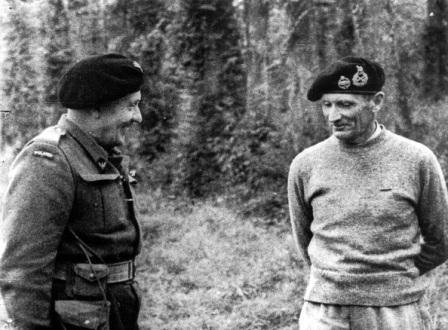

General Maczek and General Montgomery

General Maczek with General Eisenhower


Trapped in the Chambois pocket were 14 German Wehrmacht and SS divisions.  Maczek and his men were given the vital mission of closing the Chambois pocket to prevent the Germans from using it as an escape route, and successfully destroyed enemy positions.

Following this decisive victory, Maczek's Division spearheaded attacks across the battlefields of France, Belgium, the Netherlands, and at last, Germany.  The Polish troops liberated Ypres, Ghent and Passchendale in Belgium.


Maczek led a brilliant outflanking manoeuvre, and after a tough fight, succeeded in freeing the city of Breda. What made it so remarkable is that there were no civilian casualties. (In gratitude, the people of Breda granted General Maczek Dutch citizenship after the war.)

 
Polish troops liberated town of Breda Oct 1944- General Maczek
Polish troops liberated town of Breda Oct 1944

Maczek's moment of glory came when his troops captured the German port of Wilhelmshaven and accepted the surrender of the entire German garrison, including 200 vessels of Hitler's navy, the Kriegsmarine.


Wilhelmshaven German Base


Maczek led the 1st Armoured Division to the very end of the war, and was promoted to Major-General in recognition of his outstanding service and leadership. After Germany had capitulated, Maczek took command of the Polish I Corps, followed by a command of all the Polish forces in the UK until 1947, when they were officially demobilized.

After the war, Maczek opted to remain in Britain like many other Polish officers and soldiers. The communist regime in Poland had stripped him of Polish citizenship and declared him to be persona non grata. But more astounding was the fact that the British government treated Maczek with considerable disdain, claiming that he was not considered an "Allied" soldier, and therefore not eligible for combattant rights and a military pension. Consequently, he had no choice but to work as a bartender until the 1960s at an Edinburg hotel.

In 1989 an official public apology was issued by the Prime Minister Mieczyslaw Rakowski, of the Communist Polish government. Maczek was decorated with Poland's highest medal, the Order of the White Eagle.

Lieutenant General Stanislaw Maczek passed away on December 11, 1994 at the age of 102. In accordance with his wishes, he was laid to rest among the graves of his soldiers at the Polish military cemetery at Breda.


HONOURS AND AWARDS


POLAND


Order of the White Eagle (1994)

Gold Cross of the Order of Virtuti Miltari

Silver Cross of the Order of Virtuti Militari

Knight's Cross of the Order of Virtuti Militari

Commander's Cross of the Order of Polonia Restituta

Grand Cross of the Order of Polonia Restituta

Cross of Valour

Gold Cross of Merit with Swords


THE NETHERLANDS

Commander of the Order of Orange-Nassau


BELGIUM

Grand Officer of the Order of the Crown with Palms

Croix de Guerre avec palmes (Belgium)


FRANCE

Medaille commemorative de la guerre 1939-1944

Commandeur de la Legion d'Honneur

Croix de Guerre avec palmes


UNITED KINGDOM

Commander of the Order of the Bath

Companion of the Order of the Bath (military)

Distinguished Service Order


Dutch Poster Thanking Polish Armies


NEXT


March 27, 2012

GREAT POLISH GENERALS OF WW2: Wladyslaw Sikorski

General Wladyslaw Sikorski

"When the sun is higher, Sikorski is nearer."

Wladyslaw Sikorski was the personification of the hopes
of the Polish people for a free and independent Poland.
The struggle for Poland's liberation had been a very long and arduous one. At the end of WWI Poland finally
regained its independence after having been virtually erased from the map for 123 years. 

Sikorski had been at the forefront of the struggle. With an educational background in engineering and military tactics he became actively involved in a number of Polish underground organizations; in 1907 Sikorski joined the underground Polish Socialist Party; in 1908 he organized the secret Zwiazek Walki Czynnej ( Combat Association) and two years later, the Zwiazek Strzelecki (Rifleman's Association). The objective was to instigate an uprising against the Russian empire, one of the partitioners.  The creation of the latter association while approved by a statute of the Austrian authorities, were Polish paramilitary troops, formed illegally.  At the outbreak of WWI, there were over 8,000 "members" dispersed among 200 groups. Many of them joined the Polish Legions. During WWI Sikorski was the chief head of the military section of the Supreme National Committee and then as commissioner he was responsible for recruitment to the Polish Legions in Krakow, the latter organization created by Jozef Pilsudski.

ZwiÄ…zek StrzeleckiRifleman's Association

No sooner had WWI come to an end that the Polish-Soviet war (1919-21) broke out over the tenuous question of Poland's newly established borders. By that time Sikorski had become a high-ranking officer of the Polish army, and had led successful battles capturing the ancient city of Lwow, and Przyemsyl.  The Soviet forces were confident of achieving an easy victory but were very surprised by the
unexpected.  In what has been termed "Miracle at the Vistula", Polish forces under Sikorski's command succeeded in utterly defeating the Bolshevik advance towards Warsaw, giving Pilsudski the time needed to organize a counter-offensive.

Polish Soldiers displaying captured Soviet banners
Aftermath of Battle of Warsaw - Soviet-Polish War

Sikorskis' forces successfully penetrated deep into Latvia and Belarus, heaping further humiliation upon the defeated Russians. General Sikorski was hailed as the beloved hero of Poland and was decorated with Poland's highest honour, the Virtuti Militari Medal.

During the inter-war period Sikorski had succeeded Pilsudski as the Commander-in-Chief of the Polish Armed Forces (April 1921), and also became Chief of the Polish General Staff. For the next several years he rose to very high government ranks. From December 1922 to May 26, 1923 he served as Poland's Prime Minister as well as Minister of Internal Affairs.

Charles de Gaulle WW I
During this period Sikorski garnered immense respect from and support of the Polish people. He established various reforms, and built a viable foreign policy that received international approval through the League of Nations. Moreover, the United Kingdom, France, and the United States all recognized the legitimacy of Poland's new frontiers, won during the Russian-Polish war.

Sikorski had made significant strides in strengthening Polish-French cooperation. It was instrumental in laying the foundations that led to Poland's victory during the Polish Soviet War.  The French Military Mission to Poland provided the military organization and logistical assistance vital to the nascent Polish armies. Among the French officers involved in the mission was the future General Charles de Gaulle. 


Polish Badge KOP
From 1923-24 Sikorski held the position of Chief Inspector of Infantry. And the following year, under Prime Minister Wladyslaw Grabski, Sikorski served as Minister of Military Affairs, guiding the modernization of the Polish military.   He created the Border Protection Corps (Korpus Ochrony Pogranicza) a military formation to defend Polands' eastern borders from attacks of Soviet armies. From 1925-1928 Sikorski became Commander of the Military Corp District VI in Lwow, a city of great historical importance imbued with a rich Polish and Jewish cultural heritage.


Polish soldiers KOP
Despite these contributions, Sikorski was dismissed from public service in 1928 by Pilsudski and was
transferred to the Reserves; (Sikorski had joined the anti-Pilsudski movement and opposed the semi-dictatorial regime of the Sanacja.) For the next few years Sikorski had withdrawn from politics altogether and spent his time in Paris working with officials of the Ecole Superieure de Guerre and writing numerous books and articles about the scale of future warfare. Sikorski was a visionary and a pioneer of the theory of the "blitzkrieg". His publications were carefully scrutinized by several countries, in particular by Soviet Russia.

Nazi Blitzkrieg Sept 1, 1939
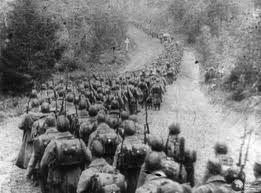
Soviet infantry invading Poland Sept 17, 1939
The rapid militarization by the Nazi Wehrmacht were to bring these theories to fruition. On 1st September 1939 Germany invaded Poland in a "lightning war" overrunning her armies with overwhelming numbers and fire power.  Seventeen days later Soviet armies invaded Poland from the east -  the culmination of a secret pact by Hitler and Stalin to partition Poland and destroy the very foundations of her existence. To the world it appeared that Poland had collapsed.  But Poland was not yet lost. 


Wladylsaw Sikorski had returned to Poland in 1938 ready to be of service however he was refused a military command by then Commander-in-Chief, Marshal Edward Rydz-Smigly (successor to Pilsudski). Thousands of Polish armed forces had escaped the German onslaught. By the end of the month, Sikorski too had evacuated Poland escaping through a perilous route from Romania to Paris.  Sikorski was at once officially installed as the Prime Minister-in-exile and Commander-in-Chief of the Polish forces, joining President-in-exile Wladyslaw Raczkiewicz, and Stanislaw Mikolajczyk.


Despite the fall of Poland, Sikorski was recognized by the West as the legitimate head of the Polish government-in-exile. Through his strong leadership he was instrumental in maintaining the cohesion of the Polish government and Armed Forces, and distinguished himself as Poland's most ardent and outspoken advocate.

But Poland was not without its armies. Though thousands of Polish armed forces had evacuated Poland, they remobilized on French soil. The Polish Highland Brigade was created and immediately deployed to defend French borders. Meanwhile the Polish Air Force was being equipped with 86 aircraft among four squadrons (amid highly questionable logistics controlled by the French authorities); and the Polish Independent Carpathian Brigade was formed in French-mandated Syria. In all there were roughly 80,000 Polish troops in France ready to fight. At the time Poland was the third largest ally.


But with the Fall of France, Polish forces evacuated once again - this time to England. On June 19, 1940 Prime Minister Sikorski met with Winston Churchill, and pledged to provide Polish forces to fight alongside those of Britain. By August, Sikorski and Churchill signed the Polish-British Military Agreement calling for the creation, and training of the Polish Armed Forces.  Most renowned were the Polish pilots who fought in the Battle of Britain the summer of 1940, and whose pilots scored the highest ratio of kills. Most famous was the 303 squadron (the Kosciuszko squadron).  At this juncture, Poland became the second largest ally, with troops stationed in Great Britain and the Middle East.

General Sikorski and Churchill inspecting Polish Troops in Scotland


When Germany invaded the Soviet Union in June 1941 in Operation Barbarossa, the dynamics of the war changed significantly. Churchill had been hoping for just such an outcome to curry favor with the Soviets, an ally upon whom the British relied to win the war against the Nazi scourge. It also presented ominous changes to Poland's relationship with Britain, and especially that with Russia. It came as no surprise to Sikorski. He was a pragmatic strategist and knew what the outcome meant. Seeing no other alternative he succumbed to pressure from the British Foreign Office and opened negotiations with the Russians.


In July 1941 General Sikorski and Ivan Maisky agreed to re-establish diplomatic relations between Poland and Russia and by mid-August, the Sikorsky-Maisky Pact was officially signed.  The Soviets abrogated the Molotov-Ribbentrop Pact of August of 1939 as null and void, and agreed to the release of tens of thousands of Polish prisoners of war on the basis of an "amnesty" , a condition which was an absurdity considering that Soviets were the aggressors. (The evacuation was fraught with numerous obstacles and took place under the most arduous conditions. Thousands of Poles perished. Those who survived and made it to the Middle East were eventually formed into the 2nd Polish Corps under the command of General Wladyslaw Anders.)

Signing of Sikorski-Maisky Agreement July 1941

Amid the huge numbers of incoming Polish refugees, there was a conspicuous void.  Many thousands of Polish officers never showed up, and their absence could not yet be explained.  Sikorski was relentless in his attempt to resolve the mystery, but no avail. Stalin provided only flimsy excuses. He assured Sikorski and Anders that all the Polish soldiers had been released but that the Soviets may have "lost track" of some of them in Manchuria.


L-R General Anders, General Sikorski, Stalin, Kujbyszewie

The horrifying truth was discovered in April 1943 when Nazi German forces found the mass graves in Katyn Forest, twelve miles west of Smolensk, Russia.  Thousands upon thousands of bodies had been exhumed and examined. They were the remains of the Polish Officers who had disappeared and who had been executed by the Soviet NKVD in 1940, upon Stalin's order.

Russian-Polish relations had always been fragile, but now had reached the breaking point. On April 16, General Sikorski fervently demanded an investigation by the International Red Cross. Ten days later Stalin broke off diplomatic ties with Poland, and in a futile attempt to create a smoke screen, accused the Polish government-in-exile of cooperating with Nazi Germany. (Russian governments have since refused to admit Stalin's culpability for the massacre, that is, until the 1990s).

Exhumed bodies of Polish Officers massacred at Katyn Forest, Russia

Another very contentious issue between Russia and Poland dealt with the subject of Polands eastern border. Stalin had long intended that the border be draw along the Curzon Line, which would sever one third of Poland's vast territory.  Sikorski fiercely argued in defense of maintaining Poland's pre-war borders and refused to yield to any pressures. But in the end Poland was betrayed by its closest allies - Great Britain and the United States,  both of whom gave Stalin whatever he wanted in exchange for his alliance. (Read about Yalta Conference)
Crash of Sikorski's Liberator July 4, 1943

On July 4, 1943 the Liberator plane carrying Sikorski and several other passengers plunged into the sea sixteen
seconds after takeoff from Gibraltar. All the passengers except for the pilot were killed. The cause of the crash was attributed to "engine trouble".  However, a Soviet conspiracy has never been ruled out. 


In fact, there were several incidences prior to the fatal crash, in which Sikorski's plane had been tampered with  Sikorski was very outspoken and a threat to the new Anglo-American-Soviet alliance, all the more reason for Stalin to want Sikorski out of the way.  His death marked a turning point not only for Polish-Anglo relations, but the future of the Polish nation and its people.  Sikorski's successor, Stanislaw Mikolajcyzak was considered "persona non grata" and possessed none of the influence nor diplomacy that Sikorski wielded so successfully.  To Churchill and Roosevelt, handing Poland over to Stalin became as easy as childs play.

Sikorski's death came as a terrible blow to a nation which hoped and prayed for freedom and independence. Poland's national newspaper, Biuletyn Informacyjny published the news to a grief-stricken country and set July 15, 1943 as a national day of mourning.

The memory of Sikorski is still very much alive in the soul of the Polish people. Since Sikorski's tragic death, statues and monuments of him have been erected throughout the world to preserve his memory.  Among the many centres and institutes there is also:  the Sikorski Institute, in London, England; a memorial plaque at Gibraltar dedicated to Sikorski; a statue of Sikorski on Portland Place in London, a stone monument on the grounds of Place Polonaise, in Toronto, Canada, and a seated sculpture of Sikorski (as a young man) at Inowroclaw, Poland. Even a film was produced in 1948, entitled, "The Enemy" and in 2003 the Polish Sejm declared the 60th anniversary of Sikorski's death as "Year of General Sikorski".

That Sikorski's name continues to be omitted from Western history is cause for concern.  It is of vital importance for historical accuracy to include the details about Poland, in particular the story of a great man and a great general who had much to teach by example. May the world come to recognize the name Sikorski and understand the true meaning of honour and greatness.

Statue of General Sikorski
Portland Place, London


General Sikorskis' Medals

Order of the White Eagle (awarded posthumously, 1943)
Commander's Cross of the Order of the Virtuti Militari
Grand Cross of the Order of Polonia Restituta
Order of the Cross of Grunwald, 1 Class (awarded posthumously 1946)
Cross of Valour (4x)
Gold Cross of Merit
Grand Officer of the Order of Leopold (Belgium)
Grand Cross of the Order of the White Lion (Czechoslovakia)
Cross of Libery, Class I and II, (Estonia)
Grand Cross of the Legion of Honour (France)
War Cross (Norway - awarded posthumously August 1943)


NEXT
GENERAL WLADYSLAW ANDERS
(click on name)


November 3, 2010

REMEMBRANCE: FALL OF FRANCE

Polish battalion in France - 1939 - Polski batalion we Francji (0:40s)


Before the September Campaign had come to an end the Polish Army had already evacuated and escaped to Romania, and from there to France.  Under the Command of General Wladyslaw Sikorski, about 85,000 Polish troops regrouped into several infantry and air support divisions to defend France from the Nazi invasion.  However due to the inadequacies of French planning and logistics none of the Polish units were provided with the necessary equipment and supplies until May 1940. By then the Polish contingent had at the ready only two infantry divisions, two independent brigades, one air squadron with another two infantry divisions still in the process of formation.  Polish Command had plans to create two full corps as well as an armoured division and over fifteen squadrons. In addition, a Polish academy and cartographic institute were being formed.  Polish Command issued a document which would prove invaluable to the French government entitled "Most important conclusions and experiences from the September Campaign" ("Najważniejsze wnioski i doÅ›wiadczenia z kampanii wrzeÅ›niowej"). It was an in-depth analysis of the strategy of the German Blitzkrieg and included suggested countermeasures.  Unfortunately, the French government ignored it.


(11/12) Battlefield I: The Fall of France Episode 1 (GDH) (10:00min)


(12/12) Battlefield I: The Battle of France Episode 1 (GDH) (05:18min)


When the Nazis invaded France, the Polish armoured units were immediately deployed, but as soon as the Germans broke through the French front, the Poles were ordered to the front line.  None of the Polish units were completely equipped, in particular the 3rd and 4th Polish divisions which were still in the midst of organization.  Polish units fought in the southern perimeter of the front and continued to do battle despite Petain's call for an armistice on June 16, 1940.  Three days later,  General Sikorski broadcast a radio bulletin pledging that Poland would continue to fight as Ally of Great Britain and with his army of about 20,000 soldiers made their escape forthwith.


General Wladyslaw Sikorski


Over 16,000 Polish soldiers of the First Grenadier Division under the Command of Boleslaw Bronislaw Duch were based in Lorraine on June 9th, and stationed along the Maginot Line as part of the French 4th Army.  From June 14th the Division fought against the Nazi advance and were able to withstand assaults for two days but had to fall back near Lagarde. The Poles covered the retreat of the French 52nd Division which was taking heavy casualties.   Within a week, the French defences were at the point of collapse, and General Duch ordered the unit to disband.  Many including the General evacuated to the UK.
Memorial badge of the First Grenadier Division, featuring  Cross of Lorraine

Over 15,800 Polish soldiers of the Second Infantry Fusiliers Division under the command of Brigadier-General Bronislaw Prugar-Ketling were stationed at Parthenay in eastern France from December 1939 to May 1940. Their mission was to defend Belfort and Alsace. From June 17 to 19 the Polish units were engaged in heavy battle near the Doubs and Saone Rivers, and succeeded in stopping a German attack on the Clos-du-Doubs hills, but because a nearby French unit retreated, the Polish forces were quickly surrounded by the Germans. Nevertheless, the Polish units were able to break through to Switzerland on the 20th or 21st of June, 1940, but were interned upon arrival.


Over 1,000 Polish soldiers of the 10th Brigade of Armored Cavalry were under the command of General Stanislaw Maczek.  The brigade fought in the Champagne and Bourgogne regions, provided protection to the flank of the 4th and 6th French Armies near Champaubert, and on June 16 routed Germans near Montbard.  By then, the French units were either routed or in retreat leaving the Poles to fight alone. Two days later the Polish unit was out of fuel and ammunition and surrounded by the Germans.  Before withdrawing, they destroyed their equipment.  The unit would later regroup in Great Britain and be renamed the elite 1st Armoured Division.  General Maczek would earn the honour of being one of the best Polish commanders of the war.

1st Armoured Division
General Stanislaw Maczek


Over 5,000 soldiers of the Polish Independent Highland Brigade under the command of General Zygmunt Bohusz-Szyszko fought in the Battle of Narvik, in Norway from May 28 to June 4, 1940.  They returned to France to take part in the defence of Brittany.  When they disbanded, the General and some of the units evacuated to the UK and Egypt, while the remainder joined the French Resistance.


Four thousand soldiers of the Polish Independent Carpathian Brigade under the command of General Stanislaw Kopanski evacuated France refusing to support the Vichy regime, and joined British troops in Palestine.


The squadron GC 1/145 "Warsaw" of the Polish Air Force fought in the Battle of France, detached to French squadrons and carried out numerous flights of industry defence.  Over 130 Polish pilots participated in battles achieving 50 to 55 victories, and loss of 25 men.


Only about 55,000 of the 85,000 Polish troops fought in Battle of France. One thousand four hundred Polish soldiers died fighting to defend France, 4,000 were wounded, 16,000 taken prisoner, 13,000 interned in Switzerland.


Link:
Polish Greatness.com


November 1, 2010

REMEMBRANCE: SEPTEMBER CAMPAIGN

Tribute to Polish Infantry 1939 - POLSKA PIECHOTA 1939


World War II began on September 1st, 1939 at 04:45 hours when the Schleswig-Holstein attacked Polish garrisons at Westerplatte. The German attack was a formidable one which has since been referred to as the Blitzkrieg, " Lightning War".  It was unlike any warfare ever seen in the world and one for which no nation was prepared to meet.

The Wehrmacht consisting of 1.5 million soldiers, 9,000 guns, 2,750 tanks and 2,300 aircraft tore through Poland with terrifying speed and force. Almost two weeks later the Red Army invaded Poland from the east with over 620,000 soldiers, 4,900 guns, 4,700 tanks and 3,300 aircraft.

Poland mobilized about one million of its army divisions, 4,300 guns, 880 tanks and about 500 aircraft. They were greatly outnumbered and their equipment outclassed by German and Soviet war machinery. Despite these impossible odds, Poland did not fall in a week as was expected.  Numerous battles were waged in which the Polish Armies inflicted significant casualties on the enemy.  The Polish Armed Forces fought for 35 days before capitulating.  It was not surrender.  Many Polish troops had escaped in order to re-group and re-arm from outside the country to continue fighting against the enemy.

The number of Polish casualties was staggering: Losses to the Germans were about 66,000 soldiers KIA, 133,700 WIA, and 420,000 were taken as POWs. Losses to the Red Army were 6,000 to 7,000 soldiers KIA and MIA, and 250,000 taken as POWs.  Of these prisoners, all the Polish officers (15,000 of them) were executed by the Soviet NKVD in 1940 in Katyn in the Soviet Union. Stalin had ordered the massacre.

The Polish Armies were able to inflict losses on the Germans even with the disproportionate number of men and materiel. It is a testament to their bravery and power of the Polish Armed Forces, and the Polish people to have fought against the enemy against all odds.

German losses were 16,343 soldiers KIA, 30,300 WIA, and 3,500 MIA, 674 tanks and 319 armored vehicules were destroyed or badly damaged, and 230 aircraft shot down (including Stuka Dive Bombers and Messerschmidts). The losses suffered by the Red Army were: 2,500 soldiers KIA and MIA, 150 combat vehicules and 20 aircraft destroyed.

Poland was the first to fight and she fought two enemies without intervention by England or France.


POLISH HEROISM

Polish soldiers are among the best trained in the world. History can also attest to that. (Napolean Bonaparte was quoted to have said that the power of 800 Polish soldiers is equal to that of that of 8,000 soldiers)  The stories of Polish heroism in WW2 battles are numerous and well documented by British, French and Polish sources.  Here are but a few stories.


Corporal Leonard Żłób was a gun commander in the 3rd battery of the 2nd Horse Artillery.  With a 75mm type 02/26 gun he destroyed 14 German tanks on September 1st, 1939 in the Battles of Mokra.  German tanks numbered over 80. Leonard Å»Å‚ób was awarded Poland's highest honour for his victory, the Virtuti Militari cross.


Coroporal Jan Suski  of the AT platoon of 2nd Horse Rifle Regiment 2. psk, made 8 kills (tanks and AFVs) by direct fire of 37mm type 36 AT gun in the Battle of Mokra, repulsing the German attack.


Jan Kawiak  of the AT platoon of 12th Uhlan Regiment made several victories and destroyed German tanks from a 37mm type 36 AT gun. He attacked the Germans from a well-hidden position under the railway viaduct. He repulsed the German attack and was promoted to a higher Uhlan rank.


Corporal Stefan Wojcieszak, commander of the Polish platoon of Ursus type 29 armoured cars from the 11th Dywizjon Pancerny destroyed 4 German Kfz 13 armoured cars, captured machine guns and several wounded German infantrymen. In the process, unfortunately the Polish platoon lost two of its armoured cars and a few Polish soldiers were wounded.


On September 16, 1939, the 6th battery of 17 pal (light AR) with an arsenal of only a total of 4 x 100n mm howitzers completely destroyed 22 tanks from Panzer-Regiment No.35 and 30 motorcycles from SS “Leibstandarte Adolf Hitler”. The Polish battery fired a total of 250 rounds at the enemy near the Manor Ruszki, situated near Adamowa Góra. Among other soldiers serving in this battery were Stn.Ogn StanisÅ‚aw Kunikowski and major Alojzy Krannerwetter.  The Panzer Regiment suffered casualties: 16 KIA, 19 WIA and 14 MIA. The German motorized Regiment also suffered high casualties while the Polish battery losses were only five slightly wounded and one officer.

Soldiers of 6th battery of 17 pal (st. ogn. Stanisław Kunikowski stands 6th from the left)

On 1st of September Karol SzumiÅ„ski, Commander of the 2nd Platoon of AT Company of 16th Infantry Regiment (3 AT guns x 37mm), the aimer of one of the guns Cholewa, and an NCO ZdzisÅ‚aw Korol destroyed 14 German tanks of the 5th Panzer-Division. Cholewa was mortally wounded lying in the trench. But before he died he fired on the German tank from a distance of 15 metres and destroyed it. This was the last and 14th tank destroyed by the Polish regiment. The German gunner, Joachim von Stunzner managed to survive the attack. He climbed out of the tank and attacked Zdzislaw Korol who had been shot in the neck by one of the German troops. The shot had been fired from a pistol from the open turret of the tank moments before it was destroyed by Cholewa. A desperate hand to hand combat ensued between Korol and von Stunzner which ended when Korol  killed von Stunzer with three shots from his rifle. Soonafter, the Germans destroyed all three of the Polish AT guns and the rest of the platoon was killed.

In the battle for the bridgehead at Rozan on September 5th, 1939 Corporal Michalak and plutonowy Józef Bień with two ATguns at the ready destroyed 5 German tanks from the "Kempf" Panzer Division and immobilized one more by breaking its Caterpillars. In the morning of the same day, Corporal Michalak, supported by the infantry platoon of corporal pchor. Sypniewski obliterated several German motorcycles and one all-terrain vehicle of the SS Motorized Reconnaissance Detachment commanded by Major Wim Brandt.

On September 14, 1939, Plutonowy podchorąży rez. Roman Edmund Orlik, of the 71st Armoured dyon of Wielkopolska Cavalry Brigade and his driver, Corporal BronisÅ‚aw Zakrzewski destroyed 3 tanks from Panzer-Regiment 36. from 4th Panzer-Division. On September 18th, at Pociecha they destroyed another 3 tanks from Panzer-Regiment 11. from 1. Leichte-Division, as well as several motorized vehicles and captured 2 German (tank) soldiers. On September 19th, during the Battle of Sierakow, they destroyed 7 German tanks (from Panzer-Abteilung 65. or from I. battalion of Panzer-Regiment 11.)  Most of the tanks were Pz-35(t) tanks. The Polish regiment were the first "tankette" aces scoring a total of 13 kills.

Roman Orlik and Bronisław Zakrzewski.


In the Battle of Brochów on September 14th, Col. Groniowski of the 7th Horse Rifle Regiment  (7psk) shot at one of the German tanks with his AT rifle disabling it,  and podchorąży StanisÅ‚aw Taylor  from the same Regiment immobilized a German tank of the Panzer-Regiment 36th by suddenly throwing a  grenade  inside the tank through the open turret.. Two days later Taylor was  killed in action.


Podchorazy Stanislaw Taylor


Link:
Polish Greatness.com

September 14, 2010

German Troops Occupy Danzig


September 14, 1939

Gdynia, Poland's only seaport was occupied by German troops.  Its port includes Gdansk and Sopot. Originally a small German fishing, Gdynia was transferred to Poland after World War I. Since then it was developed into an important rail center including industries producing metal and machinery. It has become a leading Baltic port, main naval base and shipbuilding center for Poland.  German authorities have renamed the port Gotenhafen.

Hitler inspecting his troops on the Bismarck at Gdynia (Gotenhafen)

German forces attacking from East Prussia have reached open country and crossed the Narew River near Modlin. They have swept around Warsaw to begin the process of encircling the Polish capital. The Polish units under General Zulauf which have just reached Warsaw, have been incorporated as the core of the defence forces of the burough of Praga.


Germans taken prisoner by Polish army (Praga)

 
The city of Lwow is now completely cut off by German attacks.  The German 4th Panzer division positioned just outside Warsaw has retreated.  Alerted to a possible threat, General Wladyslaw Bortonowski ordered an immediate retreat of the 26th Infantry division after they had just crossed the Bzura near Lowicz.  The Polish 4th Infantry reached the road linking Lowicz with Glowno while the 16th Infantry crossed the Bzura near Lowicz.

The German 19th Panzer Corp has reached Brest-Litovsk in eastern Poland, where ethnic Ukrainians have begun an uprising in Lwow and Stanislowow, attacking pockets of Polish infantry positioned in the area.

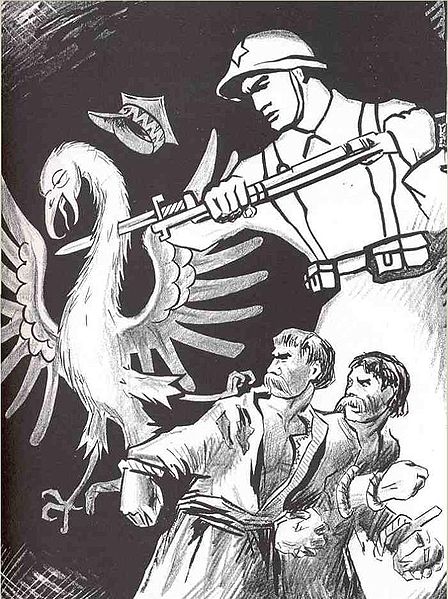
Pravda, the official newspaper of the Russian Community Party, has launched a bitter anti-Polish propaganda campaign with a front-page article deploring the treatment of minorities in Poland.


Russian Propaganda Against Poles
Soviet soldier stabbing symbolic Polish Eagle

There was a close call in the North Atlantic today. While on anti-submarine patrol along the northwestern coast of Ireland, the HMS Ark Royal just barely escaped from a U-39 German submarine attack. Moments later the U-boat was bombed by 3 British destroyers accompanying the carrier. Forth-three German crewman were captured before their ship sank.

Despite internal pressure by Hungarian officials to enter the war, the Hungarian government refrained from declaring its neutrality on the grounds that it is not threatened by Hitler.


Link:
Polish Greatness.com