 |
| General Wladyslaw Sikorski |
"When the sun is higher, Sikorski is nearer."
Wladyslaw Sikorski was the personification of the hopes
of the Polish people for a free and independent Poland.
The struggle for Poland's liberation had been a very long and arduous one. At the end of WWI Poland finally
regained its independence after having been virtually erased from the map for 123 years.
Sikorski had been at the forefront of the struggle. With an educational background in engineering and military tactics he became actively involved in a number of Polish underground organizations; in 1907 Sikorski joined the underground Polish Socialist Party; in 1908 he organized the secret Zwiazek Walki Czynnej ( Combat Association) and two years later, the Zwiazek Strzelecki (Rifleman's Association). The objective was to instigate an uprising against the Russian empire, one of the partitioners. The creation of the latter association while approved by a statute of the Austrian authorities, were Polish paramilitary troops, formed illegally. At the outbreak of WWI, there were over 8,000 "members" dispersed among 200 groups. Many of them joined the Polish Legions. During WWI Sikorski was the chief head of the military section of the Supreme National Committee and then as commissioner he was responsible for recruitment to the Polish Legions in Krakow, the latter organization created by Jozef Pilsudski.
 |
| Związek Strzelecki - Rifleman's Association |
No sooner had WWI come to an end that the Polish-Soviet war (1919-21) broke out over the tenuous question of Poland's newly established borders. By that time Sikorski had become a high-ranking officer of the Polish army, and had led successful battles capturing the ancient city of Lwow, and Przyemsyl. The Soviet forces were confident of achieving an easy victory but were very surprised by the
unexpected. In what has been termed "Miracle at the Vistula", Polish forces under Sikorski's command succeeded in utterly defeating the Bolshevik advance towards Warsaw, giving Pilsudski the time needed to organize a counter-offensive.
 |
| Polish Soldiers displaying captured Soviet banners Aftermath of Battle of Warsaw - Soviet-Polish War |
Sikorskis' forces successfully penetrated deep into Latvia and Belarus, heaping further humiliation upon the defeated Russians. General Sikorski was hailed as the beloved hero of Poland and was decorated with Poland's highest honour, the Virtuti Militari Medal.
During the inter-war period Sikorski had succeeded Pilsudski as the Commander-in-Chief of the Polish Armed Forces (April 1921), and also became Chief of the Polish General Staff. For the next several years he rose to very high government ranks. From December 1922 to May 26, 1923 he served as Poland's Prime Minister as well as Minister of Internal Affairs.
 |
| Charles de Gaulle WW I |
Sikorski had made significant strides in strengthening Polish-French cooperation. It was instrumental in laying the foundations that led to Poland's victory during the Polish Soviet War. The French Military Mission to Poland provided the military organization and logistical assistance vital to the nascent Polish armies. Among the French officers involved in the mission was the future General Charles de Gaulle.
 |
| Polish Badge KOP |
 |
| Polish soldiers KOP |
transferred to the Reserves; (Sikorski had joined the anti-Pilsudski movement and opposed the semi-dictatorial regime of the Sanacja.) For the next few years Sikorski had withdrawn from politics altogether and spent his time in Paris working with officials of the Ecole Superieure de Guerre and writing numerous books and articles about the scale of future warfare. Sikorski was a visionary and a pioneer of the theory of the "blitzkrieg". His publications were carefully scrutinized by several countries, in particular by Soviet Russia.
 |
| Nazi Blitzkrieg Sept 1, 1939 |
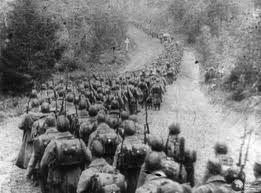 |
| Soviet infantry invading Poland Sept 17, 1939 |
Wladylsaw Sikorski had returned to Poland in 1938 ready to be of service however he was refused a military command by then Commander-in-Chief, Marshal Edward Rydz-Smigly (successor to Pilsudski). Thousands of Polish armed forces had escaped the German onslaught. By the end of the month, Sikorski too had evacuated Poland escaping through a perilous route from Romania to Paris. Sikorski was at once officially installed as the Prime Minister-in-exile and Commander-in-Chief of the Polish forces, joining President-in-exile Wladyslaw Raczkiewicz, and Stanislaw Mikolajczyk.
Despite the fall of Poland, Sikorski was recognized by the West as the legitimate head of the Polish government-in-exile. Through his strong leadership he was instrumental in maintaining the cohesion of the Polish government and Armed Forces, and distinguished himself as Poland's most ardent and outspoken advocate.
But Poland was not without its armies. Though thousands of Polish armed forces had evacuated Poland, they remobilized on French soil. The Polish Highland Brigade was created and immediately deployed to defend French borders. Meanwhile the Polish Air Force was being equipped with 86 aircraft among four squadrons (amid highly questionable logistics controlled by the French authorities); and the Polish Independent Carpathian Brigade was formed in French-mandated Syria. In all there were roughly 80,000 Polish troops in France ready to fight. At the time Poland was the third largest ally.
 |
| General Sikorski and Churchill inspecting Polish Troops in Scotland |
In July 1941 General Sikorski and Ivan Maisky agreed to re-establish diplomatic relations between Poland and Russia and by mid-August, the Sikorsky-Maisky Pact was officially signed. The Soviets abrogated the Molotov-Ribbentrop Pact of August of 1939 as null and void, and agreed to the release of tens of thousands of Polish prisoners of war on the basis of an "amnesty" , a condition which was an absurdity considering that Soviets were the aggressors. (The evacuation was fraught with numerous obstacles and took place under the most arduous conditions. Thousands of Poles perished. Those who survived and made it to the Middle East were eventually formed into the 2nd Polish Corps under the command of General Wladyslaw Anders.)
 |
| Signing of Sikorski-Maisky Agreement July 1941 |
Amid the huge numbers of incoming Polish refugees, there was a conspicuous void. Many thousands of Polish officers never showed up, and their absence could not yet be explained. Sikorski was relentless in his attempt to resolve the mystery, but no avail. Stalin provided only flimsy excuses. He assured Sikorski and Anders that all the Polish soldiers had been released but that the Soviets may have "lost track" of some of them in Manchuria.
 |
| L-R General Anders, General Sikorski, Stalin, Kujbyszewie |
The horrifying truth was discovered in April 1943 when Nazi German forces found the mass graves in Katyn Forest, twelve miles west of Smolensk, Russia. Thousands upon thousands of bodies had been exhumed and examined. They were the remains of the Polish Officers who had disappeared and who had been executed by the Soviet NKVD in 1940, upon Stalin's order.
Russian-Polish relations had always been fragile, but now had reached the breaking point. On April 16, General Sikorski fervently demanded an investigation by the International Red Cross. Ten days later Stalin broke off diplomatic ties with Poland, and in a futile attempt to create a smoke screen, accused the Polish government-in-exile of cooperating with Nazi Germany. (Russian governments have since refused to admit Stalin's culpability for the massacre, that is, until the 1990s).
 |
| Exhumed bodies of Polish Officers massacred at Katyn Forest, Russia |
Another very contentious issue between Russia and Poland dealt with the subject of Polands eastern border. Stalin had long intended that the border be draw along the Curzon Line, which would sever one third of Poland's vast territory. Sikorski fiercely argued in defense of maintaining Poland's pre-war borders and refused to yield to any pressures. But in the end Poland was betrayed by its closest allies - Great Britain and the United States, both of whom gave Stalin whatever he wanted in exchange for his alliance. (Read about Yalta Conference)
 |
| Crash of Sikorski's Liberator July 4, 1943 |
On July 4, 1943 the Liberator plane carrying Sikorski and several other passengers plunged into the sea sixteen
seconds after takeoff from Gibraltar. All the passengers except for the pilot were killed. The cause of the crash was attributed to "engine trouble". However, a Soviet conspiracy has never been ruled out.
In fact, there were several incidences prior to the fatal crash, in which Sikorski's plane had been tampered with Sikorski was very outspoken and a threat to the new Anglo-American-Soviet alliance, all the more reason for Stalin to want Sikorski out of the way. His death marked a turning point not only for Polish-Anglo relations, but the future of the Polish nation and its people. Sikorski's successor, Stanislaw Mikolajcyzak was considered "persona non grata" and possessed none of the influence nor diplomacy that Sikorski wielded so successfully. To Churchill and Roosevelt, handing Poland over to Stalin became as easy as childs play.
Sikorski's death came as a terrible blow to a nation which hoped and prayed for freedom and independence. Poland's national newspaper, Biuletyn Informacyjny published the news to a grief-stricken country and set July 15, 1943 as a national day of mourning.
The memory of Sikorski is still very much alive in the soul of the Polish people. Since Sikorski's tragic death, statues and monuments of him have been erected throughout the world to preserve his memory. Among the many centres and institutes there is also: the Sikorski Institute, in London, England; a memorial plaque at Gibraltar dedicated to Sikorski; a statue of Sikorski on Portland Place in London, a stone monument on the grounds of Place Polonaise, in Toronto, Canada, and a seated sculpture of Sikorski (as a young man) at Inowroclaw, Poland. Even a film was produced in 1948, entitled, "The Enemy" and in 2003 the Polish Sejm declared the 60th anniversary of Sikorski's death as "Year of General Sikorski".
That Sikorski's name continues to be omitted from Western history is cause for concern. It is of vital importance for historical accuracy to include the details about Poland, in particular the story of a great man and a great general who had much to teach by example. May the world come to recognize the name Sikorski and understand the true meaning of honour and greatness.
 |
| Statue of General Sikorski Portland Place, London |
General Sikorskis' Medals
Order of the White Eagle (awarded posthumously, 1943)
Commander's Cross of the Order of the Virtuti Militari
Grand Cross of the Order of Polonia Restituta
Order of the Cross of Grunwald, 1 Class (awarded posthumously 1946)
Cross of Valour (4x)
Gold Cross of Merit
Grand Officer of the Order of Leopold (Belgium)
Grand Cross of the Order of the White Lion (Czechoslovakia)
Cross of Libery, Class I and II, (Estonia)
Grand Cross of the Legion of Honour (France)
War Cross (Norway - awarded posthumously August 1943)

NEXT


 and Monastery Hill could not be penetrated. Despite heavy bombing, the enemy held fast and continued to block the road to Rome. Now, along a 30 km (18 mile) stretch from Cassino to the Gulf of Gaeta, 17 Allied Divisions were positioned ready for the next phase of battle.
 had 8 divisions: the US II Corps (Major Gen.Keyes), the 85th Infantry Division (Maj.Gen. Coulter), the US 5th Army, the French Expeditionary Corps (Maj.Gen.Brosset), 2nd Moroccan Division (Brig.Gen.Dody), the 4th Moroccan Mountain Division (Maj.Gen. Sevez), and the 3rd Algerian Division (Maj-Gen. de Monsabert).
 had the task of capturing the Liri Valley and advance towards Rome. The mission was given to the British 8th Army
 consisting of the British XIII Corps (Lt. Gen.Kirkman), the British 4th Division, the British 78th Division, the 8th Indian Division
 , and the British 6th Armored Division.
 , the 5th Canadian Division, and the 6th South African Armored Division. Also part of the British contingent was the II Polish Corps
 , under the command of Lt.General Wladyslaw Anders
 . The Polish forces
 1st Parachute Division and the 44th Infantry Division. The Liri Valley was defended by the Panzer Grenadier Division
 and a few units from the 305th Infantry Division. The coast was held by the 71st Infantry Division, 3 battalions of the 44th Infantry Division, the 15th Panzer Grenadier Division, and the 90th (Reserve) Panzer Grenadier Division
 for a massive offensive in the area. The plan called for large-scale deception targeted at Field-Marshal Kesselring
 -to convince him that the Allies had finally abandoned further attacks on the Gustav Line
 , and that their mission was now to land at Civitaveccia, north of Rome. In order to remain convincing, the Allies resorted to several diversionary tactics: code messages were sent which were intercepted by German Intelligence
 indicating that the Allies were planning a landing at Civitavecchia by the US 26th Division and the Canadian 1st Corps. A few Allied troops were dispatched to Salerno and Naples to be seen "practicing" amphibious landings - in broad daylight! Meanwhile, Allied air forces were conspicuously making reconnaissance flights all over the beaches at Civitavecchia. False information was spoon-fed to German spies while Italian partisans were put into action. The 78th Division transferred its unit to within 80 km (50 miles) behind the front line, and openly "practiced' crossing the river.
 and Rapido
 were being heavily reinforced under camouflage. The II Polish Corps
 , already positioned at Monte Cassino was ordered to maintain strict radio silence. Its location was cleverly concealed by miles of camouflage - the French Expeditionary Corps, consisting of 99,000 men was completely hidden from view!
 was so successful that it not only hid an entire army but permitted the construction of six bridges. The Germans did not suspect a thing. All troop movements were done secretly and under the cover of darkness. The ruse succeeded. Kesselring sent 2 armored divisions to Civitavecchia with additional reserves on standby.
 from 1,600 guns aimed at German positions all along the 30 km (18 mile) length coast to the Rapido Valley. The Germans were taken by complete surprise.
 went into battle. The 13th and 15th Battalions of the 5th Kresowa Infantry Division reached Point 517 (Widno) under heavy fire but lost 20% of their men. The 13th Battalion (Col. Kaminski) was the first to reach Phantom Ridge, but were caught in a barrage of gunfire (in front and both flanks), mines and traps. Casualties were very heavy and the units were almost completely wiped out.


 supported by the Polish 2nd Armored Brigade. But before they could achieve their objective, their tanks were hit by enemy fire and burst into flames. The remaining tanks were destroyed by mines, killing or wounding 18 of the 20 engineers.
 of the Moroccan supply battalion were able to climb the Arunci mountains with barely any German resistance. (The Germans had assumed that no one could scale its rugged slopes. They were sorely mistaken.) The goumiers captured Monte Rotondo and reached the Ausente Valley. This opened the southern section of Cassino.
 mission. They were able to capture and hold enemy positions. By nightfall the entire northern section of Phantom Ridge lay in Polish control. By sunrise the 15th Polish Battalion captured the southern slope of Phantom Ridge. The 5th Kresowa Infantry Division succeeded in penetrating enemy positions on Phantom Ridge, and Colle Sant'Angelo but were met with heavy fire and were driven back.


