Showing posts with label Franklin Roosevelt. Show all posts

September 3, 2018

SEPTEMBER 3 - DAILY CHRONICLES OF HISTORY

SEPTEMBER 3

1921

Iwo Cyprian Pogonowski (dob) was a Polish-born polymath writer and inventor with 50 patents to his credit. He was a civil and industrial engineer by profession, educated in Poland, Belgium, and the United States. He was also a writer on Polish and European history, author of historical atlases, and lexicographer Pogonowski was born in Lwow, Poland. After the invasion of Poland in WW2, he was sent to Auschwitz with 500 other prisoners, and transferred to  Oranienburg-Sachsenhausen.   He survived the camps and was liberated on May 2, 1945.  Pogonowski summarized his horrific experiences at the German concentration camps in a three-page article popularized in Richard C. Lukas' Out of the Inferno.


1939

British Prime Minister Radio Broadcast: I am speaking to you from the Cabinet Room at 10, Downing Street.       This morning the British Ambassador in Berlin handed the German Government a final Note stating that unless we heard from them by 11 0'clock that they were prepared at once to withdraw their troops from Poland a state of war would exist between us. I have to tell you now that no such undertaking has been received, and that consequently this country is at war with Germany.        You can imagine what a bitter blow it is to me that all my long struggle to win peace has failed. Yet I cannot believe that there is anything more or anything different that I could have done and that would have been more successful.        Up to the very last it would have been quite possible to have arranged a peaceful and honourable settlement between Germany and Poland. But Hitler would not have it. He had evidently made up his mind to attack Poland whatever happened, and although he now says he put forward reasonable proposals which were rejected by the Poles, that is not a true statement.         The proposals were never shown to the Poles, nor to us, and, though they were announced in a German broadcast on Thursday night, Hitler did not wait to hear comments on them, but ordered his troops to cross the Polish frontier. His action shows convincingly that there is no chance of expecting that this man will ever give up his practice of using force to gain his will. He can only be stopped by force.        We and France are to-day, in fulfillment of our obligations, going to the aid of Poland, who is so bravely resisting this wicked and unprovoked attack upon her people. We have a clear conscience. We have done all that any country could do to establish peace, but a situation in which no word given by Germany's ruler could be trusted and no people or country could feel themselves safe had become intolerable. And now that we have resolved to finish it, I know that you will all play your part with calmness and courage.       As such a moment as this the assurances of support that we have received from the Empire are a source of profound encouragement to us.         ...Now may God bless you all and may He defend the right. For it is evil things that we shall be fighting against, brute force, bad faith, injustice, oppression and persecution. And against them I am certain that the right will prevail."  The deadline passed with no response.    (Editors note:  After Britain declared war on Germany, it was followed by declarations of war from France, Australia, New Zealand, South Africa, and  Canada.  Despite these declarations, no military action was taken to assist Poland. The following eight months was relatively quiet and uneventful. This period of time was called the Phoney War. )


President Franklin Roosevelt gave a fireside chat on outbreak of war:   " My fellow Americans and my friends:      Tonight my single duty is to speak to the whole of America.   Until four-thirty this morning I had hoped against hope that some miracle would prevent a devastating war in Europe and bring to an end the invasion of Poland by Germany........ You must master at the outset a simple but unalterable fact in modern foreign relations between nations. When peace has been broken anywhere, the peace of all countries everywhere is in danger.      It is easy for you and for me to shrug our shoulders and to say that conflicts taking place thousands of miles from the continental United States, and, indeed, thousands of miles from the whole American Hemisphere, do not seriously affect the Americas-and that all the United States has to do is to ignore them' and go about its own business. Passionately though we may desire detachment, we are forced to realize that every word that comes through the air, every ship that sails the sea, every battle that is fought, does affect the Americana future. Let no man or woman thoughtlessly or falsely talk of America sending its armies to European fields. At this moment there is being prepared a proclamation of American neutrality. This would have been done even if there had been no neutrality statute on the books, for this proclamation is in accordance with international law and in accordance with American policy......The most dangerous enemies of American peace are those who, without well-rounded information on the whole broad subject of the past, the present and the future, undertake to speak with assumed authority, to talk in terms of glittering generalities, to give to the nation assurances or prophesies which are of little present or future value.......We seek to keep war from our own firesides by keeping war from coming to the Americas........ It is serious enough and tragic enough to every American family in every State in the Union to live in a world that is torn by wars on other continents. Those wars today affect every American home. It is our national duty to use every effort to keep them out of the Americas......I hope the United States will keep out of this war. I believe that it will. And I give you assurance and reassurance that every effort of your Government will be directed toward that end.      As long as it remains within my power to prevent, there will be no black-out of peace in the United States. "


At 6:00 p.m. King George VI addressed the British Empire by radio. " In this grave hour, perhaps the most fateful in our history, I send to every household of my peoples, both at home and overseas, this message, spoken with the same depths of feeling for each one of you as if I were able to cross your threshold and speak to you myself.    For the second time in the lives of most of us, we are at war. Over and over again, we have tried to find a peaceful way out of the differences between ourselves and those who are now our enemies; but it has been in vain.     We have been forced into a conflict, for we are called, with our allies, to meet the challenge of a principle which, if it were to prevail, would be fatal to any civilized order in the world.       It is a principle which permits a State, in the selfish pursuit of power, to disregard its treaties and its solemn pledges, which sanctions the use of force, or threat of force, against the sovereignty and independence of other States.     Such a principle, stripped of all disguise, is surely the mere primitive doctrine that might is right. And if this principle were established throughout the world, the freedom of our own country and of the whole British Commonwealth of Nations would be in danger.     But far more than this, the peoples of the world would be kept in the bondage of fear, and all hopes of settled peace and of security, of justice and liberty, among nations, would be ended.      This is the ultimate issue which confronts us. For the sake of all that we ourselves hold dear, and of the world order and peace, it is unthinkable that we should refuse to meet the challenge.       It is to this high purpose that I now call my people at home and my peoples across the seas who will make our cause their own.    I ask them to stand calm and firm and united in this time of trial.       The task will be hard. There may be dark days ahead and war can no longer be confined to the battlefield, but we can only do the right as we see the right, and reverently commit our cause to God. If one and all we keep resolutely faithful to it, ready for whatever service or sacrifice it may demand, then with God's help, we shall prevail.         May He bless and keep us all."


The three-day Battle of Grudziądz ended with Polish withdrawal from the city.  When the Polish defenders retreated they destroyed the bridges over the Vistula and retreated to the south-east, towards the Drwęca river, where they took new defensive positions. The Germans captured the city the next day. Grudziądz was the location of the headquarters of the Polish 16th Infantry Division, as well as the military Center of Cavalry Training. Grudziadz played a crucial role as strong point in the defence of the Vistula River Line and in securing the route of retreat of Polish divisions of the Pomorze Army, engaged on the western bank of the river.  Several  infantry divisions were stationed in the Polish Corridor (the 9th, the 15th, and the 27th) together with the Pomeranian Cavalry Brigade from Bydgoszcz. Both units were positioned in the Corridor on September 1, 1939 at the moment of the invasion and were vulnerable to a German attack.  The German 4th Army stood on the east side of the Vistula, along the line stretching from Grudziądz to Lidzbark. Grudziądz was defended by the Operational Group East, consisting of the 4th from Toruń and the local 16th Infantry Division, both part of the Pomorze Army.


Bloody Sunday:  Just days after Germany invaded Poland, German soldiers staged an insurrection in Bydgoszcz, in what was called, Bloody Sunday. It started with an attack by German Selbstschutz snipers firing on Polish troops which were in retreat.  When the Poles reacted, the Germans launched the final retaliatory strike - the mass execution of Polish hostages. The Nazis instructed the press to publish a photo of a few dead bodies of German victims, staged in a way to provide "evidence of the so-called "barbarism" of the Polish people.  (These staged events were typical strategies of the Nazi German propaganda campaigns.)


SS Athenia was torpedoed by German submarine:   The SS Athenia, a British passenger ship was the first vessel attacked and sunk by the German Kriegsmarine. Casualties were 117 civilian passengers and crew, including 28 U.S. citizens.  Under the command of Captain James Cook, the vessel had left port at Glasgow on September 1, on the way to Montreal via Liverpool and Belfast. On the third day the German U-30 spotted her and after tracking the vessel for three hours launched two torpedoes.  One exploded on her port side, in the engine room, and she began to settle by the stern.  The SS Athenia sent out a distress signal and several vessels responded immediately rescuing over 980 passengers and crew.  The German liner SS Bremen, which was en route from New York to Murmansk, also received Athenia's distress signal, but ignored it. Athenia remained afloat for more than 14 hours, until she finally sank stern first at 10:40 the next morning.


1941

The first experimental gassing took place at Block 11, in the basement of Auschwitz I.  The Nazi SS gathered 600 Russian POWs and 250 Polish people and subjected them with lethal gassing of Zyklon B, a deadly cyanide-based pesticide.  It was Karl Fritsch, an SS functionary, who first proposed the idea of using the gas for the purposes of mass exterminations.  Initially, Fritsch ensured that the cells were not air-tight, so as to subject the victims to a long, excruciating suffocation.


January 24, 2018

JANUARY 24 - DAILY CHRONICLES OF HISTORY

JANUARY 24

1934

Jews were banned from the German Labor Front. After Hitler's rise to power, the National Socialist trade union organization which replaced the various independent trade unions of the Weimar Republic. Many of the labor union leaders were imprisoned and sent to concentration camps, and the money in union coffers, which were the workers money, was confiscated by the Nazi party. Membership to the German Labor Front was mandatory, and even a patriotic duty. Jews were excluded.


1939

Hermann Goring was instructed to set up an organization in Germany similar to the Zentralstelle in Austria. The German office was called the Reichzentralstelle fuer Juedische Auswanderung, Reich Central Office for Jewish Emigration, to organize and supervise the forced expulsion of Jews from Germany, that is, deportation to concentration camps.


SS leader Reinhard Heydrich was ordered by Hermann Göring to speed up the "emigration "of Jews. Heydrich was second in importance to Heinrich Himmler in the Nazi SS organization and the principle planner of the Final Solution. Goring was one of the most powerful leaders of the Nazi Party and was the C-C of the Luftwaffe, as well as having created the Gestapo.


1944

President Roosevelt issued a statement condemning German and Japanese ongoing "crimes against humanity." In response to political pressure to help Jews under Nazi persecution, President Roosevelt created the War Refugee Board.  Josiah E. DuBois, Jr, Treasury Dept. lawyer of the WRB, found evidence that the U.S. State Department had actively suppressed information about the murder of the Jews from reaching the United States public. To add to the turpitude, in July 1943, the US Treasury had given permission to the World Jewish Congress to send money to Switzerland, but prevented them from doing so for a period of six months. The War Refuge Board was the only major effort undertaken by the US government and had been credited with rescuing tens of thousands of Jews from Nazi-occupied countries.  (Editors note:  The efforts of the WRB however heroic, were been tainted by subterfuge at the highest level of government, and an inexcusable degree of bureaucratic red tape.)


1945

The Battle of Poznań began for the German-occupied stronghold city of Poznań in Poland. It was a massive assault by the Soviet Union's Red Army that had as its objective the elimination of the Nazi German garrison in the stronghold city of Poznań in occupied Poland. The defeat of the German garrison required almost an entire month of painstaking reduction of fortified positions, intense urban combat, and a final assault on the city's citadel by the Red Army.


1982

In his weekly noon blessing in St. Peters Square, Pope John Paul II prayed for an end to martial law in Poland and asked the Catholic faithful to "pray for my fatherland". He read from the pastoral letter which was delivered to Polish churches that ''I want to assure my fellow nationals that their wishes are mine as well.'


1993

Polish ferry boat John Heweliusz sank, 52 killed. The ferry capsized and sank in 27 metres of water off Cape Arcona on the coast of Rügen in the Baltic Sea while sailing toward Ystad. Ten bodies were never found. 9 people were rescued. The sinking of Jan Heweliusz is the most deadly peacetime maritime disaster involving a Polish ship.


March 27, 2012

GREAT POLISH GENERALS OF WW2: Wladyslaw Sikorski

General Wladyslaw Sikorski

"When the sun is higher, Sikorski is nearer."

Wladyslaw Sikorski was the personification of the hopes
of the Polish people for a free and independent Poland.
The struggle for Poland's liberation had been a very long and arduous one. At the end of WWI Poland finally
regained its independence after having been virtually erased from the map for 123 years. 

Sikorski had been at the forefront of the struggle. With an educational background in engineering and military tactics he became actively involved in a number of Polish underground organizations; in 1907 Sikorski joined the underground Polish Socialist Party; in 1908 he organized the secret Zwiazek Walki Czynnej ( Combat Association) and two years later, the Zwiazek Strzelecki (Rifleman's Association). The objective was to instigate an uprising against the Russian empire, one of the partitioners.  The creation of the latter association while approved by a statute of the Austrian authorities, were Polish paramilitary troops, formed illegally.  At the outbreak of WWI, there were over 8,000 "members" dispersed among 200 groups. Many of them joined the Polish Legions. During WWI Sikorski was the chief head of the military section of the Supreme National Committee and then as commissioner he was responsible for recruitment to the Polish Legions in Krakow, the latter organization created by Jozef Pilsudski.

Związek StrzeleckiRifleman's Association

No sooner had WWI come to an end that the Polish-Soviet war (1919-21) broke out over the tenuous question of Poland's newly established borders. By that time Sikorski had become a high-ranking officer of the Polish army, and had led successful battles capturing the ancient city of Lwow, and Przyemsyl.  The Soviet forces were confident of achieving an easy victory but were very surprised by the
unexpected.  In what has been termed "Miracle at the Vistula", Polish forces under Sikorski's command succeeded in utterly defeating the Bolshevik advance towards Warsaw, giving Pilsudski the time needed to organize a counter-offensive.

Polish Soldiers displaying captured Soviet banners
Aftermath of Battle of Warsaw - Soviet-Polish War

Sikorskis' forces successfully penetrated deep into Latvia and Belarus, heaping further humiliation upon the defeated Russians. General Sikorski was hailed as the beloved hero of Poland and was decorated with Poland's highest honour, the Virtuti Militari Medal.

During the inter-war period Sikorski had succeeded Pilsudski as the Commander-in-Chief of the Polish Armed Forces (April 1921), and also became Chief of the Polish General Staff. For the next several years he rose to very high government ranks. From December 1922 to May 26, 1923 he served as Poland's Prime Minister as well as Minister of Internal Affairs.

Charles de Gaulle WW I
During this period Sikorski garnered immense respect from and support of the Polish people. He established various reforms, and built a viable foreign policy that received international approval through the League of Nations. Moreover, the United Kingdom, France, and the United States all recognized the legitimacy of Poland's new frontiers, won during the Russian-Polish war.

Sikorski had made significant strides in strengthening Polish-French cooperation. It was instrumental in laying the foundations that led to Poland's victory during the Polish Soviet War.  The French Military Mission to Poland provided the military organization and logistical assistance vital to the nascent Polish armies. Among the French officers involved in the mission was the future General Charles de Gaulle. 


Polish Badge KOP
From 1923-24 Sikorski held the position of Chief Inspector of Infantry. And the following year, under Prime Minister Wladyslaw Grabski, Sikorski served as Minister of Military Affairs, guiding the modernization of the Polish military.   He created the Border Protection Corps (Korpus Ochrony Pogranicza) a military formation to defend Polands' eastern borders from attacks of Soviet armies. From 1925-1928 Sikorski became Commander of the Military Corp District VI in Lwow, a city of great historical importance imbued with a rich Polish and Jewish cultural heritage.


Polish soldiers KOP
Despite these contributions, Sikorski was dismissed from public service in 1928 by Pilsudski and was
transferred to the Reserves; (Sikorski had joined the anti-Pilsudski movement and opposed the semi-dictatorial regime of the Sanacja.) For the next few years Sikorski had withdrawn from politics altogether and spent his time in Paris working with officials of the Ecole Superieure de Guerre and writing numerous books and articles about the scale of future warfare. Sikorski was a visionary and a pioneer of the theory of the "blitzkrieg". His publications were carefully scrutinized by several countries, in particular by Soviet Russia.

Nazi Blitzkrieg Sept 1, 1939
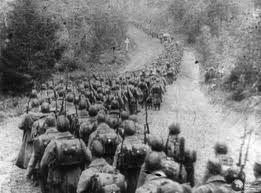
Soviet infantry invading Poland Sept 17, 1939
The rapid militarization by the Nazi Wehrmacht were to bring these theories to fruition. On 1st September 1939 Germany invaded Poland in a "lightning war" overrunning her armies with overwhelming numbers and fire power.  Seventeen days later Soviet armies invaded Poland from the east -  the culmination of a secret pact by Hitler and Stalin to partition Poland and destroy the very foundations of her existence. To the world it appeared that Poland had collapsed.  But Poland was not yet lost. 


Wladylsaw Sikorski had returned to Poland in 1938 ready to be of service however he was refused a military command by then Commander-in-Chief, Marshal Edward Rydz-Smigly (successor to Pilsudski). Thousands of Polish armed forces had escaped the German onslaught. By the end of the month, Sikorski too had evacuated Poland escaping through a perilous route from Romania to Paris.  Sikorski was at once officially installed as the Prime Minister-in-exile and Commander-in-Chief of the Polish forces, joining President-in-exile Wladyslaw Raczkiewicz, and Stanislaw Mikolajczyk.


Despite the fall of Poland, Sikorski was recognized by the West as the legitimate head of the Polish government-in-exile. Through his strong leadership he was instrumental in maintaining the cohesion of the Polish government and Armed Forces, and distinguished himself as Poland's most ardent and outspoken advocate.

But Poland was not without its armies. Though thousands of Polish armed forces had evacuated Poland, they remobilized on French soil. The Polish Highland Brigade was created and immediately deployed to defend French borders. Meanwhile the Polish Air Force was being equipped with 86 aircraft among four squadrons (amid highly questionable logistics controlled by the French authorities); and the Polish Independent Carpathian Brigade was formed in French-mandated Syria. In all there were roughly 80,000 Polish troops in France ready to fight. At the time Poland was the third largest ally.


But with the Fall of France, Polish forces evacuated once again - this time to England. On June 19, 1940 Prime Minister Sikorski met with Winston Churchill, and pledged to provide Polish forces to fight alongside those of Britain. By August, Sikorski and Churchill signed the Polish-British Military Agreement calling for the creation, and training of the Polish Armed Forces.  Most renowned were the Polish pilots who fought in the Battle of Britain the summer of 1940, and whose pilots scored the highest ratio of kills. Most famous was the 303 squadron (the Kosciuszko squadron).  At this juncture, Poland became the second largest ally, with troops stationed in Great Britain and the Middle East.

General Sikorski and Churchill inspecting Polish Troops in Scotland


When Germany invaded the Soviet Union in June 1941 in Operation Barbarossa, the dynamics of the war changed significantly. Churchill had been hoping for just such an outcome to curry favor with the Soviets, an ally upon whom the British relied to win the war against the Nazi scourge. It also presented ominous changes to Poland's relationship with Britain, and especially that with Russia. It came as no surprise to Sikorski. He was a pragmatic strategist and knew what the outcome meant. Seeing no other alternative he succumbed to pressure from the British Foreign Office and opened negotiations with the Russians.


In July 1941 General Sikorski and Ivan Maisky agreed to re-establish diplomatic relations between Poland and Russia and by mid-August, the Sikorsky-Maisky Pact was officially signed.  The Soviets abrogated the Molotov-Ribbentrop Pact of August of 1939 as null and void, and agreed to the release of tens of thousands of Polish prisoners of war on the basis of an "amnesty" , a condition which was an absurdity considering that Soviets were the aggressors. (The evacuation was fraught with numerous obstacles and took place under the most arduous conditions. Thousands of Poles perished. Those who survived and made it to the Middle East were eventually formed into the 2nd Polish Corps under the command of General Wladyslaw Anders.)

Signing of Sikorski-Maisky Agreement July 1941

Amid the huge numbers of incoming Polish refugees, there was a conspicuous void.  Many thousands of Polish officers never showed up, and their absence could not yet be explained.  Sikorski was relentless in his attempt to resolve the mystery, but no avail. Stalin provided only flimsy excuses. He assured Sikorski and Anders that all the Polish soldiers had been released but that the Soviets may have "lost track" of some of them in Manchuria.


L-R General Anders, General Sikorski, Stalin, Kujbyszewie

The horrifying truth was discovered in April 1943 when Nazi German forces found the mass graves in Katyn Forest, twelve miles west of Smolensk, Russia.  Thousands upon thousands of bodies had been exhumed and examined. They were the remains of the Polish Officers who had disappeared and who had been executed by the Soviet NKVD in 1940, upon Stalin's order.

Russian-Polish relations had always been fragile, but now had reached the breaking point. On April 16, General Sikorski fervently demanded an investigation by the International Red Cross. Ten days later Stalin broke off diplomatic ties with Poland, and in a futile attempt to create a smoke screen, accused the Polish government-in-exile of cooperating with Nazi Germany. (Russian governments have since refused to admit Stalin's culpability for the massacre, that is, until the 1990s).

Exhumed bodies of Polish Officers massacred at Katyn Forest, Russia

Another very contentious issue between Russia and Poland dealt with the subject of Polands eastern border. Stalin had long intended that the border be draw along the Curzon Line, which would sever one third of Poland's vast territory.  Sikorski fiercely argued in defense of maintaining Poland's pre-war borders and refused to yield to any pressures. But in the end Poland was betrayed by its closest allies - Great Britain and the United States,  both of whom gave Stalin whatever he wanted in exchange for his alliance. (Read about Yalta Conference)
Crash of Sikorski's Liberator July 4, 1943

On July 4, 1943 the Liberator plane carrying Sikorski and several other passengers plunged into the sea sixteen
seconds after takeoff from Gibraltar. All the passengers except for the pilot were killed. The cause of the crash was attributed to "engine trouble".  However, a Soviet conspiracy has never been ruled out. 


In fact, there were several incidences prior to the fatal crash, in which Sikorski's plane had been tampered with  Sikorski was very outspoken and a threat to the new Anglo-American-Soviet alliance, all the more reason for Stalin to want Sikorski out of the way.  His death marked a turning point not only for Polish-Anglo relations, but the future of the Polish nation and its people.  Sikorski's successor, Stanislaw Mikolajcyzak was considered "persona non grata" and possessed none of the influence nor diplomacy that Sikorski wielded so successfully.  To Churchill and Roosevelt, handing Poland over to Stalin became as easy as childs play.

Sikorski's death came as a terrible blow to a nation which hoped and prayed for freedom and independence. Poland's national newspaper, Biuletyn Informacyjny published the news to a grief-stricken country and set July 15, 1943 as a national day of mourning.

The memory of Sikorski is still very much alive in the soul of the Polish people. Since Sikorski's tragic death, statues and monuments of him have been erected throughout the world to preserve his memory.  Among the many centres and institutes there is also:  the Sikorski Institute, in London, England; a memorial plaque at Gibraltar dedicated to Sikorski; a statue of Sikorski on Portland Place in London, a stone monument on the grounds of Place Polonaise, in Toronto, Canada, and a seated sculpture of Sikorski (as a young man) at Inowroclaw, Poland. Even a film was produced in 1948, entitled, "The Enemy" and in 2003 the Polish Sejm declared the 60th anniversary of Sikorski's death as "Year of General Sikorski".

That Sikorski's name continues to be omitted from Western history is cause for concern.  It is of vital importance for historical accuracy to include the details about Poland, in particular the story of a great man and a great general who had much to teach by example. May the world come to recognize the name Sikorski and understand the true meaning of honour and greatness.

Statue of General Sikorski
Portland Place, London


General Sikorskis' Medals

Order of the White Eagle (awarded posthumously, 1943)
Commander's Cross of the Order of the Virtuti Militari
Grand Cross of the Order of Polonia Restituta
Order of the Cross of Grunwald, 1 Class (awarded posthumously 1946)
Cross of Valour (4x)
Gold Cross of Merit
Grand Officer of the Order of Leopold (Belgium)
Grand Cross of the Order of the White Lion (Czechoslovakia)
Cross of Libery, Class I and II, (Estonia)
Grand Cross of the Legion of Honour (France)
War Cross (Norway - awarded posthumously August 1943)


NEXT
GENERAL WLADYSLAW ANDERS
(click on name)


February 10, 2012

YALTA CONFERENCE: SECRETS, LIES, AND BETRAYAL


Yalta. The name is synonymous with deception and betrayal. Yalta continues to endure as one of the greatest controversies of our time. For decades Western leaders, political analysts, academia, and journalists have been grappling with facts, half truths, lies and conjecture in the struggle to untangle the most baffling imbroglio of the twentieth century. Today it becomes ever more urgent to understand the lessons of Yalta and re-examine the events that led to the Cold War.


The Yalta Conference, one of a series of summit meetings during World War II, was convened at the Livadia Palace in the Crimea from February 4 to February 11, 1945. In the span of seven days the "Big Three" - President Franklin D. Roosevelt, Prime Minister Winston Churchill, and Marshall Josef Stalin, agreed upon the configuration of a post-war Europe, and sealed it's fate and that of the world for the next 47 years.

Yalta Conference February 4, 1945 Stalin, Roosevelt, Churchill and others

The meetings concluded with a set of protocols that dealt with a number of issues, including the unconditional surrender of Nazi Germany, the declaration of a liberated Europe, the restoration of sovereignty and self-determination to countries that had been occupied by Nazi Germany; the establishment of order and the rebuilding of national economies. The allies agreed to impose severe punitive damages against Germany that would be exacted by the payment of billions of dollars in reparations, the subjugation and dismemberment of the German state and military, and the establishment of allied zones of occupation therein to ensure future world peace and security.


Foremost in the Yalta agreement was the imperative of creating the United Nations organization based on the principles espoused by Roosevelt and Churchill in the Atlantic Charter signed in August 1941. It sought to establish world security and commit nations to  "respect the right of all people's to choose the form of government under which they will live and....to see sovereign rights and self-government restored to those who have been forcibly deprived of them...". The inclusion of these conditions in the Yalta Protocol was an absurdity, because by the time the Conference took place, the Red Army already occupied much of Eastern Europe and constituted a military force that was three times the size of the Allied forces positioned in the West.


PM Stanislaw Mikolajcyk
The Soviet Red Army had already occupied Poland under the pretext of a so-called "liberation" in January 1945.  In July 1944, the Polish Committee of National Liberation, also called the Lublin Committee was installed as the so-called "provisional" government of Poland, staffed by communist administrators, and backed by the notorious NKVD. Polish Prime Minister Stanislaw Mikolajcyk was deliberately left out of all summit conferences and never kept informed about its agreements.

Mikolajcyk continued to protest the Soviet occupation unaware that Poland had already been ceded to Stalin. His persistence caused considerable annoyance to Churchill and he berated Mikolajcyk for his refusal to surrender to Stalin's wishes. But it was all fait accompli.


Post-World War II Map of Soviet Influence in Europe

It was within this framework that Churchill and Roosevelt sought assurances from Stalin for a future Polish state. However the resulting Protocol was disturbing in its ambiguity. Though Stalin agreed to a future Polish government, he insisted that it would be based on the already existing Soviet-controlled Polish Provisional Government but he assured them that such government would be reorganized along a broader "democratic" basis by the inclusion of democratic leaders from Poland itself, and from Poles abroad" and that he would allow the "free and unfettered elections as soon as possible on the basis of universal suffrage and secret ballot." What eventually transpired would shock and outrage the world.


The agenda also included the question of Poland's post-war borders yet the matter had already been settled surreptitiously at theTeheran Conference in 1943. Stalin insisted that the Polish eastern border be determined by the Curzon Line which would result in the dissection of a third of Poland's territory. A secret meeting had been arranged at which Roosevelt unilaterally ceded Polish territory to Stalin in exchange for assurances that Russia would ally itself with the US in the Pacifc War. The deal was done without Churchill having known about it beforehand.


Incidentallly, during the Yalta Conference Roosevelt had taken many an occasion to snub Churchill perhaps in an attempt to improve his own bargaining position with Stalin.Churchill was bullied and mocked mercilessly. It was a spectacle of ridiculous proportions and one which achieved nothing other to amuse Stalin immensely. The rift that existed between Roosevelt and Churchill did nothing to strengthen their resolve against Stalin.

The Yalta agreement was hailed around the world as a resounding success. Reminiscent of Chamberlain's triumphant return to London after the Munich Agreement in 1938, Churchill was welcomed with similar fanfare when he returned to London after Yalta. Lord Beaverbrook, an enduring friend lavished Churchill with praise fit for a hero saying, "You now appear to your countrymen to be the greatest statesman as well as the greatest warrior."   


Time Magazine Stalin Man of the Year

From the moment that the Soviet Union became an ally, the British and American propaganda machine went into full swing. In January 1943 Time Magazine released its issue featuring Josef Stalin as Man of the Year. The ensuing article praised him for his "tough guy" approach because it "brought results".

In March 1943 Life Magazine devoted an entire issue glorifying the Russian Soviet leadership, proclaiming that Lenin was "perhaps the greatest man of modern time". They even suggested that the FBI was fundamentally comparable to that of the NKVD.  American media made every effort to draw similarities between the Americans and the Russians, and declared that the Soviets are "just like us". They "look like Americans", "dress like Americans" and "think like Americans".


Even Hollywood got in on the act and produced about a dozen pro-Soviet films, such as "Mission to Moscow", "Counterattack", "Song of Russia", "Days of Glory", "The North Star", and "The Battle of Russia" just to name a few. "Mission to Moscow" was made upon the request of President Roosevelt. The producer of the film, Robert Buckner referred to the production as "an expedient lie for political purposes". It portrayed the Soviet Union along the lines of an American style democracy in the attempt to whitewash the American public. But most disturbing thing of all was that at the heart of the American psyche was the genuine conviction that any "anti-Soviet" sentiment was considered inflammatory and anti-American. The propaganda was successful.


Even the British public was mislead about the true nature of the Soviet leader and did not consider Russia a threat. The British and Americans desperately needed the Russians if they were to defeat Nazi Germany.  Churchill went so far as to openly criticize the Polish government-in-exile for its refusal to cultivate "friendly relations" with Russia, implying that Poland was the real "enemy" and as a result was made an outcast.


Churchill and Roosevelt considered the Soviet Union a valuable ally and took every opportunity to portray the Soviet leader as an amiable bearer of democratic freedoms and peace. In their effort to paint a rosy picture of their alliance with the Soviet Union, they even referred to Stalin as "Uncle Joe"  however they both tread very carefully in an effort not to antagonize Stalin nor cause him any public embarassment or offense.


Roosevelt provided Stalin with considerable financial support as part of the Land Lease Agreement. In the period from 1941 to 1945, the United States shipped about $11.3 billion worth of supplies to the Soviet Union. (The US also shipped goods to other allies worth, $31 billion to Britain, $3 billion to France and slightly over $1 billion to China. The total expense to Americans was $50 billion, the equivalent of $611 billion today.) In addition the USSR received with more than 2,000 locomotives, 11,000 railcars, and 18,700 aircraft. By 1945, over two-thirds of trucks utilized by the Red Army came from the United States. Incidentals were also shipped to Russia, such telephone cable, aluminum, canned rations, and clothing. In return, Roosevelt wanted Stalin's support in the Pacfic War.


It was not long until news leaked out about the truth of the Yalta accords, and that Roosevelt and Churchill had sold out to Stalin's demands. (Other secret deals included, at Stalin's insistence, US recognition of Port Arthur, of Mongolian independence from China, of Soviet interests in the Manchurian railway, as well as special voting rights for the Soviet members of the United Nations Security Council.) The British House of Commons was in an uproar over the deal about Poland, and anxious about the possible consequences.  In a blistering speech in the House of Commons MP Dunglass denounced Churchill for the "transfer to another power the territory of an ally" and that Churchill failed to permit the Polish government to have "the full right to choose their own government free from the influence of any other power." The following day twenty-five MP's who opposed the Yalta agreement introduced an amendment to the vote of confidence.  However, the amendment was defeated by a landslide: 385 votes against, and 11 abstained. Only 25 votes were in favor.

PM Winston Churchill
Despite the heated accusations, Churchill expressed immense self-confidence that the Yalta Conference was a success and staunchly defended his position saying, "I repudiate any suggestion that we are making a questionable compromise or yielding to force or fear. The Poles will have the future in their own hands, with the single limitation that they must honestly follow a policy friendly to Russia. That is surely reasonable. I know of no government which stands to its obligations more solidly than the Russian Soviet government."

Stalin and Churchill caricature


In reality Churchill had long been a harsh critic of communism and thoroughly despised Stalin and his regime. He was well informed about Stalin's murderous campaigns, the endless purges, the slaughter that lay in wake of the Red Army, in particular their hand in the massacre of thousands of Polish Officers at Katyn in 1940.  Most heinous was the betrayal of the Poles during the Warsaw Uprising in 1944.  At the crucial moment when the Polish Army most expected help from the Russians, the Soviet Red Army stopped at the banks of the Vistula River and merely watched and waited while the Nazis were slaughtering the Poles. It was all the more shameful because Churchill and Roosevelt refused to help the Polish Home Army despite their frantic pleas for assistance. Churchill imposed a media ban to prevent these facts from being public knowledge.  After the defeat of the Warsaw Uprising, Churchill met with the Polish Prime Minister in Moscow, turned to him and uttered these words: "The Russians will sweep through your country and your people will be liquidated.  You are on the verge of annihilation."

Katyn Massacre - (Russia)
16,000 Polish officers were executed by Soviet NKVD


Franklin D. Roosevelt
Roosevelt on the other hand was willfully ignorant and adamantly refused to confront any of the facts despite constant attempts by the State Department to inform him of the true nature of "Russian diplomacy". FDR revealed his naievete when he unabashedly defended his opinion of Stalin.He said, "I think that if I give him everything that I possibly can and ask nothing from him in return, nobless oblige, he won't try to annex anything and will work for a world of democracy and peace".

During the Yalta meetings, Roosevelt sent a letter to Stalin (dated February 6, 1945) in which he tried to persuade him to make reasonable concessions in regard to a future Polish government otherwise it would have put the three of them in a "bad light throughout the world", that is, Stalin recognized one government "while we and the British are recognizing another in London". 


Soon after the conclusion of the Yalta conference, and three weeks before his death, Roosevelt came to the startling realization that he had failed miserably, and that his advisors had been right all along. He admitted that "Averell is right.  We can't do business with Stalin. He has broken every one of the promises he made at Yalta.".   Averell Harriman, US Ambassador to the Soviet Union, had accompanied Roosevelt to Yalta and encouraged the President to take a tougher position against Stalin, in defense of the Polish question.

In a Top Secret White House memorandum dated May 11, 1945, William Leahy, Chairman of the US Joint Chiefs of Staff relayed a message to the U.S. Secretary of State which Churchill had dispatched to Foreign Secretary Anthony Eden. In it Churchill advised Eden of the urgency of resolving the Polish problem, and expressed grave concern over European security should American troops withdraw too quickly. The following is a reproduction of this two page document in its entirety.


Churchill expressed concern over what he termed the "Polish deadlock",  worried about the impending tide of Soviet expanisionism and the fear that Poland would be "completely engulfed and buried deep in Russian-occupied lands".  But in the wake of the Yalta conference these concerns were swept aside and replaced by the single determination to win the war whatever the cost.


Churchill was a highly skilled orator who also demonstrated exceptional dramatic license. Memos such as that presented above served only to perpetuate his masquerade, a tactic which was well timed. His gesture of trying to salvage European security and rescue Poland at the last moment could only assure that Churchill's political intregrity and legacy would remain unscathed.


Roosevelt was never particularly interested in the "Polish problem".  His main preoccupation in 1944 was winning another Presidential term.  On October 11, 1944 he invited the members of the Polish American Congress to the White House. It was a perfect photo opportunity. Behind the President was a huge map of Poland on the wall illustrating the demarcation of its eastern border along the Riga Line rather than the Curzon Line. In an effort to win the trust and support of Polish Americans, Roosevelt concealed the truth about Yalta, and assured the Polish delegation that they could depend on the friendship of the US government. Roosevelt won their vote easily all with few words and a big map.

President Franklin D. Roosevelt
and members of Polish American Congress


IMMEDIATE REPERCUSSIONS OF YALTA

In March 1945, Stalin demonstrated his compliance with the terms of Yalta by inviting Polish leaders from abroad to form the new Polish Government of National Unity (TRJN). But upon their arrival, they were immediately arrested by the Soviet NKVD. Though Prime Minister Mikolajcyk joined a few others to co-operate in this new government, they were all betrayed.

By June of that year, the new coalition government was organized, and consisted of members of the Polish government-in-exile, and those of Polish Communist Party. But Stalin made certain that none of the old guard possessed any real power.

Stalin's promise for "free and unfettered elections" never materialized. The communists used repression, bribery, threats, and even murder of opposition members to consolidate their power. An "election" was held only when the communists were certain to obtain majority support. No British nor American observers were permitted to attend. Prime Minister Mikolajcyk had no choice but to resign.


The Polish government-in-exile did not recognize the TRJN - neither did the Vatican. But surprisingly on July 5th, 1945, the United States gave the TRJN full recognition, which soon after was followed by France and the United Kingdom. By October of that year delegates of TRJN signed the United Nations Charter, and Soviet Poland became a full member of the United Nations. In retrospect the events leading up to the demise of Poland's sovereignty had all the makings of a coup d'etat. Stalin was a master puppeter, and Churchill and Roosevelt were his puppets.

By August 16, 1945 the controversy over the Curzon line was finally settled, albeit by questionable and devious means. The "Soviet" Polish government agreed to cede its eastern territories to the Soviet Union and officially recognized the Curzon Line as its eastern border. 


Throughout this episode the Soviet NKVD embarked on a massive man-hunt to capture Polish soldiers of the Armia Krajowa. Polish fighters were arrested, tortured and hanged. Thousands more Poles were deported to remote camps in the Russian gulag. Polish troops which had helped the Red Army drive the Germans out of Lwow, Wilno and Lublin were summarily executed. Sixteen prominent leaders of the Polish underground were arrested and killed after having been subjected to a mock trial. The NKVD was able to track them down only because British Foreign Minister Athony Eden gave Stalin the list of names.


CONCLUSION

With the fall of the Iron Curtain and the end of the Cold War there is a resurgence of interest in the events of the Yalta Conference and a re-examination of the causes of the Cold War. The controversy still continues to plague us and questions arise as to which side was actually responsible for the start of the Cold War, and precisely when? Were the Americans responsible, or the Soviets? Is there anything that Churchill and Roosevelt could have done to prevent it's escalation and how? Many in the West continue to defend the legacy of Roosevelt and Churchill, insisting that they innocently fell victim to Stalin's chicanery. It is imperative that we look at the cold, hard facts before we can formulate objective conclusions.


Now that the Cold War is over, Russia is an equal among democratic nations. Communism, its ideology and fanaticism has melted away giving rise to the anticipation of a more peaceful co-existence. No matter. Rivalries will continue to exist irregardless of the catalyst, be it ideological, cultural, or political. On February 27, 1945 Churchill addressed the House of Commons about the Crimea Conference, in which he stated, "It is a mistake to look too far ahead. Only one link in the chain of destiny can be handled at a time." He was sorely mistaken. It is vital to the future peace and security of the world that international agreements entered into with friendly nations (or adversaries) take into account the long-term ramifications. Quick fixes do not work. The Yalta Conference proved it.

September 5, 2011

Warsaw Uprising 1944: September 5 Roosevelt Praises Polish Heroes

Polish civilians& Insurgents run behind Barricade
The German offensive on Powisle continues. Covered by tanks, the infantry attacked insurgents from three directions and have taken up positions in the huge building of the PZUW State Insurance Company on Kopernika Street. Soon afterwards German troops seized Sewerynow,Obozna and Leszczyska Streets. By evening insurgents under the command of Captain Stanislaw Skibniewski "Cubryna" have left the ruins of the power station building. The Poles have completely run out of ammunition. Meanwhile evacuation of civilians to Srodmiescie continues.


In the area of Jasna and Szpitalna Streets, strong enemy artillery fire and air raids continue unabated. Amid the maelstorm, Polish fighters succeeded in repulsing the German attack on their positions in the ruins of the Police Department, in the Holy Cross Church, and along the entire length of Krolewska Street. Srodmiescie has been heavily bombarded and the entire area is in flames. Civilians have fled the area and have found relative safety in the southern part of the district.

Church of the Holy Cross - Warsaw Uprising 1944
The insurgents have taken up positions on Frascati Street and have secured a vital liaison between Czerniakow and Srodmiescie through Ksiazeca Street. In command of the units in Czerniakow is Col. Jan Mazurkiewicz “Radoslaw”. The former commander of the area, Captain Zygmunt Netzer  “Kryska” has been appointed his second-in-command.

The District Commander’s staff has re-established its base in the Palladium movie theatre at 7/9 Zlota Street, a structure that is more solid and modern while the Home Army Headquarters has relocated to the PAST building on Piusa XI Street.

PAST building Warsaw 1944

Yesterday Churchill had dispatched an urgent telegram to President Roosevelt proposing that Britain and the US engage in a joint air operation to drop material supplies over Warsaw irregardless of Stalin's wishes. Roosevelt issued his reply today stating that he was informed by US Military Intelligence that Polish insurgents have already left Warsaw and that German troops have taken full control of the city. His conclusion was that "the problem of relief for the Poles in Warsaw has therefore unfortunately been solved by delay and by German action, and there now appears to be nothing we can do to assist them. I have long been deeply distressed by our inability to give adequate assistance to the heroic defenders of Warsaw, and I hope that we may together still be able to help Poland be among the victors in this war with the Nazis. (Roosevelt) In the meantime, President Roosevelt has focused his attention on campaigning for re-election.


 Democratic Campaign 1944 1944 (00:03:57)


 POWSTANIE WARSZAWSKIE cz.1. (00:09:48m)  


Warsaw Uprising: Insurgent column on corner of Chmielna and Szpitalna Street.