Showing posts with label NKVD. Show all posts

August 11, 2018

AUGUST 11 - DAILY CHRONICLES OF HISTORY

AUGUST 11

1892

Wladyslaw Anders (dob) was a General in the Polish Army, and later became a politician and prominent member of the Polish Government-in-Exile in London. When Poland was invaded by Germany on September 1, 1939,  Anders was called into action and commanded the Nowogródzka Cavalry Brigade in the Battle of Mlawa. With the collapse of the Polish Northern Front, the Brigade withdrew towards Warsaw, fighting several battles against the Germans. Following the Soviet attack on September 17, 1939 Anders retreated south in the direction of Lwów in the attempt to reach the Hungarian or Romanian border but was wounded twice and captured by the Red Army. The Soviets transferred Anders to the notorious Lubyanka prison were he was confined until February 29, 1940. During his imprisonment, he was interrogated and tortured by the NKVD who attempted to force him to join the Russian Army. He refused.  But after the Nazis launched Operation Barbarossa, and the signing of the Sikorski-Maisky Agreement, Anders was released, and given the command to form a Polish army which would join the Soviets in the battle against the Nazis. Ander's army, the 2nd Polish Corp were composed of Polish civilians who had been deported to the Russian gulag,  from Soviet-occupied Poland.  The Polish 2nd Corps became a vital tactical and operational unit of the Polish Armed Forces in the West. Anders commanded the Corps throughout the Italian Campaign, capturing Monte Cassino on May 18, 1944, later fighting on the Gothic Line and in the final spring offensive. After the end of World War Two, Anders was prominent in the Polish Government in Exile in London and became inspector-general of the Polish forces-in-exile, as well as working on behalf of various charities and welfare organization. He never returned to Poland.


1939

Ribbentrop met with Ciano, the Italian Ambassador to Germany, and Attolico:  During the meeting, both Ciano and Attolico were horrified to learn from Ribbentrop that Germany planned to attack Poland that summer, and that the Danzig issue was merely a pretext for aggression. When Ciano offered to broker a Polish-German settlement,  Ribbentrop admitted that "We want war!"  Despite Ciano's efforts, the Germans did not want a diplomatic solution, but rather they wanted war only to eradicate Poland from the map.  Ribbentrop was certain that neither Britain nor France would go to war for Poland, claiming that "France and England cannot intervene because they are insufficiently prepared militarily and because they have no means of injuring Germany."


1944

Ochota Massacre:  Germans recaptured the Ochota district of Warsaw from Polish insurgents. (The Polish Underground had launched the Warsaw Uprising on the first of August 1944) By August 11, the Nazis expelled more Polish civilians from their homes and murdered them. Their bodies were placed in piles in the neighboring Hugo Kollajaj Secondary School, doused with alcohol and set on fire. On August 12 a German officer captured three boy scouts of the Gustaw Battalion of the Home Army, and shot them in the backs of their heads as they lowered corpses into an excavated pit.  On August 13, the final evacuation of civilians to the Pruszków transit camp began. This was the Ochota Massacre,  a German orchestrated mass murder of civilians, involving looting, arson, torture and rape. These atrocities continued unabated from August 4 to August 25, 1944 and were carried out by the notorious RONA brigade, commanded by Bronislav Kaminski, of the so-called Russian National "Liberation" Army.   The RONA units withdrew from Ochota in the last week of August 1944, but looting of property continued until the beginning of October. The Nazi Germans organized this campaign of pillaging, and loaded the stolen property on trains and truck convoys headed for Germany. Lastly, units of the Vernichtungskommando were brought into the district where they systematically set street after street on fire, resulting in the total destruction of the Ochota district. More than 40,000 Polish civilians were murdered.


1945

Violent eruption of Krakow Pogrom:  On August 11, 1945, in the Soviet-occupied city of Kraków, Poland,  the pogrom resulted in the shooting death of one person, Róża Berger while she was standing behind closed doors. Five others were wounded.  The prelude to the pogrom occurred on June 27, 1945, when a local Jewish woman, Milicja Obywatelska, was arrested by the police for the alleged abduction of a child. In reality, the mother placed the child in her care. But rumours started to spread like wild fire that the Jewish woman had tried to kill the child and a hysterical mob gathered outside. The militia was brought in to restore peace but the rumours of blood libel continued to spread. By August 11, 1945, the rumours claimed that the number of "victims" had increased to 80. Groups of young hooligans converged at Kleparski Square every week to throw stones at the Kupa Synagogue. On August 11, an attempt was made (by whom?) to seize a thirteen-year-old boy who was vandalizing the synagogue, but the youth managed to escape and ran to the nearby marketplace screaming "Help me, the Jews have tried to kill me!" That's when all hell broke loose. Crowds broke into the syngagogue during Saturday Sabbath service, beating the Jews, and burning the Torah scrolls. Jewish men, women and children were attacked and beaten on the streets, their homes broken into and robbed. Jews wounded during the pogrom were attacked in hospital.  The notorious Soviet NKVD prepared a report for Joseph Stalin, in which they claimed that it was Polish militiamen who sanctioned the violence. (Editors note: In both the Krakow Pogrom and the Kielce Pogrom (July 4 1946) the violence was ignited in the same manner - that of accusations of the abduction of children and blood libel.  Regardless of whether the Polish miltiamen sanctioned the violence,  it can be surmised that the Soviet NKVD were the instigators of the pogrom, and bears their MO.  The NKVD issued a report to Stalin about the event, so their presence at the scene should have raised suspicions.)


1957

Rudolf Stefan Weigl was a Polish biologist and inventor of the first effective vaccine against epidemic typhus. During the Nazi occupation of Poland, Weigl harbored Jews, thereby risking execution by the Germans. His vaccines were also smuggled into the Lwów Ghetto and the Warsaw Ghetto, saving countless additional Jewish lives. Weigl employed and protected Polish intellectuals, Jews and members of the Polish underground. In 1945 Weigl moved to Kraków, Poland. He was appointed Chair of the General Microbiology Institute of Jagiellonian University, and later Chair of Biology of the Poznań Medical Faculty. He died on August 11, 1957 in the Polish mountain resort of Zakopane. In 2003,  Rudolf Weigl was recognized as Righteous Among Nations of the World.


July 7, 2018

JULY 7 - DAILY CHRONICLES OF HISTORY

JULY 7

1943

The Polish Underground State imposed severe punishment to anyone found guilty of  collaborating with the Nazis,blackmailing Jews, or handing Jews over to the Germans.  The Polish Directorate for Civil Action printed these warnings and distributed them throughout Poland in their underground newspapers.  On this day, the underground Polish Court handed down sentence to a Polish man guilty of the crime of treason.  The Court Sentence read as follow: " By sentence of the special court in Warsaw, on July 7, 1943, Borys, alias Boguslaw, alias Boguslaw Jan Pilnik, born on May 5, 1912, son of Aleksander and Felicjy Szolkowska, domiciled in Warsaw, ulica Pierackiego 17, was sentenced to death and the loss of civic and public rights for collaborating with Nazi authorities to the detriment of the Polish community and for denouncing to German authorities, Polish citizens of Jewish nationality who were hiding from the Germans;  also for extorting from his victims large sums of money under pretext of needing this money to protect the persons hiding;  subsequently, after betraying them to the Germans, they extorted from the families of his victims various possessions - allegedly to supply them to the arrested person but which he appropriated to himself.  (Directorate for Civil Action)  The sentence was carried out August 25, 1943.


 1944

The Polish Home Army began Operation Ostra Brama, an armed uprising against Nazi occupiers in Wilno as part of Operation Tempest. Although the the Polish army were able to defeat the Germans, the following day the Soviet Red Army entered the city and the Soviet NKVD proceeded to intern and arrest Polish soldiers and their officers. Several days later, the Soviets took control of Wilno, while the remaining Polish troops retreated into the surrounding forests.  Gradually, the Soviets encircled the area and captured them.  The West did not know about this situation. The British media was censored, by decree of the Minister of Information, Brendan Bracken, so that news about Soviet actions would not leak to the West.  Britain, and the US did not want to sully the image of the Soviet Union as the "liberator" of Europe from Nazi evil.  And Poland had already lost its eastern territories to Stalin at the Tehran Conference, but none of the Polish soldiers fighting in the Battle of Wilno knew about it at the time.


May 18, 2018

MAY 18 - DAILY CHRONICLES OF HISTORY

MAY 18

1944

Troops of General Anders' 2nd Polish Corps attached to the British Eight Army captured Monastery Hill, Monte Cassino, on May 18, 1944.  A soldier of the Polish unit raised the Polish flag over the ruins of the abbey at 10:20 am. It ended five months of brutal and bloody fighting for control of the strategic height.  (Note:  Polish II Corps launched their second attack on Monte Cassino on May 17, with no natural cover for protection and under constant artillery and mortar fire from the strongly fortified German positions. Fighting was fierce, and resorted to hand to hand combat.  As the Allies advanced in the Liri valley, Germans had to withdraw due to dwindling material, but chose new defensive positions on the Hitler Line.  In the early hours of May 18, the British 78th Division and Polish II Corps linked up in the Liri valley 2 miles (3.2 km) west of Cassino town. At the end of the war the Poles constructed  a Polish Cemetery at Monte Cassino on the slope of the mountain.


Stalin proclaimed GKO Order No. 5859, which implemented the deportation of the Tatars. It began on this day, and continued until the May 20th, 1944.  The notorious Soviet NKVD agents went from house to house arresting Crimean Tatars at gunpoint and forcing them into sealed cattle trains that would transfer them almost 3,200 kilometres (2,000 mi) away to remote locations in the Uzbek Soviet Socialist Republic. The Soviets gave the Tatars permission to carry only up to 500 kg of their property per family.  By 8:00 on the first day, the NKVD had already loaded 90,000 Crimean Tatars distributed in 25 trains. The next day, an additional 136,412 people were crammed into railroad cars, without food or water.  The trip took several weeks, and by the end over 7,800 people had perished.  At least  228,000 people were deported from Crimea, many of them families. Officially, there was not a single Crimean Tatar left in Crimea. During the deportation process, the NKVD confiscated 80,000 houses, 500,000 cattle, 360,000 acres of land, and 40,000 tons of agricultural provisions that were left behind by the Crimean Tatars.


1974

The world's tallest structure was built by Jan Polak, a Polish architect.  The  Konstantynow Radio Tower, built in Warsaw, weighed 420 tonnes and measured 646 metre high (half a mile). It was the second tallest structure ever built, being surpassed only by Dubai's Burj Khalifa.  But on August 8, 1991 the structure was carelessly destroyed by a group of workmen employed by Mostostal Zabrze, a construction company charged with the tower’s upkeep.  The construction co-ordinator and the division chief, were both charged as responsible for the collapse of the tower, and sentenced to two and a half, and two years in jail, respectively. By 1992, plans were underway to rebuild the tower, but the townspeople protested due to radiation emission from the tower.


April 25, 2018

APRIL 25 - DAILY CHRONICLES OF HISTORY

APRIL 25

1933

Immediately after Hitler came to power in Germany he began to issue edicts to strip the freedom of Jewish citizens. On this day he declared the Law against Overcrowding in Schools and Universities which limited the number of Jewish students in public schools. During his dictatorship, he issued over 400 edicts.


1938

Minister Eugeniusz Kwiatkowski visited Polish Upper Silesia. Kwiatkowski was a famous Polish economist, deputy Prime Minister and Minister of the Treasury. He was credited with great accomplishments such as the construction of Gdynia seaport, the development of the Polish Merchant Navy and sea trade, and the creation of Centralny Okręg Przemysłowy (The Central Industrial Region).  The goal of his 5-year project  was to create a heavy industrial center in the middle of the country, as far as possible from any borders, strengthen the Polish economy and reduce unemployment.  But the COP was interrupted by the outbreak of the WW2 when Germany and Russia invaded Poland in September 1939. At the end of the war in 1945, the COP project was rebuilt by the Soviet-controlled People's Republic of Poland.


1942

Nazi Germans deported Jews from Würzburg to Krasniczyn Ghetto, in Eastern Poland, There were no survivors.  On April 25, 1942,  "852 Jews were marched  from the Platz's garden in Wurzburg to Aumühle station. The transport train DA 49 was ready for transport there. At 13:00 o'clock the delivery driver "properly handed over", the train passed the Würzburg main station in the direction of Bamberg at 15:20 o'clock; here were added another 103 Jews. Via Lichtenfels , Kronach and Saalfeld , through northern Silesia , the transport arrived in Lublin on April 28, 1942 at 2:00. There he reached the destination station Krasnystaw at 5:45 am at 5:45 am. The Würzburg Gestapo recorded the transport, "The transport was handed over completely; Incidents did not happen. A police intervention was not required. "The deportees were transferred on foot to Kraśniczyn. Almost certainly all the survivors were taken to the Sobibor extermination camp June 6th. ( Editors note:  This account is based on Nazi documentation of the deportation of Jews. The remaining documents were probably destroyed by Nazi officials.)  The other transport was dated on April 30, 1942.


1943

Soviet Union broke diplomatic relations with Polish Government In Exile in London;  Earlier in April 1943, Nazi Germans discovered mass graves of over 15,000 Polish officers near Smolensk, Russia (Katyn Massacre) who were massacred by the Soviet NKVD at the start of the war. The Soviet government denied all culpability, and claimed that the Germans did it.  The Allied governments believed the Soviets and formally accepted their explanation, however, the Polish Government in Exile refused to accept it and demanded an investigation. Stalin then severed all diplomatic ties with the Polish Government in Exile.


1944

German Nazi agents secretly approached Western allies to propose a trade deal: Adolph Eichmann approached Joel Brand to broker a deal between the SS and the United States or Britain, in which the Nazis would exchange one million Jews for 10,000 trucks for the Eastern front and large quantities of tea and other goods. It was the most ambitious of a series of such deals between Nazi and Jewish leaders. Eichmann called it "Blut gegen Waren" ("blood for goods"). Nothing came of the proposal, which The Times of London called one of the most loathsome stories of the war. Historians believe that Heinrich Himmler and the SS, intended the negotiations as cover for peace talks with the Western Allies that would exclude the Soviet Union and perhaps even Hitler. Whatever its purpose, the proposal was thwarted by the British government. They arrested Brand in Aleppo. (Note: Joel Brand was a leading member of Budapest's Aid and Rescue Committee, which smuggled Jews out of German-occupied Europe. After Germany invaded Hungary in March 1944, Brand became known for his efforts to save the country's Jews from deportation to the Auschwitz concentration camp in German-occupied Poland.)


1945

The RAAF conducted its last significant mission of the war with a raid against Hitler's retreat at Berchtesgaden.  At 5:00 am, 20 Lancasters from squadron 460 began readying for take-off. In the air they would join a force totaling more than 300 Lancasters and 16 Mosquitos of Bomber Command, as well as over 270 B-24 Liberator bombers from the US 8th Air Force, which targeted the railway infrastructure leading to Berchtesgaden. Escorting them were 88 P-51D Mustang fighters from the US 8th Army Air Force. Once the target was found, over 1,400 tons of bombs were dropped, including four 12,000 pound Tallboy bombs. The heavy payload was designed to destroy bunker networks that were believed to exist below the Obersalzberg complex. The SS barracks – the key target – were severely damaged. Houses belonging to Göring (who survived the raid in his bomb shelter) and Bormann were destroyed. The RAF official historian, Hilary Saunders, boasted that a thousand-pounder had made the deep end of Göring’s swimming pool a little bit deeper.)


The East Prussian Offensive and the Samland Offensive ended in Soviet victory. Even after this time, German forces continued to resist on the Vistula Spit, the long sandbar enclosing the Vistula Lagoon, until the end of the war.


Via telephone hookup, President Truman addressed the delegates at the opening session of the United Nations Conference on International Organization (UNCIO) in San Francisco. "You members of this Conference are to be the architects of the better world," Truman said. "In your hands rests our future. By your labors at this Conference, we shall know if suffering humanity is to achieve a just and lasting peace. Let us labor to achieve a peace which is really worthy of their great sacrifice. We must make certain, by your work here, that another war will be impossible."


1959

Then Bishop Karol Wojtyła (the future Pope John Paul II) had petitioned the communist regime for permission to build a Catholic Church in Kraków's new industrial suburb of Nowa Huta. (Nowa Huta was built by the Soviets as a model socialist workers' community which Soviets intended to be secular.)  Having been denied a church, the citizens erected a large wooden cross without a permit, resulting in violent clashes between the police and citizens.  Bishop Karol Wojtyla supported the local citizens by hosting outdoor Christmas Eve Midnight Masses in 1959, regardless of weather. And every time the regime removed the cross, he would see to it that it was replaced with another cross.


March 5, 2018

MARCH 5 - DAILY CHRONICLES OF HISTORY

MARCH 5

1813

Kazimierz Stanislaus Gzowski (dob) was an engineer best known for his work on a wide variety of Canadian railways as well as work on the Welland Canal. He also served as acting Lieutenant Governor of the Province of Ontario from 1896 to 1897. Gzowski was born in Saint Petersburg to a noble Polish father, Count Stanislaw Gzowski, who was Captain in the Russian Imperial Guard. During the Polish November Uprising Kazimierz served as combat engineer in rank of podporuchik in Polish army under the command Józef Dwernicki against Russians. He emigrated to Canada in 1841.


1940

The Katyn Massacre was perpetrated by Soviet NKVD chief Lavrentiy Beria to execute all members of the Polish Officer Corps. His official document was approved and signed by Stalin. Of the total number of victims, about 8,000 were Polish officers arrested and during the 1939 Soviet invasion of Poland;  about 6,000 were Polish police, and the remainder were Polish intelligentsia whom the Soviets referred to as "intelligence agents, gendarmes, landowners, saboteurs, factory owners, lawyers, officials, and priests" The Nazi Germans announced that they discovered mass graves in the Katyn Forest in 1943 and blamed the Soviets for the crime. Stalin denied it and blamed the Nazi Germans for the killings. When the Polish Government-in-exile asked for an investigation by the International Committee of the Red Cross, Stalin immediately severed diplomatic relations with Poland. It wasn't until 1990 that the Soviet government officially admitted and condemned the NKVD as the perpetrator,  whose crimes were covered up by the Soviet government for decades.


1945

The 19th Army of the Soviet 2nd Belorussian Front captured Köslin. This battle was fought against the German Wehrmacht on the eastern front as part of the East Pomeranian Strategic Offensive.  It was followed by the Danzig Offensive Operation from March 7 to 31; the Arnswalde-Kolberg Offensive Operation from March 1 to 18; and the Altdamm Offensive Operation  from March 18 to April 4, 1945. The fighting in Danzig was the most savage. According to Soviet claim,  39,000 German soldiers were killed, and 10,000 captured.


1946

Churchill's famous Iron Curtain speech was delivered at Westminster College, Fulton, Missouri. It sent shock waves throughout the world. Here is an excerpt of the speech:  ".... From Stettin in the Baltic to Trieste in the Adriatic an iron curtain has descended across the Continent. Behind that line lie all the capitals of the ancient states of Central and Eastern Europe. Warsaw, Berlin, Prague, Vienna, Budapest, Belgrade, Bucharest and Sofia, all these famous cities and the populations around them lie in what I must call the Soviet sphere, and all are subject in one form or another, not only to Soviet influence but to a very high and, in some cases, increasing measure of control from Moscow. Athens alone -- Greece with its immortal glories -- is free to decide its future at an election under British, American and French observation. The Russian-dominated Polish Government has been encouraged to make enormous and wrongful inroads upon Germany, and mass expulsions of millions of Germans on a scale grievous and undreamed-of are now taking place. The Communist parties, which were very small in all these Eastern States of Europe, have been raised to pre-eminence and power far beyond their numbers and are seeking everywhere to obtain totalitarian control. Police governments are prevailing in nearly every case, and so far, except in Czechoslovakia, there is no true democracy......"  Churchill was not surprised by this outcome as he and Roosevelt were well informed of Stalin's intentions at the Yalta Conference, and other conferences of the Big Three. Their impetus for bowing to Stalin's wishes is that they needed Russia to support the war effort,  and the west disseminated a flood of propaganda to persuade the world that Stalin was just a good ole boy, and even nicknamed him "Uncle Joe".  The reality was quite different. Stalin was a dictator and a ruthless killer. Stalin instigated the Cold War and threatened the world with communist expansion that was continued for more than three decades after his death.


1947

The Judge's Trial was the third of 12 trials of the United States Military Tribunal at Nuremberg (not to be confused with the Nuremberg Trials). It was also called the "Subsequent Nuremberg Trials". The trial was held from March 5 to December 4, 1947 at which the accused were 16 Nazi German jurists and lawyers. They were charged with crimes against humanity in the implementation of Nazi German "racial purity" programs through the eugenic and racial laws. Among the defendants, 10 were found guilty, 4 received sentences for lifetime imprisonment,  6 received prison sentences of varying lengths and 4 persons were acquitted of all charges.


January 19, 2018

JANUARY 19 - DAILY CHRONICLES OF HISTORY

JANUARY 19

1863

In 1861 Ludwik Mierosławski became a commander of Polish-Italian military school in Genoa. On January 19,1863 he returned to Poland to join the January Uprising, where he became the leader of the Uprising. Eventually after suffering two defeats (Battle of Krzywosądz and Battle of Nowa Wieś), and political conflict with Marian Langiewicz, Mierosławski resigned his position, and returned to Paris. He would be a vocal critic of the preparation and organization of the January Uprising. He continued to take part in politics of Polish emigrants, but he lost popularity.


1945

With German troops mostly driven out of Poland and the entry of Soviet Troops, Home Army (Armia Krajowa) Commander Leopold Okulicki ordered his forces to disband. (Note: Okulicki ordered the disbandment of the Home Army for fear that the presence of an allied force in Poland would only lead to more people being murdered or arrested by the Soviets. Following an NKVD provocation, he was arrested and imprisoned in Moscow. According to Okulicki, “In comparison with the NKVD, the Gestapo methods are child's play."


1947

Rigged Elections: Polish legislative elections were held, the first since World War Two. The elections were marred by violence. Anti-Communist opposition candidates and political activists were harassed and persecuted by 100,000 men of the Volunteer Reserve Militia (ORMO). According to official results, the Democratic Bloc (dominated by the communist Polish Workers Party, Polish Socialist Party (PPS), People's Party (SL), Democratic Party (SD) and non-partisan candidates) gained 80.1% of the vote and 394 of the 444 seats in the Legislative Sejm. The largest opposition party, the Polish People's Party, was officially credited with 28 seats. In a Time Magazine article, "In a spirit of partisan exuberance tempered with terror, Poland approached its first nationwide popular election, ten days hence. By the last week most of the combined opposition (Socialist and Polish Peasant Party) candidates had been jailed, and their supporters more or less completely cowed by the secret police, by striking their names from voting lists and by arrests. The Communist-dominated Government ventured to predict an "overwhelming" victory."


Leszek Balcerowicz (dob) was a Polish professor of economics at the Warsaw School of Economics, the former chairman of the National Bank of Poland and Deputy Prime Minister in Tadeusz Mazowiecki's government. He was famous for implementing the Polish economic transformation program in the 1990s commonly referred to as the Balcerowicz Plan. The Balcerowicz Plan was a series of reforms, which sought to end hyperinflation and balance the national budget. This resulted in a substantial increase in prices and had forced state-owned companies to become competitive. This amounted to a real shock to the Polish economy. He received harsh criticism for his plan, but most economists agree that without introducing such radical changes, Poland's economic success and steady economic growth would not have been possible.


March 28, 2012

GREAT POLISH GENERALS OF WW2: Wladyslaw Anders

Polish Prometheus - painting by Horace Vernet
Prologue

Poland had ceased to exist as a nation in 1795 when its territory was invaded and partitioned for the third time among the empires of Austria, Prussia and Russia.  A total of 215,000 square kilometers (83,000 square miles) was split among them, the lions share kept by Russia. The King of Poland Stanislaw August Poniatowski abdicated in November 1795 and spent the remainder of his life in Grodno, Russia.

Poland would not emerge again as a nation for another 123 years.
 

Painting depicting Polish Legions
fighting with Napoleons army 1799

Though Poland was invaded and occupied she was never conquered. The Polish Legion was formed
(1790-1810) - an army-in-exile allied with the French to fight against their common mortal enemies. (Among the Polish commanders was Jan Henryk Dąbrowski, the Polish hero after whom the Polish national anthem was written.) The Poles fought with Napoleons armies, believing that in so doing, France would come to Poland's aid. In 1807 Napoleon Bonaparte set up the Duchy of Warsaw on land that had been ceded by the Kingdom of Prussia.


The Duchy, covering an area of 155,000 square kilometers (59,846 sq.miles) was held in personal union by King Frederick Augustus I of Saxony, one of Napoleon's allies.


But when Napoleon failed in his plan to conquer Russia, the Duchy fell again under Russian control and was replaced in 1815 by the Congress of Poland (officially known as the Kingdom of Poland). However it was nothing more than a puppet state under the iron control of Russian powers.

Waves of Polish gentry, artists, poets, intelligentsia, and politicians emigrated from the former Polish state, from 1831 to 1870, seeking not only freedom and liberty, but the chance to plan and instigate revolutionary uprisings against the empires. The Polish Uprisings of 1831 and 1863 were brutally crushed by imperialist forces, and the Soviets inflicted draconian measures upon the Polish people, including that of Russification. Polish property was confiscated, people deported, forced into military service, Polish universities and schools were closed, resulting in a dramatic decrease in literacy. The Austrian sector fared only slightly better, but the Poles were instead subjected to Germanization.


General Wladyslaw Anders

From this crucible arose future generations of great Polish leaders who would fight for Polish freedom and independence. One of them was Wladyslaw Anders. He was born on August 11, 1892 in Krosniewice-Blonie (near Kutno) about a hundred miles west of Warsaw, in what was then part of the Russian Empire.


Anders had been brought up in the Protestant-Evangelical Church, but many years later would convert to Roman Catholicism. He was an undergraduate at Riga Technical University, and joined the Polish fraternity, Arkonia. Wladyslaw's father, Albert, was of Germanic origin, and worked as an agronomist and administrator of estates. His mother was Elizabeth Tauchert. Wladyslaw was one of four brothers, Charles, George Edward and Tadeusz, all of whom were officers in the Polish army at the start of WWII.

Badge of Krechowiecki Lancers Regiment

During WWI, Wladyslaw Anders served in the Tsar's Imperial Army and led the 1st squadron of the 1st Krechowiecki Lancer's Regiment. By the mid-1930s he had been promoted through the ranks to become General.  After WWI he joined the newly formed Polish Army and was appointed commander of the 15th Poznan Lancers Regiment and led them in battle against the Red Army in the Polish-soviet war of 1919.


In September 1939 when the Germans invaded Poland, Wladyslaw Anders assumed command of the Nowogrodek Calvary Brigade, which fought at Lidzbark. He was shot twice during battle, but despite his wounds, he led his men to safety. After the Soviets invaded, Anders was captured by the Red Army and deported to the infamous Lubyanka prison in Moscow where he was interrogated and tortured. He was imprisoned for two years and vowed that if he were to survive the horrors he would convert to Catholicism. He kept his promise. He might have been doomed to a tragic end, had it not been for an unexpected event - on June 22, 1941 the Nazi's invaded Russia.

Lubyanka Prison, Moscow (recent photo)
Stalin might have been aware of the impending German invasion but was ill-prepared to counter the German blitzkrieg. Russian losses were initially very heavy, and though the Soviets had substantial war materiel they were hopelessly obsolete. It was a key turning point for Britain in the war. Though Churchill vehemently detested the communist regime, he wasted no time in establishing a military alliance with Stalin. Churchill stated emphatically, that "If Hitler invaded Hell, I would at least make a favorable reference to the Devil in the House of Commons." Henceforth under the Lend-Lease program, Britain, as well as the United States and Canada began shipping massive quantities of supplies and war materiel to Russia. (By 1945 a total of 1,400 ships had made the perilous trans-Atlantic crossings.)


Shortly after Germany's attack on the Soviet Union, Stalin ordered the release of Wladyslaw Anders from prison, with the intention of forming a Polish army on Soviet soil. By August 4, 1941 General Sikorski named Wladyslaw Anders as commander of the new Polish army and on the 17th of August, the Sikorski-Maisky agreement was signed. The agreement called for the release of tens of thousands of Polish POWs from Russian gulags who would form the new Polish Army. Generals Sikorski and Anders had met with Stalin to discuss the details of Polish armament, which was conditional upon the release of all Polish POWs from Soviet camps. The new recruits came to be known as "Ander's Army" - officially the 2nd Polish Corps.

Polish POWs ex-gulag prisoners lined up at recruitment centre to enlist in Anders Army - 1941


Polish ex-PoWs in Anders Army
Poles who had been arrested by the Red Army during the invasion in 1939, and who were interned in gulags throughout Siberia, were being released - but only a small fraction of them. Despite pressure from Sikorski and Anders, Stalin was unwilling to release all Polish POWs. They were being used as slave labor for Soviet production quotas, and later, forced to enlist in the Soviet armies.

Recruitment for the new Polish army initially took place in the NKVD camps, beginning in the Buzuluk area. By the end of 1941 over 25,000 soldiers had been recruited and several infantry divisions had been formed. (Among these recruits was Menachem Begin, future Prime Minister of Israel.)

Thousands of Polish refugees who tried to make the perilous journey never reached the checkpoints, having died along the way from starvation, illness and extreme cold. Others had travelled thousands of miles from the remote camps in Siberia to Tashkent, Kermine, Samarkand (in Uzbekistan), and Ashkhabad (in Turkmenistan) to enlist in the new Polish army. The notorious NKVD agents raised numerous obstacles in an effort to prevent the refugees from reaching their destinations. In one of the incidences, they were ordered to disembark from a train and were left stranded in the wasteland of the Russian Steppes as the train sped off without them.

The ranks of Polish recruits were steadily expanding.  Attempting to take advantage of the Polish-Soviet agreement, Stalin wanted to send the new recruits to the front immediately - without reinforcements, but General Anders refused to permit it. The gulag had rendered the men were too weak and ill for military duty. In retaliation, Stalin reduced the food supply from 70,000 to 26,000 soldiers. It was not enough food to sustain them all, considering that the total number of Polish refugees was 115,000 (military and civilian). To meet the urgency, General Anders ordered his soldiers to share whatever food was available with the civilians. 

Starving Polish Children rescued by Iran

Sikorski, Anders and Churchill had met to discuss the formation of the Polish army under British command, and plans for an evacuation of Polish military and civilians from the USSR.  After several
postponements, Stalin finally relented, and on March 18, 1942, he agreed to the evacuation of the Polish army to Iran. A mass exodus of biblical proportions began in March until the end of August of that year.  Masses of Polish soldiers and civilians traveled by ship and overland to reach Palestine, through Iran and Iraq.  When news leaked out among the Soviet camps that an evacuation was taking place there erupted a violent surge of refugees trying to reach Soviet borders. Not all made it out in time. The remainder were trapped in Russia, not having received official permission to leave. Despite vigorous efforts by General Sikorski and General Anders to negotiate for their release, Stalin adamantly refused to concede.

Transport carrying Polish refugees from USSR arrive at Persian port 1941

Out of the one and a half million Poles who were deported to Russia, over half of them perished from starvation, cold, and disease.  Approximately 41,000 soldiers and 74,000 civilians - women, children, and the elderly, all Polish nationals, left Russia and made their way through Iran eventually reaching British Command bases in the Middle East.

When General Anders reviewed his new recruits for the first time, they were severely emaciated, ill, and dressed in rags. It was a startling sight to behold, made all the more astounding when these same men lined up, stood at attention and saluted Anders. Polish boys voluntarily joined the cadets, and about 1,500 Polish women joined the Auxiliary services. By 1943, the men of the 2nd Polish Corps were fit, healthy, well-trained and ready for battle. (Incidentally, there were many other Polish Divisions stationed in Palestine, including the 3rd Carpathian Rifle Division, Carpathian Lancers, 12th Podbole Lancers, etc.)


General Wladyslaw Anders reviewing troops of 2nd Polish Corps

Upon reaching Palestine, 4,000 Jewish soldiers from Ander's Army had deserted, although a few of them like Menachem Begin requested permission to do so. The news of such desertion came as a terrible blow to an army that was on the verge of going into battle. Despite British pressure to charge them with desertion, General Anders was not willing to pursue a court martial, but chose instead to grant them all amnesty. Despite this betrayal, there were many other Polish-Jews who chose to remain with the Corps and fought together with them in the battles at Monte Cassino. (Many of them also died in battle and their graves, marked with the Star of David, rest alongside those of other Polish heroes at the Polish War Cemetery at Monte Cassino.)


General Anders had been anticipating the arrival of some 15,000 Polish officers, none of whom ever showed up, and whose whereabouts could not be determined.  After an extensive search turned up nothing, Anders approached Stalin on several occasions asking for an explanation but his inquiries were always met with evasion and lies. (It wasn't until 1943 that the shocking truth was discovered. The Nazis discovered the mass graves of the missing Polish Officers, at Katyn, near Smolensk Russia. Each Officer had been executed by the Soviet NKVD by a single bullet to the back of the head and their corpses piled layer upon layer into huge mass graves.) 

Polish Officers massacred at Katyn Forest (Smolensk Russia) April 1940


Polish Soldiers Charging Up Phantom Hill
The 2nd Polish Corps became known as one of the best trained military units of WW2, and the Polish soldiers were praised for their fierce fighting ability and bravery. Their greatest victory was the capture of Monte Cassino on May 17-18, 1944. Polish troops were able to succeed when
other allied troops failed at every attempt. But it was a victory that was hard-won and cost the lives of many thousands of Polish soldiers.

The 2nd Polish Corps waged other battles along the Adriatic Coast, liberating the cities of Bologna and Ancona.


General Wladyslaw Anders chatting with General Alexander


The Battle of Monte Cassino was a major victory for the Allies and a stepping stone to the next great victory in the greatest battle of all time - the Battle of Normandy. Yet despite these victories, Poland had been betrayed and abandoned by her allies. The men of the 2nd Polish Corps had fought and died for the freedom of Italy, and of Europe, not knowing that they had already lost their beloved homeland - Poland.


Though the West has always proclaimed to be the victors of World War II, the reality was quite different.  It was not democracy that won, but rather totalitarianism. General Anders cautioned Western Allies to be wary of the Soviets, knowing full well the Russian reputation for deceit.  But his forewarning fell on deaf ears.  Anders stated, 


“It is impossible to imagine
that humanity has suddenly become blind
 and has really lost the consciousness of a mortal danger."


By the end of WW2, the Soviets had installed a communist puppet regime in Poland and began hunting  Polish soldiers and officers who were deemed "enemies of the state".  Many Poles never returned to Poland after the war. Those who did were imprisoned, tortured, and executed. For these reasons, Wladyslaw Anders and many others chose to remain in exile.  For the interim Anders maintained a prominent role in the Polish government-in-exile, and as inspector-general of the Polish forces-in-exile.
General Wladyslaw Anders passed away in London on May 12, 1970.  He never applied for British citizenship.  According to his last wishes, he was buried at the Polish War Cemetery at Monte Cassino, Italy - among the fallen heroes of the 2nd Polish Corps.   


Insignia of 2nd Polish Corps


Polish War Cemetary, Monte Cassino, Italy


NEXT:
GENERAL STANISLAW MACZEK
(click on name)


February 28, 2012

WW2 PROPAGANDA: WAR OF WORDS Part 3 Soviet Propaganda


Stalin speech on November 7, 1941 (with English subtitles) (00:06:48m)


Stalin - the very name continues to evoke controversy today. He rose to power on a wave of deception and murder and became one of the most feared and dangerous despots of all time. Throughout the thirty years of his reign, Stalin was responsible for the deaths of millions of people yet the Russian people revered him as a father-figure and demi-god. It is astonishing to note that some Russians today still praise his legacy.

It is not difficult to perceive how this demon rose to the heights of demagoguery.  Stalin was among the progenitors of the 1918 October Revolution
driven by the theories of Marxist-Leninism. It appealed to and galvanized a nation through slogans idealizing the struggle of the "proletariat" against the oppressive masters of imperialism and capitalism. However it only replaced one power elite with the tyranny  of another.


The above video documented Stalin's address on November 7, 1941 to the Soviet military forces, in the wake of their overwhelming losses to the "German brigands". The Nazis had spearheaded Operation Barbarossa in June of that year in an ambitious campaign to conquer the Soviet Union and though they had achieved initial successes it would be short-lived. 

The above Soviet propaganda poster appealed to the patriotic sentiment of the nation by referring to the legendary victories of the Russian armies; in wars against the Teutonic Knights in the Battle of the Ice in April 1242, against the Prussians in 1760 when Russians captured Berlin during the Seven Years' War,  and the pivotal October Revolution, in which the government was overthrown and power seized by the Bolsheviks.  It proclaimed that Russian victory would again be achieved despite the assault of the Nazi German hordes. In this illustration a Russian soldier slays a German soldier who is depicted as a demon (made apparent by the addition of little horns on his helmet) and a sluggard (by the lack of any weapon except that of a bottle of alcohol.)


This Soviet poster speaks for itself. It depicts
comical images of Hitler and his generals running for their lives from the approaching convoy of Soviet tanks. It was meant not only to demoralize and ridicule the Wehrmacht but assert Soviet confidence that military fortunes were shifting in their favor. In the early stages of this war, German forces succeeded in penetrating Russian-occupied territories through eastern Poland and the Baltic states and captured Leningrad and then Smolensk. By autumn 1941 the Germans were poised to attack Moscow but the onset of a Russian winter literally froze them in their tracks.  It was then that Stalin was ready to launch a fierce counteroffensive with troops he had called in from Siberia and the Far East, supported by an ample supply of new tanks and weapons. The battles ensued for four more long years until the Red Army was able to defeat the Nazis all the way back to Berlin.


In this poster Hitler was portrayed as a miniature version of "Napoleon" and bearing a tiny pistol which was hopelessly inadequate against the butt of a big Russian rifle. The implicit message was that Hitler would suffer the same humiliating defeat as Napoleon. The background shadow of a farmer's pitchfork with the date 1812 referred to the Patriotic War during which Napoleons armies attempted to conquer Russia. It was an historic battle of epic proportions but which ended with catastrophic results and the decimation of Napoleons' Grand Armee. The caricature of Hitler holding a shredded document represented the Non-Aggression Pact signed between Germany and Russia just prior to the outbreak of WWII - an outright condemnation of Germany as the aggressor.


The caption of this "Defend the city of Lenin" was an attempt to rally the support of the Russian people in the defence of their "fatherland" from the German invasion. It depicted two Russian military men who symbolized the Red Army of the army and naval forces, accompanied by the a poor farmer and his wife - symbols of the "proletariat". All four stood united against imperialist invaders in the struggle to defend Leningrad and the military-industrial complex. It was as much an ideological war as it was a military one, defending the city which was named after the leader of the October Revolution.


The caption roughly translated means "Join the army of front-line women! Women at arms are soldiers, helpers, and friends!"  When Germany attacked the Soviet Union in June 1941 thousands of Soviet women volunteered to enlist in the Red Army but were initially turned away by government officials.  It was not long afterwards that they were permitted to enlist, serving primarily in medical and auxiliary capacities. Eventually Russian women were deployed; as pilots, machine gunners, tank crew members and snipers and bore their share of the burden of WW2, or what came to be known as the Great Patriotic War. Of the 800,000 Russian women who served in the Red Army, about 200,000 received military decorations and in time 89 women would receive the highest decoration of the country, the Hero of the Soviet Union. This was in sharp contrast to the role that German women played during WWII. German culture and tradition was such that women were expected to remain in the home and pursue their roles as wife and mother. German women did indeed receive medals from the Reich but it was to reward them for having the most children possible.


This poster entitled, "Set Europe Free" (1944) was the work of the famous Russian artist, Viktor Koretskij who produced many striking, iconic images that were used by Russian propagandists.  Europe, represented here by the image of a courageous and stoic woman has just been liberated from Nazi bondage. Though it is barely perceptible, the shackles on her wrists bear the engravings of Nazi swastikas.  The combined military power of the allies, as illustrated by the swords bearing the flags of Britain, the United States, and the Soviet Union share in her liberation, although not equally.  The Russian sword is significantly larger alluding to the fact that Russia employed more military resources and suffered heavier casualties than that of the other allies' combined.

This poster designed by Viktor Deni in November 1920 was entitled "Comrade Lenin Cleanses the Earth of Filth" Lenin is depicted as sweeping (purging) the world of elements opposed to communist ideology; the imperialists, the capitalists and the Jews. This image belies the reality of the Red Terror. Anyone daring to oppose the Bolsheviks was arrested, tortured and subjected to summary executions. Prisons were overflowing with men and women deemed as "enemies of the state". Lenin claimed that the real terror emanated from British imperialists and their allies, such as Yudenich (a commander of the Russian Imperial Army and leader of the anti-communist White movement during the Russian Civil War), Kolchak (a Russian naval commander who became the supreme ruler of the counter-revolutionary anti-communist White forces) and Marshal Jozef Pilsudski (Poland's Chief of State from 1918-22) who was largely responsible for regaining Poland's independence in 1918 after 123 years of national oblivion. When Stalin reached power in 1924 his own brand of terror far exceeded that of Lenin's.


This photo taken in the 1930s is an example of the kind of propaganda used by the Stalinist regime. The top photo showed the image of Nikolai Yezhov walking with Stalin. Yezhov was head of the NKVD, an ardent Bolshevik and close confidant. He was arrested and put on trial for suspicion of plotting to assassinate Stalin. Though he pleaded innocence he was sentenced to death and was executed in 1940 in one of Stalin's Great Purges. The bottom photo shows that the image of Yezhov had been airbrushed out, a common practice of the time. Moreover,Stalin had declared him damnatio memoriae, which entailed the complete eradication of the name Yezhov, and the very memory that he ever existed.


Bearing similarity to that of Nazi Germany, the Russian government had installed a department named Glavlit, to take over all state media and control its dissemination through censorship and propaganda. Publication of all books, newspapers and the like, as well as radio and TV broadcasting came under ts harshest scrutiny. All undesirable information was vigorously censored and history was virtually rewritten, by the elimination or fabrication of information, to comply with the demands of the communist elite.


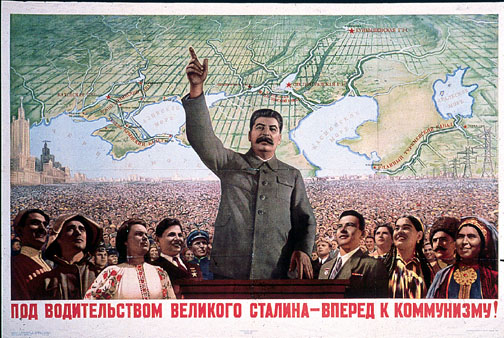
The caption proclaimed, "Under the Leadership of the Great Stalin - Forward to Communism" depicting Stalin at the helm of the vast empire stretching farther than the eye can see. He was portrayed as a beloved saviour and father-figure. To Russians who had grow up during his regime, they came to believe that the nation and the people would collapse without him. He commanded devotion, respect and even love from a people who were terrorized with the fear that they would be subjected to his murderous reprisals if they failed to demonstrate a sufficient degree of fawning. Like Lenin, Stalin created this cult of personality around himself to establish unquestioned authority over, and obedience by the masses. After Lenin's death his image still figured prominently in propaganda posters, along that of Stalin. That Lenin's embalmed body was put on perpetual display seemed almost to evoke the myth of "sainthood", given the evidence of an uncorruptible body.(In January of 2011, the United Russia party set up a website inviting the Russian people to vote on whether Lenin should be buried. Two-thirds of the respondents voted "yes" however no definitive action has been taken.)


This poster depicts a large raised hand which overshadows and contains the hands and faces of what constitute the masses. It undeniably affirmed the complete authority that Stalin exercised over the Russian people. The poster`s message, "Soviet Hands - We'll execute the plan for the great works." which reinforced communist ideology and extolled the value of workers as the "vanguard" in the business of nation-building. The reality however was quite different. In 1922 the industrial production in Russia reached only 22% of what it had been at the start of WWI. Through Stalin's intervention a marked recovery was achieved but not without considerable reduction in public consumption so that re-investment of capital could be directed toward industrial development. Central to Stalins policies was a ruthless expropriation of wealth from the kulaks. By 1933, workers' incomes plummeted to one-tenth of what it had been in 1926. Criminals and political prisoners were forced into unpaid labor, and between 1930 and 1932, over 520 factories had been constructed.


NEXT


February 10, 2012

YALTA CONFERENCE: SECRETS, LIES, AND BETRAYAL


Yalta. The name is synonymous with deception and betrayal. Yalta continues to endure as one of the greatest controversies of our time. For decades Western leaders, political analysts, academia, and journalists have been grappling with facts, half truths, lies and conjecture in the struggle to untangle the most baffling imbroglio of the twentieth century. Today it becomes ever more urgent to understand the lessons of Yalta and re-examine the events that led to the Cold War.


The Yalta Conference, one of a series of summit meetings during World War II, was convened at the Livadia Palace in the Crimea from February 4 to February 11, 1945. In the span of seven days the "Big Three" - President Franklin D. Roosevelt, Prime Minister Winston Churchill, and Marshall Josef Stalin, agreed upon the configuration of a post-war Europe, and sealed it's fate and that of the world for the next 47 years.

Yalta Conference February 4, 1945 Stalin, Roosevelt, Churchill and others

The meetings concluded with a set of protocols that dealt with a number of issues, including the unconditional surrender of Nazi Germany, the declaration of a liberated Europe, the restoration of sovereignty and self-determination to countries that had been occupied by Nazi Germany; the establishment of order and the rebuilding of national economies. The allies agreed to impose severe punitive damages against Germany that would be exacted by the payment of billions of dollars in reparations, the subjugation and dismemberment of the German state and military, and the establishment of allied zones of occupation therein to ensure future world peace and security.


Foremost in the Yalta agreement was the imperative of creating the United Nations organization based on the principles espoused by Roosevelt and Churchill in the Atlantic Charter signed in August 1941. It sought to establish world security and commit nations to  "respect the right of all people's to choose the form of government under which they will live and....to see sovereign rights and self-government restored to those who have been forcibly deprived of them...". The inclusion of these conditions in the Yalta Protocol was an absurdity, because by the time the Conference took place, the Red Army already occupied much of Eastern Europe and constituted a military force that was three times the size of the Allied forces positioned in the West.


PM Stanislaw Mikolajcyk
The Soviet Red Army had already occupied Poland under the pretext of a so-called "liberation" in January 1945.  In July 1944, the Polish Committee of National Liberation, also called the Lublin Committee was installed as the so-called "provisional" government of Poland, staffed by communist administrators, and backed by the notorious NKVD. Polish Prime Minister Stanislaw Mikolajcyk was deliberately left out of all summit conferences and never kept informed about its agreements.

Mikolajcyk continued to protest the Soviet occupation unaware that Poland had already been ceded to Stalin. His persistence caused considerable annoyance to Churchill and he berated Mikolajcyk for his refusal to surrender to Stalin's wishes. But it was all fait accompli.


Post-World War II Map of Soviet Influence in Europe

It was within this framework that Churchill and Roosevelt sought assurances from Stalin for a future Polish state. However the resulting Protocol was disturbing in its ambiguity. Though Stalin agreed to a future Polish government, he insisted that it would be based on the already existing Soviet-controlled Polish Provisional Government but he assured them that such government would be reorganized along a broader "democratic" basis by the inclusion of democratic leaders from Poland itself, and from Poles abroad" and that he would allow the "free and unfettered elections as soon as possible on the basis of universal suffrage and secret ballot." What eventually transpired would shock and outrage the world.


The agenda also included the question of Poland's post-war borders yet the matter had already been settled surreptitiously at theTeheran Conference in 1943. Stalin insisted that the Polish eastern border be determined by the Curzon Line which would result in the dissection of a third of Poland's territory. A secret meeting had been arranged at which Roosevelt unilaterally ceded Polish territory to Stalin in exchange for assurances that Russia would ally itself with the US in the Pacifc War. The deal was done without Churchill having known about it beforehand.


Incidentallly, during the Yalta Conference Roosevelt had taken many an occasion to snub Churchill perhaps in an attempt to improve his own bargaining position with Stalin.Churchill was bullied and mocked mercilessly. It was a spectacle of ridiculous proportions and one which achieved nothing other to amuse Stalin immensely. The rift that existed between Roosevelt and Churchill did nothing to strengthen their resolve against Stalin.

The Yalta agreement was hailed around the world as a resounding success. Reminiscent of Chamberlain's triumphant return to London after the Munich Agreement in 1938, Churchill was welcomed with similar fanfare when he returned to London after Yalta. Lord Beaverbrook, an enduring friend lavished Churchill with praise fit for a hero saying, "You now appear to your countrymen to be the greatest statesman as well as the greatest warrior."   


Time Magazine Stalin Man of the Year

From the moment that the Soviet Union became an ally, the British and American propaganda machine went into full swing. In January 1943 Time Magazine released its issue featuring Josef Stalin as Man of the Year. The ensuing article praised him for his "tough guy" approach because it "brought results".

In March 1943 Life Magazine devoted an entire issue glorifying the Russian Soviet leadership, proclaiming that Lenin was "perhaps the greatest man of modern time". They even suggested that the FBI was fundamentally comparable to that of the NKVD.  American media made every effort to draw similarities between the Americans and the Russians, and declared that the Soviets are "just like us". They "look like Americans", "dress like Americans" and "think like Americans".


Even Hollywood got in on the act and produced about a dozen pro-Soviet films, such as "Mission to Moscow", "Counterattack", "Song of Russia", "Days of Glory", "The North Star", and "The Battle of Russia" just to name a few. "Mission to Moscow" was made upon the request of President Roosevelt. The producer of the film, Robert Buckner referred to the production as "an expedient lie for political purposes". It portrayed the Soviet Union along the lines of an American style democracy in the attempt to whitewash the American public. But most disturbing thing of all was that at the heart of the American psyche was the genuine conviction that any "anti-Soviet" sentiment was considered inflammatory and anti-American. The propaganda was successful.


Even the British public was mislead about the true nature of the Soviet leader and did not consider Russia a threat. The British and Americans desperately needed the Russians if they were to defeat Nazi Germany.  Churchill went so far as to openly criticize the Polish government-in-exile for its refusal to cultivate "friendly relations" with Russia, implying that Poland was the real "enemy" and as a result was made an outcast.


Churchill and Roosevelt considered the Soviet Union a valuable ally and took every opportunity to portray the Soviet leader as an amiable bearer of democratic freedoms and peace. In their effort to paint a rosy picture of their alliance with the Soviet Union, they even referred to Stalin as "Uncle Joe"  however they both tread very carefully in an effort not to antagonize Stalin nor cause him any public embarassment or offense.


Roosevelt provided Stalin with considerable financial support as part of the Land Lease Agreement. In the period from 1941 to 1945, the United States shipped about $11.3 billion worth of supplies to the Soviet Union. (The US also shipped goods to other allies worth, $31 billion to Britain, $3 billion to France and slightly over $1 billion to China. The total expense to Americans was $50 billion, the equivalent of $611 billion today.) In addition the USSR received with more than 2,000 locomotives, 11,000 railcars, and 18,700 aircraft. By 1945, over two-thirds of trucks utilized by the Red Army came from the United States. Incidentals were also shipped to Russia, such telephone cable, aluminum, canned rations, and clothing. In return, Roosevelt wanted Stalin's support in the Pacfic War.


It was not long until news leaked out about the truth of the Yalta accords, and that Roosevelt and Churchill had sold out to Stalin's demands. (Other secret deals included, at Stalin's insistence, US recognition of Port Arthur, of Mongolian independence from China, of Soviet interests in the Manchurian railway, as well as special voting rights for the Soviet members of the United Nations Security Council.) The British House of Commons was in an uproar over the deal about Poland, and anxious about the possible consequences.  In a blistering speech in the House of Commons MP Dunglass denounced Churchill for the "transfer to another power the territory of an ally" and that Churchill failed to permit the Polish government to have "the full right to choose their own government free from the influence of any other power." The following day twenty-five MP's who opposed the Yalta agreement introduced an amendment to the vote of confidence.  However, the amendment was defeated by a landslide: 385 votes against, and 11 abstained. Only 25 votes were in favor.

PM Winston Churchill
Despite the heated accusations, Churchill expressed immense self-confidence that the Yalta Conference was a success and staunchly defended his position saying, "I repudiate any suggestion that we are making a questionable compromise or yielding to force or fear. The Poles will have the future in their own hands, with the single limitation that they must honestly follow a policy friendly to Russia. That is surely reasonable. I know of no government which stands to its obligations more solidly than the Russian Soviet government."

Stalin and Churchill caricature


In reality Churchill had long been a harsh critic of communism and thoroughly despised Stalin and his regime. He was well informed about Stalin's murderous campaigns, the endless purges, the slaughter that lay in wake of the Red Army, in particular their hand in the massacre of thousands of Polish Officers at Katyn in 1940.  Most heinous was the betrayal of the Poles during the Warsaw Uprising in 1944.  At the crucial moment when the Polish Army most expected help from the Russians, the Soviet Red Army stopped at the banks of the Vistula River and merely watched and waited while the Nazis were slaughtering the Poles. It was all the more shameful because Churchill and Roosevelt refused to help the Polish Home Army despite their frantic pleas for assistance. Churchill imposed a media ban to prevent these facts from being public knowledge.  After the defeat of the Warsaw Uprising, Churchill met with the Polish Prime Minister in Moscow, turned to him and uttered these words: "The Russians will sweep through your country and your people will be liquidated.  You are on the verge of annihilation."

Katyn Massacre - (Russia)
16,000 Polish officers were executed by Soviet NKVD


Franklin D. Roosevelt
Roosevelt on the other hand was willfully ignorant and adamantly refused to confront any of the facts despite constant attempts by the State Department to inform him of the true nature of "Russian diplomacy". FDR revealed his naievete when he unabashedly defended his opinion of Stalin.He said, "I think that if I give him everything that I possibly can and ask nothing from him in return, nobless oblige, he won't try to annex anything and will work for a world of democracy and peace".

During the Yalta meetings, Roosevelt sent a letter to Stalin (dated February 6, 1945) in which he tried to persuade him to make reasonable concessions in regard to a future Polish government otherwise it would have put the three of them in a "bad light throughout the world", that is, Stalin recognized one government "while we and the British are recognizing another in London". 


Soon after the conclusion of the Yalta conference, and three weeks before his death, Roosevelt came to the startling realization that he had failed miserably, and that his advisors had been right all along. He admitted that "Averell is right.  We can't do business with Stalin. He has broken every one of the promises he made at Yalta.".   Averell Harriman, US Ambassador to the Soviet Union, had accompanied Roosevelt to Yalta and encouraged the President to take a tougher position against Stalin, in defense of the Polish question.

In a Top Secret White House memorandum dated May 11, 1945, William Leahy, Chairman of the US Joint Chiefs of Staff relayed a message to the U.S. Secretary of State which Churchill had dispatched to Foreign Secretary Anthony Eden. In it Churchill advised Eden of the urgency of resolving the Polish problem, and expressed grave concern over European security should American troops withdraw too quickly. The following is a reproduction of this two page document in its entirety.


Churchill expressed concern over what he termed the "Polish deadlock",  worried about the impending tide of Soviet expanisionism and the fear that Poland would be "completely engulfed and buried deep in Russian-occupied lands".  But in the wake of the Yalta conference these concerns were swept aside and replaced by the single determination to win the war whatever the cost.


Churchill was a highly skilled orator who also demonstrated exceptional dramatic license. Memos such as that presented above served only to perpetuate his masquerade, a tactic which was well timed. His gesture of trying to salvage European security and rescue Poland at the last moment could only assure that Churchill's political intregrity and legacy would remain unscathed.


Roosevelt was never particularly interested in the "Polish problem".  His main preoccupation in 1944 was winning another Presidential term.  On October 11, 1944 he invited the members of the Polish American Congress to the White House. It was a perfect photo opportunity. Behind the President was a huge map of Poland on the wall illustrating the demarcation of its eastern border along the Riga Line rather than the Curzon Line. In an effort to win the trust and support of Polish Americans, Roosevelt concealed the truth about Yalta, and assured the Polish delegation that they could depend on the friendship of the US government. Roosevelt won their vote easily all with few words and a big map.

President Franklin D. Roosevelt
and members of Polish American Congress


IMMEDIATE REPERCUSSIONS OF YALTA

In March 1945, Stalin demonstrated his compliance with the terms of Yalta by inviting Polish leaders from abroad to form the new Polish Government of National Unity (TRJN). But upon their arrival, they were immediately arrested by the Soviet NKVD. Though Prime Minister Mikolajcyk joined a few others to co-operate in this new government, they were all betrayed.

By June of that year, the new coalition government was organized, and consisted of members of the Polish government-in-exile, and those of Polish Communist Party. But Stalin made certain that none of the old guard possessed any real power.

Stalin's promise for "free and unfettered elections" never materialized. The communists used repression, bribery, threats, and even murder of opposition members to consolidate their power. An "election" was held only when the communists were certain to obtain majority support. No British nor American observers were permitted to attend. Prime Minister Mikolajcyk had no choice but to resign.


The Polish government-in-exile did not recognize the TRJN - neither did the Vatican. But surprisingly on July 5th, 1945, the United States gave the TRJN full recognition, which soon after was followed by France and the United Kingdom. By October of that year delegates of TRJN signed the United Nations Charter, and Soviet Poland became a full member of the United Nations. In retrospect the events leading up to the demise of Poland's sovereignty had all the makings of a coup d'etat. Stalin was a master puppeter, and Churchill and Roosevelt were his puppets.

By August 16, 1945 the controversy over the Curzon line was finally settled, albeit by questionable and devious means. The "Soviet" Polish government agreed to cede its eastern territories to the Soviet Union and officially recognized the Curzon Line as its eastern border. 


Throughout this episode the Soviet NKVD embarked on a massive man-hunt to capture Polish soldiers of the Armia Krajowa. Polish fighters were arrested, tortured and hanged. Thousands more Poles were deported to remote camps in the Russian gulag. Polish troops which had helped the Red Army drive the Germans out of Lwow, Wilno and Lublin were summarily executed. Sixteen prominent leaders of the Polish underground were arrested and killed after having been subjected to a mock trial. The NKVD was able to track them down only because British Foreign Minister Athony Eden gave Stalin the list of names.


CONCLUSION

With the fall of the Iron Curtain and the end of the Cold War there is a resurgence of interest in the events of the Yalta Conference and a re-examination of the causes of the Cold War. The controversy still continues to plague us and questions arise as to which side was actually responsible for the start of the Cold War, and precisely when? Were the Americans responsible, or the Soviets? Is there anything that Churchill and Roosevelt could have done to prevent it's escalation and how? Many in the West continue to defend the legacy of Roosevelt and Churchill, insisting that they innocently fell victim to Stalin's chicanery. It is imperative that we look at the cold, hard facts before we can formulate objective conclusions.


Now that the Cold War is over, Russia is an equal among democratic nations. Communism, its ideology and fanaticism has melted away giving rise to the anticipation of a more peaceful co-existence. No matter. Rivalries will continue to exist irregardless of the catalyst, be it ideological, cultural, or political. On February 27, 1945 Churchill addressed the House of Commons about the Crimea Conference, in which he stated, "It is a mistake to look too far ahead. Only one link in the chain of destiny can be handled at a time." He was sorely mistaken. It is vital to the future peace and security of the world that international agreements entered into with friendly nations (or adversaries) take into account the long-term ramifications. Quick fixes do not work. The Yalta Conference proved it.