Showing posts with label Red Army. Show all posts

March 10, 2018

MARCH 10 - DAILY CHRONICLES OF HISTORY

MARCH 10

1920

Red Army under Marshal Tukhachevsky began a western offensive. He was a leading Soviet military leader and theoretician from 1918 to 1937 and commanded the Soviet Western Front in the Soviet-Polish War of 1920–1921.  In the lead-up to hostilities, Tukhachevsky concentrated his troops near Vitebsk, which he theatrically dubbed, "The Gates of Smolensk". When he issued his troops orders to cross the border, Tukhachevsky said, "The fate of world revolution is being decided in the west: the way leads over the corpse of Poland to a universal conflagration.... On to Wilno, Minsk, and Warsaw -- Forward!


1944

The USS Leopold was sunk by enemy action. On 9 March, while south of Iceland, the Leopold  reported a radar contact at 19:50 at 8,000 yd (7,300 m), which placed it 7 mi (11 km) south of the convoy at 57°37′0″N 26°30′0″W. Assisted by the destroyer escort Joyce, Leopold was ordered to intercept. General Quarters was sounded and orders were issued to "fire on sight." A flare was released and gun crew strained to sight the submarine in the lighted area. The U-boat was almost submerged when spotted and the gun crews had to work blind. "Leopold" was struck by an acoustic torpedo fired from the German submarine U-255. Shortly after the torpedo strike the crew of "Leopold" began to abandon ship as the Leopold broke in half. "Joyce" rescued 28 survivors at the close of the action; 171 others were lost through the explosion on board, drowning, and - most of all - cold water emersion." Leopold"'s bow still remained afloat early the next morning, and was sunk as a hazard to navigation by gunfire from "Joyce" 400 miles south of Iceland.


1945

German submarine U-275 struck a mine and sank off Newhaven, East Sussex.


U-681 was grounded off Scilly, damaging the pressure hull and propellers. Unable to dive, the commander of the U-boat, headed towards the Irish coast seeking internment by Irish authorities. But the next morning PB4Y-1 Liberator N of VPB-103 spotted the sub on the surface and went in for the kill.  Eight depth charges further damaged the U-boat.  With sea cocks opened and demolition charges set, U-681 submerged followed by a massive explosion. Of the crew of 47, a British escort picked up 38 survivors.


August 15, 2012

POLISH ARMED FORCES DAY AUGUST 15

Polish Armed Forces Day is celebrated on August 15th in tribute to all Polish armed forces, of land, sea and air, and the Polish men and women who have made great contributions and sacrifices in the service of Poland, and the world.

Jozef Pilsudski - Polish Russian War - Miracle on the Vistula
Jozef Pilsudski
It also commemorates the Polish victory during the Battle of Warsaw, or what is has often been referred to as the "Miracle on the Vistula".   That few westerners even know about this Battle is rather disturbing since it marked a crucial point in world history.  It was more than a Polish victory in defense of her national sovereignty.  Poland was the bulwark standing between the Soviet Union and the spread of global communism. 

Poland's thousand-year history has been a long and bloody saga of countless invasions by neighbouring enemy states who sought to destroy the very existence of the Polish nation, its culture, and its people.  From 1795 to 1918, Poland was partitioned for the third time in its history, by Russia, Prussia and Austria.  It had virtually ceased to exist as a nation and was virtually obliterated from the map.  After 123 years of oblivion the Polish state came into existence once again, the result of terms set out in the Versailles Treaty.

But no sooner had World War One ended that the Polish-Soviet war had commenced. While Poland was struggling to solidify its new-found sovereignty and re-establish its borders, the Russian Civil War was in full swing. Bolshevik propaganda boasted that Warsaw would quickly fall, and thus signal the beginning of communist revolutions that would sweep throughout Poland, Germany and other western European nations.

The Russian commander Mikhail Tukhachevsky planned to cross the Vistula River and surround Warsaw to the north and south, thereby cutting of Polish access to the port of Gdansk, and its vital supplies of materiel.  The Russians expected the maneuver to result in a swift and massive victory, much like that of 1831 during the November Uprising.  What transpired shocked and humiliated the Russians.

The Battle of Warsaw began on August 12th, 1920 and in two days the Red Army conquered the city of Radzymin.  Sikorski's 5th Army courageously fought against three Russian armies, the 3rd, 4th and 15th Soviet armies simultaneously.  They were able to hold out until dawn until the Polish 18th Infantry Division was dispatched to relieve them.  By midnight the 203rd Polish Uhlan Regiment broke through Russian lines and successfully attacked the enemy command post, destroying its radio station.  

The battle ensued until, on August 15, the town of Nasielsk was almost completely destroyed. Polish troops then recaptured Radzymin which was a military and a moral victory.  The Soviet advance towards Warsaw had all come to standstill.

Sikorski's 5th army, in liaison with a few, but no less potent, number of mechanized units of tanks and armoured cars, launched what can only be described as a "blitzkrieg-type" of maneuver, which successfully scattered Russian troops away from Warsaw environs. In addition, Polish troops had the support of two armoured trains which were used to disrupt Soviet maneuvers.

Despite these Polish victories, the Russian commander was convinced that everything was going according to his plan.  He knew that there were just a few Polish troops in their path and that the south of Warsaw would be vulnerable to attack.   However, the commander of the 1st Cavalry Army, Semyon Budyonny, disobeyed orders to march on Warsaw, and instead marched on the city of Lwow.

On August 16 the Polish Reserve Army, under the command of Marshal Jozef Pilsudski, marched north from the Wieprz River and coming face to face with the Mazyr Group, quickly retreated. But - as the Soviets pursued them, they lost many of their own troops, and were left with only one or active divisions.  Polish divisions launched a fierce counter-offensive and succeeded in pushing north 45 kilometers without any opposition. By evening the Poles liberated the town of Wladawa, and succeeded in cutting communication and supply routes of the Soviet 16th army.  They successfully outmaneuvered the Soviet troops, leaving them surprised and confused in their wake.  It was a stunning Polish victory!

At the end of the war, Red Army casualties were about 15,000 KIA, 500 MIA, 10,000 WIA, and 65,000 captured.  Conversely, Polish losses were about 4,500 KIA, 22,000 WIA, and 10,000 missing.  Polish troops captured about 231 pieces of Soviet artillery and 1,023 machine guns.


BOG,  HONOR,  OJCZYZNA
GOD, HONOR, COUNTRY


February 28, 2012

WW2 PROPAGANDA: WAR OF WORDS Part 3 Soviet Propaganda


Stalin speech on November 7, 1941 (with English subtitles) (00:06:48m)


Stalin - the very name continues to evoke controversy today. He rose to power on a wave of deception and murder and became one of the most feared and dangerous despots of all time. Throughout the thirty years of his reign, Stalin was responsible for the deaths of millions of people yet the Russian people revered him as a father-figure and demi-god. It is astonishing to note that some Russians today still praise his legacy.

It is not difficult to perceive how this demon rose to the heights of demagoguery.  Stalin was among the progenitors of the 1918 October Revolution
driven by the theories of Marxist-Leninism. It appealed to and galvanized a nation through slogans idealizing the struggle of the "proletariat" against the oppressive masters of imperialism and capitalism. However it only replaced one power elite with the tyranny  of another.


The above video documented Stalin's address on November 7, 1941 to the Soviet military forces, in the wake of their overwhelming losses to the "German brigands". The Nazis had spearheaded Operation Barbarossa in June of that year in an ambitious campaign to conquer the Soviet Union and though they had achieved initial successes it would be short-lived. 

The above Soviet propaganda poster appealed to the patriotic sentiment of the nation by referring to the legendary victories of the Russian armies; in wars against the Teutonic Knights in the Battle of the Ice in April 1242, against the Prussians in 1760 when Russians captured Berlin during the Seven Years' War,  and the pivotal October Revolution, in which the government was overthrown and power seized by the Bolsheviks.  It proclaimed that Russian victory would again be achieved despite the assault of the Nazi German hordes. In this illustration a Russian soldier slays a German soldier who is depicted as a demon (made apparent by the addition of little horns on his helmet) and a sluggard (by the lack of any weapon except that of a bottle of alcohol.)


This Soviet poster speaks for itself. It depicts
comical images of Hitler and his generals running for their lives from the approaching convoy of Soviet tanks. It was meant not only to demoralize and ridicule the Wehrmacht but assert Soviet confidence that military fortunes were shifting in their favor. In the early stages of this war, German forces succeeded in penetrating Russian-occupied territories through eastern Poland and the Baltic states and captured Leningrad and then Smolensk. By autumn 1941 the Germans were poised to attack Moscow but the onset of a Russian winter literally froze them in their tracks.  It was then that Stalin was ready to launch a fierce counteroffensive with troops he had called in from Siberia and the Far East, supported by an ample supply of new tanks and weapons. The battles ensued for four more long years until the Red Army was able to defeat the Nazis all the way back to Berlin.


In this poster Hitler was portrayed as a miniature version of "Napoleon" and bearing a tiny pistol which was hopelessly inadequate against the butt of a big Russian rifle. The implicit message was that Hitler would suffer the same humiliating defeat as Napoleon. The background shadow of a farmer's pitchfork with the date 1812 referred to the Patriotic War during which Napoleons armies attempted to conquer Russia. It was an historic battle of epic proportions but which ended with catastrophic results and the decimation of Napoleons' Grand Armee. The caricature of Hitler holding a shredded document represented the Non-Aggression Pact signed between Germany and Russia just prior to the outbreak of WWII - an outright condemnation of Germany as the aggressor.


The caption of this "Defend the city of Lenin" was an attempt to rally the support of the Russian people in the defence of their "fatherland" from the German invasion. It depicted two Russian military men who symbolized the Red Army of the army and naval forces, accompanied by the a poor farmer and his wife - symbols of the "proletariat". All four stood united against imperialist invaders in the struggle to defend Leningrad and the military-industrial complex. It was as much an ideological war as it was a military one, defending the city which was named after the leader of the October Revolution.


The caption roughly translated means "Join the army of front-line women! Women at arms are soldiers, helpers, and friends!"  When Germany attacked the Soviet Union in June 1941 thousands of Soviet women volunteered to enlist in the Red Army but were initially turned away by government officials.  It was not long afterwards that they were permitted to enlist, serving primarily in medical and auxiliary capacities. Eventually Russian women were deployed; as pilots, machine gunners, tank crew members and snipers and bore their share of the burden of WW2, or what came to be known as the Great Patriotic War. Of the 800,000 Russian women who served in the Red Army, about 200,000 received military decorations and in time 89 women would receive the highest decoration of the country, the Hero of the Soviet Union. This was in sharp contrast to the role that German women played during WWII. German culture and tradition was such that women were expected to remain in the home and pursue their roles as wife and mother. German women did indeed receive medals from the Reich but it was to reward them for having the most children possible.


This poster entitled, "Set Europe Free" (1944) was the work of the famous Russian artist, Viktor Koretskij who produced many striking, iconic images that were used by Russian propagandists.  Europe, represented here by the image of a courageous and stoic woman has just been liberated from Nazi bondage. Though it is barely perceptible, the shackles on her wrists bear the engravings of Nazi swastikas.  The combined military power of the allies, as illustrated by the swords bearing the flags of Britain, the United States, and the Soviet Union share in her liberation, although not equally.  The Russian sword is significantly larger alluding to the fact that Russia employed more military resources and suffered heavier casualties than that of the other allies' combined.

This poster designed by Viktor Deni in November 1920 was entitled "Comrade Lenin Cleanses the Earth of Filth" Lenin is depicted as sweeping (purging) the world of elements opposed to communist ideology; the imperialists, the capitalists and the Jews. This image belies the reality of the Red Terror. Anyone daring to oppose the Bolsheviks was arrested, tortured and subjected to summary executions. Prisons were overflowing with men and women deemed as "enemies of the state". Lenin claimed that the real terror emanated from British imperialists and their allies, such as Yudenich (a commander of the Russian Imperial Army and leader of the anti-communist White movement during the Russian Civil War), Kolchak (a Russian naval commander who became the supreme ruler of the counter-revolutionary anti-communist White forces) and Marshal Jozef Pilsudski (Poland's Chief of State from 1918-22) who was largely responsible for regaining Poland's independence in 1918 after 123 years of national oblivion. When Stalin reached power in 1924 his own brand of terror far exceeded that of Lenin's.


This photo taken in the 1930s is an example of the kind of propaganda used by the Stalinist regime. The top photo showed the image of Nikolai Yezhov walking with Stalin. Yezhov was head of the NKVD, an ardent Bolshevik and close confidant. He was arrested and put on trial for suspicion of plotting to assassinate Stalin. Though he pleaded innocence he was sentenced to death and was executed in 1940 in one of Stalin's Great Purges. The bottom photo shows that the image of Yezhov had been airbrushed out, a common practice of the time. Moreover,Stalin had declared him damnatio memoriae, which entailed the complete eradication of the name Yezhov, and the very memory that he ever existed.


Bearing similarity to that of Nazi Germany, the Russian government had installed a department named Glavlit, to take over all state media and control its dissemination through censorship and propaganda. Publication of all books, newspapers and the like, as well as radio and TV broadcasting came under ts harshest scrutiny. All undesirable information was vigorously censored and history was virtually rewritten, by the elimination or fabrication of information, to comply with the demands of the communist elite.


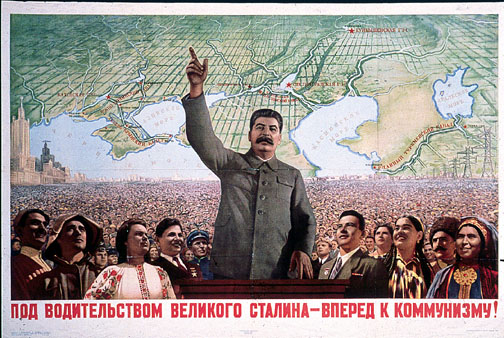
The caption proclaimed, "Under the Leadership of the Great Stalin - Forward to Communism" depicting Stalin at the helm of the vast empire stretching farther than the eye can see. He was portrayed as a beloved saviour and father-figure. To Russians who had grow up during his regime, they came to believe that the nation and the people would collapse without him. He commanded devotion, respect and even love from a people who were terrorized with the fear that they would be subjected to his murderous reprisals if they failed to demonstrate a sufficient degree of fawning. Like Lenin, Stalin created this cult of personality around himself to establish unquestioned authority over, and obedience by the masses. After Lenin's death his image still figured prominently in propaganda posters, along that of Stalin. That Lenin's embalmed body was put on perpetual display seemed almost to evoke the myth of "sainthood", given the evidence of an uncorruptible body.(In January of 2011, the United Russia party set up a website inviting the Russian people to vote on whether Lenin should be buried. Two-thirds of the respondents voted "yes" however no definitive action has been taken.)


This poster depicts a large raised hand which overshadows and contains the hands and faces of what constitute the masses. It undeniably affirmed the complete authority that Stalin exercised over the Russian people. The poster`s message, "Soviet Hands - We'll execute the plan for the great works." which reinforced communist ideology and extolled the value of workers as the "vanguard" in the business of nation-building. The reality however was quite different. In 1922 the industrial production in Russia reached only 22% of what it had been at the start of WWI. Through Stalin's intervention a marked recovery was achieved but not without considerable reduction in public consumption so that re-investment of capital could be directed toward industrial development. Central to Stalins policies was a ruthless expropriation of wealth from the kulaks. By 1933, workers' incomes plummeted to one-tenth of what it had been in 1926. Criminals and political prisoners were forced into unpaid labor, and between 1930 and 1932, over 520 factories had been constructed.


NEXT


September 21, 2011

Warsaw Uprising 1944: September 21 Poles Are Fiercest Adversaries says Himmler

Polish Insurgents have been waiting for the First Polish Army to make a landing and have fled burning buildings to take positions in the trenches along the banks of the Vistula. They are waiting, but the declared aid has not arrived.

General Monter has sent a radio message to the commanding officer of Zoliborz Sector ordering the him to expand and fortify his territory.  Though Polish Command had pleaded for weeks for Russian assistance, the Polish strategy is now to invite Soviet commanders to come to them, rather than vice versa. It is a decision that is widely supported by Polish political leaders in Warsaw as well as by the Delegatura.

Polish civilian and military authorities have assembled in the Centre City Sector. The Deputy Prime Minister, the Delegatura are making preparations to welcome the Red Army.  Polish troops of the Armia Krajowa will be concentrated in the same region to provide security in the event of any hostile activities or provocation. The Government Delegate of the city of Warsaw will direct the civilian administration for the interim.  Briefings among civilians and military personal are underway to establish an attitude of friendliness and willingness to cooperate with the Red Army, on the condition however, that Polish authorities are respected.

The AK have been wiped out by the German forces.  Throughout the onslaught, Russian spies had infiltrated Warsaw. During the month of September there were a total of five Red Army shortwave stations operating inside Warsaw reporting everything to Soviet Headquarters. Since the beginning of the Uprising, a Russian officer by the name of Captain Kalugin had linked up with AK command in Warsaw, and throughout the Uprising Kalugin was sending messages to Stalin through the AK short-wave stations. One of those messages from early August has been translated and contains a request for Soviet assistance in key areas of Warsaw.


Soviet reconnaissance planes have been spotted flying over the fires of Warsaw while the Polish Communists have infiltrated the city, intermingling with civilians and the AK. The communists secretly gathered information and gauged conditions in Warsaw as well as the general morale of the civilians and secretly dispatched their reports through messengers and other means to the Soviet-backed "Lublin Committee", in other words, they went directly to Stalin.

German Command proposed surrender to Czerniakow Sector but the insurgents declined. The battle continues. The Germans blew up the remaining pumping stations at Koszykowa Street as well as the public wells, which were the only source of potable water in the city. Enemy forces have exerted continuous pressure on the Czerniakow beachhead.

Polish civilians queue for water at the pump in early September  Warsaw 1944

Water fills a huge crater created by German bombing Warsaw 1944

Ryszard Bialous "Jerzy"
Polish troops under the command of Captain Ryszard Bialous “Jerzy” linked with soldiers from the First Polish Army under the command of Major Stanislaw Latyszonek, now hold control of only a patch of the riverbank and two houses located at 53 Solec Street and at 1 Wilanowska Street on the corner of Solec Street. Srodmiescie is being pounded continuously by heavy artillery fire. Meanwhile insurgents have managed to destroy an enemy barricade on the corner of Aleje Jerozolimskie and Bracka Street. In the western part of Srodmiescie, they were able to fight off a German attack on Borman’s factory on Towarowa Street.

Captain Bialous had fought in defense of Warsaw during the September Campaign of 1939. He was a platoon commander in the 8th Battalion of Sappers Infantry Division. He was seriously wounded in both legs and was hospitalised for four months.  After he was discharged from the hospital he founded the organisation of the famous Grey Ranks. By 1943 he became head of the organization and was known by the code-name Zygmunt. During the Uprising he has been commander of the battalion "Sophy". On August 31st after the death of John Caius Andrzejewski, Bialous became commander of the brigade diversion "Broda 53" in the Radoslaw regiment of the Armia Krajowa. By the end of the Uprising, the "Sophy" Battalion will have lost over 360 soldiers,(KIA, MIA) or 70% of its fighting force. Bialous was promoted three times: in January 1941, Lieutenant reserves; May 1943, Lieutenant; and September 1944, Captain.  He was decorated with the Cross of Valour three times and the Order of the Virtuti Militari V Class.

Cross of Valour - Poland WW2
Virtuti Militari V Class - Poland WW2

In Zoliborz, a German assault on Kepa Potocka has stopped the landing of the 6th Infantry Regiment. Survivors managed to cross over to the right bank of the Vistula. Unaware of that, insurgent troops, unaware of their presence, attack Marymont at dawn. They reached Promyka Street and waited for soldiers of the 6th infantry regiment, who were supposed to break through from across the river. Realizing their isolation, Home Army soldiers retreated destroying the fortifications of the German positions they had managed to seize.

"This is the fiercest of our battles since the start of the war. It compares to the street battles of Stalingrad." 
SS chief Heinrich Himmler to German generals on 21 September 1944

During September, 42 planes of the Squadron 1586 flew 17 combat missions to Warsaw, 16 to Italy, 7 to Yugoslavia and 2 to Bulgaria. Eight crews perished in flights to Warsaw. There were no losses in flights to other countries. The last flights to Warsaw were on 20 and 21 September. Total losses of Squadron 1586 for the months of August and September 1944 were 17 crews, 15 in flight to Warsaw, one crew while delivering supplies to other zones in Poland, and one in northern Italy.

Flight conditions to Warsaw were extremely hazardous and every plane that returned had been hit. Even parachutes inside the planes were riddled by German bullets or explosives.

Lt. John Ward is a British soldier and member of the Armia Krajowa.  From the very outset of the Uprising, Ward has been dispatching secret coded messages to London detailing the events in Warsaw.  He is also the "voice" of an Underground Polish radio station, transmitting regular reports to Polish civilians around Warsaw.

Warsaw headquarters of the Polish Home Army have established direct contact with the Soviet forces on the east bank of the Vistula. Liaison is carried out by two wireless operators who landed in Warsaw by parachute on the area occupied by Polish troops.


September 15, 2011

Warsaw Uprising 1944: September 15 SOVIETS SEND POLISH TROOPS TO THEIR DEATH

Throughout the day Zoliborz was pounded by enemy artillery fire, mortar fire and bombing raids. The Germans have taken over another section of the riverbank from Krasinskiego Street to the Citadel. Home Army units are now completely cut off from the Vistula.

German troops have launched attacks on Dolny Mokotow and set Sielce on fire. There is heavy fighting on Dolna, Piaseczynska, Chelmska and Belwederska Streets. The insurgents retreat Sielce after a bloody struggle. Fort Legionow Dabrowskiego falls and German troops have occupied almost all of Dolny Mokotow. The new line of defense for Mokotow is Belwederska Street.

Polish Soldiers of the "Miotła" Battalion Radosław

A Kosciuszko division patrol crossed into Czerniakow this morning and established contact with a liaison officer of 'Radoslaw'. Fighting was heavy in the area bordered by Ludna, Okrag, Czerniakowska and Zagorna Streets. By nightfall about 300 heavily-armed soldiers from the Polish First Division crossed to the left bank of the Vistula. German troops, with support from the air used every means to prevent the insurgents from reaching the Vistula.

1st Polish Infantry Division supporting Soviet 76th and 175th Infantry Divisions
 on southern edge of Praga September 12th 1944

The Red Army captured the right bank of the Praga district while Polish 1st Army units under Soviet command but without support. The Czerniakow district has fallen with heavy casualties. When the Russians occupied the Praga suburbs of Warsaw their advance all but came to a stop. Apparently Russian chicanery has sustained the illusion of a Soviet rescue while permitting the Germans to wipe out the non-Communist Polish forces. Earlier today on radio General Michal Rola-Rymierski, the Commander-in-Chief of Polish forces under the Soviet Command, made a proclamation stating, “The time for liberation of our capital has come...I order...soldiers of the First Polish Army...to storm Warsaw!”


Russian Soldiers Firing on Germans in Warsaw

The First Polish Army, under the command of Major General Zygmunt Berling, undertook to force the Vistula River and link with Polish insurgents in the regions of Czerniakow and Zoliborz. Berling sent forward three patrols of the 1st Polish Army including the 3rd Polish (Kosciuszko) Infantry Division. The first boats reached the western shore in an area defended by about 400 Polish soldiers of the Armia Krajowa. Although the AK units were cut off from the rest of the insurgents, they were able to maintain control of the shore in anticipation of a Soviet support. But artillery cover and air support supplied by the Soviets was grossly insufficient to counter fierce German machine-gun fire as the troops were crossing the River. Upon landing, enemy fire virtually wiped out the Polish contingent. Polish casualties were very heavy. Only a small number of troops were able to make it ashore - the I, and III Battalion of the 9th Infantry Regiment, and the 3rd Infantry Division.


According to Soviet and Polish sources, the staff of the First Byelorussian Front allotted the First Polish Army additional Soviet forces: 5 brigades of artillery, one regiment of mortars, 3 battalions of engineers and one battalion of amphibious cars. In addition six units of artillery and the Red Air Force were to support the action. The plan was not successful due to poor organization and intense German artillery fire. Moreover the first wave of soldiers were ill-equipped, and the units that did succeed in crossing to the insurgents side of the Vistula suffered very heavy losses.

General K.F. Telegin
Nikolai Ivanovicty Syerov, a war correspondent, asked Colonel Pagaryelov, the political officer of the division the reason why Soviet troops were not moving forward, and what was happening in Warsaw. The Colonel responded that according to orders he received from his superior, General K.F. Telegin, there was an uprising in Warsaw, but that it was being fought by nationalist and bourgeoisie under the auspices of the Polish government in exile. As such it was not in the interest of the Soviet Union to provide them with support.


Many of the men of the First Polish Army had been deportees from eastern Polish territories during the Invasion of Poland in 1939. Upon being drafted they were forced to swear allegiance "to be faithful to the Soviet Union and maintain the brotherhood of arms with the friendly Red Army” while Polish armed forces in exile took oaths to protect and defend Poland, the President of the Polish Commonwealth,its constitution and laws. It is noteworthy that the officers of the First Polish Army are predominately Soviets wearing Polish uniforms and that their staff is comprised of Communist political officers many of whom are not Polish.

Polish soldiers of 27th Infantry forced to conscript into Soviet Polish People's Army


September 13, 2011

Warsaw Uprising 1944: September 13 Soviet Troops Smash Praga District

German troops have systematically blown up several bridges in Warsaw: at noon it was the Poniatowski Bridge - by evening, the railway bridges near the Citadel and just before midnight the Kierbedz Bridge was completely demolished.  Throughout the day German troops launched continuous attacks on Czerniakow while German air raids and artillery went about destroying all the larger buildings. One by one the Germans have eliminated points of Polish resistance in the area of Czerniakowski Port and on Lazienkowska Street. Enemy fire was so overwhelming that insurgent troops were forced to leave the port.  Polish units also had to retreat from the even-numbered side of Lazienkowska Street. Meanwhile enemy units have taken over the gasworks premises in Ludna Street and have seized the ZUS building on Czerniakowska Street. After a fierce 24-hour battle, the Germans seized the buildings of St. Lazarus Hospital on Ksiazeca Street.  The insurgents attempted to launch a counterattack to recapture the entry of Ksiazeca Street in Trzech Krzyzy Square and restore communication between Srodmiescie and Czerniakow but failed.


Wyzwolenie Warszawskiej Pragi (00:10:30m) 


Armia Krajowa Headquarters dispatched a messenger to cross the Vistula during the night and attempt to establish contact with Berling's army staff.  The Soviet offensive resumed today and Russian troops have smashed their way through to Praga, a suburb of Warsaw. During the night the Soviet airforce has made its first supply drops over Warsaw for the Polish fighters.  Rokossovsky later remarked that "This is when the Uprising in the Polish capital should have started.  A joint strike by the Soviet Army from the east and the insurgents from Warsaw, taking the bridges, could have succeeded in liberating and holding Warsaw, though, even in the most favourable circumstances that would have been just about all the Front's troops could do."  

 
Soviet troops advance in Warsaw's districts 1944
Concerned about the arrival of Russian troops into Warsaw, General Bor sent detailed instructions to General Monter on the recommended behaviour by the Polish units.  Monter has been ordered to hold the regions in Polish hands, but to clear the main routes through Warsaw so that the Red Army could pursue the Germans, In addition, there has been an order for all AK partisans currently outside Warsaw, to come to the city.  Territories that are still held by the insurgents have been clearly identified by Polish flags.  Attached to Bors' instructions was a note entitled, "How to Parley with the Red Army".  General Monter has immediately issued Special Order number 83, calling for the seizure of as much of Warsaw as possible. Lt. John Ward is a British soldier and member of Armia Krajowa has been reporting on the Uprising through regular secret messages dispatched to London.  Ward has been giving a rare glimpse into the daily struggles and horrors experienced by Polish civilians and insurgents.  Today's report, albeit brief, tells of the sort of brutality waged by German forces against Polish insurgents. Polish Home Army men who had captured a house from the Germans on Zulinski Street found some food supplies left behind by the enemy. Five of the men were so famished that they at once ate part of the food. It was poisoned with strychnine and three of them have died; the other two are in a serious state.  


August 23, 2011

Warsaw Uprising 1944: August 23 - Germans Wipe Out Entire Polish Army

Junkers JU 87B Dive Bomber
German forces have launched a brutal attack against a unit of Armia Ludowa (The Polish Communist underground army) killing all 150 members. The Armia Ludowa was the same unit responsible for having liberated 324 men and 24 women from a German camp located in the Old Town district of Warsaw. Eighty-nine were Polish citizens, while the rest were victims of Nazi persecution from Romania, Holland, and Hungary.

The Armia Ludowa are communist partisan forces formed by the Polish Workers Party. Their objectives are to support the Soviet military against German forces as well as create a pro-Soviet communist government in Poland. As such they have refused to join the Polish Underground State however many AL soldiers joined the ranks of the 1st Polish Army that was recently formed in the Soviet Union rather than the Red Army.

Most of the members of the 1st Polish Army are Poles and secular Jews who had been deported to the Russian gulag after the Russians invaded Poland on September 17, 1939.  Over 40 per cent of the officers are of Soviet origin while the command staff and training officers constitute 70 to 85% of the forces. That the Soviets maintain tight command and control of the regiment clearly indicates continued distrust of the Poles.  The 1st Polish Army is organized in much the same way as its Soviet counterpart but with substantially weaker armament.

Armia Ludowa Peoples Army in a forest near Lublin

From positions inside the ruins of Warsaw City Hall Polish insurgents managed to shoot down a Ju 87 Stuka Bomber. It is the only bomber that the insurgents have been able to shoot down since the Uprising started.  The reason is that the AK placed a ban on targeting aircraft due to lack of sufficient ammunition. Later in the afternoon Germans launched an offensive in all sectors, attacking the Jan Bozy Hospital on Bonifraterska Street, the Fiat Factory on Sapiezynska Street and buildings of the State Securities Plant on Sanguszki Street. The Simona passage on Dluga Street burst into flames under heavy enemy fire.


Lt. John Ward
Lt. John Ward, a British soldier, and member of the AK has dispatched ever more urgent messages to London reporting that fighting has escalated in intensity.  A special dispatch was also wired to The Times providing details of the battle for Warsaw. This is what he wrote:

The battle for Warsaw is increasing in intensity. Today in Pius Street the Telephone Exchange was taken by storm. The action lasted 26 hours. The day before the Central Telephone Building in Sienna Street was taken. In all, some 200 prisoners have been taken in these two operations. Polish losses were not high. Yesterday the Germans opened fire with a mine-thrower in the area south of Jeroboams Avenue. In two hours they destroyed 22 houses, each house of which contained from 20-60 flats. More information to follow tomorrow.


Article addressed to The Times;

Today in Warsaw a battle is going on that I think is very difficult for the British nation to understand. It is a battle that is being carried on as much by the civil population a; by A. K., the troops of the Polish Home Army. It is total warfare. Every street in the city has been a field of battle for the past 24 days. The enemy mine-throwers, artillery and aircraft are taking a heavy toll of human life. The damage to property is incalculable. Normal life in the city is, of course, at a complete standstill. Practically the whole population is engaged in some sort of public duty. Thousands of people have been mobilized to stand by to put out the fires that are raging throughout the city day and night. Thousands more are engaged in keeping the streets that are in the hands of A. K. free from debris. There are, of course, many other duties such as couriers, field telephone workers, and of course Red Cross, which is working excellently under the most difficult conditions.

The actual army, that is to say A. K., is a queer mixture. Fighting in it are young boys of 16 years and old men of 70 years. There are weapons for about one man in a hundred. Weapons are varied; they range from the small automatic pistols 65 caliber to rifles. There are also some few heavy machine guns, but these are only used in emergency, as they use too much ammunition. Very few military formalities are observed. In fact, it is impossible to enforce any large amount of discipline in an army that is two-thirds untrained and has no uniform. There are colonels fighting as simple soldiers under the command of young lieutenants.

Weapons are being constructed. Hand grenades have been made from old gas pipes filled with some explosive mixture. These grenades have to be lit with a simple match before being thrown. Flame throwers that have been hurriedly constructed in small workshops are in use. Perhaps the most ingenious weapon of all was used two days ago. I personally saw ten of them explode. In an old German store 120 80-pound artillery shells were found; at first it seemed they were useless, until a sapper, since killed, put inside two detonators, to each of which was attached a 25 second fuse. When the order for action was given these shells were thrown from a second floor window as near to the German position as possible, and then the company of A. K. fled to such cover as was obtainable, the effect of this ingenious maneuver being considerable. The weapons that have been dropped by the GRAF have been of great value but are in quantity inadequate.


Another problem that is facing the population today is the shortage of food. Warsaw is a city that has been starved by the Germans for nearly five years. The quantity of food in the city at the outbreak of hostilities was small. It is already 24 days since hostilities began and at the moment in Warsaw we see no hope of a speedy end to the present state of affairs.


The population have a second great worry. What form will the Russian occupation take? News comes daily of further leading members of the community being arrested in territories occupied by Soviet troops. Also a large number of officers from A. K. have been put into Soviet concentration camps. It was understood by the Polish people when the uprising started that it was only a question of a few days before the Soviet troops entered the city. The fight against the common enemy that has been waged in Poland during the past five years has been hard and bitter. The population of the Capital was called upon to make one final effort. The call was answered gallantly. Hardships are many, losses very high, but despite all this the determination of the people is firm to hold out and rid their city and country of the enemy.


Just one month ago today, the Lwow Uprising was launched by the Armia Krajowa in what was planned to become a nation-wide Uprising code-named Operation Tempest. The battle for Lwow lasted a mere five days and ended with a Polish victory of sorts. No sooner had the AK liberated Lwow that the Red Army arrested the Polish soldiers and forced them to join the Red Army or be deported to the gulag. Lwow is now under Soviet control. After a fierce battle Polish units were able to take back the Holy Cross Church as well as the adjacent building of the former Police Headquarters at No. 1 Krakowskie Przedmiescie Street. This has given Polish units a much needed advantage, from which to attack German positions towards the Old Town.
 
Polish Insurgents on observation post on tower of Holy Cross Church (Gustaw Battalion?)
On the opposite side of Krakowskie Przedmiescie troops under the command of Captail Cyprian Odorkiewicz "Krybar" has charged the University. Also taking part in the attack were insurgent armored cars "Kubus" and "Jas". However the Germans succeeded in repelling the attack. Kubus, means little Jacob in Polish, but also "Winne the Pooh". Construction of the first Kubus began on August 8, 1944 in a car repair shop belonging to Stanislaw Kwiatkowski.in the borough of Powisle at the corner of Tampka and Topiel Streets. The designer and engineer is Walerian Bieliecki. In fact there was no blueprint prepared. The construction was improvised and took thirteen days to complete. The Kubus is based on the chassis of a Chevrolet 157 truck, licence-built in pre-war Poland by Lilpop. Rau I. Lowenstein Company. The chassis is fitted with steel plates for protection of the crew. The plates have been bolted to a steel frame and then welded together. The Kubus could carry between 8 and 12 soldiers and is armed with a Soviet-built DP machine gun, underground-built K pattern flamethrower and hand grenades, in addition to personal armament of the soldiers.  It entered service yesterday as soon as it was completed and was attached to the "Wydra" motorised unit.  Today the Poles mounted a concentrated attack against German positions at the main campus of the Warsaw University. Poles charged the campus driving the Kubus, together with a captured Sd.Kfz.251/3 Ausf.D APC  but the attempt failed under heavy German fire.
 
Polish armoured car "Kubus" Warsaw Uprising
Rear view of "Jas"  (has internal mounted antenna)

During the Nazi occupation of Poland there has been a circulation of about 137 underground newspapers. There is an extensive array of journals printed by the Polish Underground, including a few written in the German language for propaganda purposes. The Polish Underground press has had remarkable longevity and success in distributing these newspapers -  right under the German noses. The vigor of the Polish Underground has not subsided. Since the Uprising began almost three weeks ago, young Poles have been risking their lives to deliver messages between insurgent units throughout Warsaw. Their sacrifices and those of child soldiers merits them the same respect as that conferred to any Polish soldier.


August 16, 2011

Warsaw Uprising 1944: August 16 - STALIN TURNS HIS BACK ON WARSAW

WARSAW CITY ON FIRE
Polish forces in the Old Town have taken a drastic toll. Casualties have been very high. There are now fewer than 5,000 insurgents trying to defend an area of 10 square kilometers. The battleground has shifted dramatically in the course of the past two weeks. On August 1st it covered an area of about 140 square kilometres (54 square miles).

Since morning the Old Town has been hit with a continuous barrage of artillery and mortar fire and the Germans managed to seize the Canonesses Convent in Teatralny Square. Attempts by the Poles to retake the building have failed. Maj. Mieczysław Chyżynski “Pelka” has fought back strong enemy attacks on the State Securities Plant on Sanguszki Street from Rybaki and Zakroczymska Streets. Polish resistance is very strong and the German attack has collapsed at the fiercely defended barricades at the entries to Podwale, Piwna, and Swietojanska Streets.

During the night, "Czata 49" and "Zoska" battallions launched an attack to join troops marching in from the Kampinos Forest.  The "Czata 49" battalion pushed the Germans back from Stawki Street and held its positions for three hours. But the attack launched by the "Zoska" battalion in the neigborhood of Nalewski Street failed.

Czata 49 Battalion

Major Alfons Kotowski "Okon" arrived in the vicinity of Laski to take over command of the Kampinos Forest troops and organize relief for Warsaw. German forces continue to attack northern Srodmiescie, and have seized control of the Water Filters Station where they have blocked the water supply network.

Tadeusz Gajcy 'Topor'
Famous poet and AK soldier Tadeusz Gajcy 'Topor' was killed in action today and perished on Leszno Street. He was the co-founder and editor of the literary magazine Sztuka i Narod and he was notable for having been a founding member of the underground press in 1942. He is remembered for his fervent contributions as member of the Generation of Columbuses. It is a term relegated to the entire generation of Poles who were born after 1918. During this period their youth was in essence the “discovery of Poland” at a time in which Poland finally regained independence and statehood after 123 years of oblivion. It spurred an entire generation with the mission to fight against foreign occupation. Also killed was his friend, also a poet, Cadet Zdislaw Leon Stoinski "Chmura".


While the fighting rages on, British and Polish authorities continue diplomatic discourse over the war. Ambassador Raczynski has issued a reply to a letter he received just yesterday from the British Government. Addressing it to Sir Orme Sargent of the British Foreign Office, as well as Mr. Eden. Raczynski stated that Soviet radio had on several occasions made appeals to the Polish nation to rise up against the Germans, their latest appeal having been made just three days before the Uprising took place. Despite British claims to the contrary, Prime Minister Mikolajczyk and the Polish Minister for Foreign Affairs, Tadeusz Romer vigorously contend that the Polish Government had indeed properly informed His Majesty’s Government that actions were to be taken by the Polish Home Army against the Germans in Warsaw. The Polish Government has been criticized by Britain, as well as by the Soviet Government for not having established prior notification before the start of the Uprising.

Adam Aston - Warsaw Melody (Powstanie Warszawskie) 1944 (00:03:47m)

The Red Army appears to have stopped its assault on Warsaw. There is considerable speculation as to the reasons for this sudden change. Certain sources have indicated that it is a calculated tactic by Stalin to allow the German forces to destroy the Warsaw insurgents who are loyal to the Polish Government-in-Exile in London and consequently hostile to Stalin’s overtures.
Soviet soliders near the Vistula River
Just a little over two weeks ago, the Soviet Army had reached the outskirts of the beleaguered city. The 1st Belorussian Front had taken part in the Lublin-Brest Operation from mid-July to early August with the mission to clear central-eastern Poland of Nazi German forces. They also took part Operation Lvov-Sandomierz and Operation Bagration during which Soviet forces succeeded in completely destroying large numbers of German units. In desperation German forces have attempted to assemble reinforcements to hold the line of the Vistula River.

Soviet tanks Operation Bagration
 American WW2 poster
 promoting US and USSR alliance
The Vistula is the last river barrier which remains separating the Soviet and German armies. However, the few panzer and SS divisions assembled in haste are notably inferior to that of the Soviet war machine. The Soviet armies have planned to seize bridgeheads across the Vistula and Narew rivers from which they will launch offensives and resupply their units. Though Warsaw is right at the limit of the planned Soviet advance, the Soviets do not consider it an essential in their strategy. Instead, they have already seized several important bridgeheads to the south of Warsaw and are defending them ferociously against German counterattacks. Stalin has notified Prime Ministers Churchill and Mikolajczyk that the Soviet government intends to dissociate themselves from the "Warsaw disturbance". Lt. John Ward, a British soldier, and member of the AK has dispatched messages again today to London reporting on the days events in Warsaw. The message reads as follows:
Lt. John Ward
The Germans in Warsaw are making a great deal of damage with mine-throwers. They are using half explosive material, half incendiary. Result is the explosive makes huge holes in the wall and the incendiary material sets fire to the houses. Many of the finest buildings in Warsaw have been destroyed in this manner. Casualties among the civil population are heavy. Practically every house in Warsaw that is not burned out has its allotment of refugees. Many thousands of people have not only lost their homes but also all they possessed. All refugees are received as guests. Often they arrive one day in a house and a few hours later they must look for a new home because that one too is set on fire or bombed out.