Showing posts with label Napoleon. Show all posts

March 28, 2012

GREAT POLISH GENERALS OF WW2: Wladyslaw Anders

Polish Prometheus - painting by Horace Vernet
Prologue

Poland had ceased to exist as a nation in 1795 when its territory was invaded and partitioned for the third time among the empires of Austria, Prussia and Russia.  A total of 215,000 square kilometers (83,000 square miles) was split among them, the lions share kept by Russia. The King of Poland Stanislaw August Poniatowski abdicated in November 1795 and spent the remainder of his life in Grodno, Russia.

Poland would not emerge again as a nation for another 123 years.
 

Painting depicting Polish Legions
fighting with Napoleons army 1799

Though Poland was invaded and occupied she was never conquered. The Polish Legion was formed
(1790-1810) - an army-in-exile allied with the French to fight against their common mortal enemies. (Among the Polish commanders was Jan Henryk Dąbrowski, the Polish hero after whom the Polish national anthem was written.) The Poles fought with Napoleons armies, believing that in so doing, France would come to Poland's aid. In 1807 Napoleon Bonaparte set up the Duchy of Warsaw on land that had been ceded by the Kingdom of Prussia.


The Duchy, covering an area of 155,000 square kilometers (59,846 sq.miles) was held in personal union by King Frederick Augustus I of Saxony, one of Napoleon's allies.


But when Napoleon failed in his plan to conquer Russia, the Duchy fell again under Russian control and was replaced in 1815 by the Congress of Poland (officially known as the Kingdom of Poland). However it was nothing more than a puppet state under the iron control of Russian powers.

Waves of Polish gentry, artists, poets, intelligentsia, and politicians emigrated from the former Polish state, from 1831 to 1870, seeking not only freedom and liberty, but the chance to plan and instigate revolutionary uprisings against the empires. The Polish Uprisings of 1831 and 1863 were brutally crushed by imperialist forces, and the Soviets inflicted draconian measures upon the Polish people, including that of Russification. Polish property was confiscated, people deported, forced into military service, Polish universities and schools were closed, resulting in a dramatic decrease in literacy. The Austrian sector fared only slightly better, but the Poles were instead subjected to Germanization.


General Wladyslaw Anders

From this crucible arose future generations of great Polish leaders who would fight for Polish freedom and independence. One of them was Wladyslaw Anders. He was born on August 11, 1892 in Krosniewice-Blonie (near Kutno) about a hundred miles west of Warsaw, in what was then part of the Russian Empire.


Anders had been brought up in the Protestant-Evangelical Church, but many years later would convert to Roman Catholicism. He was an undergraduate at Riga Technical University, and joined the Polish fraternity, Arkonia. Wladyslaw's father, Albert, was of Germanic origin, and worked as an agronomist and administrator of estates. His mother was Elizabeth Tauchert. Wladyslaw was one of four brothers, Charles, George Edward and Tadeusz, all of whom were officers in the Polish army at the start of WWII.

Badge of Krechowiecki Lancers Regiment

During WWI, Wladyslaw Anders served in the Tsar's Imperial Army and led the 1st squadron of the 1st Krechowiecki Lancer's Regiment. By the mid-1930s he had been promoted through the ranks to become General.  After WWI he joined the newly formed Polish Army and was appointed commander of the 15th Poznan Lancers Regiment and led them in battle against the Red Army in the Polish-soviet war of 1919.


In September 1939 when the Germans invaded Poland, Wladyslaw Anders assumed command of the Nowogrodek Calvary Brigade, which fought at Lidzbark. He was shot twice during battle, but despite his wounds, he led his men to safety. After the Soviets invaded, Anders was captured by the Red Army and deported to the infamous Lubyanka prison in Moscow where he was interrogated and tortured. He was imprisoned for two years and vowed that if he were to survive the horrors he would convert to Catholicism. He kept his promise. He might have been doomed to a tragic end, had it not been for an unexpected event - on June 22, 1941 the Nazi's invaded Russia.

Lubyanka Prison, Moscow (recent photo)
Stalin might have been aware of the impending German invasion but was ill-prepared to counter the German blitzkrieg. Russian losses were initially very heavy, and though the Soviets had substantial war materiel they were hopelessly obsolete. It was a key turning point for Britain in the war. Though Churchill vehemently detested the communist regime, he wasted no time in establishing a military alliance with Stalin. Churchill stated emphatically, that "If Hitler invaded Hell, I would at least make a favorable reference to the Devil in the House of Commons." Henceforth under the Lend-Lease program, Britain, as well as the United States and Canada began shipping massive quantities of supplies and war materiel to Russia. (By 1945 a total of 1,400 ships had made the perilous trans-Atlantic crossings.)


Shortly after Germany's attack on the Soviet Union, Stalin ordered the release of Wladyslaw Anders from prison, with the intention of forming a Polish army on Soviet soil. By August 4, 1941 General Sikorski named Wladyslaw Anders as commander of the new Polish army and on the 17th of August, the Sikorski-Maisky agreement was signed. The agreement called for the release of tens of thousands of Polish POWs from Russian gulags who would form the new Polish Army. Generals Sikorski and Anders had met with Stalin to discuss the details of Polish armament, which was conditional upon the release of all Polish POWs from Soviet camps. The new recruits came to be known as "Ander's Army" - officially the 2nd Polish Corps.

Polish POWs ex-gulag prisoners lined up at recruitment centre to enlist in Anders Army - 1941


Polish ex-PoWs in Anders Army
Poles who had been arrested by the Red Army during the invasion in 1939, and who were interned in gulags throughout Siberia, were being released - but only a small fraction of them. Despite pressure from Sikorski and Anders, Stalin was unwilling to release all Polish POWs. They were being used as slave labor for Soviet production quotas, and later, forced to enlist in the Soviet armies.

Recruitment for the new Polish army initially took place in the NKVD camps, beginning in the Buzuluk area. By the end of 1941 over 25,000 soldiers had been recruited and several infantry divisions had been formed. (Among these recruits was Menachem Begin, future Prime Minister of Israel.)

Thousands of Polish refugees who tried to make the perilous journey never reached the checkpoints, having died along the way from starvation, illness and extreme cold. Others had travelled thousands of miles from the remote camps in Siberia to Tashkent, Kermine, Samarkand (in Uzbekistan), and Ashkhabad (in Turkmenistan) to enlist in the new Polish army. The notorious NKVD agents raised numerous obstacles in an effort to prevent the refugees from reaching their destinations. In one of the incidences, they were ordered to disembark from a train and were left stranded in the wasteland of the Russian Steppes as the train sped off without them.

The ranks of Polish recruits were steadily expanding.  Attempting to take advantage of the Polish-Soviet agreement, Stalin wanted to send the new recruits to the front immediately - without reinforcements, but General Anders refused to permit it. The gulag had rendered the men were too weak and ill for military duty. In retaliation, Stalin reduced the food supply from 70,000 to 26,000 soldiers. It was not enough food to sustain them all, considering that the total number of Polish refugees was 115,000 (military and civilian). To meet the urgency, General Anders ordered his soldiers to share whatever food was available with the civilians. 

Starving Polish Children rescued by Iran

Sikorski, Anders and Churchill had met to discuss the formation of the Polish army under British command, and plans for an evacuation of Polish military and civilians from the USSR.  After several
postponements, Stalin finally relented, and on March 18, 1942, he agreed to the evacuation of the Polish army to Iran. A mass exodus of biblical proportions began in March until the end of August of that year.  Masses of Polish soldiers and civilians traveled by ship and overland to reach Palestine, through Iran and Iraq.  When news leaked out among the Soviet camps that an evacuation was taking place there erupted a violent surge of refugees trying to reach Soviet borders. Not all made it out in time. The remainder were trapped in Russia, not having received official permission to leave. Despite vigorous efforts by General Sikorski and General Anders to negotiate for their release, Stalin adamantly refused to concede.

Transport carrying Polish refugees from USSR arrive at Persian port 1941

Out of the one and a half million Poles who were deported to Russia, over half of them perished from starvation, cold, and disease.  Approximately 41,000 soldiers and 74,000 civilians - women, children, and the elderly, all Polish nationals, left Russia and made their way through Iran eventually reaching British Command bases in the Middle East.

When General Anders reviewed his new recruits for the first time, they were severely emaciated, ill, and dressed in rags. It was a startling sight to behold, made all the more astounding when these same men lined up, stood at attention and saluted Anders. Polish boys voluntarily joined the cadets, and about 1,500 Polish women joined the Auxiliary services. By 1943, the men of the 2nd Polish Corps were fit, healthy, well-trained and ready for battle. (Incidentally, there were many other Polish Divisions stationed in Palestine, including the 3rd Carpathian Rifle Division, Carpathian Lancers, 12th Podbole Lancers, etc.)


General Wladyslaw Anders reviewing troops of 2nd Polish Corps

Upon reaching Palestine, 4,000 Jewish soldiers from Ander's Army had deserted, although a few of them like Menachem Begin requested permission to do so. The news of such desertion came as a terrible blow to an army that was on the verge of going into battle. Despite British pressure to charge them with desertion, General Anders was not willing to pursue a court martial, but chose instead to grant them all amnesty. Despite this betrayal, there were many other Polish-Jews who chose to remain with the Corps and fought together with them in the battles at Monte Cassino. (Many of them also died in battle and their graves, marked with the Star of David, rest alongside those of other Polish heroes at the Polish War Cemetery at Monte Cassino.)


General Anders had been anticipating the arrival of some 15,000 Polish officers, none of whom ever showed up, and whose whereabouts could not be determined.  After an extensive search turned up nothing, Anders approached Stalin on several occasions asking for an explanation but his inquiries were always met with evasion and lies. (It wasn't until 1943 that the shocking truth was discovered. The Nazis discovered the mass graves of the missing Polish Officers, at Katyn, near Smolensk Russia. Each Officer had been executed by the Soviet NKVD by a single bullet to the back of the head and their corpses piled layer upon layer into huge mass graves.) 

Polish Officers massacred at Katyn Forest (Smolensk Russia) April 1940


Polish Soldiers Charging Up Phantom Hill
The 2nd Polish Corps became known as one of the best trained military units of WW2, and the Polish soldiers were praised for their fierce fighting ability and bravery. Their greatest victory was the capture of Monte Cassino on May 17-18, 1944. Polish troops were able to succeed when
other allied troops failed at every attempt. But it was a victory that was hard-won and cost the lives of many thousands of Polish soldiers.

The 2nd Polish Corps waged other battles along the Adriatic Coast, liberating the cities of Bologna and Ancona.


General Wladyslaw Anders chatting with General Alexander


The Battle of Monte Cassino was a major victory for the Allies and a stepping stone to the next great victory in the greatest battle of all time - the Battle of Normandy. Yet despite these victories, Poland had been betrayed and abandoned by her allies. The men of the 2nd Polish Corps had fought and died for the freedom of Italy, and of Europe, not knowing that they had already lost their beloved homeland - Poland.


Though the West has always proclaimed to be the victors of World War II, the reality was quite different.  It was not democracy that won, but rather totalitarianism. General Anders cautioned Western Allies to be wary of the Soviets, knowing full well the Russian reputation for deceit.  But his forewarning fell on deaf ears.  Anders stated, 


“It is impossible to imagine
that humanity has suddenly become blind
 and has really lost the consciousness of a mortal danger."


By the end of WW2, the Soviets had installed a communist puppet regime in Poland and began hunting  Polish soldiers and officers who were deemed "enemies of the state".  Many Poles never returned to Poland after the war. Those who did were imprisoned, tortured, and executed. For these reasons, Wladyslaw Anders and many others chose to remain in exile.  For the interim Anders maintained a prominent role in the Polish government-in-exile, and as inspector-general of the Polish forces-in-exile.
General Wladyslaw Anders passed away in London on May 12, 1970.  He never applied for British citizenship.  According to his last wishes, he was buried at the Polish War Cemetery at Monte Cassino, Italy - among the fallen heroes of the 2nd Polish Corps.   


Insignia of 2nd Polish Corps


Polish War Cemetary, Monte Cassino, Italy


NEXT:
GENERAL STANISLAW MACZEK
(click on name)


February 28, 2012

WW2 PROPAGANDA: WAR OF WORDS Part 3 Soviet Propaganda


Stalin speech on November 7, 1941 (with English subtitles) (00:06:48m)


Stalin - the very name continues to evoke controversy today. He rose to power on a wave of deception and murder and became one of the most feared and dangerous despots of all time. Throughout the thirty years of his reign, Stalin was responsible for the deaths of millions of people yet the Russian people revered him as a father-figure and demi-god. It is astonishing to note that some Russians today still praise his legacy.

It is not difficult to perceive how this demon rose to the heights of demagoguery.  Stalin was among the progenitors of the 1918 October Revolution
driven by the theories of Marxist-Leninism. It appealed to and galvanized a nation through slogans idealizing the struggle of the "proletariat" against the oppressive masters of imperialism and capitalism. However it only replaced one power elite with the tyranny  of another.


The above video documented Stalin's address on November 7, 1941 to the Soviet military forces, in the wake of their overwhelming losses to the "German brigands". The Nazis had spearheaded Operation Barbarossa in June of that year in an ambitious campaign to conquer the Soviet Union and though they had achieved initial successes it would be short-lived. 

The above Soviet propaganda poster appealed to the patriotic sentiment of the nation by referring to the legendary victories of the Russian armies; in wars against the Teutonic Knights in the Battle of the Ice in April 1242, against the Prussians in 1760 when Russians captured Berlin during the Seven Years' War,  and the pivotal October Revolution, in which the government was overthrown and power seized by the Bolsheviks.  It proclaimed that Russian victory would again be achieved despite the assault of the Nazi German hordes. In this illustration a Russian soldier slays a German soldier who is depicted as a demon (made apparent by the addition of little horns on his helmet) and a sluggard (by the lack of any weapon except that of a bottle of alcohol.)


This Soviet poster speaks for itself. It depicts
comical images of Hitler and his generals running for their lives from the approaching convoy of Soviet tanks. It was meant not only to demoralize and ridicule the Wehrmacht but assert Soviet confidence that military fortunes were shifting in their favor. In the early stages of this war, German forces succeeded in penetrating Russian-occupied territories through eastern Poland and the Baltic states and captured Leningrad and then Smolensk. By autumn 1941 the Germans were poised to attack Moscow but the onset of a Russian winter literally froze them in their tracks.  It was then that Stalin was ready to launch a fierce counteroffensive with troops he had called in from Siberia and the Far East, supported by an ample supply of new tanks and weapons. The battles ensued for four more long years until the Red Army was able to defeat the Nazis all the way back to Berlin.


In this poster Hitler was portrayed as a miniature version of "Napoleon" and bearing a tiny pistol which was hopelessly inadequate against the butt of a big Russian rifle. The implicit message was that Hitler would suffer the same humiliating defeat as Napoleon. The background shadow of a farmer's pitchfork with the date 1812 referred to the Patriotic War during which Napoleons armies attempted to conquer Russia. It was an historic battle of epic proportions but which ended with catastrophic results and the decimation of Napoleons' Grand Armee. The caricature of Hitler holding a shredded document represented the Non-Aggression Pact signed between Germany and Russia just prior to the outbreak of WWII - an outright condemnation of Germany as the aggressor.


The caption of this "Defend the city of Lenin" was an attempt to rally the support of the Russian people in the defence of their "fatherland" from the German invasion. It depicted two Russian military men who symbolized the Red Army of the army and naval forces, accompanied by the a poor farmer and his wife - symbols of the "proletariat". All four stood united against imperialist invaders in the struggle to defend Leningrad and the military-industrial complex. It was as much an ideological war as it was a military one, defending the city which was named after the leader of the October Revolution.


The caption roughly translated means "Join the army of front-line women! Women at arms are soldiers, helpers, and friends!"  When Germany attacked the Soviet Union in June 1941 thousands of Soviet women volunteered to enlist in the Red Army but were initially turned away by government officials.  It was not long afterwards that they were permitted to enlist, serving primarily in medical and auxiliary capacities. Eventually Russian women were deployed; as pilots, machine gunners, tank crew members and snipers and bore their share of the burden of WW2, or what came to be known as the Great Patriotic War. Of the 800,000 Russian women who served in the Red Army, about 200,000 received military decorations and in time 89 women would receive the highest decoration of the country, the Hero of the Soviet Union. This was in sharp contrast to the role that German women played during WWII. German culture and tradition was such that women were expected to remain in the home and pursue their roles as wife and mother. German women did indeed receive medals from the Reich but it was to reward them for having the most children possible.


This poster entitled, "Set Europe Free" (1944) was the work of the famous Russian artist, Viktor Koretskij who produced many striking, iconic images that were used by Russian propagandists.  Europe, represented here by the image of a courageous and stoic woman has just been liberated from Nazi bondage. Though it is barely perceptible, the shackles on her wrists bear the engravings of Nazi swastikas.  The combined military power of the allies, as illustrated by the swords bearing the flags of Britain, the United States, and the Soviet Union share in her liberation, although not equally.  The Russian sword is significantly larger alluding to the fact that Russia employed more military resources and suffered heavier casualties than that of the other allies' combined.

This poster designed by Viktor Deni in November 1920 was entitled "Comrade Lenin Cleanses the Earth of Filth" Lenin is depicted as sweeping (purging) the world of elements opposed to communist ideology; the imperialists, the capitalists and the Jews. This image belies the reality of the Red Terror. Anyone daring to oppose the Bolsheviks was arrested, tortured and subjected to summary executions. Prisons were overflowing with men and women deemed as "enemies of the state". Lenin claimed that the real terror emanated from British imperialists and their allies, such as Yudenich (a commander of the Russian Imperial Army and leader of the anti-communist White movement during the Russian Civil War), Kolchak (a Russian naval commander who became the supreme ruler of the counter-revolutionary anti-communist White forces) and Marshal Jozef Pilsudski (Poland's Chief of State from 1918-22) who was largely responsible for regaining Poland's independence in 1918 after 123 years of national oblivion. When Stalin reached power in 1924 his own brand of terror far exceeded that of Lenin's.


This photo taken in the 1930s is an example of the kind of propaganda used by the Stalinist regime. The top photo showed the image of Nikolai Yezhov walking with Stalin. Yezhov was head of the NKVD, an ardent Bolshevik and close confidant. He was arrested and put on trial for suspicion of plotting to assassinate Stalin. Though he pleaded innocence he was sentenced to death and was executed in 1940 in one of Stalin's Great Purges. The bottom photo shows that the image of Yezhov had been airbrushed out, a common practice of the time. Moreover,Stalin had declared him damnatio memoriae, which entailed the complete eradication of the name Yezhov, and the very memory that he ever existed.


Bearing similarity to that of Nazi Germany, the Russian government had installed a department named Glavlit, to take over all state media and control its dissemination through censorship and propaganda. Publication of all books, newspapers and the like, as well as radio and TV broadcasting came under ts harshest scrutiny. All undesirable information was vigorously censored and history was virtually rewritten, by the elimination or fabrication of information, to comply with the demands of the communist elite.


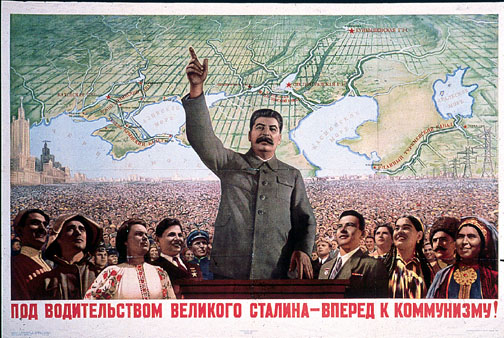
The caption proclaimed, "Under the Leadership of the Great Stalin - Forward to Communism" depicting Stalin at the helm of the vast empire stretching farther than the eye can see. He was portrayed as a beloved saviour and father-figure. To Russians who had grow up during his regime, they came to believe that the nation and the people would collapse without him. He commanded devotion, respect and even love from a people who were terrorized with the fear that they would be subjected to his murderous reprisals if they failed to demonstrate a sufficient degree of fawning. Like Lenin, Stalin created this cult of personality around himself to establish unquestioned authority over, and obedience by the masses. After Lenin's death his image still figured prominently in propaganda posters, along that of Stalin. That Lenin's embalmed body was put on perpetual display seemed almost to evoke the myth of "sainthood", given the evidence of an uncorruptible body.(In January of 2011, the United Russia party set up a website inviting the Russian people to vote on whether Lenin should be buried. Two-thirds of the respondents voted "yes" however no definitive action has been taken.)


This poster depicts a large raised hand which overshadows and contains the hands and faces of what constitute the masses. It undeniably affirmed the complete authority that Stalin exercised over the Russian people. The poster`s message, "Soviet Hands - We'll execute the plan for the great works." which reinforced communist ideology and extolled the value of workers as the "vanguard" in the business of nation-building. The reality however was quite different. In 1922 the industrial production in Russia reached only 22% of what it had been at the start of WWI. Through Stalin's intervention a marked recovery was achieved but not without considerable reduction in public consumption so that re-investment of capital could be directed toward industrial development. Central to Stalins policies was a ruthless expropriation of wealth from the kulaks. By 1933, workers' incomes plummeted to one-tenth of what it had been in 1926. Criminals and political prisoners were forced into unpaid labor, and between 1930 and 1932, over 520 factories had been constructed.


NEXT