Showing posts with label powstanie warszawskie. Show all posts

August 1, 2012

WARSAW UPRISING: PERSPECTIVES

On August 1st 1944 the Polish Underground launched an Uprising in a desperate attempt to liberate Warsaw, and Poland from the Nazi occupiers.  For 63 days the Polish Home Army and Polish civilians fought against overwhelming odds, outnumbered and outgunned by the German wehrmacht.  Despite continuous promises of allied support, Britain and the US left the Poles to fight alone, abandoned and subsequently betrayed.

The Warsaw Uprising was a tragedy of epic proportions: 10,000 Polish insurgents were killed in action;  6,000 missing in action;  5,000 wounded in action;  200,000 Polish civilians killed;  700,000 Polish people were expelled from Warsaw and about 85% of the city was razed to the ground.    It was followed by yet another no less catastrophic event - the brutal occupation of Polish territory and suppression of its sovereignty and independence by the Soviet regime.  Former members of the Polish Home Army were arrested and subjected to mock trials, convicted and imprisoned. Many of them died under so-called "mysterious circumstances."  

For over forty years the history of the Warsaw Uprising was heavily censored and maligned by the Soviet regime, and ignored by the West.  Only with the end of the Cold War has Poland been able to speak openly about the realities of the Warsaw Uprising.  

Marek Jan Chodakiewicz, a research professor of history at the Institute of World Politics, wrote in May 2004, an article entitled, The Warsaw Uprising 1944: Perceptions and Reality "..finally, we are at last free to study the tragedy and triumph of Warsaw in all its complexity.  Let us not be crippled by any censorship.  All is fair game. May perceptions be replaced with reality."  


The disturbing reality is that Western perceptions of the Uprising are still tainted by anti-Polish propaganda and revisionism, which is aided and abetted by the media around the world.  With few exceptions, newspapers persistently print inaccurate articles that verge on libelous comments about Polish history of WW2.  Apparently few journalists today are concerned with investigative reporting, and prefer to take the easy route by relying on hearsay.  Truth continues to be a casualty.

There is a chasm between Western and Eastern perspectives: the West has already relegated WW2 to that of ancient history, dismissing it as irrelevant.  But the past is still very much alive in the hearts and minds of Eastern Europeans, particularly the Poles.  According to Piotr Wrobel, author of the book, "The Devil's Playground: Poland in World War II",  "the war is a vivid memory, the emotional wounds are still fresh".  Unlike many other European nations, Poland has been suffered from centuries of invasion, brutal occupation and repression, and the danger of annihilation at the hands of the German and the Soviet invaders.

One cannot discuss World War II without mentioning Poland, however there are countless number of Western publications that have virtually eliminated any reference to Poland.  Churchill set this precedent at the end of WW2.  He stated that "history will be kind to me for I intend to write it."  Indeed.  He published a ten-volume treatise about World War II history, in which hardly any mention was made about Poland.  It was only a matter of time before the truth would come out. But public reaction was not quite as expected.

Andrzej Wajda  director of Kanal _ Warsaw Uprising
Andrzej Wajda
In 1957, the Polish film "Kanal" directed by Andrzej Wajda was the recipient of the Special Jury Prize at the Cannes Film Festival.  The screenwriter of the film, Jerzy Stefan Stawinski was showered with praise for having come up with such a "magnificent story"!  Apparently, the press thought this was a fictional story.  Upon hearing about this, Wajda told him, "Listen,  tell these gentlemen that you didn't make this up, you lived through it."

Jerzy Stefan Stawinski screenwriter of Kanal _ Warsaw Uprising
Jerzy Stefan Stawinski


A Polish public opinion research center CBOS (Centrum Badania Opinii Spolecznej) conducted a poll in July 2009, marking the 65th Anniversary of the Warsaw Uprising. They asked Polish citizens, "Do you consider the Warsaw Uprising important to you personally?"   The answer was a resounding yes.  Forty-one percent said that it was "Very Important", followed closely by 46% which said it was "Rather Important".  Only 8% claimed that it was "not very important", while 3% reported that it was "not at all important".  There does not seem to be an equivalent poll from Western sources, but it is safe to say that the Western mentality continues to be mired in apathy.

There are many lessons to be learned by studying the history of the Warsaw Uprising. It is surprising that even among people who are very intelligent and well educated, there is a lack of sufficient understanding and knowledge.  This refusal to face the past seems almost tantamount to self-censorship.  What would our forefathers say?


WARSAW UPRISING 1944
COMPLETE DAY BY DAY INDEX
August 1, 1944 to October 6, 1944


October 8, 2011

WARSAW UPRISING 1944: COMPLETE INDEX OF BLOG POSTS AUGUST 1, 2011 to OCTOBER 6, 2011

THE WARSAW UPRISING

The Warsaw Uprising was the most ferocious battle fought during WWII. Never before or since has the world witnessed such savagery, courage, and betrayal. Savagery of the SS Nazi storm troopers as they wielded all the power of the German Wehrmacht against the Polish Home Army. Courage of the Polish insurgents as they fought fearlessly against overwhelming and impossible odds. Betrayal of Poland by its' closest allies (England and the United States) which promised to come to the aid of Warsaw in its' darkest hours, and instead chose political expediency instead of Honour.

Though the allies won the war, freedom came at a very high price. Poland - the 4th largest ally lost the war, it's country and independence - languishing behind the Iron Curtain for more than 45 years. After almost half a century, the silence has finally been broken and the facts revealed. From August 1, 2011 to October 6, 2011, Polish Greatness (Blog) published daily posts documenting the events of the Warsaw Uprising - the courage of the Polish Insurgents in fighting against the overwhelming force of the Wehrmacht, the ferocious and bloody massacres, and battles, and the determination of the insurgents to fight to the very end.


COMPLETE INDEX OF BLOG POSTS
WARSAW UPRISING 1944

Click on the following links to read blog posts

MONTH OF AUGUST


MONTH OF SEPTEMBER


MONTH OF OCTOBER


REMEMBER THE UPRISING


October 6, 2011

Warsaw Uprising 1944: October 6 Compendium of Resources


COMPENDIUM OF RESOURCES
WARSAW UPRISING 1944


RECOMMENDED WEBSITES

Warsaw Uprising 1944
(Project In Posterum)

Warsaw Uprising 1944
Polonia Today.com

Written in English, Before, During and After the
Powstanie Warszawskie - The Warsaw Uprising
(compiled and edited by Lester P. Gideon)

by Wanda Koscia


Translated from Polish by Antoni Bohdanowicz

The Warsaw Rising 
Poland In Exile.com


by Wilhelm Ratuszynski

Poland in Exile


MILESTONES IN THE STORY OF THE POLISH AMERICAN CONGRESS
THE FIRST 50 YEARS 1944-1994

German Crimes Committed During the Warsaw Uprising Part I
Document compiled by Dr. S.D. Stein
Faculty of Humanities, Languages and Social Sciences
University of the West of England, Bristol

On the Front Lines: Interview with Wladyslaw Bartoszewski
Former Minister for Foreign Affairs & Participant and Historian
of the Warsaw Uprising
September 1, 2004 The Warsaw Voice online

Polish Special Duties Flight no. 1586 and the Warsaw Uprising
by Michael A. Peszke
Summer 2006 Air Power History

Warsaw Uprising 1944
(Polish Home Army ex-Servicemen Association - Montreal Branch)

WARSAW UPRISING: The Forgotten Soldiers of World War II
CNN Classroom Edition - Educator Guide (Grades 7-12)

A GERMAN SOLDIER'S PERSPECTIVE OF THE WARSAW UPRISING 1944
by Wlodzimierz Nowak and Angelika Kuzniak  23-08-2004
(reprinted on Polish Greatness.com website)

Muzeum Powstania Warszawskiego

Remembering the Warsaw Uprising
by Maciej Siekierski
Military History On Line

The Warsaw Uprising
by Lukasz Pajewski
Info Poland - Poland in the Classroom

The Warsaw Uprising
Polish American Journal.com
Dedicated to the Preservation, Promotion, and Continuance
of Polish American Culture

The Kampinos Group
by Ezy.Ryder

Warsaw Uprising
by Polish Greatness.com (the website)


BOOKS ABOUT WARSAW UPRISING 1944


NOTHING BUT HONOUR
The Story of the Warsaw Uprising 1944
by Janusz Kazimierz Zawodny


THE WARSAW UPRISING OF 1944
by Wlodzimierz Borodziej and Barbara Harshav


That the Nightingale Return: Memoir of the Polish
Resistance, the Warsaw Uprising,
and German POW Camps
by Leokadia Rowinska


A Memoir of the Warsaw Uprising
by Miron Bialoszewski, and Madeline Levine


To Hope Or Die: From Warsaw Uprising
to Sachsenhausen Concentration Camp and After, Memoirs of a Survivor
by Edmund Szybicki


Lack of Outside Support during the Warsaw Uprising
by Frederic P. Miller, Agnes F. Vandome, and John McBrewster


Military History of the Warsaw Uprising
by Frederic P. Miller, Agnes F. Vandome, and John McBrewster


Destroy Warsaw! Hitler's Punishment, Stalin's Revenge
by Andrew Borowiec


Airlift to Warsaw: The Rising of 1944
by Neil D. Orpen


Rising: The Battle for Warsaw
by Norman Davies


The Warsaw Rising of 1944
by Jan Ciechanowski


Poland Alone: Britain, SOE and the
 Collapse of the Polish Resistance 1944
by Jonathan Walker


Krystyna: The Tragedy of Polish Resistance
by Simon Wiesenthal


Women Heroes of World War II: 26 stories of Espionage,
Sabotage, Resistance and Rescue
By Kathryn J. Atwood


The Civilian Population and the Warsaw Uprising of 1944
by Joanna K. Hanson


When God Looked the Other Way: An Odyssey of War, Exile and Redemption
by Wesley Adamczyk


BEST FILM ABOUT WARSAW UPRISING

Kanał


Scene from film "Kanal"


Warsaw Uprising 1944: October 6 The Aftermath


After the Poles had evacuated Warsaw the Germans in defiance of the terms of the capitulation agreement, began a wholesale destruction of the city. German Command dispatched special teams of German engineers dispersed throughout Warsaw, setting fires, and systematically destroyed buildings. Demolition squads of flamethrowers and explosive experts set about their task to obliterate the very existence of Warsaw, building by building, block by block. Nothing was overlooked - historical monuments, the Polish national archives, libraries and museums and their priceless manuscripts and collections, palaces - the very cultural heritage of a people was blasted into oblivion, gone forever. Nothing was left to show that there used to be a great cosmopolitan city here - but just a pile of rubble and ashes. According to the Germans, the area was slated to become a military transit station.


Warsaw 1944: A Necropolis (00:04:15m)

Meanwhile, Stalin's Red Army remained poised across the banks of the Vistula River observing the macabre destruction being carried out. In the rest of Poland, Soviet NKVD agents were hunting down Polish insurgents and executing them; many other Poles were deported to Russian gulags.

At the end of German operation, Warsaw's public losses were estimated as follows:

10,455 Buildings
923 Historical Buildings (94% of Warsaw)
25 Churches
Monuments
14 Libraries
The National Library
81 elementary schools 
64 high schools
Warsaw University 
Polytechnic


Over 516,000 individual pieces of art were looted by German armies including 2,800 paintings by European painters,11,000 paintings by Polish painters, 1,400 sculptures, 75,000 manuscripts, 25,000 maps, 90,000 books of which 20,000 were printed before the year 1800, and hundreds of thousands of other invaluable artistic and historical artifacts. Among the many priceless paintings destroyed was the painting of "Virgin and Child with Saint John the Baptist and St. Stanislaw" painted by Palma il Giovane.  The painting was once looted by Napoleon but returned to Warsaw in the 1820s.  


The exact amount of losses to private and public property, including cultural and scientific artifacts was quite considerable. It was not until the late 1940s that efforts were made to estimate the total value of damages - it came to US$30 billion. (In 2004, the President of Warsaw and subsequently President of Poland, appointed an historical commission to review the evaluation and estimated losses to have been at least US$31.5 billion, however these estimates were increased in to $45 billion in 2004 and to $54.6 billion in 2005.)


The Warsaw Uprising was the most tragic battle of World War II. Over 18,000 Polish insurgents were killed or missing in action, over 5,000 wounded, 15,000 sent to POW camps. (However other sources mention that 60,000 AK soldiers were killed during the Uprising.)
Over 200,000 Polish civilians died in the 63 days of battle, and about 700,000 were expelled from Warsaw, and 55,000 sent to concentration camps, including 13,000 to Auschwitz.  About 3,400 insurgents chose to go underground and continue to fight. Berling's Polish Army suffered 5,660 casualties KIA, MIA, or WIA. 

German casualties were about 10,000 KIA, 7,000 MIA, and 9,000 WIA.  Up to 2,000 Germans were captured and taken prisoners by the Polish insurgents. German material losses were: three airplanes (two outside Warsaw in Kampinos forest ), 310 tanks, self-propelled artillery, armored cars, 4 rocket launchers, 22 artillery pieces (caliber 75mm), and 340 trucks and cars.


By January 1945 about 85% of the buildings had been destroyed: 10% damages were sustained as a result of the September 1939 campaign and other combat; 15% during the Warsaw Ghetto Uprising (which had taken place in April 1943); 25% during the Uprising, and 35% due to systematic German actions after the Uprising.  

General Dwight Eisenhower, Commander of the Allied Forces in Europe, visited Warsaw in 1945 and was so moved by the scene of utter destruction that he stated, “I have seen many towns destroyed, but nowhere have I been faced with such destruction.”

Poland had lost a staggering 38 per cent of its national assets whereas France and Britain lost only 1.5 % and 0.8% respectively.  Moreover,  Poland lost vast regions of their country including two great cultural centers of Wilno and Lwow. 

Despite the so-called "liberation" of Poland by Soviet troops on January 17, 1945, Poland, the 4th largest Ally, had really lost the war, betrayed by Britain, the United States, and the Soviet Union.


ROYAL CASTLE DESTROYED (above photo & aerial view)


Warsaw 1944:  A Death Sentence


October 5, 2011

Warsaw Uprising 1944: October 5 POLAND GOES INTO CAPTIVITY

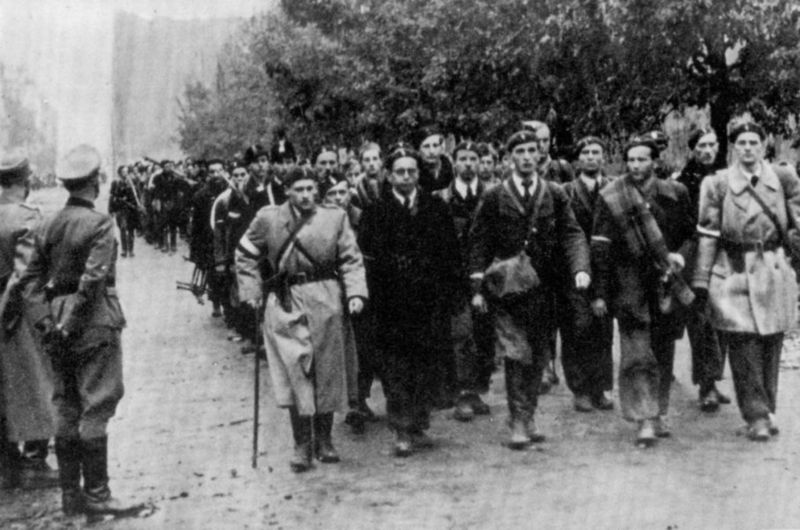
For the second day insurgents have been laying down their armaments and surrendering to the Germans. At about 9:00 this morning the remainder of Polish regiments began leaving Warsaw. The 72nd Infantry Regiment of the AK under the command of Lt. Col. Jan Szczurek-Cergowski “Slawbor” left the district of southern Srodmiescie marching along the pre-determined exit routes - Sniadeckich, 6-go Sierpnia, Sucha and Filtrowa Streets. 


They were followed by members of the Home Army Headquarters, the Command of the 10th Infantry Division, and the National Armed Forces "Sokol" group under the command of Col. Spirydion Koizewski "Topor" as well as the 36th Infantry Regiment under the command of Major Stanislaw Blaszczak "Rog" from northern Srodmiescie. Also falling into line were staff members of the Warsaw District of the Corps and the 28th Infantry division and the Municipal Headquarters marching along Zelazna, Aleje Jerozolimska and Grojecka Streets.  The 15th Infantry Regiment under the command of Lt. Col Franciszek Rataj "Pawel" was the last group to leave Warsaw - the route they took was along Grzybowska, Chlodna and Wolska Streets.  A covering battalion under the command of Lt. Col. Franciszek Pacek “Mscislaw” will remain in Warsaw for the next few days and will be expected to lay down arms only on October 9th, 1944.


German soldiers directed the columns of insurgents to Ozarow from where they were boarded onto freight trrains and transported to Stalag 334 at Lamsdorf (Lambinowice) in Slask Opolski. Once having arrived the insurgents will be registered and sent to POW camps in Germany and Austria.

Home Army Commander-in-Chief General Tadeusz Komorowski “Bor” and five generals: Tadeusz Pelczynski “Grzegorz”, Antoni Chrusciel “Monter”, Tadeusz Kossakowski “Krystynek”, Kazimierz Sawicki “Prut” and Albin Skroczyński “Laszcz” were taken into captivity along with 11,668 soldiers exclusively from the Srodmiescie district.  Meanwhile, General Leopold Okulicki “Niedzwiadek” has left the city together with the civilians. Thenceforth Okulicki has been put in charge of further underground activity.  


(L) General Bor
The remaining civilians were forced to leave the city, although there are reports that many of them have decided not to leave and be sent to POW camps. Among them are a few insurgents who have been designated by the Home Army to remain and continue the struggle.  At least 55,000 civilians will end up in concentration camps, and be categorized as "criminals" by the German Nazi authorities. An additional 150,000 will be transported to Germany for forced labor.


During the two-month Uprising approximately 13,000 Warsaw residents were rounded up and arrested by German troops and deported to Auschwitz concentration camp. Polish prisoners comprised of government officials, professors, physicians, artists, blue-collar workers, pregnant women, the elderly, the sick and injured. Many were transferred to labor camps in Germany and worked to death.  About 550,000 Polish residents from Warsaw were deported to Durchgangslager 121 (Dulag 121) in addition to 100,000 civilians from outlying areas. In the months of August, September and October approximately 650,000 Poles had passed through the Pruszkow transit camp.

Pruszkow transit camp

The Uprising, which was encouraged by Stalin, had given the Polish people renewed hope that Poland would soon be liberated.  British and American promises for military assistance convinced the Poles to continue fighting to the very bitter end.  However, unbeknowst to Prime Minister Mikolajczyk, Churchill and Roosevelt had already ceded Polish territory to Stalin at the Teheran Conference a year before.  For 63 days the Poles fought in vain, waiting for help that would never arrive. A tragedy more brutal than capitulation was the relevation that the Allies aided and abeted Stalin's chicanery.  In a final coup de grace, Prime Minister Churchill sent an official letter today to Polish Prime Minister Mikolajczyk.  The following is an excerpt:

Prime Minister Mikolajczyk
"My Dear Excellency, I received with deep sorrow your letter telling me that resistance had ceased in Warsaw. As you know, we were anxious to do everything in our power to bring assistance to General Komorowski’s forces and nothing but insuperable difficulties of weather and geography prevented our assistance being more effective."


October 4, 2011

Warsaw Uprising 1944: October 4 NOT YET IS POLAND LOST!!!

It has been 63 days of long and bitter struggle for the Polish people, days marked by despair and hope, pain and suffering and constant battle against a hated enemy. It has all come to an end. Early this morning Polish regiments congregated near the Technical University in Warsaw in preparation for a "trial surrender". Barricades that had been there before had been "symbolically" removed yesterday. The Company commander issued his final orders and gave his last speech as the soldiers listened intently, and then at the end, they sang the national anthem, "Not Yet Is Poland Lost ". Their voices rang out across the square with such power - clearly indicating that while the Polish people have surrendered they have not by any means been defeated. Finally at the command of "Attention" the soldiers burst into cheers and shouts of "Long live our beloved Polish Republic"!!! 


General and Commander-in-Chief of the Home Army Tadeusz Komorowski “Bor” signed the last cable to the Polish Government in exile in London, which will be dispatched tomorrow morning.  General Bor and General von dem Bach met each other today and despite the conclusion of negotiations, General von dem Bach continued to pressure Bor for additional concessions. He demanded that General Bor issue an order to all regiments of the AK, in addition to those located outside Warsaw, to "cease underground activities against German forces".  Moreover he insisted that Polish Communist insurgents be excluded from the protection of the Geneva Convention in regard to treatment of prisoners of war.  In both cases, General Bor adamantly refused to comply.


General Bor surrenders to General von dem Bach Zelewski


Left: General Tadeusz Komorowski "Bor"

At 9:00 am the first Home Army units to leave Warsaw was the 21st Infantry Regiment under the command of Lt. Col. Stanlislaw Kaminski "Daniel". They were among the troops that fought so bravely in Srodmiescie South. They marched along Sniadeckich, 6-go Sierpnia, Such and Filtrowa Streets and were closely followed by other companies, marching four abreast.


Among them were old and young men as well as women, each clad in spruced up uniforms or civvies and immaculately groomed. Each wore the white and red armbands of the AK, or the Polish eagle on their caps. Many wore military decorations pinned to their lapels, and many sported their weapons which were meticulously cleaned and gleaming.

German officers and soldiers lined each side of the street. In a most unexpected gesture, they lowered their weapons and watched the retreat in silence. A few German soldiers saluted as a show of respect.

The rest of the regiments will be leaving Warsaw tomorrow morning and according to the Capitulation Act they will surrender their armaments and ammunition.  Soldiers of the 21st and 72nd infantry regiments of the Home Army have already deposited their guns and ammunition on the corner of Wspolna and Marszalkowska Street; the 36th infantry regiment in Napoleona Square, and the 15th infantry regiment in Grzybowski Square.

While the Polish regiments were preparing for surrender, SS officer Bronislav Kaminski was court-martialled today by the German military court. He and his entire staff were sentenced to death and shot by a German firing squad. The event was reported by German Command, however in an effort to avoid reprisals from the men of SS STRONA the Germans stated that Kaminski was assassinated by the Polish Armia Krajowa. Kaminski was the notorious commander of the SS Sturmbrigade RONA which participated with the SS Dirlewanger and SS Reinfarth in the bloody massacres at Wola and Ochota in early August. In just a few days they slaughtered 40,000 to 100,000 Polish men, women, and children. It was one of the bloodiest of massacres during the war.


Warsaws' underground newspapers published and distributed their last issues today: Dziennik Radiowy, Robotnik, Wiadomości Powstańcze and No. 102 of the Biuletyn Informacyjny. Polish underground radio aired their last broadcasts today, including the famous "Blyskawica" radio station. Jan Georgica Grzegorzewicz" took the microphone at Blyskawica today mentioning only the technical parameters of the station, and its working conditions. At 7:30 pm Jan broadcast the Warszawianka song in farewell, and at the end destroyed the transmitter with a hammer.