Showing posts with label Tadeusz Komorowski Bor. Show all posts

October 5, 2011

Warsaw Uprising 1944: October 5 POLAND GOES INTO CAPTIVITY

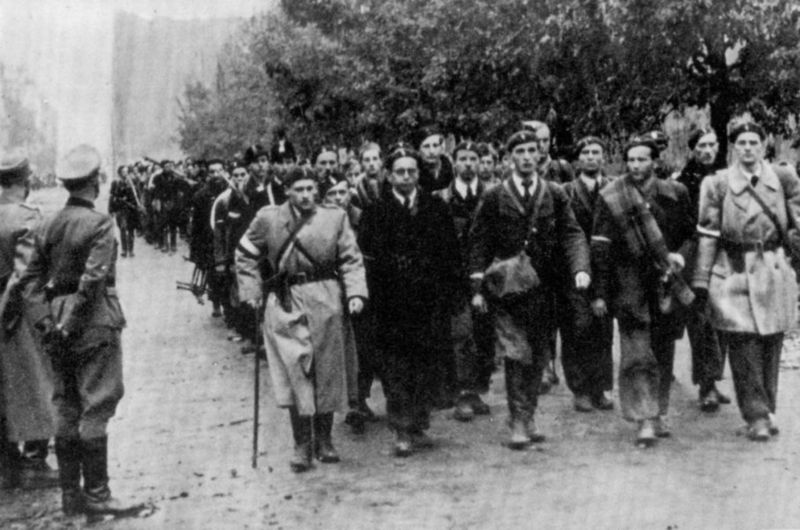
For the second day insurgents have been laying down their armaments and surrendering to the Germans. At about 9:00 this morning the remainder of Polish regiments began leaving Warsaw. The 72nd Infantry Regiment of the AK under the command of Lt. Col. Jan Szczurek-Cergowski “Slawbor” left the district of southern Srodmiescie marching along the pre-determined exit routes - Sniadeckich, 6-go Sierpnia, Sucha and Filtrowa Streets. 


They were followed by members of the Home Army Headquarters, the Command of the 10th Infantry Division, and the National Armed Forces "Sokol" group under the command of Col. Spirydion Koizewski "Topor" as well as the 36th Infantry Regiment under the command of Major Stanislaw Blaszczak "Rog" from northern Srodmiescie. Also falling into line were staff members of the Warsaw District of the Corps and the 28th Infantry division and the Municipal Headquarters marching along Zelazna, Aleje Jerozolimska and Grojecka Streets.  The 15th Infantry Regiment under the command of Lt. Col Franciszek Rataj "Pawel" was the last group to leave Warsaw - the route they took was along Grzybowska, Chlodna and Wolska Streets.  A covering battalion under the command of Lt. Col. Franciszek Pacek “Mscislaw” will remain in Warsaw for the next few days and will be expected to lay down arms only on October 9th, 1944.


German soldiers directed the columns of insurgents to Ozarow from where they were boarded onto freight trrains and transported to Stalag 334 at Lamsdorf (Lambinowice) in Slask Opolski. Once having arrived the insurgents will be registered and sent to POW camps in Germany and Austria.

Home Army Commander-in-Chief General Tadeusz Komorowski “Bor” and five generals: Tadeusz Pelczynski “Grzegorz”, Antoni Chrusciel “Monter”, Tadeusz Kossakowski “Krystynek”, Kazimierz Sawicki “Prut” and Albin Skroczyński “Laszcz” were taken into captivity along with 11,668 soldiers exclusively from the Srodmiescie district.  Meanwhile, General Leopold Okulicki “Niedzwiadek” has left the city together with the civilians. Thenceforth Okulicki has been put in charge of further underground activity.  


(L) General Bor
The remaining civilians were forced to leave the city, although there are reports that many of them have decided not to leave and be sent to POW camps. Among them are a few insurgents who have been designated by the Home Army to remain and continue the struggle.  At least 55,000 civilians will end up in concentration camps, and be categorized as "criminals" by the German Nazi authorities. An additional 150,000 will be transported to Germany for forced labor.


During the two-month Uprising approximately 13,000 Warsaw residents were rounded up and arrested by German troops and deported to Auschwitz concentration camp. Polish prisoners comprised of government officials, professors, physicians, artists, blue-collar workers, pregnant women, the elderly, the sick and injured. Many were transferred to labor camps in Germany and worked to death.  About 550,000 Polish residents from Warsaw were deported to Durchgangslager 121 (Dulag 121) in addition to 100,000 civilians from outlying areas. In the months of August, September and October approximately 650,000 Poles had passed through the Pruszkow transit camp.

Pruszkow transit camp

The Uprising, which was encouraged by Stalin, had given the Polish people renewed hope that Poland would soon be liberated.  British and American promises for military assistance convinced the Poles to continue fighting to the very bitter end.  However, unbeknowst to Prime Minister Mikolajczyk, Churchill and Roosevelt had already ceded Polish territory to Stalin at the Teheran Conference a year before.  For 63 days the Poles fought in vain, waiting for help that would never arrive. A tragedy more brutal than capitulation was the relevation that the Allies aided and abeted Stalin's chicanery.  In a final coup de grace, Prime Minister Churchill sent an official letter today to Polish Prime Minister Mikolajczyk.  The following is an excerpt:

Prime Minister Mikolajczyk
"My Dear Excellency, I received with deep sorrow your letter telling me that resistance had ceased in Warsaw. As you know, we were anxious to do everything in our power to bring assistance to General Komorowski’s forces and nothing but insuperable difficulties of weather and geography prevented our assistance being more effective."


October 4, 2011

Warsaw Uprising 1944: October 4 NOT YET IS POLAND LOST!!!

It has been 63 days of long and bitter struggle for the Polish people, days marked by despair and hope, pain and suffering and constant battle against a hated enemy. It has all come to an end. Early this morning Polish regiments congregated near the Technical University in Warsaw in preparation for a "trial surrender". Barricades that had been there before had been "symbolically" removed yesterday. The Company commander issued his final orders and gave his last speech as the soldiers listened intently, and then at the end, they sang the national anthem, "Not Yet Is Poland Lost ". Their voices rang out across the square with such power - clearly indicating that while the Polish people have surrendered they have not by any means been defeated. Finally at the command of "Attention" the soldiers burst into cheers and shouts of "Long live our beloved Polish Republic"!!! 


General and Commander-in-Chief of the Home Army Tadeusz Komorowski “Bor” signed the last cable to the Polish Government in exile in London, which will be dispatched tomorrow morning.  General Bor and General von dem Bach met each other today and despite the conclusion of negotiations, General von dem Bach continued to pressure Bor for additional concessions. He demanded that General Bor issue an order to all regiments of the AK, in addition to those located outside Warsaw, to "cease underground activities against German forces".  Moreover he insisted that Polish Communist insurgents be excluded from the protection of the Geneva Convention in regard to treatment of prisoners of war.  In both cases, General Bor adamantly refused to comply.


General Bor surrenders to General von dem Bach Zelewski


Left: General Tadeusz Komorowski "Bor"

At 9:00 am the first Home Army units to leave Warsaw was the 21st Infantry Regiment under the command of Lt. Col. Stanlislaw Kaminski "Daniel". They were among the troops that fought so bravely in Srodmiescie South. They marched along Sniadeckich, 6-go Sierpnia, Such and Filtrowa Streets and were closely followed by other companies, marching four abreast.


Among them were old and young men as well as women, each clad in spruced up uniforms or civvies and immaculately groomed. Each wore the white and red armbands of the AK, or the Polish eagle on their caps. Many wore military decorations pinned to their lapels, and many sported their weapons which were meticulously cleaned and gleaming.

German officers and soldiers lined each side of the street. In a most unexpected gesture, they lowered their weapons and watched the retreat in silence. A few German soldiers saluted as a show of respect.

The rest of the regiments will be leaving Warsaw tomorrow morning and according to the Capitulation Act they will surrender their armaments and ammunition.  Soldiers of the 21st and 72nd infantry regiments of the Home Army have already deposited their guns and ammunition on the corner of Wspolna and Marszalkowska Street; the 36th infantry regiment in Napoleona Square, and the 15th infantry regiment in Grzybowski Square.

While the Polish regiments were preparing for surrender, SS officer Bronislav Kaminski was court-martialled today by the German military court. He and his entire staff were sentenced to death and shot by a German firing squad. The event was reported by German Command, however in an effort to avoid reprisals from the men of SS STRONA the Germans stated that Kaminski was assassinated by the Polish Armia Krajowa. Kaminski was the notorious commander of the SS Sturmbrigade RONA which participated with the SS Dirlewanger and SS Reinfarth in the bloody massacres at Wola and Ochota in early August. In just a few days they slaughtered 40,000 to 100,000 Polish men, women, and children. It was one of the bloodiest of massacres during the war.


Warsaws' underground newspapers published and distributed their last issues today: Dziennik Radiowy, Robotnik, Wiadomości Powstańcze and No. 102 of the Biuletyn Informacyjny. Polish underground radio aired their last broadcasts today, including the famous "Blyskawica" radio station. Jan Georgica Grzegorzewicz" took the microphone at Blyskawica today mentioning only the technical parameters of the station, and its working conditions. At 7:30 pm Jan broadcast the Warszawianka song in farewell, and at the end destroyed the transmitter with a hammer.


September 6, 2011

Warsaw Uprising 1944: September 6 Communist Takeover Expected

During the night, masses of civilians move from Powisle and Srodmiescie North to the southern side of Aleje Jerozolimskie Street. German armoured trains have been travelling east across Warsaw and 3 west. The Poles have been powerless to disrupt any of this traffic.    

 
Air raids and shelling of Srodmiescie North has continued since early this morning. The insurgent troops have been able to fight off enemy attacks on Nowy Swiat Street from Krakowskie Przedmiescie, on Kredytowa Street from Malachowski Square, on Krolewska Street from the Saski Gardens and on Towarowa Street from the Zawiszy Square area. However, German troops have intensified their attacks with air raids and a general offensive has been launched on Powisle from the north, east and south against the last insurgent positions in the district.   

 
Despite overwhelming German firepower, insurgents continued to fight for the last vestige of territory, engaging the enemy in fierce house to house battles, and sometimes room by room. Polish troops began a gradual retreat to Srodmiescie By evening German troops have taken control of the entire area of Powisle. and insurgents have withdrawn to City Centre sector. The new front line is Nowy Swiat Street. German planes have passed the area dropping leaflets in Polish calling on civilians to leave Warsaw on September 7 and 8th and promise that a cease fire will be in effect during the evacuation. It was signed by von dem Bach.  

 
Lt.John Ward, a British soldier and member of the Armia Krajowa has dispatched an urgent message to London describing the desperate situation of civilians and insurgents and pleaded for help for Warsaw.  
 
Addressed to Colonel P…
Sir, I have seen a radiogram in which it is stated that from four to seven machines daily drop supplies over Warsaw. 
Sir, I can state that these supplies are not dropped in the centre of the city where they are most needed. And I have not heard that there have been any dropped near the city. I have agreed to accept the proposition to act as correspondent to The Times – as communicated to me by E…, subject to your agreement.  
 
The situation in the City Centre is still in Polish hands. After the fall of the Old Town the enemy turned all his artillery and air force against the centre of the city. The attacks are now practically without any break. Many of the streets have been systematically destroyed house by house. The enemy aircraft fly at roof-top height. Electric works which have been in the hands of the Home Army since the first day of the uprising were damaged 47 hours ago. It is doubtful whether the damage will be repairable.  
 
General Bor and the Delegate of the Polish Government dispatched a message to the Polish Prime Minister and Commander-in-Chief in London, reporting on the critical situation in Warsaw. In this message he raised the concern about Polands future after the war. In his message he stated this:

 "We think that the defeat of the Uprising of Warsaw will have not only military effects after the war, but political one. If both the Polish Government and its allies could appreciate this now, it might be useful during political bargaining. It is obvious that, after the Uprising in Warsaw collapses, power will pass into Communist hands not only in Warsaw, but also in the whole country. Immediate assistance from you in the form of bombardments and supplies can improve the situation and slightly delay the crisis.”