Showing posts with label Stanislaw Mikolajczyk. Show all posts

August 3, 2018

AUGUST 3 - DAILY CHRONICLES OF HISTORY

AUGUST 3

1914

Jozef Pilsudski, Marshal of Poland, created the First Cadre Company in Cracow. It was the predecessor of the Polish Legions, and formed the core of the Polish Legions' First Brigade during World War I. On August 6, 1914, Austro-Hungary declared war on Tsarist Russia.  The First Cadre crossed into Russia and captured Kielce, then proceeded to break through Russian lines and advanced north. The Polish troops attempted to capture Warsaw so as to set off an uprising in Tsarist Poland against the Russian regime. However, on August 13,  the Russians checked the First Cadre just outside Kielce, forcing the Cadre's retreat from Kielce to Kraków.


1944

Polish Prime Minister Met with Stalin:  Polish Prime Minister Stanislaw Mikolajczyk met with Marshal Stalin in an effort to make arrangements for Mikolajczyk to travel to Warsaw and begin preparations for the establishment of a new Polish government there. Mikolajczyk added that he expected Warsaw to be free very soon to which Stalin replied, “Pray God!”   But Stalin refused his request on the grounds that the Soviet Union has broken off diplomatic relations with Poland and did not recognize the legitimacy of the Polish Government in Exile in London.


1948

Russian Spy in U.S. State Department:   Alger Hiss, an American government official,  was accused of being a Soviet spy in 1948 and convicted of perjury in connection with this charge.  On August 3, 1948, Whittaker Chambers, a former Communist Party member, appeared before the House Committee on Un-American Activities (HUAC) to denounce Alger Hiss.  Chambers asserted that he had known Hiss as a member of "an underground organization of the United States Communist Party" in the 1930s, code named the "Ware Group" and that "the purpose of this group at that time was not primarily espionage. Its original purpose was the Communist infiltration of the American government. But espionage was certainly one of its eventual objectives."  Espionage was treason, traditionally punishable by death. The distinction was not lost on the cleverest member of HUAC, Congressman Richard Nixon. He had been studying the FBI's files for five months, courtesy of J. Edgar Hoover. Nixon launched his political career in hot pursuit of Hiss and the alleged secret Communists of the New Deal.

July 30, 2018

JULY 30 - DAILY CHRONICLES OF HISTORY

JULY 30

1941

The Sikorski-Mayski Pact was signed in London between Poland and the Soviet Union, the signatories being General Wladyslaw Sikorski and Soviet Ambassador to the UK, Ivan Mayski.  The pact re-opened diplomatic relations between Poland and Russia. A subsequent military pact signed between the two adversaries on August 14, 1941, resulted in the release of tens of thousands of Polish POWs held in Soviet camps. Stalin also agreed to nullify any pacts he had with Nazi Germany, invalidate the 1939 Soviet-German partition of Poland, and  granted "amnesty to many Polish citizens. (Many of the released POWs joined Anders Army, the 2nd Polish Corps)


1944

Polish Prime Minister met with Stalin:  Stalin, under pressure from Churchill and Roosevelt, finally agreed to meet with Polish Prime Minister Stanislaw Mikolajczyk in Moscow.  Mikolajczyk did not approve of Stalin's chicanery regarding the future of the Poland, and attempted to defend Polish interests, to no avail. Stalin did not recognize the legitimate Polish Government in Exile in London, and had already installed his own regime. (On July 22, 1944 Stalin set up the  ‘Polish Committee of National Liberation’ (PKWN) which was for all intents and purposes, a puppet-government controlled by Stalin.)


1945

USS Indianapolis sunk after delivery of "Little Boy": At 00:15 on July 30, the USS Indianapolis was hit on her starboard side by two Type 95 torpedoes, one in the bow and one amidships, from the Japanese submarine I-58. The Indianapolis sustained massive damage and took on a heavy list, settling by the bow. In a matter of twelve minutes, she completely rolled over, the stern rose into the air and she plunged beneath the waves. About 300 of the 1,196 crewmen went down with the ship. The ship did not have enough life jackets, and most of the crew were set adrift without life jackets.  On July 26, the USS Indianapolis had delivered the atomic weapon components to Tinian, which would later be assembled and dropped on Hiroshima. Then she was on the way to Guam, sailing toward Leyte, then onto Okinawa to join VADM Jesse B. Oldendorf's Task Force 95. (see July 16, 1945)


October 5, 2011

Warsaw Uprising 1944: October 5 POLAND GOES INTO CAPTIVITY

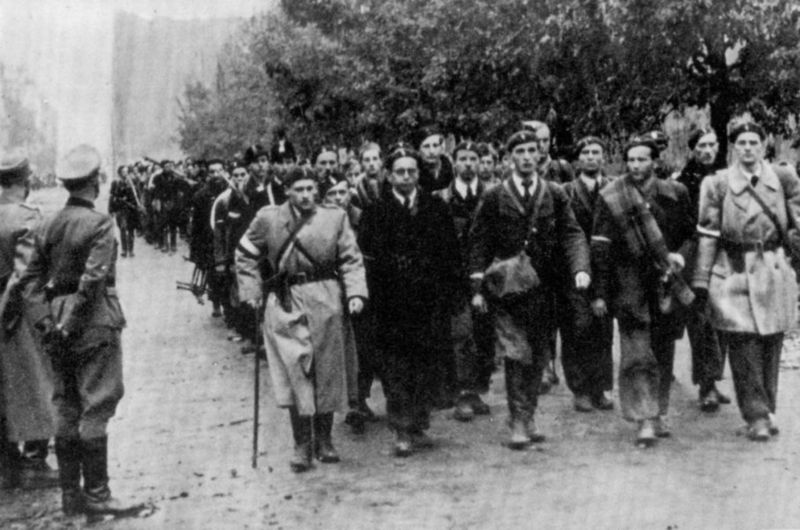
For the second day insurgents have been laying down their armaments and surrendering to the Germans. At about 9:00 this morning the remainder of Polish regiments began leaving Warsaw. The 72nd Infantry Regiment of the AK under the command of Lt. Col. Jan Szczurek-Cergowski “Slawbor” left the district of southern Srodmiescie marching along the pre-determined exit routes - Sniadeckich, 6-go Sierpnia, Sucha and Filtrowa Streets. 


They were followed by members of the Home Army Headquarters, the Command of the 10th Infantry Division, and the National Armed Forces "Sokol" group under the command of Col. Spirydion Koizewski "Topor" as well as the 36th Infantry Regiment under the command of Major Stanislaw Blaszczak "Rog" from northern Srodmiescie. Also falling into line were staff members of the Warsaw District of the Corps and the 28th Infantry division and the Municipal Headquarters marching along Zelazna, Aleje Jerozolimska and Grojecka Streets.  The 15th Infantry Regiment under the command of Lt. Col Franciszek Rataj "Pawel" was the last group to leave Warsaw - the route they took was along Grzybowska, Chlodna and Wolska Streets.  A covering battalion under the command of Lt. Col. Franciszek Pacek “Mscislaw” will remain in Warsaw for the next few days and will be expected to lay down arms only on October 9th, 1944.


German soldiers directed the columns of insurgents to Ozarow from where they were boarded onto freight trrains and transported to Stalag 334 at Lamsdorf (Lambinowice) in Slask Opolski. Once having arrived the insurgents will be registered and sent to POW camps in Germany and Austria.

Home Army Commander-in-Chief General Tadeusz Komorowski “Bor” and five generals: Tadeusz Pelczynski “Grzegorz”, Antoni Chrusciel “Monter”, Tadeusz Kossakowski “Krystynek”, Kazimierz Sawicki “Prut” and Albin Skroczyński “Laszcz” were taken into captivity along with 11,668 soldiers exclusively from the Srodmiescie district.  Meanwhile, General Leopold Okulicki “Niedzwiadek” has left the city together with the civilians. Thenceforth Okulicki has been put in charge of further underground activity.  


(L) General Bor
The remaining civilians were forced to leave the city, although there are reports that many of them have decided not to leave and be sent to POW camps. Among them are a few insurgents who have been designated by the Home Army to remain and continue the struggle.  At least 55,000 civilians will end up in concentration camps, and be categorized as "criminals" by the German Nazi authorities. An additional 150,000 will be transported to Germany for forced labor.


During the two-month Uprising approximately 13,000 Warsaw residents were rounded up and arrested by German troops and deported to Auschwitz concentration camp. Polish prisoners comprised of government officials, professors, physicians, artists, blue-collar workers, pregnant women, the elderly, the sick and injured. Many were transferred to labor camps in Germany and worked to death.  About 550,000 Polish residents from Warsaw were deported to Durchgangslager 121 (Dulag 121) in addition to 100,000 civilians from outlying areas. In the months of August, September and October approximately 650,000 Poles had passed through the Pruszkow transit camp.

Pruszkow transit camp

The Uprising, which was encouraged by Stalin, had given the Polish people renewed hope that Poland would soon be liberated.  British and American promises for military assistance convinced the Poles to continue fighting to the very bitter end.  However, unbeknowst to Prime Minister Mikolajczyk, Churchill and Roosevelt had already ceded Polish territory to Stalin at the Teheran Conference a year before.  For 63 days the Poles fought in vain, waiting for help that would never arrive. A tragedy more brutal than capitulation was the relevation that the Allies aided and abeted Stalin's chicanery.  In a final coup de grace, Prime Minister Churchill sent an official letter today to Polish Prime Minister Mikolajczyk.  The following is an excerpt:

Prime Minister Mikolajczyk
"My Dear Excellency, I received with deep sorrow your letter telling me that resistance had ceased in Warsaw. As you know, we were anxious to do everything in our power to bring assistance to General Komorowski’s forces and nothing but insuperable difficulties of weather and geography prevented our assistance being more effective."


September 18, 2011

Warsaw Uprising 1944: September 18 Russia Allows Air Drops to Warsaw


Anthony Eden
Anthony Eden has informed the War Cabinet “that the Russians had now sent help by air to the Polish Underground Army in Warsaw, and had also afforded facilities for the United States Air Force to do likewise." The Soviets have finally relented and have granted a one time clearance for B-17s of the United States Air Force to land and refuel at Soviet airfields.

Last evening the officer responsible for organization and recovery of air supplies was stationed in his pillbox at Zlota Street number 7-9 and heard a particular Polish melody on the BBC radio broadcast during Polish hour. According to a prearranged code, the song meant that the next day a major air supply drop would be coming to Warsaw. It was confirmed at 10:00 this morning by a second musical code broadcast by the BBC that the planes were already in the air and should reach Warsaw within 3 to 4 hours. Between noon and 1:00 pm today houses in Warsaw, or rather what remained of them, vibrated to the drone of throbbing engines of Flying Fortresses passing overhead and the din of German anti-aircraft artillery shooting at them. There were 107 four-engine Boeing B-17 planes covering the skies of Warsaw! It was the largest airdrop yet made during the Uprising.

Waclaw Zagorski "Lech" from the Chrobry II Battalion described the incredible scene. A sentry at the Panska Street gateway sounded a warning of approaching aircraft. Zagorski looked up. To the north and at very high altitude he saw them coming. He said that "they looked like silver birds in a blue sky lightly scattered with little clouds". He started to count them but in the excitement was distracted. But someone did count...there were no less than 102 airplanes and then somebody shouted wildly "They're Liberators! And they're Ours!!" Zagorski was awestruck and he exclaimed, "It was as if the dead had arisen from their graves!"

Polish Insurgents revel at sight of Flying Fortresses over Warsaw

Suddenly dozens of parachutes started to drop and it seemed like tiny little white clouds opening. German troops began firing but the parachutes were out of range. While some containers fell in Polish-controlled areas, the remainder were carried away by the wind into enemy territory. Before the first containers even landed the insurgents made a mad dash to collect them amid the roar of German fire power. The Germans were firing with everything they had - rifles, machine guns, grenades, mortars, artillery.

Supplies were dropped from from 17,000 feet but were caught in a strong wind. Many of the containers floated directly towards German positions and were captured by enemy forces. Some of the insurgents wept openly while other struck the walls with their fists in anger and despair.

Some supplies did fall into insurgents' territory.  When the containes were opened the Poles found the following items: Sten guns and ammunition, equipment for sappers mines, revolvers, anti-tank weapns, and percussion caps. They also found containers with tinned beef imported from Argentina, chocolate and biscuits. The last container held medical supplies including vials of blood donated by Polish soldiers in Edinburgh. When the ambulance girls handled the precious cargo, Zagorski noticed that their hands trembled....


B-17 Flying Fortresses flying in formation

Many insurgents disregarded the danger of German snipers and gathered on rooftops deliriously waving their hands and shouting words of gratitude. The Eighth Airborne Army of the United States dropped 1,284 capsules containing weapons and ammunition. Supplies were gathered and loaded by the Polish section of the British Strategic Operations Executive. Each bomber had a crew of ten members and could take 12 containers. The following supplies were packed:

Machine pistols, Stern 2976
Light machine guns, Bren 211
Bazookas (Piat) 110
Revolvers 545
Explosives (Gammon) 2490
Explosives (plastic) 7865 kg
Fuses for explosives 54,400 metres
Fuses(other) 8720 meters
Detonating caps 21,990 pieces
Meat tins 53,520
Hardtack 2016 tons
Margarine 2016 tons
American soldiers K rations 51,820
Milk 5820 rations
Medical equipment 12 containers
Ammunition (unspecified) a total of 2,267,250
Shells 2,200
Grenades 4,360

The AK commander acknowledged that only 228 containers were retrieved, adding that insurgents had to fight the enemy to obtain another 32 containers. Moreover 28 containers were destroyed because their parachutes were burned. There is no confirmation, but in all probability the civilian population retained a certain number of food containers.

There were some unexpected surprises in some of the retrieved containers that fell into insurgents hands. For example, part of the ammunition was found to be nothing more than wooden bullets, the kind used for training exercises. The containers also packed money, which the AK Commander in Chief expressly instructed England not to send.

Here is an extract from one of the USAAF Operations Intelligence Summary, reported by number 283.

BOMBER REPORT
COMBAT WINGS (110 B-17S) DISPATCHED TO DROP SUPPLIES AT WARSAW. THREE A/C RETURN EARLY. ALL FORMATIONS DROPED ON PRIMARY VISUALLY. APPROXIMATELY 1284 CONTAINERS DROPPED WITH FAIR TO EXCELLENT RESULTS. 105 A/C LANDED AT RUSSIAN BASES. FLAK: MODERATE, ACCURATE. E/A OPPOSITION: NIL CLAIMS: NIL LOSSES: TWO B-17S, CAUSE UNKNOWN

However, sources indicate that the mission suffered losses of 41 planes, and 36 crew. (A crew consists of approximately 7-10 men, depending on the type of plane.) The Poles lost 17 planes and 16 crews; British and South African lost 22 planes and 18 crews; Americans lost two planes and one crew.

A total of 306 planes had taken off for Warsaw. Among the crew members, 91 were Polish, 50 were British, 55 South Africans and 110 Americans. Following the mission the American planes landed near Poltava airfield and from there went to England via Italy. The entire trip took 6 days.

In response to the disastrous outcome, Polish PM in exile Stanislaw Mikolajczyk made a heart-rending appeal to Churchill for another daylight shuttle mission to Warsaw. There is no reply as yet.

Kazimierz Sosnkowski
According to Eden, Polish-Russian relations had “a very marked improvement” which he claimed was the result of Anglo-British intervention and persistence in the matter. He added that it was of utmost importance that Polish Prime Minister Mikolajczyk return to Moscow immediately for further consultations but before this could occur Eden stated that General Kazimierz Sosnkowski, the Polish Supreme Commander in Chief should resign.General Sosnkowski had made several public statements expressing his grave concern over the loss of Polish sovereignty, his fear of the seizure of the Polish eastern territories by Soviet troops, and the lack of effective allied support for the Uprising of Warsaw. Now the British government is pressuring for his dismissal.

Monter sent an urgent radio message to Marshal Rokossovky offering the collaboration of AK insurgents with General Berling's Army and the Soviet Army. But just as in all previous messages sent by Polish Command, the Soviets did not respond.

German command has again proposed surrender to Colonel Niedzielski, AK Commander of Zoliborz Sector. In defiance, the Colonel had asked the Germans to surrender to him instead. The battle continues.