Showing posts with label Espionage. Show all posts

August 3, 2018

AUGUST 3 - DAILY CHRONICLES OF HISTORY

AUGUST 3

1914

Jozef Pilsudski, Marshal of Poland, created the First Cadre Company in Cracow. It was the predecessor of the Polish Legions, and formed the core of the Polish Legions' First Brigade during World War I. On August 6, 1914, Austro-Hungary declared war on Tsarist Russia.  The First Cadre crossed into Russia and captured Kielce, then proceeded to break through Russian lines and advanced north. The Polish troops attempted to capture Warsaw so as to set off an uprising in Tsarist Poland against the Russian regime. However, on August 13,  the Russians checked the First Cadre just outside Kielce, forcing the Cadre's retreat from Kielce to Kraków.


1944

Polish Prime Minister Met with Stalin:  Polish Prime Minister Stanislaw Mikolajczyk met with Marshal Stalin in an effort to make arrangements for Mikolajczyk to travel to Warsaw and begin preparations for the establishment of a new Polish government there. Mikolajczyk added that he expected Warsaw to be free very soon to which Stalin replied, “Pray God!”   But Stalin refused his request on the grounds that the Soviet Union has broken off diplomatic relations with Poland and did not recognize the legitimacy of the Polish Government in Exile in London.


1948

Russian Spy in U.S. State Department:   Alger Hiss, an American government official,  was accused of being a Soviet spy in 1948 and convicted of perjury in connection with this charge.  On August 3, 1948, Whittaker Chambers, a former Communist Party member, appeared before the House Committee on Un-American Activities (HUAC) to denounce Alger Hiss.  Chambers asserted that he had known Hiss as a member of "an underground organization of the United States Communist Party" in the 1930s, code named the "Ware Group" and that "the purpose of this group at that time was not primarily espionage. Its original purpose was the Communist infiltration of the American government. But espionage was certainly one of its eventual objectives."  Espionage was treason, traditionally punishable by death. The distinction was not lost on the cleverest member of HUAC, Congressman Richard Nixon. He had been studying the FBI's files for five months, courtesy of J. Edgar Hoover. Nixon launched his political career in hot pursuit of Hiss and the alleged secret Communists of the New Deal.

February 14, 2012

SPY WEEK: FAMOUS POLISH SPIES - COMPLETE INDEX OF SERIES

SPY WEEK: Famous Polish Spies was a Special series published in February 2011 and since then public interest in this subject continues unabated. I have created yet another "Complete Index", this time for the Spy Week series!   This will allow you not only to navigate more easily through a series, but also alert you if you have missed any posts! Similar indexes have been made for special series such as "Battle of Monte Cassino", "Invasion of Poland", "Warsaw Uprising-Day by Day" and others.

Polish Greatness (Blog) has more exciting Special features coming your way in 2012 on a variety of new topics that I hope you will enjoy. Thank you for visiting, and I look forward to your comments and suggestions!


SPY WEEK: FAMOUS POLISH SPIES - COMPLETE INDEX OF SERIES

Part I


Part II


Part III

December 5, 2011

Secret Polish Forces of WW2: The "Silent & Dark Ones" PART I: Introduction

On September 1st, 1939 the German Wehrmacht launched a blitkrieg attack on Poland the likes of which had never before been seen in the history of warfare. Two weeks later the Soviet Union attacked Poland from the east. Though Polish troops were overwhelmed  by the German war machine, they did not cower but fought courageously. However, by month's end they withdrew upon the orders of the Polish government. A massive evacuation was underway as thousands of Polish troops headed for Romania, and from there to France where they reassembled their forces under the auspices of the French Armed Forces.

Within a few short months, on December 30, 1939 a plan had been devised by Captain Jan Gorski for the creation of a secret unit that would maintain contact with the Polish underground unit called ZWZ (Związek Walki Zbrojnej) Union of Armed Struggle. Gorski in collaboration with his associate, Captain Maciej Kalenkiewicz, studied and analyzed documents about German paratroops, and how a Polish equivalent could be used in covert support operations, and assist in a future uprising in occupied-Poland. However,Gorski's plan was never adopted despite his frequent submissions.

Captains Jan Gorski and Maciej Kalenkiewicz,England WW2

According to one Polish Air Force Commander, General Zajac, the plan was a good one, but efforts at implementing it would have been futile due to the lack of materiel resources, transport, and training facilities in France. After the capitulation of France, Polish troops again evacuated and regrouped in Great Britain.


On September 20, 1940 General Wladyslaw Sikorski, the Commander-in-Chief of Polish Armed Forces, ordered the creation of special covert operatives, the Oddział III Sztabu Naczelnego Wodza (Section III of the Commander-in-Chief's Staff) whose mission was contingency planning and covert operations in Poland, as well as air delivery of arms and supplies and training of Polish paratroops. Just several weeks earlier, Prime Minister Winston Churchill, and Minister of Economic Warfare, Hugh Dalton, had officially inaugurated the SOE (Special Operations Executive) with the sole purpose of conducting guerilla warfare against the Axis powers. Their chief objective was to provide instruction and assistance to resistance movements in Nazi-occupied countries. To use Churchill's words they were to "set Europe ablaze".


Training took place in Scotland under the utmost of secrecy and was directed by the Polish 6th Detachment of the General Staff and the British Special Operations Executive (SOE). Because of it's secrecy very few allied officials even knew of it's existence. The SOE was instrumental in providing the secret Polish forces, the Cichociemni with every resource at it's disposal including training facilities and logistical support. Many of the Polish units were based at Audley End House, in Essex, England. There they received rigorous training before parachuting into Poland. Recruits were also trained at Ringway in Manchester. Incidentally, each paratroop was promoted one rank higher at the moment of their first jump.

Cichociemni - Parachute Training in Great Britain - WW2

Thousands of Polish men and women volunteered but only a few were chosen.  Among the recruits were one general, 112 staff officers, 894 officers, 592 NCO's,  771 privates, 15 women, and 28 civilian envoys of the Polish government-in-exile. Of a total of 2,413 candidates, only 605 successfully completed the rigorous training and passed all their exams. Among those transported to Poland were soldiers of all grades. The oldest agent was 54 years of age, and the youngest, 20. Only those demonstrating superior physical and intellectual faculties were accepted into the elite corps. These elite fighters were officially sworn in as members of Armia Krajowa - their identities known only to the Polish General Staff.

Training was comprehensive and extremely demanding.  In addition to sabotage, covert operations and partisan warfare, there was intensive instruction requiring the mastery of the use of all weapons which included British, Polish, German, Russian and Italian armaments. Courses dealt with a vast array of specialized subjects which included topography, cryptography, and sharpshooting. Recruits were also taught the details of German laws that were imposed on occupied-Poland, the art of Jujutsu, and shooting at invisible targets. The final course concentrated on strategies and techniques for creating a new, false identity.


Cichociemni Training in England: Otton Wiszniewski and Jan Serafin (operating Sten machine gun)

The chosen few eventually came to be referred to as the Cichociemni, the "Silent, Dark ones" so-called because individuals would vanish mysteriously and silently during the night to carry out special operations. Although the Cichociemni collaborated with the British SOE, the former was predominately independent. Polish Command was free to choose their own operatives, and operated their own radio communications.


These special Polish agents played a large role in allied covert operations. Their first flight was organized on the night of February 15-16, 1941 in which three Polish soldiers (athletes), were transported by a two-engine British Whitley bomber headed for Poland: Captain Stanislaw Krzymowski (code-named Kostka "Cube");  Jozef Zalbieski (code-named Zbik "Wildcat") and courier Czeslaw Raczkowski (code-named "Wlodek"). The flight was a long and hazardous one whose route passed directly over German positions.  The intended drop zone was to have been in Wloszczowa in Kielce, but due to unknown circumstances they ended up at Cieszyn Silesia, near Skoczdw, in a zone that Germany had annexed. 

Due to the extreme danger, flights were suspended temporarily.  After a period of nine months flights resumed however using an alternate flight path from Denmark or Sweden, and air transport by a Halifax Bomber that was built to handle long hauls.  Planes had to take off only during the night and only by moonlight - Poland did not have radar making it essential for the pilots to rely on eyesight to navigate. During summers, flights were altogether suspended due to the shorter night hours.  By the end of 1943, the Cichociemni base was transferred to Brindisi, Italy and flights resumed by Liberator aircraft.

Flight path carrying Cichociemni agents to Poland WW2


Cichociemni parachute drop Poland WW2

Allied missions conducted a total of 483 air bridges but lost 68 planes to crashes and enemy fire.  Apart from the Cichociemni themselves, about 630 tonnes of war material were delivered in special containers.  The Cichociemni airdropped supplies and war materiel including large amounts of currency to the Armia Krajowa in Poland -  currencies amounting to 40,869,800 in forged Polish zloty, $26,299,375 in banknotes and gold bullion, £ 1,755 in gold bullion,and 3,578,000 German marks.

By December 1944, 316 Polish soldiers and 28 envoys had successfully parachuted into Poland. In addition, 17 Polish agents parachuted into Albania, Greece, Italy and Yugoslavia, to carry out missions for the SOEC, although the number of Polish agents who parachuted into France is still undetermined. Among them was one of the most famous of Cichociemni, the vivacious and inimitable Krystyna Skarbek. Incidentlaly, she was one of the founding members of the SOE, and helped to organize cells of Polish spies throughout Central Europe, including Poland, Hungary, France and Egypt. Skarbek, it had been said, was one of Churchill's most favorite spy, she so dazzled him.

Krystyna Skarbek - Cichociemni - SOE Operative

The Cichociemni agents were assigned to special units of the ZWZ and the Armia Krajowa, mostly comprising units of the Wachlarz, Zwiazek Odwetu, and KeDyw underground divisions. Many of them were promoted and served as staff officers of the secret Polish army. They carried out many missions, most notable among them were Operation Tempest, and the Uprisings in Wilno, Lwow and Warsaw.


Cichociemny Jan Piwnik (Ponury) and colleagues from Kedyw unit of Home Army
Radom-Kielce Home Army area, 1944

Among their areas of expertise, the Cichociemni were highly skilled and efficient in the covert take-over of many functions in Nazi-occupied countries, working for intelligence organizations, functioning as radio-operators and envoys, flying missions, and coordinating airdrops and forging documents.  Many of them were instructors in secret military schools, teaching the art of anti-tank warfare, diversion, and partisan warfare.

The emblem of the Cichociemni is a Polish eagle, descending on the attack, clutching a wreath of olive leaves encircling the letters PW- Polska Walczaca, meaning Poland Fights. The Cichociemni were the predecessors of today's GROM, (Grupa Reagowania Operacyjno-Manewrowego), that is, the Operational Mobile Reaction Group - special anti-terrorist forces unit.  The name GROM means "thunder", aptly represented by an emblem of the same Polish eagle on the attack cluthing a lightning bolt.

Of the 344 Cichociemni flown to Poland, 113 were killed in action: 9 were shot down before their planes reached their targets; 84 during battle against the Germans, or died as a result of being tortured by the Gestapo, after having been captured and arrested; 10 committed suicide in captivity in prisons and concentration camps; and 10 were executed by the Communists during and following the end of war. 91 Cichociemni took part in the Warsaw Uprising. 18 were killed in action.


NEXT:
  PART II: MISSIONS  Operation Foxley


February 21, 2011

SPY WEEK Famous Polish Spies: Conclusion

This concludes the series "SPY Week Famous Polish Spies". In the process of my research I had come across the names of many more Polish spies from the World War II era, but unfortunately due to lack of time I was unable to include them all in my special series.  It would have been a monumental task far exceeding the confines of this blog.

Throughout the week, I have been awestruck by these dynamic and gifted people and their amazing stories. They must never be forgotten because their sacrifices were made not only for the freedom of Poland, but for the freedom of the world.

P.S.
the following was posted on January 14, 2018

In the process of reviewing this blog post, I noticed that the links to You Tube videos I embedded had all been broken.  I had posted seven parts of a series called, "Subversion and control of Western Society which are instructional videos from Yuri Bezmenov, a KGB agent..  You may still find them on You Tube.

But instead of these videos I am posting just one, from Yuri Bezmenov. Even though it was made in the 1980s, I feel that the subject is more relevant than ever today.   The title of this video, is aptly called, "How to Brainwash a Nation".  Please share it with everyone you know. Our best defence is knowledge.


It is quite amazing how little we know know about propaganda, and even less able to recognize it when we see, read, or hear it.  It's the most dangerous threat to our democratic nations, whether the  propaganda is in our homeland, or from foreign sources..  I have already posted some blogs about propaganda, called World War II propaganda - War of Words, which focuses on Nazi and Soviet propaganda. Its worthwhile to read this as a starting point. I'm beginning to think I'll have to write much more on the subject!

Stay tuned!

February 20, 2011

SPY WEEK Famous Polish Spies - Jerzy Sosnowski

Jerzy Sosnowski

Jerzy Sosnowski (December 3/4, 1896 - died 1942,1944 or 1945?) was a Polish spy in Weimar Germany (1926-1934) and a Major of the Second Department of the General Headquarters of the Polish Army (Dwójka). His code names were Georg von Nalecz-Sosnowski and Ritter von Nalecz. In the Soviet Union, he was known as Jurek Sosnowski, but other sources knew him by the name Stanislaw Sosnowski.

Sosnowski was born into an affluent family at the time of the Austro-Hungarian Empire.  His father was an engineer and owner of a construction company in Lwow. In August 1914 he joined the Polish 1st Legions Infantry Division and later transferred to the cavalry officers’ academy in Holitz. Upon graduating, he was sent to the Eastern Front and later completed a machine gunner course.  In March 1918 he enrolled in an aviation course in Wiener Neustadt’s renowned Theresian Military Academy.

When Poland regained it's independence in 1918, Sosnowski enlisted in the newly created Polish Army. As a soldier of the 8th Uhlan Regiment of Prince Jozef Poniatowski, he fought with distinction and was promoted to the Rotmistrz.and became commander of a horse squadron of the 8th Regiment. Sosnowski was an excellent cavalry rider and participated in international tournaments in Paris and Berlin.

Upon the advise of his friend, Captain Marian Chodacki, Sosnowski became a member of the Second Department of the General Headquarters, which was responsible for military intelligence as well as espionage activities. After completing a course he was sent to Berlin and became Director of the In-3 office of Polish intelligence.

When he arrived in Berlin, Sosnowski presented himself as Polish Baron Ritter von Nalecz expressing deep dislike for Jozef Pilsudski and seeking a close cooperation with Germany. He enacted a convincing  role of a rabid anticommunist member of a secret anti-bolshevik military organization.

Young, dashing and handsome, the "Baron" quickly became popular among Berlin’s social and diplomatic circles. He was embroiled in a steamy love affair with an exotic night-club dancer by the name of Lea Niako, who ended up denouncing him to German counter-intelligence. He was arrested, and were it not for his diplomatic immunity, would have been sentenced to death. He was subsequently expelled from Germany.

Lea Niako
The Adlon Hotel and French Riviera  were among the place of many lavish soirees attended by Sosnowski and his contacts.


He had an affair with Baroness Benita von Falkenhayn who was related to Erich von Falkenhayn, a former Chief of the General Staff of the German Imperial Army. In December 1926, he persuaded her to cooperate with Polish intelligence because of her many connections and detailed knowledge of the German General Staff.  Soon afterwards, Sosnowski gained the services of Günther Rudloff, an officer of the Abwehr’s Berlin’s branch who agreed to cooperate - apparently because he owed a considerable amount of money to Sosnowski.

Benita von Falkenhayn

Sosnowski’s quick successes raised suspicions among officers of the Second Department of the General Headquarters in Warsaw. But his next achievements met with even greater success, that the Polish headquarters were convinced of his professionalism.

Erich von Falkenhayn

Among the agents working for the Polish spy included Irene von Jena and Renate von Natzmer, from Reichswehr’s headquarters (Reichswehrministerium).  Sosnowski initially introduced himself as a British journalist by the name of Graves - as von Jena hated Poles, only later revealing his real identity. Other agents were Lotta von Lemmel and Isabelle von Tauscher as well as Falkenhayn and von Natzme, who became his lovers.

They all supplied Sosnowski with very useful information and documentation.

In 1929, with the help of Renate von Natzmer Sosnowski was able to obtain a copy of German war plans against Poland, entitled, "Organisation Kriegsspiel". He demanded 40 000 German marks for the document but his superiors in Warsaw refused to pay that much believing that the information he possessed was actually German disinformation. Sosnowski entered into a secret deal with von Natzmer. Ritter von Nalecz cut the price by half and finally after which he sent all documents to Warsaw for at no charge.The Polish authorities still declined to take advantage of these documents.

It is widely recognized that until 1934, the In-3 office headed by Sosnowski, and its base at the Polish Embassy in Berlin, were the best among foreign branches of Polish intelligence, its activities costing around 2 million zlotys, an expensive venture indeed.

By the fall of 1933 the Abwehr obtained details of the Polish network of agents from Lieutenant Jozef Gryf-Czajkowski, a double agent who had previously held Sosnowski’s post in Berlin and from Maria Krusek, a German actress and one of Sosnowski's lovers, both of whom betrayed Sosnowski in their allegiance to the Abwehr.

On February 27, 1934, Sosnowski was arrested by the Gestapo during a party in an apartment at 36 Lützowufer Street. Within days, many people were arrested including Benita von Falkenhayn, Renate von Natzmer, and Irene von Jena. Günther Rudloff avoided arrest claiming that he provided useful intelligence information to the Abwehr only because of his liaison with Sosnowski. Only later did the Nazis discover the truth about Rudloff's activities, and he was sentenced to death. He committed suicide on July 7, 1941.

On February 16, 1935 von Falkenhayn and von Natzmer were sentenced to death and later executed by at Plötzensee prison by beheading. Sosnowski and von Jean were sentenced to life imprisonment.

Plötzensee prison - condemned prisoners were brought to House III (center) immediately before sentence was carried out. They were beheaded in the execution shed (to the left) It was torn down after 1945 and a Memorial wall and courtyard now stands in its place..

Sosnowski was bereaved at the deaths of his mistresses. He was quoted in Time Magazine, in the August 16, 1936 issue: "I am haunted by the deaths of those women. Until I was released in an exchange of prisoners I had seen no human face for 14 months. My food was lowered to me by guards from a trap door. The tragic deaths of those two - my former associates - haunt me night & day and I can only attempt to gain peace through prayer for their souls"

According to heresay Benita von Falkenhayn wanted to marry Sosnowski and obtain a Polish passport, thus saving her life, but Adolf Hitler thwarted her attempt.

Sosnowski was released in April 1936 when he was exchanged for three German spies caught in Poland. However, Polish headquarters instead accused Sosnowski with fraud and high treason and put him under house arrest. They had always been suspicious of Sosnowski and of his great successes.

His trial began on March 29, 1938 in the Military District Court in Warsaw where he was charged with treason and for collaborating with Germany. Sosnowski denied all charges but on June 17, 1939 he was found guilty and sentenced to 15 years imprisonment as well as a fine of 200 000 zlotys. He was about to appeal the decision but the outbreak of World War II made it impossible .

After this point in time, It is difficult to determine the fate of Sosnowski. According to one report he was evacuated east from prison in early September 1939 and shot by the prison guards on September 16 or 17, near Brzesc nad Bugiem or Jaremcze.

Another report claims that Sosnowski was shot but survived only to be captured later by the NKVD. He was arrested on November 2, 1939 by order of Pavel Sudoplatov and transported to the Lubyanka prison in Moscow. There, after "talks" with officers of Soviet intelligence he cooperated with them; allegedly working as an expert on Polish and German affairs, and participating in interrogations of General Mieczysław Boruta-Spiechowicz.

By the time the German-Soviet war began, Sosnowski was said to have become an NKVD agent, and teaching at an espionage school in Saratov, where in 1943 he was promoted to the rank of colonel.

In the same year he allegedly was transferred to German-occupied Poland, where he cooperated with the communist People’s Army. It is rumoured that in September 1944 during the Warsaw Uprising, he ended up in Warsaw, where he probably died.

Ivan Serov maintained that Sosnowski was executed by the Home Army in 1944, however, Pavel Sudoplatov claimed in 1958, that Sosnowski was executed in 1945 by order of Nikita Khrushchev. Some Russian sources claim that he died in 1942 in Saratov, during a hunger strike.


source:
Wikipedia

Suggested Links:
"Love, Espionage and the Ax"  (English, German, and Polish translations)
"Germany: Baroness Beheaded" Time Magazine, February 25, 1935

SPY WEEK Famous Polish Spies - Jan Kowalewski

Jan Kowalewski

Lt. Col. Jan Kowalewski (October 1892 – 31 October 1965) was a Polish cryptologist, intelligence officer, engineer, journalist, and military commander. He was the founder and first Head of the Polish Cipher Bureau. operating with a large staff of cryptologists whom he recruited. They successfuly broke Soviet military codes and ciphers during the Polish-Soviet War which were vital to Poland winning the 1920 Battle of Warsaw.

Jan Kowalewski was born in Lodz, Congress Poland, during the rule of the Russian Empire. Between 1909 and 1913, after having graduated from a local trade school he studied at the University of Liège in Belgium, where he graduated from the faculty of chemistry.


World War I

When he returned to Poland in 1913 only to be mobilized for the Russian Army. World War I broke out the following year.  He fought on the Belarusian and Romanian fronts as an officer of the Engineering and Signal Corps. In December 1918 he was given permission to join the Polish unit  which was formed of Poles in Russia, and under command of Gen. Lucjan Zeligowski.  He held the position of Chief of Intelligence of the Polish 4th Rifle Division, and crossed the Romanian border with his Division reaching Poland by May 1919. 

Polish-Soviet War

Kowalewski was a polyglot and amateur cryptologist. Initially attached to the staff of General Jozef Haller, he fought in Volhynia and Eastern Lesser Poland during the Polish-Ukrainian War for the city of Lwów. During his service he succeeded in breaking codes and ciphers of the army of the West Ukrainian People's Republic and General Anton Denikin's White Russian forces. Apparently his discovery was purely accidental, and the result of boredom. He would spent the entire night intercepting radio messages and discarding the encrypted ones. It caused quite a sensation among the staff.

Subsequently he was transferred to Warsaw and assumed the post of Chief of the Polish General Staff's radio-intelligence department. By early September he had selected a group of mathematicians from Warsaw University and Lwów University. Stanisław Lesniewski, Stefan Mazurkiewicz and Waclaw Sierpinski, who were also able to break Russian ciphers. Kowalewski's contribution to Polish victory in the Polish-Soviet War remained a secret for over 70 years. He was posthumously awarded Poland's highest military decoration, the Virtuti Militari.

Interbellum

After the war ended, he was appointed commander of intelligence to the staff of the Third Silesian Uprising. In 1923 he was sent to Tokyo, where he organized a course for Japanese officers in radio intelligence. He received the Order of the Rising Sun - the highest military award in Japan in recognition of his great service.

He graduated from the École Supérieure de Guerre in Paris in 1928  and was promoted to the rank of Major. Although he was no longer directly involved in radio intelligence he retained his rank as a Polish intelligence officer. From 1929 to 1933 he served as a military attaché at the Polish embassy in Moscow but was declared persona non grata and transferred to a similar post in the embassy in Bucharest, where he remained until 1937. When he returned to Poland he served briefly as head of one of the branches of the Obóz Zjednoczenia Narodowego political organization. He also became director of TISSA,  a Polish intelligence-sponsored company which imported rare materials for the Polish arms industry. He was also promoted to Lieutenant Colonel.

World War II

After the invasion of Poland in 1939, he was evacuated to Romania, where he headed a committee of relief for Polish war refugees. In January 1940 he relocated to France where he enlisted in the Polish Army in exile and became a proponent of an Allied offensive in the Balkans but the plan was made mott by the subsequent German spring offensive and the fall of France. Kowalewski had to flee German-occupied France and Spain to reach Portugal, where he formed yet another committee of relief for war refugees.

Kowaleski was Initially based at Figueira da Foz but soon relocated to Lisbon, a center of espionage and battleground for spies of all countries involved in World War II. There he contacted a friend, Jean Pangal, who was  a Romanian centrist politician and former Romanian envoy to Lisbon.  Pangal was
dismissed at the end of 1941 by Romanian leader Ion Antonescu because of his pro-Allied stance, Pangal remained in Lisbon and became a collaborator of Polish intelligence in Allied attempts to win over the Third Reich's allies - Hungary, Romania, Finland and Italy. 

Lisbon 1941

Collaboration with Pangal was vital to the Polish and Allied war effort. Kowalewski was able to convince General Wladyslaw Sikorski and Minister Stanislaw Kot to establish a center of Polish intelligence in Lisbon, realized on January 15, 1941. Officially it was named the Center for Contact with the Continent (Placówka Łączności z Kontynentem), headed by Kowalewski. It became the core of an extensive network of Polish resistance,  as well as sabotage and intelligence organizations throughout Nazi-occupied Europe.

The Center acted entirely independently, unlike similar groups in Poland which were directed by commanders operating from London or Warsaw. The Center coordinated the activities of dozens of groups operating in France, Belgium, the Netherlands, Greece, Italy, North Africa, Spain and even Germany. Moreover, it organized communications between the Polish Government in Exile and occupied Europe, in addition to providing logistical and financial support for Polish resistance groups throughout Western Europe.

Kowalewski's intelligence network was invaluable to the British government and the SOE, to whom most of the reports were sent. The Lisbon center scored an extraordinary coup when it passed information concerning the exact date of Operation Barbarossa allowing the British government to know well in advance of the operation.

Kowalewski succeeded in neutralizing a secret German radio station which was communicating  with U-Boats operating in the Atlantic. He was of invaluable service to the former Romanian King Carol II, enabling him to escape from Romania and leave Spain for Lisbon.

Though Kowalewski had contacts with several politicians of Hungary, Romania and Italy willing to change sides, the situation changed after the Casablanca Conference of 1943, when the Allies demanded the unconditional surrender of the Axis.

The situation deteriorated further, after the Tehran Conference when it became clear that Hungary and Romania would come under Soviet domination and that the plan for a second front in the Balkans which would allow the Hungarians and Romanians to break with the Nazi Germany was finally dismissed.  The Soviets demanded that Kowaleski be dismissed from his post in England. Frank Roberts, head of the Central Department of the British Foreign Office, informed General Colin Gubbins, head of the SOE, that Kowalewski's network was not only aimed at the Germans, but allegedly posed a threat to Soviet interests by establishing a Polish-Hungarian-Romanian bloc.

On March 6, 1944 Sir Alexander Cadogan of the Foreign Office informed the Polish minister of foreign affairs Edward Raczyński that Kowalewski's contacts with the opposing powers could be regarded as treachery and recommeded Kowalewski;s dismissal.

Although no proof was provided, the Polish government was under pressure to submit to British directives and dismissed Kowalewski on March 20. The next month he was transported to London.

Kowalewski was then appointed Chief of the Polish Operations Bureau at the Special Forces Headquarters in which his task was the preparation of Polish resistance organizations in occupied Europe for the Operation Overlord. However, his post was mostly titular in nature, as any arrangements that Kowalewski could made would be futile.

After the war Kowalewski remained in exile in Great Britain and worked as a journalist until 1955 after which he became the editor-in-chief of an Eastern Europe and Soviet Russia monthly.  In 1958 and 1959 he was also a tutor at an unofficial military school for the Polish diaspora and he briefly collaborated with Radio Free Europe and other Polish exile organizations.

In the latter part of his years, in 1963, he briefly returned to cryptanalysis and managed to break the codes used by Romuald Traugutt during the January Uprising.

He died of cancer on October 31, 1965 in London.


Virtuti Militari
Order of the Rising Sun (Japan's Highest Medal)


source:
Wikipedia

Suggested Links:
 The Enigma

February 18, 2011

SPY WEEK Famous Polish Spies - Boleslaw Kontrym

Boleslaw Kontrym

Boleslaw Kontrym (August 27, 1898—1953) was a Polish army officer, soldier of the Armia Krajowa (Home Army), and fought in the Warsaw Uprising,  and organized the secret police force. He was also known by his codenames: Żmudzin, Biały, Bielski, and/or Cichocki.

Kontrym was born in Zaturka near Luck (Wolyn) He began his military career in March 1915, when he volunteered with the Imperial Russian Army.  Initially he served in the 106th Infantry Regiment  for which he completed NCO
training in Saratov.

Between August and December 1915, he was commander of the platoon of 250th Infantry Regiment and from June 1916 served as an adjutant of the 3rd Battalion of 127 Infantry Regiment. In August 1917 Kontrym was promoted to commanding officer of the cavalry recon unit of the 660th Infantry Regiment and simultaneously promoted to the rank of lieutenant.

Kontrym enlisted in Polish Army units that were formed in Russia; from 1918 he served in the 5th Polish Cavalry Regiment of the II Polish Army Corps but in May of the same year it was disarmed and interned by the Germans at Kaniow.  Kontrym escaped from the German POW camp and attempted to join Polish Army units in Murman, Russia but on October 1918 he was arrested by the Bolshevik Cheka and conscripted into the Red Army. He fought against the Polish Army as a commander of 82 Infantry Regiment and 28th Brigade of the 10th Infantry Division.

For his leadership and bravery, he was awarded the Order of the Red Banner three times. On February 1921, he was transferred from his unit to study at the Frunze Military Academy.  At the Academy he contacted Romuald Wolikowski, the Polish Military attaché  to whom he passed Soviet military secrets. When his espionage activities were discovered and he had to escape to Poland.

Kontrym served in the Polish 1st Independent Parachute Brigade. Member of Cichociemni. He also fought with distinction in the Warsaw Uprising.

He was arrested by the Sluzba Bezpieczeństwa and executed for treason. The date of his death is obscure - either on the 2nd or 20th of January 1953.

Medals

Poland
Virtuti Militari V class
Krzyż Walecznych three times.

Soviet Union
Order of the Red Banner three times


Virtuti Militari

Krzyż Walecznych

Order of the Red Banner


source: Wikipedia


Editors Note:  FYI:  The images of medals posted here may or may not be the exact version which was awarded to the recipient.  There are several classes for each medal depending on various factors such as type of military (or civilian) service, rank of officer (or soldier), class of award, year in which it was awarded, etc   The lack of sufficient information on the web (or omission) has compounded the difficulty in selecting the correct class of medal. I apologize for any inaccuracies.  

SPY WEEK Famous Polish Spies - Edmund Charaszkiewicz

Edmund Charaszkiewicz
October 14, 1895 – December 22, 1975, London

Edmund Charaszkiewicz was a Polish military officer whose career spanned both World Wars and whose specialty was in clandestine warfare. During the interbellum period, he was an important part of negotiations in which Poland’s borders were established again after 123 years of partition between its neighbouring enemies Russia and Germany. For twelve years before World War II, he coordinated the Promethean Movement, a plan envisaged by Marshal Jozef Pilsudski to safeguard the Second Republic of Poland. Its objective was to liberate non-Russian peoples within Tsarist Russia, and by succession, the Soviet Union by supporting nationalist independent movements within their territories.

At the age of 18, he joined the Riflemen’s Association and attended one term at a non-commissioned officer’s school, using his second name, Kalikst, as his pseudonym. When World War I broke out, Charaszkiewicz enlisted in the Polish Legions and served in several units as well as having endured several illnesses. In November 1917 he was inducted into the Polish Auxiliary Corps as a senior sergeant major until February 1918 after which he was released from his unit to serve in the German Army. In an effort to avoid such service he went into hiding in Krakow and some months later worked at the Ministry of Military Affairs of the Polish Armed Forces in Warsaw.

No sooner had World War I ended that Charaszkiewiz fought again in the Polish Soviet War of 1919-21, at Nowoswieciany, Podbrodzie, Bezdanv, Ejszvszki, and Vilnius. He had joined the Polish Army and held rank of sublieutenant. He was taken prisoner during the defense of Vilnius and was interned by the Lithuanians in July 1920 but escaped a month later. He returned to the Bialystok Rifle Regiment and took command of the 11th Company from September 21 to October 6, 1920 after which he served as junior officer in the 9th Company. On February 27, 1921 he was nominated for Poland’s highest military decoration – the Virtuti Miltari, for conspicuous valor behind Soviet lines.

By December 1920, Charaszkiewicz was assigned to Intelligence, specifically the Wawelberg Group (also known as the Konrad Wawelberg Destruction Group), a Special Forces Unit established by the Polish General Staff’s Section II. He became deputy commander of the demolition squads whose objective it was to blow up 7 rail bridges which linked Upper Silesia to the rest of Germany. It set off the Third Silesian Uprising (from May 2 to August 15, 1921) in which Poles, and Polish Silesians took up arms and fought against German rule.  Charaszkiewicz was again decorated with highest honors on June 27, 1922, the Virtuti Militari, 5th class – for courage and steadfastness. He was also decorated with the Silver Cross of Merit,and cited for actions taken in the Polish Soviet War, and Third Silesian Uprising, and for protecting Polish citizens in the Polish-Lithuanian neutral zone. Official evaluations commended him for his strength of character, initiative, energy, enthusiasm, and devotion to duty, most particularly in covert operations undertaken in Lithuania. (Poland had a running dispute over Vilnius.) After the Third Silesian Uprising (May 2 – July 5, 1921), in 1922 Charaszkiewicz was assigned to the General Staff's Section II.

In the early months during World War II, Charaszkiewicz described the operation of Polish military-intelligence during the Third Silesian Uprising and hailed it as a model for any successful operation; by its planning, execution, superior personnel and training, as well as ample cache of weapons, explosives, ammunition, equipment and supplies – expeditiously smuggled into target zones and cached in advance. This was in sharp contrast to the operation that took place in 1938 in which Poland took over Zaolzie, disputed territories between interwar Poland and Czechoslovakia,an operation which he described as insufficiently executed and ill-prepared.

Charaszkiewicz's was highly qualified for intelligence work, and his skills included knowledge of German, French and English. On July 1, 1919 he was promoted to lieutenant, on July 1, 1925, to captain and in 1935 to major. Up until World War II, he also served as chief of “Office 2” (Ekspozytura) of the General Staff’s Section II. Office 2 was given the responsibility to plan, prepare and execute clandestine warfare operations.

Immediately after the end of World War I, Poland began organizing a clandestine network in anticipation of looming threats from Germany and the Soviet Union. Charaszkiewicz was already part of the secret operation since April 15, 1922.

Polish clandestine operations developed at a vigorous pace, especially after Adolf Hitler's accession to power in 1933. Poland’s objective was to prepare for future military action which was intended to destroy and paralyze enemy military transport and depots not only within Poland but chiefly in Germany and the Soviet Union. The recruitment of Polish personnel was undertaken with the greatest of care so as not to alert suspicions of neighboring countries. It wasn’t until mid-1939, that training of Polish forces began to occur en masse.


Covert Operations

From 1935, Office 2 employed 11 officers, seven of whom were delegated to Office "A" (which dealt with the West—Germany, East Prussia, Danzig, Czechoslovakia) and was headed by Feliks Ankerstein with a team of 22 civilian contract workers. Most of the officers had served in Office 2 for at least six years.

Their primary objective was to organize and execute clandestine operations outside Poland, throughout neighboring countries, and in particular, the preparation of resistance cells in Poland in the event of war and occupation by enemy forces.

Office "B" was headed by Major Dabrowski from 1937-1939, and dealt with clandestine operations against the Soviet Union, in particular the Promethean Operation (which focused on non-Russian peoples such as Caucasus, Tatars, Ukrainian and Cossack émigrés) and established covert organizations along Poland’s borders with Soviet Belarus and Ukraine.

Office "A" (the West) was tasked with preparing and running clandestine operations against "Western" countries of interest while agents of Office 2 operated in Germany, Danzig, Czechoslovakia and Lithuania. They also penetrated anti-Hitler German émigré communities in Czechoslovakia and especially those in France.

In 1935 Charaszkiewicz and Ankerstein organized a covert group called, “Group Zygmunt” operating in the Free City of Danzig. It was auspicious timing since this group would soon come to the defence of the Polish Post Office in Danzig at the outbreak of World War II. In addition to Danzig, Group Zygmunt was also positioned throughout Poland’s western border and Pomerania. Their objective, in the event of attack, was sabotage and clandestine operations against the enemy.

Charaszkiewicz knew that war with Germany was inevitable. The Polish-German Non-aggression Pact of January 26, 1934, signaled an urgent need for the reorientation of Polish foreign policy. It was not until spring 1934 that Poland began to set up covert propaganda and clandestine operations in the Zaolzie area of Czechoslovakia where previously there were none. (Originally, it had not been part of the sphere of interest of Office 2.)

As early as 1933, Charaszkiewicz began making recommendations to Wiktor Tomir Drymmer, a colleague from the old Polish Legions, of the necessity of creating covert organizations to cover all countries that harboured significant Polish communities. They agreed that the organization would have to be covert, nationalist and elite, in character. Ankerstein drew up the organizations’ regulations.

Drymmer Wiktor

The organization was eventually run by a “Committee of Seven”, or K-7 which comprised half of the personnel of the Polish Foreign Ministry namely Drymmer, his political deputy Dr. Wladyslaw Jozef Zeleski, and Tadeusz Kowalski and his deputy Tadeusz Kawalec; The other half of the organization would comprise personnel from Office 2: Charaszkiewicz, Ankerstein and his deputy Captain Wojciech Lipinski. Subsequently, Lieutenant Colonel Ludwik Zych, Chief of Staff of Poland’s Border Guard was also recruited.

K-7 recruited young Poles who were residing in Czechoslovakia, Germany, Lithuania, Latvia and Romania's Bukovina and trained them in small groups in Poland, to be deployed in wartime. In May 1938 K-7 began to conduct courses in Warsaw, Gdynia and several other Polish cities.

The first clandestine operations by K-7 members took place in Zaolzie in 1935 and again in 1938 with Poland’s annexation of that territory. The operations were directed from Warsaw by Drymmer and Charaszkiewicz, and in the field by Ankerstein and Zych. Immediately afterwards preparations were underway for a covert operation codenamed Lom (Crowbar) to take place in Czechoslovakia’s eastern Carpathian Rus in conjunction with Hungarian operations from the south. The operation took place during the months of October and November 1938 and helped bring about the First Vienna Award on November 2, 1938 (it permitted Hungary to regain territory lost to her after World War I.) With this plan fully accomplished, the historic Polish-Hungarian border was recreated.

This common border would have significant importance only six months later, in September of 1939 when Hungarian Regent Miklos Horthy’s government denied German forces access to cross the Carpathian Rus into southeastern Poland, as a matter of “Hungarian honor”. His refusal gave the Polish government and tens of thousands of Polish military the chance to escape into Hungary and Romania and from there, to France, and Syria.

The next task of Office 2 was to organize "behind-the-lines covert-operation networks" (siatki dywersji pozafrontowej) which would include intelligence, sabotage and covert operations in the event of an outbreak of war.

Charaszkiewicz was the "architect" and director of these networks which were in the midst of intensive preparation by May 1939.  The organizations were given names such as "Secret Military Organization" (Tajna Organizacja Wojskowa, or TOW) and "Mobile Combat Units" (Lotne Oddziały Bojowe). After Poland was invaded by Germany in September 1939, many of these networks were transformed into the first underground resistance movements, which later became part of the Union for Armed Struggle (Związek Walki Zbrojnej, or ZWZ). Similarly, another unit that rose from “behind the lines covert operation network” was the White Eagle Organization in Krakow on September 22, 1939 (Organizacja Orła Białego, or OOB).  In 1940, it  became part of ZWZ. The OOB was an important organization that made a significant impact in southern Poland, as well as in Silesia, Warsaw and Lublin.  OOB was formed by the order of Ankerstein, (Charaszkiewicz’ deputy). Before he departed for Hungary, he also gave a three-day covert-operations training for members of the organization.

Before the outbreak of war, a vast network of clandestine groups had already been formed with the mission of paralyzing the lines of communication and destroying enemy command and supply stations. The underground members were drawn from numerous sources such as Riflemen’s Association (Związek Strzelecki), Reserve Noncommissioned Officer’s Association, (Związek Podoficerów Rezerwy), Reserve Officer’s Association, (Związek Oficerów Rezerwy), as well as referrals by County Offices of Physical Education and Military Training (Powiatowe Urzędy Wychowania Fizycznego i Przysposobienia Wojskowego, or PUWFiPW), the Polish Scouting Association (Związek Harcerzy Polskich, or ZHP), the Polish Socialist Party (PPS), and a host of other organizations.

Preparations were coordinated by the Department for Planning Wartime Intelligence and Covert Operations (Wydział Planowania Wywiadu I Dywersji Wojennej) -  created in late 1937. Among its objectives were the organization of procedures for the mobilization of foreign intelligence network and assuring its functioning under wartime conditions, as well as securing covert support for the army at the front.

By spring 1938 the training of clandestine networks had increased sharply. Office 2 was giving courses - under the guise of civil-defense training - that covered cryptology, intelligence micro-photography, toxicology, railway sabotage, hand-to-hand combat, new weapons, explosives, and suppression of fires. The scope of covert operations was increased as a result of the growing preponderance of the enemy war machine.

By summer 1939, Polish weapons and explosives were being distributed to clandestine centers and patrols in Poland as well as to contacts within the Third Reich. Despite Polish efforts to maintain secrecy of their operations, German intelligence was able to obtain information about their activities. When war broke out in September 1939, the German forces overran the Polish population thereby paralyzing their clandestine networks.

Major Charaszkiewicz became head of Department F (Wydział) at the Staff of the Commander-in-Chief and despite the outbreak of war continued to carry out his function until September 20, 1939.He commissioned the creation of at least one underground organization during that time after which he and other K-7 members escaped Poland into Romania. There he organized a group of officers who would return to Poland to continue the work of clandestine covert warfare.


In Romania

Charaszkiewicz established connections with a Sanation group, the "Schaetzel-Drymmer group," that was supportive of Foreign Minister Józef Beck. Charaszkiewicz also participated in the creation of  Office “R” (Ekspozytura) - Polish intelligence headquarters in Bucharest, with branches scattered throughout Romania. The foundation of these networks were not only vital to the conduct of Polish intelligence but to establish a liaison with occupied Poland.


In Bucharest

October 1939. Charaszkiewicz received a letter from his British colleague, Lt. Col. Colin Gubbins (who would soon become the prime instigator for the Special Operations Executive (S.O.E.) in which he informed Charasziewicz that he had been personally searching for him, and wished to offer every possible assistance, including financial resources. (Charaszkiewicz declined the money). A British visa was provided for him through the British military attaché. He never used the visa.

On October 31, 1939, he arrived at the Bessiere barracks in France upon which he was without assignment for a number of months. Following a brief stay at Vichy, he joined the Officer’s Legion at Niort (April – May 1940) After France's capitulation in June 1940, Charaszkiewicz was able to evacuate to Great Britain. He organized armoured trains C and D , serving as deputy commander, then later as commander.

On August 3, 1943, he was transferred to the Polish Infantry Training Center (Centrum Wyszkolenia Piechoty), then to the Administrative Department (Oddział) of the Polish Ministry of National Defense.  Until 1946 he was deputy chief, then chief, of the Information Department of the Inspectorate of Polish Military Headquarters; directed the General Department (Wydział) in the Inspectorate for Civilian Affairs.

During his career as an intelligence and covert-operations officer, Charaszkiewicz helped pioneer modern techniques of asymmetric warfare.Before the onset of WWII in a report about his meetings with British officials, he noted how far advanced Poland`s techniques surpassed that of Britain.

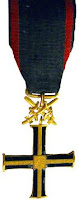
Charaszkiewicz had received many Polish decorations, including the Cross of Virtuti Militari (5th class, 1922), the Order of Polonia Restituta (3rd, 4th and 5th classes), the Cross of Independence with Swords

Virtuti Militari

Order of Polonia Restitua

Cross of Independence with Swords


Source: Wikipedia


Editors Note:  FYI:  The images of medals posted here may or may not be the exact version which was awarded to the recipient.  There are several classes for each medal depending on various factors such as type of military (or civilian) service, rank of officer (or soldier), class of award, year in which it was awarded, etc   The lack of sufficient information on the web (or omission) has compounded the difficulty in selecting the correct class of medal. I apologize for any inaccuracies.