Showing posts with label SOE. Show all posts

March 26, 2012

GREAT POLISH GENERALS OF WW2: Introduction


When asked who were the greatest allied generals of World War II, most people would immediately think of Patton, Eisenhower, MacArthur, Montgomery, among others. And rightly so. Their brilliant strategies paved the way towards impressive victories for which they will forever be remembered and glorified.

During World War II all eyes were on the superpowers - the United States, Great Britain, and the Soviet Union but the war was not won by a handful of generals. Many other Allied Generals equally meritorious of recognition had made invaluable contributions to the allied war effort. Beneath the veneer were veritable legions of smaller armies of great soldiers led by generals who served with every bit of courage, military brilliance, and greatness, but whose names have since been forgotten.

Poland was one such nation. Polish military officers of WWII, and the men who followed them have become legendary for their ability to wage battle against even the most powerful of foes. It has always been so. Napoleon Bonaparte had once remarked upon seeing the Polish Legions in battle, that the power of 1,000 Polish soldiers was like that of 10,000 men, so fierce was their motivation to fight and win, whatever the odds.

German troops march into Warsaw- Invasion of Poland 1939
Germans march into Warsaw WW2
When Germany invaded Poland on September 1, 1939, they expected the Poles to surrender in a matter of days, if not a week. But the Soviet invasion on the 17th of September made it imperative for Polish armies to withdraw immediately. Though Poland was jointly occupied in the west and east, and Warsaw had capitulated on September 29th, multitudes of Polish armed forces had re-assembled on foreign soil to continue to do battle against the enemy. To the world, Poland had been conquered. But to the Polish armies, the battle was just beginning.


Numerous Polish generals had served Poland with great distinction in both world wars, including the Polish-Soviet War. This special series focuses on four of Poland's greatest generals of WWII, the battles they fought, (both on and off the battlefields), their struggles, and the men whom they led to victory.

SIKORKSI, ANDERS, MACZEK, and SOSABOWSKI were Polish Generals during World War II. What made them so great lay beyond immediate perception. History has taught us a standard that a great general is one who has been able to conquer, subdue, and destroy the multitudes of peoples. But true greatness does not portend invasion and destruction, but rather the ability to face calamity head on and fight against it with valor and honour.

Unbeknowst to much of the world, the Polish made very significant contributions to assisting the allies towards victory. Their names and the names of their beloved leaders will forever be remembered, as their monuments stand in testament to their Greatness. The following are a few of the other Polish Generals whose valor and self-sacrifice have earned them admiration and respect. (Please note that there will be four other posts in this series.)


POLISH GENERALS OF VALOR


Gen.Wladyslaw Bortnowski
Wladyslaw Bortnowski (1891-1966) was one of the highest ranking generals in the Polish army during WWII. He commanded the Pomorze army, and managed to save a large number of his troops from enemy fire, withdrawing southwards with them to take part in the Battle of Bzura in the September Defensive wars. Initially, the Polish forces achieved success but ultimately failed under a barrage of German counter-attacks. Bortnowski was heavily wounded and taken prisoner by the Germans. He survived the Nazi POW camps and was liberated in 1945.

Awards and Decorations: Virtuti Militari (Silver Cross); Commander of Legion of Honour (France); Cross of Independence, Commander's Cross with Star of Polonia Restituta; Cross of Valor (4x) and Gold Cross of Merit.


General Antoni Chrusciel
Antoni Chruściel(1895-1960) was commander of the Polish underground forces which fought in the Warsaw Uprising of 1944, as well as the Chief of Staff of the Armia Krajowa (Home Army). Chrusciel and General "Bor" Komorowski had ordered the full mobilization of troops on August 1st at 17:00 hours. The objective to liberate Warsaw, and all of Poland ended tragically 63 days later. Despite promises by the British and American allies to provide assistance and military intervention to the Polish insurgents, none ever came. Chrusciel was captured by the Germans and spent the rest of the war in POW camps until liberation in 1945.

Awards and Decorations: Knight's Cross of Order of Virtuti Militari; Gold Cross of Order of Virtuti Militari; Silver Cross of Order of Virtuti Militari; Grand Cross of the Order of Polonia Restitua; Cross of Independence; Cross of Valor (4x); Gold Cross of Merit; Armia Krajowa Cross; Medal of Ten Years of Regained Independence Commemorative Medal for War 1918-21; Bronze Medal of Valor (2x); and the Yser Medal (Belgium).


Gen. Boleslaw Bronislaw Duch
Boleslaw Bronislaw Duch (1885-1980) was a Major General. When Poland was invaded in 1939, Duch was able to evade capture by the enemy and withdrew to western Europe, where he served in France as commander of the Polish 1st Grenadier Division in 1940, the 1st Rifle Brigade of the 1st Polish Corps in Scotland (1942-43), and the 3rd Carpathian Infantry Division of the 2nd Polish Corps (1943-46).

Awards and Decorations: Knight's Cross of Order of Virtuti Militari; Gold Cross of Order of Virtuti Militari; Silver Cross of Order of Virtuti Militari; Commander's Cross with Star of the Polonia Restituta, Cross of Merit with Swords, Cross of Valour (8x), Cross of Independence, Gold Cross of Merit with Swords, Gold; Cross of Merit, Military Cross, and Inter-Allied Medal.


Emil August "Nil" Fieldorf Polish General WW2
Emil August "Nil" Fieldorf
Emil August "Nil" Fieldorf (March 20, 1895 - February 24, 1953) was a Brigadier General and Deputy Commander-in-Chief of the Armia Krajowa (Home Army). During the invasion of Poland, he commanded his regiment but was defeated by the Germans on the night of September 8-9, 1939. He attempted to escape, dressed in civilian clothing but was arrested at the Slovak border and interned. Several weeks later he escaped and joined the Polish army in France. After several months he made a perilous circuitous route back to Poland and joined the Polish Underground. A year later he was given command of the Kedyw (Special Operations executive). He planned and instigated the successful assassination of Nazi SS Franz Kutschera on February 2 1944. After the tragic collapse of the Warsaw Uprising, Fieldorf was arrested by Soviet NKVD and sent to a labor camp. At the time the Soviets did not know his real identity and had released him in 1947. But he was recaptured in 1948 as a result of a false offer of "amnesty" subjected to a mock trial. He was executed on April 16, 1952.

Awards and Decorations: Gold Cross of Order of Virtuti Militari; Silver Cross of Order of Virtuti Militari; Cross of Independence; Knight's Cross of the Order of Polonia Restituta; Cross of Valour (4x); Gold Cross of Merit; and Merit Forces Central Lithuania.The Order of the White Eagle was conferred posthumously in 2006.


General Michal Tadeusz Karaszewicz-Tokarzewski  - Polish General WW2
 Michal T. Karaszewicz-Tokarzewski
Michal Tadeusz Karaszewicz-Tokarzewski (January 5, 1839-May 22, 1964) was a General who founded the resistance movement "Polish Victory Service". During the September Campaign of 1939 he commanded the Operation group of the Armia Pomorze (Pomeranian Army). He fought in the Battle of Bzura and the Defense of Warsaw, serving as second-in-command of Armia Warszawa, under the command of General Juliusz Rommel. At the end of September he became commanding officer of the "3rd Lwow area of the ZWZY" but was arrested and imprisoned by the Soviet NKVD. After his release from prison in 1941, Michal was given command of the "6th Infantry Division" of the Polish Army in Russia, that came to be known as "Ander's Army". From March 1943 until the following year he served as second-in-command of the Polish Army in the East, and in 1944 became commander of the 3rd Polish Corps formed in Egypt. After the war he remained in London in exile.

Awards and Decorations: Commander of the Virtuti Militari Order; Commander of the Order of Polonia Restituta; Cross of Independence with Swords; Cross of Valor (4x); Gold Cross of Merit with Swords (2x);and the Order of the White Eagle (conferred posthumously in 1964).


General Tadeusz Pełczyński - Polish General WW2
General Tadeusz Pełczyński
Tadeusz Pełczyński (February 14, 1892-January 3, 1985) was a General, intelligence officer and Chief of the Polish General Staff, Section II (Military Intelligence). He was also Chief of Staff, and Deputy Commander of the ZWZ Armia Krajowa (Home Army). Pelczynski commanded numerous sabotage operations conducted by special Kedyw units which succeeded in destroying thousands of enemy targets, including railway lines and transport vehicules of the German Wehrmacht. He took part in the Warsaw Uprising, but five weeks into the fighting he was gravely wounded when the PKO bank on Swietokrzyska Street was bombed. When the Uprising came to an end, Pelczynski was taken prisoner by the Germans and interned at concentration camps at Langwasser and at Colditz. He was liberated by the allies in 1945. Pelcyznski's greatest contribution to the war effort occurred just shortly before WWII broke out. It was his wish that the Enigma Secret (which the Poles had cracked) should be smuggled out of the country and given to the British as a gift. Had it not been for the Polish contribution, the war might have been lost.Gordon Welchman, former mathematician-cryptologist of Britain's Bletchley Park wrote thus: "Ultra would never have gotten off the ground if we had not learned from the Poles, in the nick of time, the details both of the German military [Enigma Machine] and of the operating procedures that were in use."

Awards and Decorations:  Gold Cross of Order of the Virtuti Militari; Silver Cross of Order of Virtuti Militari; Cross of Independence; Officer's Cross of the Order of Polonia Restituta; Cross of Valour (3x); Gold Cross of Merit; and Home Army Cross.


General Ludomił Antoni Rayski - Polish pilot and Officer WW2
General Ludomił Antoni Rayski
Ludomił Antoni Rayski (1892-1977) was a Polish pilot, engineer and military officer. During the interwar years he served as Commander of the Polish Air Force and was instrumental in the modernization of Polish military aviation. He also served in the Austro-Hungarian Army, Polish Legion, French Air Force, French Foreign Legion and Royal Air Force. Despite his illustrious military career he was a controversial figure. Thrust into circumstances beyond his control, he refused to submit to allegations of wrong-doing.

After the joint German-Soviet invasion of Poland, Rayski along with many other high-ranking officers evacuated and headed for France through Romania and Hungary. Many Polish soldiers and officers never made it to France as they were captured and interned. When Rayski finally arrived in France he reported to General Zajac, ready for duty in the PAF, but was flatly refused. Apparently, Rayski and many other Polish officers were made scapegoats for the Polish defeat in the September Campaign. In protest, he wrote a memo to all the Polish officers criticizing the matter. Polish Command ordered him to report for duty at Carisay, but when Rayski refused he was court martialled and sentenced to ten months imprisonment for insubordination. The sentence was not carried out but instead Rayski was demoted and left without a job.

Though he attempted to volunteer for active duty elsewhere he was rejected, first by the French L'Armee de l'Air, and then by the Finnish Air Force after they had employed him only briefly. After the German invasion of France, Rayski escaped to England along with many other Polish forces, but met with more tribulation, and was interned at Rothesay on the Isle of Bute, in Scotland. After two months he was released and was permitted to transport planes for the allies between Asia and North Africa.
With the tragic accident of General Sikorski on July 4, 1943, the new commander, General Kazimierz Sosnkowski allowed Rayski to return to active service. At the same time Sosnkowski resumed the court martial proceedings and in the following year after a trial by jury, Rayski was finally acquitted of all charges and the verdict declared him not guilty. Throughout his service with the RAF, Rayski flew a total of 1,519 hours of combat. However, he was never given back his rank as General.

Awards and Decorations: Silver Cross of the Virtuti Militari; Commander's Cross with Star of the Order of Polonia Restituta; Officer's Cross with Star of the Order of Polonia Restituta; Cross of Independence; Cross of Valor (4x); Gold Cross of Merit (2x); Warsaw Uprising Cross; Order of the Cross of the Eagle Class II (Estonia); Officer of the Legion of Honour (France); Distinguished Service Order (UK); Air Force Cross (UK); Italy Star (UK); Gallipoli Star (Ottoman Empire); Field Pilot Badge; and Badge for wounds and injuries (3x).


Józef Ludwik Zając Polish General WW2
Józef Ludwik Zając
Józef Ludwik Zając (1891-1963) was a Polish pilot and General. He had graduated from Jagiellonian University with a PhD in philosophy in 1915. In 1912 he joined the Riflemen's Association and enrolled in an officer's training program. During World War I he commanded several regiments of the famous Polish Legions, and joined the Blue Army of General Jozef Haller.  Zajac fought in the latter phase of the Polish-Soviet War and became Chief of Staff of the Operational Group "Wisla" of several Polish army divisions.

During the interwar period he attended the military college in France, Ecole Superieure de Guerre and in 1924 he was promoted to Brigade General.  By February 1939 he had replaced General Ludomil Rayski as Commander of the Polish Air Force. Zajac was a firm proponent of the theory of air superiority in which he placed greater emphasis on fighter planes than bombers, but there was no time to exploit these ideas. When WW2 broke out, Zajac escaped and made his way to France. When France was invaded he evacuated to England and was appointed Deputy Commander of the Polish 1 Corps. The following year he was commander of the Polish Air Force in the Middle East, then promoted to Division General. He served also as Deputy Commander of the Polish Army in the Middle East until 1943.  At the end of WW2 he settled in Edinburgh where he earned another PhD in philosophy and devoted his life work to academia. During his career he published numerous books on the subject of psychology, military science, as well as his memoirs.

Honours and Awards: Silver Cross of the Order of Virtuti Militari; Commander's Cross of the Order of Polonia Restituta; Officer's Cross of the Order of Polonia Restituta; Cross of Independence; Cross of Valor (4x); Gold Cross of Merit with Swords; Merit of the Forces in Central Lithuania; Military Merit Cross (Austro-Hungary); Companion of the Order of the Bath (UK); and the Chevalier of the Legion of Honour (France).


Elzbieta Zawacka Brigadier General- Poland WW2
Brg. Gen.Elzbieta Zawacka
Elżbieta "Zo" Zawacka (March 19, 1909 - January 10, 2009) graduated from the University of Poznan majoring in mathematics and worked as a teacher. At the same time she was working secretly as an instructor for an underground paramilitary organization for women, the Przysposobienie Wojskowe Kobiet (PWK). When World War II broke out she became the Commander of the the PWK and led the defence of the city of Lwow.  A month later she joined the Silesian branch of the ZWZ and the following year relocated to Warsaw to begin working as a courier transporting documents from nazi-occupied Poland to London and back. She also organized routes for the other couriers. She was appointed Deputy of Zagroda, the Department of Foreign Communication of the Home Army. Zawacka was retained as SOE agent for England and travellied across perilous routes through Germany, France, and Spain to Gibraltar. From there she was transported by plane to London where she commenced intensive training in parachute jumping. On September 10, 1943 she was dropped into Poland and was the only woman to have been a member of the famous Cichociemni. Zawacka fought in the Warsaw Uprising in 1944.After Warsaw surrendered, she relocated to Krakow and continued her underground activities. In 1945, she joined an anti-communist organization called Freedom and Independence but resigned soonafter to commence a teaching position.

In 1951 Zawacka was arrested and tortured by the notorious Soviet Urzad Bezpieczenstwa (Security Service of the Ministry of Internal Affairs). She was sentenced to 10 years imprisonment for treason and espionage but sentence was commuted and she was freed in 1955.

Henceforth she resumed her academic studies enrolling at Gdansk University for a doctorate degree, Zawacka became a tenured professor at the Institute of Pedagogy at Mikołaj Kopernik University in Toruń where she founded the department of Andragogy. During the 1980s she participated in the Solidarnosc movement.

On May 3, 2006 President Lech Kaczynski promoted Elzbieta Zawacka to rank of Brigadier General of the Polish Army. She was the second and last women in the history of the Polish Army to have received such an honour.

Awards and Decorations:  Order of the White Eagle; Order of Virtuti Militari; Silver Cross (2x); Cross of Valor (5x); Commander's Cross with Star of the Order of Polonia Restituta; Officer's Cross with Star of the Order of Polonia Restituta; Gold Cross of Merit with Swords; Home Army Cross; Army Medal; Medal Pro Memoria.


Polish Greatness Poland First to Fight


NEXT:
GENERAL WLADYLSAW SIKORSKI
(click on name)


December 15, 2011

Secret Polish Forces of WW2: The "Silent and Dark Ones" Conclusion

The Cichociemni were a special elite force of the Polish Armed Forces during World War II. Their main objective was to conduct a series of uprisings, in conjunction with the Armia Krajowa (the Polish Home Army) and free Poland by seizing control of major cities including Warsaw. The tactic was straightforward: while the Germans were preoccupied in setting up defenses against the approaching Soviet Red Army, Polish civil authorities planned on re-establishing control before the Soviets arrived.

It was called Operation Tempest (Operation Storm). Details of the uprising were already being planned in September of 1942. It was slated to begin in Central Poland, that is, the General Gouvernment and quickly spread to other regions. The Poles had every expectation that the plans would succeed.  During the long years of occupation, the Polish State did not collapse, but merely went underground. Every sector of government, civil and military, continued to exist and function, although in secret, thus ensuring an easier transition when the time came to reassert power.


Cichociemni Spadochroniarze Armii Krajowej (00:03:39)

The Cichociemni were a cut above the rest - trained in partisan warfare, espionage, and sabotage, among many other specialties. Of 2,413 candidates for the training programme, only 605 managed to pass the test. These heroic men (and a couple of women) fought in the Wilno, Lwow and Warsaw Uprisings, parachuting into Poland under cover of darkness, hence their nickname, the "Silent and Dark Ones".  They were also selected by the SOE for secret missions in other Nazi-occupied countries, including Egypt, Hungary, and France.


CICHOCIEMNI - MISSION FLIGHT TO POLAND


Visit Parts I, II and III of this special series present rare videos, photos, and historical data and information about the most mysterious and powerful special forces of WW2, the Cichociemni.


PART  I
Introduction

PART II  MISSIONS  
Operation Foxley
Operation Most III
Operation Belt
Operation Heads - Operacja Glowki
Operation Burkl - Operacja Burkl
Operation Kutschera
Operation Ostrama Brama
Operation Arsenal

PART III
Famous Cichociemni


Suggested Links

"The Unseen and Silent: Special Operation Paratroops in the Warsaw Uprising"  (in English)
by Professor Jerzy R. Krzyzanowski (Warsaw Uprising 1944 website)


"Stanislaw Edward Mostwin, Polish Freedom Fighter Dies" (in English)
The Baltimore Sun June 4,2011 (Obituary)


Cichociemni (in Polish)
NB. I recommend that you install a translator toolbar to read this in your language.


Cichociemni i ich znaczenie dla Armii Krajowej  (in Polish)
(Cichociemni and their importance to Armia Krajowa)


(Cichociemni Parachute Training)


Cichociemni Wallpaper


LOYAL TO THE VOW

December 6, 2011

Secret Polish Forces of WW2: The "Silent & Dark Ones" PART II: MISSIONS Operation Foxley

OPERATION FOXLEY
Winston Churchill

In November 1944, the British SOE devised the plan for the assassination of Adolph Hitler, though it was never carried out. Apparently there was considerable resistance to the plan, in particular by the deputy head of SOE's German Directorate, Lt. Col. Ronald Thornley, although his superiors, Sir Gerald Templer and Prime Minister Churchill both supported it wholeheartedly.

Sir Gerald Templar
The method chosen and most likely to have succeeded had the plan gone forward, would have been a sniper attack at Hitler's compound in Berghof. According to information given by a German prisoner (who had been a member of Hitler's personal guard at Berghof), Hitler took daily, solitary walks near the woods, and always at the same time - 10:00 a.m. During these moments he was not visible from the sentry posts, thus providing a perfect opportunity for a sniper to get a clean and easy shot. Whenever Hitler was present at Berghof the Nazi flag was raised and could clearly be seen from a cafe in the nearby town.

The plan called for two SOE paratroops (a British sniper, and a German-speaking Pole) disguised in German army uniforms to parachute to landing targets in the surrounding area and position themselves within the compound. In preparation for the mission a sniper was assigned to practice sessions firing at moving dummy targets using the standard Wehrmacht rifle, the accurized Kar 98K.

Hitler's retreat at Berghof
KAR98k German sniper rifle with scope


The KAR98k was one of the most effective sniper weapons of the German Wehrmacht. It was a 7.92mm bolt-action rifle with 4x power sniper scope (an improvement over previous models.) It had a range of 1000 yards, although the 5-round magazine had to be loaded a round at a time.

The SOE had the good fortunate to have found a reliable inside man, Heidentaler, a German who lived in Salzburg, Austria, only 20 kilometres from Berghof. Heidentaler was vehemently anti-Nazi, and regularly visited the shooting range with other like-minded shopkeepers.

Hitler talking walk at Berghof compound

Operation Foxley had all the earmarks for success
but was scrapped by British authorities.

The British came up with variety of excuses to call off the Operation. In 1944 Hitler had already proven himself to be a poor military strategist. The British feared the consequences of Hitler's assassination, that is, his successor might very well possess superior military leadership skills that would pose an even greater threat to the allies. Thornley's reason to oppose the plan was that the assassination of Hitler would have made him a martyr and thereby fan the flames of Nazism.


NEXT:
PART II: MISSIONS Operation Most III

December 5, 2011

Secret Polish Forces of WW2: The "Silent & Dark Ones" PART I: Introduction

On September 1st, 1939 the German Wehrmacht launched a blitkrieg attack on Poland the likes of which had never before been seen in the history of warfare. Two weeks later the Soviet Union attacked Poland from the east. Though Polish troops were overwhelmed  by the German war machine, they did not cower but fought courageously. However, by month's end they withdrew upon the orders of the Polish government. A massive evacuation was underway as thousands of Polish troops headed for Romania, and from there to France where they reassembled their forces under the auspices of the French Armed Forces.

Within a few short months, on December 30, 1939 a plan had been devised by Captain Jan Gorski for the creation of a secret unit that would maintain contact with the Polish underground unit called ZWZ (Związek Walki Zbrojnej) Union of Armed Struggle. Gorski in collaboration with his associate, Captain Maciej Kalenkiewicz, studied and analyzed documents about German paratroops, and how a Polish equivalent could be used in covert support operations, and assist in a future uprising in occupied-Poland. However,Gorski's plan was never adopted despite his frequent submissions.

Captains Jan Gorski and Maciej Kalenkiewicz,England WW2

According to one Polish Air Force Commander, General Zajac, the plan was a good one, but efforts at implementing it would have been futile due to the lack of materiel resources, transport, and training facilities in France. After the capitulation of France, Polish troops again evacuated and regrouped in Great Britain.


On September 20, 1940 General Wladyslaw Sikorski, the Commander-in-Chief of Polish Armed Forces, ordered the creation of special covert operatives, the Oddział III Sztabu Naczelnego Wodza (Section III of the Commander-in-Chief's Staff) whose mission was contingency planning and covert operations in Poland, as well as air delivery of arms and supplies and training of Polish paratroops. Just several weeks earlier, Prime Minister Winston Churchill, and Minister of Economic Warfare, Hugh Dalton, had officially inaugurated the SOE (Special Operations Executive) with the sole purpose of conducting guerilla warfare against the Axis powers. Their chief objective was to provide instruction and assistance to resistance movements in Nazi-occupied countries. To use Churchill's words they were to "set Europe ablaze".


Training took place in Scotland under the utmost of secrecy and was directed by the Polish 6th Detachment of the General Staff and the British Special Operations Executive (SOE). Because of it's secrecy very few allied officials even knew of it's existence. The SOE was instrumental in providing the secret Polish forces, the Cichociemni with every resource at it's disposal including training facilities and logistical support. Many of the Polish units were based at Audley End House, in Essex, England. There they received rigorous training before parachuting into Poland. Recruits were also trained at Ringway in Manchester. Incidentally, each paratroop was promoted one rank higher at the moment of their first jump.

Cichociemni - Parachute Training in Great Britain - WW2

Thousands of Polish men and women volunteered but only a few were chosen.  Among the recruits were one general, 112 staff officers, 894 officers, 592 NCO's,  771 privates, 15 women, and 28 civilian envoys of the Polish government-in-exile. Of a total of 2,413 candidates, only 605 successfully completed the rigorous training and passed all their exams. Among those transported to Poland were soldiers of all grades. The oldest agent was 54 years of age, and the youngest, 20. Only those demonstrating superior physical and intellectual faculties were accepted into the elite corps. These elite fighters were officially sworn in as members of Armia Krajowa - their identities known only to the Polish General Staff.

Training was comprehensive and extremely demanding.  In addition to sabotage, covert operations and partisan warfare, there was intensive instruction requiring the mastery of the use of all weapons which included British, Polish, German, Russian and Italian armaments. Courses dealt with a vast array of specialized subjects which included topography, cryptography, and sharpshooting. Recruits were also taught the details of German laws that were imposed on occupied-Poland, the art of Jujutsu, and shooting at invisible targets. The final course concentrated on strategies and techniques for creating a new, false identity.


Cichociemni Training in England: Otton Wiszniewski and Jan Serafin (operating Sten machine gun)

The chosen few eventually came to be referred to as the Cichociemni, the "Silent, Dark ones" so-called because individuals would vanish mysteriously and silently during the night to carry out special operations. Although the Cichociemni collaborated with the British SOE, the former was predominately independent. Polish Command was free to choose their own operatives, and operated their own radio communications.


These special Polish agents played a large role in allied covert operations. Their first flight was organized on the night of February 15-16, 1941 in which three Polish soldiers (athletes), were transported by a two-engine British Whitley bomber headed for Poland: Captain Stanislaw Krzymowski (code-named Kostka "Cube");  Jozef Zalbieski (code-named Zbik "Wildcat") and courier Czeslaw Raczkowski (code-named "Wlodek"). The flight was a long and hazardous one whose route passed directly over German positions.  The intended drop zone was to have been in Wloszczowa in Kielce, but due to unknown circumstances they ended up at Cieszyn Silesia, near Skoczdw, in a zone that Germany had annexed. 

Due to the extreme danger, flights were suspended temporarily.  After a period of nine months flights resumed however using an alternate flight path from Denmark or Sweden, and air transport by a Halifax Bomber that was built to handle long hauls.  Planes had to take off only during the night and only by moonlight - Poland did not have radar making it essential for the pilots to rely on eyesight to navigate. During summers, flights were altogether suspended due to the shorter night hours.  By the end of 1943, the Cichociemni base was transferred to Brindisi, Italy and flights resumed by Liberator aircraft.

Flight path carrying Cichociemni agents to Poland WW2


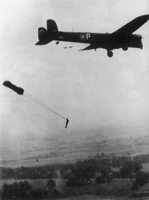
Cichociemni parachute drop Poland WW2

Allied missions conducted a total of 483 air bridges but lost 68 planes to crashes and enemy fire.  Apart from the Cichociemni themselves, about 630 tonnes of war material were delivered in special containers.  The Cichociemni airdropped supplies and war materiel including large amounts of currency to the Armia Krajowa in Poland -  currencies amounting to 40,869,800 in forged Polish zloty, $26,299,375 in banknotes and gold bullion, £ 1,755 in gold bullion,and 3,578,000 German marks.

By December 1944, 316 Polish soldiers and 28 envoys had successfully parachuted into Poland. In addition, 17 Polish agents parachuted into Albania, Greece, Italy and Yugoslavia, to carry out missions for the SOEC, although the number of Polish agents who parachuted into France is still undetermined. Among them was one of the most famous of Cichociemni, the vivacious and inimitable Krystyna Skarbek. Incidentlaly, she was one of the founding members of the SOE, and helped to organize cells of Polish spies throughout Central Europe, including Poland, Hungary, France and Egypt. Skarbek, it had been said, was one of Churchill's most favorite spy, she so dazzled him.

Krystyna Skarbek - Cichociemni - SOE Operative

The Cichociemni agents were assigned to special units of the ZWZ and the Armia Krajowa, mostly comprising units of the Wachlarz, Zwiazek Odwetu, and KeDyw underground divisions. Many of them were promoted and served as staff officers of the secret Polish army. They carried out many missions, most notable among them were Operation Tempest, and the Uprisings in Wilno, Lwow and Warsaw.


Cichociemny Jan Piwnik (Ponury) and colleagues from Kedyw unit of Home Army
Radom-Kielce Home Army area, 1944

Among their areas of expertise, the Cichociemni were highly skilled and efficient in the covert take-over of many functions in Nazi-occupied countries, working for intelligence organizations, functioning as radio-operators and envoys, flying missions, and coordinating airdrops and forging documents.  Many of them were instructors in secret military schools, teaching the art of anti-tank warfare, diversion, and partisan warfare.

The emblem of the Cichociemni is a Polish eagle, descending on the attack, clutching a wreath of olive leaves encircling the letters PW- Polska Walczaca, meaning Poland Fights. The Cichociemni were the predecessors of today's GROM, (Grupa Reagowania Operacyjno-Manewrowego), that is, the Operational Mobile Reaction Group - special anti-terrorist forces unit.  The name GROM means "thunder", aptly represented by an emblem of the same Polish eagle on the attack cluthing a lightning bolt.

Of the 344 Cichociemni flown to Poland, 113 were killed in action: 9 were shot down before their planes reached their targets; 84 during battle against the Germans, or died as a result of being tortured by the Gestapo, after having been captured and arrested; 10 committed suicide in captivity in prisons and concentration camps; and 10 were executed by the Communists during and following the end of war. 91 Cichociemni took part in the Warsaw Uprising. 18 were killed in action.


NEXT:
  PART II: MISSIONS  Operation Foxley


September 24, 2011

Warsaw Uprising 1944: September 24 - Polish Heroes: The Cichociemni - "Silent Dark Ones"

German forces have intensified attacks on the three remaining centers of insurgent resistance: Zoliborz, Srodmiescie and Mokotow. Throughout the day Mokotow was the main focus of German attacks. A general assault was launched early this morning by German infantry supported by artillery, air force and armoured units. Insurgents have been able to fight off most of the attacks. After a fierce struggle in the southern and southeastern sectors, the Germans have captured Krolikarnia Palace. They destroyed an advance insurgent position at 162 Pulawska Street and have reached the line of Ksawerow Street. By nightfall Home Army troops attacked and attempted to recapture the area but failed. In the eastern sector of Mokotow defense, German tanks have forced the insurgents to retreat to the line of Konduktorska Street. The remaining insurgent positions are still in Polish hands. Casualties are high on both sides.

German Cannon "Ferdinand" fires on Polish Insurgent positions Warsaw 1944
Wounded Polish Officer - background buildings of Lower Mokotow
                "Krawiec" Company from "Rys" Battalion at 134 Pulawska Street in Mokotow district during inspection by Stanislaw Kaminski "Daniel". "Krawiec" Company just came from Kabacki Forest through Wilanow to Mokotow district bringing arms for "Baszta" Regiment. On the left company commander Stanisław Milczynski "Gryf". From the right in the first row: Wladyslaw Zyganski "Zuk" and Tadeusz Kozlowski "Kozak".            


Radio communication with Soviet Command has peaked these past few days. Just two days ago two Soviet soldiers under the command of Captain Kolos have parachuted into Warsaw with Soviet radio transmitters. The radio set provided by Soviet Major Chernuhin has established a vital communication link between the AK commander of Mokotow Sector and a Soviet artillery post. Captain Wieckowski, of the Soviet-backed Armia Ludowa has been dispatching messages from a Soviet radio transmitter in Zoliborz Sector. An AK (Armia Krajowa) officer with access to the radio set at Berlings Headquarters has also been transmitting to and receiving messages from the AK Headquarters in Warsaw. The high intensity communication gives every indication that Soviet forces will soon advance.
Cichociemni parachuting into Poland WW2
A special intelligence unit of the Polish Army General Staff Headquarters in London, England, called "Barnes Lodge" has been on round the clock surveillance 24 hours a day, seven days a week, listening to radio messages coming in from Polish Home Army Command in Warsaw. There are currently about twelve transmitters in the units, the last delivered by Polish agents of the SOE who had parachuted into Poland just before the Uprising broke out.  Polish agents are risking their lives. If at any time during the transmission of messages, or receipt of them, a Polish operative, or cichociemni, can be discovered by the enemy and shot on the spot.

Franek Rymaszewski, one of the operators, listens for underground messages from Poland
 in one of the radio telegraph stations in "Barnes Lodge" near Kings Langley, North London.  

Polish conspiratorial transmitter and receiver, type AP1, called "peepshtock"


Cichociemni (the "Silent, Dark Ones") are an elite special operations division of the Polish army in exile. They were created in Great Britain to be a crack team in partisan warfare in occupied Poland, and are highly skilled at espionage and sabotage activities. They are all expert marksmen irregardless of the weapons used - be they British, Polish, Russian, German, or Italian weaponry. All soldiers who pass training are sworn in as members of Armia Krajowa.

Cichociemni are entirely independent of the British army, though the unit was organized in collaboration with SOE (Special Operations Executive). The Cichociemni is the only one in the SOE which is free to chose its own men and operate its own radio communication with an occupied country. The identities of these heroic men are kept secret and are known only to the Polish General Staff. The oldest of them is 54 years of age, while the youngest is only 20.  All members of the Special Unit are promoted one rank upwards at the moment of their jump.


Emblem of Cichociemni