Showing posts with label Auschwitz. Show all posts

June 14, 2018

JUNE 14 - DAILY CHRONICLES OF HISTORY

JUNE 14

1634

Russia and Poland signed Peace Treaty of Polianow:  The Treaty of Polyanovka (Polish: Polanów) was signed on June 14, 1634 between the Polish-Lithuanian Commonwealth and Tsardom of Russia in the village of Semlevo located near the Polyanovka River. The accord was signed in the aftermath of the Smolensk War. The negotiations began on April 30 after the failure of the Polish siege of Belaya. Overall, the agreement confirmed the pre-war status quo, with Russia paying a large war indemnity (20,000 rubles in gold) for Władysław IV agreeing to surrender his claim to the Russian throne and return the royal insignia to Russia. Władysław, despite holding an upper hand, was trying to bring Russia into an anti-Sweden alliance; hence in a gesture of goodwill he agreed to give the Russians the border town of Serpeysk and nearby territories. However, the alliance never came through, as the Polish Sejm, unwilling to fight Sweden after the Treaty of Sztumska Wieś, subsequently objected, and Russians saw no benefit in such an alliance.


1906

Pogrom against Jews in Bialystok in Russian Empire: The pogrom occurred between from June 14–16, 1906 in then part of the Russian Empire. Between 81 and 88 people were murdered and about 80 people wounded.  Just as shots were fired, the violence suddenly erupted as mobs of thugs began looting Jewish stores and apartments. The police did nothing to stop it and even participated. By the next day, the attacks on Jewish people no longer appeared as a spontaneous outbreak of violence but rather systematic as in a coordinated military attack.  Russian authorities tried to blame the pogrom on the local Polish population in order to stir up hatred between the Jews and Poles (both of which were opposed to the Tsar).  However Jewish survivors of the violence reported that the local Polish population had in fact sheltered many Jews during the pogrom and did not participate in it. Apolinary Hartglas, a Polish Jewish leader and later a member of the Polish Sejm, together with Ze'ev Jabotinsky, managed to obtain secret documents issued by Szeremietiev which proved that the pogrom was planned in advance by Russian authorities and that the murderers were Russian railroad workers transported from Russia to instigate the violence.


1940

Auschwitz concentration camp began to operate in Nazi controlled Poland. The first transport, from the southern Polish city of Tarnów, consisted of 728 Poles, including 20 Jews. (eventually  3 million would die within its confines). The inmate population grew quickly as the camp absorbed Poland's intelligentsia and dissidents, including members of the Polish underground resistance. By March 1941, 10,900 were imprisoned there, most of them Poles. By the end of 1940, the Nazis had confiscated land in the surrounding area to create a 40-square-kilometre (15 sq mi) "zone of interest" surrounded by a double ring of electrified barbed wire fences and watchtowers.


German forces occupied Paris unopposed on June 14 after a chaotic period of flight of the French government that led to a collapse of the French army. The Battle of France was fought from May 10 to June 25, 1940.  French divisions made a determined resistance but were unable to overcome the German air superiority and armoured mobility. Though the French believed that the Maginot Line would be sufficient defence, German tanks charged through its defenses and deep into France. German commanders met with French officials on June 18 with the objective of forcing the new French government to accept an armistice that amounted to surrender. On June 22, the Second Armistice at Compiègne was signed by France and Germany, resulting in a division of France. The neutral Vichy government led by Marshal Philippe Pétain superseded the Third Republic and Germany occupied the north and west. Italy took control of a small occupation zone in the south-east, and the Vichy regime was left in control of unoccupied territory in the south known as the zone libre.


1944

The Battle of Porytowe Wzgórze began between Polish and Russian partisans and Nazi German forces:  Polish and Russian partisans, numbering around 3,000 found themselves overwhelmed and surrounded by 25,000 to 30,000 German soldiers backed by artillery, tanks, armored cars and air support.  The Germans managed to break through the partisans' line of defense and despite high casualties among the Poles and Russians, they managed to drive the Germans back. The Germans took cover in the woods nearby from which they could keep the partisans under constant fire, increasing the number of casualties, then capturing the western side of the Porytowe Hill, they succeeded in breaching the main line of defense. The Poles and Russians counterattacked, and were able to recover their lost positions and break out of the trap. After fierce fighting, and heavy losses, the main columns of partisans, managed to reach the safety of the Solska Wilderness after a march of 40 kilometers.


April 27, 2018

APRIL 27 - DAILY CHRONICLES OF HISTORY

APRIL 27

1943

On the night of April 26-27, 1943 Witold Pilecki broke out of Auschwitz concentration camp. When Pilecki was assigned to a night shift at a camp bakery outside the fence, he and two other prisoners overpowered a guard, cut the phone line and escaped  taking with them valuable documents stolen from the Nazi Germans. Pilecki was a member of the Polish underground Home Army (Armia Krajowa). In September 1940, using a fake ID with the name of Tomasz Serafinski, he voluntarily allowed himself to be arrested in a roundup along with 2,000 other Poles (among them Wladyslaw Bartoszewski), and was deported to Auschwitz.  His inmate number was 4859.  Before Pilecki started gathering intelligence of the activities in the camp, the Allies had no idea that it was a death camp. Pilecki also attempted to organize a inmate resistance and proposed that the Allies bomb the camp.. He organized the underground Union of Military Organizations (ZOW) whose task it was to   improve inmate morale, provide news from outside, distribute extra food and clothing to members, set up intelligence networks and train detachments to take over the camp in the event of a relief attack by the Home Army, arms air drops or an airborne landing by the Polish 1st Independent Parachute Brigade based in Britain. The reports Pilecki provided the Allies were a principal source of intelligence on Auschwitz, but the Allies replied that his plans were impossible to carry out.


1945

U.S. troops liberated Kaufering concentration camp: Kaufering and Mühldorf were two sub-camps attached to Dachau.  Kaufering was constructed to accommodate a fighter plane factory in the Landsberg region and included eleven camps, the largest containing thousands of prisoners, primarily Jewish, living in partially buried huts for camouflage from aerial reconnaissance. On April 27, 1945,  soldiers of the 134th Ordnance Maintenance Battalion of the 12th Armored Division led by Capt. John P. Jones discovered the camp. The SS had forced the prisoners on a death march ahead of the arrival of the Battalion.  Six of the Kaufering Concentration Camps were liberated by the 7th Army's 103rd Infantry Division, 411th Regiment.  The camp was filled with the skeletons of Jews, Poles, Russians, French and un-Nazified Germans. In two of the camps the soldiers found Jewish men, women and children shoved together, 100 to a hut. Military officers secured from the neighbouring countryside 1,000 loaves of bread, 1,000 quarts of milk and 750 pounds of fresh meat per day to feed the emaciated living who weighed just 50 to 60 pounds from 5 to 6 years of forced labor, starvation and exposure. In one camp, 300 dead bodies lay on the ground while 600 "living zombies shuffled aimlessly." Colonel Edward F. Seiller, commander of the 12th Armored Division's Military Government, took control of the camp and had some 250 civilians from the nearby town of Landsberg brought to the camp and ordered them to bury the dead prisoners.


2014

The Canonization of Pope John XXIII and Pope John Paul II was held on this day , Divine Mercy Sunday. The canonization Mass was celebrated by Pope Francis (with Pope Emeritus Benedict XVI),  in St. Peter's Square at the Vatican.  About 150 cardinals and 700 bishops concelebrated the Mass, and at least 500,000 people attended the Mass, with an estimated 300,000 others watching from video screens placed around Rome.


March 1, 2018

MARCH 1 - DAILY CHRONICLES OF HISTORY

MARCH 1

1810

Frederick Chopin (dob) was a Polish composer and virtuoso pianist of the Romantic era who wrote primarily for the solo piano though he also wrote two piano concertos, a few chamber pieces, and some songs to Polish lyrics. Among his major piano works were mazurkas, waltzes, nocturnes, polonaises, études, and sonatas.  He gained worldwide fame and admiration for being a leading musician of his era. Chopin's "poetic genius was based on a professional technique that was without equal in his generation." A child prodigy, he completed his musical education and composed his earlier works in Warsaw before leaving Poland at the age of 20, less than a month before the outbreak of the November 1830 Uprising.  Chopin was credited with introducing to music a new sense of nationalism. In a 1836 review of the piano concertos, Schumann highlighted the composer's patriotic feelings for his native Poland, writing that "Now that the Poles are in deep mourning (following the defeat of the November Uprising of 1830), their appeal to us artists is even stronger ... If the mighty autocrat in the north ( Nicholas I of Russia) could know that in Chopin's works, in the simple strains of his mazurkas, there lurks a dangerous enemy, he would place a ban on his music. Chopin's works are cannon buried in flowers!" Chopin's music remains very popular and is regularly performed, recorded and broadcast around the world. The International Chopin Piano Competition, founded in 1927, is held every five years in Warsaw. The Frederyk Chopin Institute of Poland lists on its website over eighty societies worldwide devoted to the composer and his music. The Institute site also lists nearly 1,500 performances of Chopin works on YouTube as of January 2014.


1941

Heinrich Himmler paid his first visit to Auschwitz Concentration Camp.  He was accompanied by Gauleiter, and the head of the Upper Silesia SS-Brigadeführer Fritz Brach, the high commander of the SS and the Police in Wrocław SS-Obergruppenführer Ernst Schmauser, SS-Oberführer Glücks, the head of the districts, and the highest representatives of the IG Farbenindustrie complex.  During the visit he ordered Commandant Rudolf Höss to expand the current camp to hold a total of 30,000 prisoners, expand the camp to Birkenau with capacity for 100,000 prisoners, supply 10,000 prisoners to work for the nearby I.G. Farben factory, and to expand the camp's agricultural and industrial output. Rudolf Höss and his family hosted Heinrich Himmler for dinner during Himmler's inspection of Auschwitz Concentration Camp in occupied Poland.


1943

In New York, American Jews held a mass rally at Madison Square Garden to pressure the U.S. government into helping the Jews of Europe. It drew a crowd of 70,000. Subsequently, similar rallies were held in a several cities throughout the United States. The "Rally of Hope” expressed the sympathy of Americans for the Jewish children persecuted in Nazi Europe. The focal point of the rally was a pageant in which 1,000 children and adult actors participated. The meeting was addressed by Senator William Langer of South Dakota, Eddie Cantor and Rep. Joseph Clark Baldwin of New York.


1951

Mokotow Prison Massacres:  On March 1, 1951, the Soviet-controlled Communist Polish secret police, Urząd Bezpieczeństwa (UB), carried out the execution of seven members of the 4th Headquarters of the anti-Communist organization Wolność i Niezawisłość (WiN) in the Mokotów Prison in Warsaw. They were accused of actively participating in anti-Nazi resistance during World War Two.  The executed men were: Łukasz Ciepliński, Karol Chmiel, Adam Lazarowicz, Józef Rzepka, Józef Batory, Mieczysław Kawalec and Franciszek Błażej. The accused were not given an opportunity to refute charges brought against them, despite the fact that on several occasions Ciepliński had stated that he was tortured and that his confessions were extracted with the use of torture. The Communist judges disregarded his testimony. The courtroom was filled with UB functionaries. All seven men were shot on March 1, 1951, at five- to ten-minute intervals. They were executed with a single shot to the back of the head, the standard Communist execution method, and consistent with the executions of Polish officers at Katyn Forest. The executions began at approximately 8 p.m., with Ciepliński being shot first, followed by Batory at 8:05, Chmiel at 8:15, Kawalec at 8:20, Lazarowicz at 8:25, Blazej at 8:35, and Rzepka at 8:45. Two of the executed men, that is, Ciepliński and Rzepka, were previously awarded Poland's highest military decoration for valor, the Cross of the Virtuti Militari. The firing squad consisted of a single man, the notorious Piotr Śmietański, nicknamed by the prisoners the "Butcher of the Mokotow Prison."  Smietanski was believed to have emigrated to Israel in 1968. The burial place of the seven WiN soldiers executed by the Communist regime remains unknown to this day. The 1950 court ruling rendered by the Communist court was overturned in 1992 by the Warsaw Military Court and the seven convicted and executed men were acquitted retrospectively on all counts. In the 1992 court ruling, it is stated that the executed WiN soldiers "Fought and Died for a Free and Sovereign Poland."


January 18, 2018

JANUARY 18 - DAILY CHRONICLES OF HISTORY

JANUARY 18

1919

Ignacy Jan Paderewski was the Prime Minister of Poland as well as Foreign Minister from January 18 to November 27, 1919 and represented Poland at the Paris Peace Conference in 1919. He played an important role in meeting with President Woodrow Wilson and obtained the explicit inclusion of establishing an independent Poland as point 13 in Wilson's peace terms in 1918 (the Fourteen Points). Paderewski was also a renown Polish pianist and composer and fervent spokesman for Polish independence. He was a favorite of concert audiences around the world.


1940

Palmiry Massacre: 255 Jews in Warsaw were arrested at random by the Nazi Germans. Over the next week they would be taken to the Palmiry Forest outside the city and shot dead. (Note: Between December 1939 and July 1941 more than 1700 Poles and Jews – mostly the inmates of Pawiak prison – were executed by the SS and the Ordnungspolizei in the forest glade near Palmiry. The best documented of these massacres took place on 20–21 of June 1940, wherein 358 members of the Polish political, cultural and social elite were murdered in a single operation.)


1943

Warsaw Ghetto Uprising:  The Nazi Germans began their second deportation of the Jews, which set off a violent armed uprising by the Jews in the Warsaw Ghetto.  Jewish fighters of the ŻZW, joined by elements of the ŻOB, put up an armed resistance, engaging the Germans in direct exchanges of gunfire. Though the ŻZW and ŻOB suffered heavy losses (including some of their leaders), the Germans also took casualties, and within a few days the Germans halted the deportation. Only 5,000 Jews were removed, instead of the 8,000 planned by SS Globocnik. Hundreds of Jews in the Warsaw ghetto were ready to fight, adults and children, though sparsely armed with handguns, homemade molotov cocktails, and a few weapons that were smuggled into the Ghetto by the Polish underground. Many of the Jewish insurgents knew that their actions was a futile effort to save themselves, but that they fought the battle for the honour of the Jewish people, and a protest against the silence and apathy of its allies. The ZZW and ZOB were Jewish resistance organizations. The former had close ties to Armia Krajowa.


1945

The Germans ordered the evacuation of the remaining 60,000 inmates of Auschwitz concentration camp ahead of the advancing Soviets. Some were deported by rail while others were forced to march in freezing temperatures.


The Soviet-controlled Polish Committee of National Liberation moved from Lublin to Warsaw.


Soviet troops captured Krakow, Poland


October 5, 2011

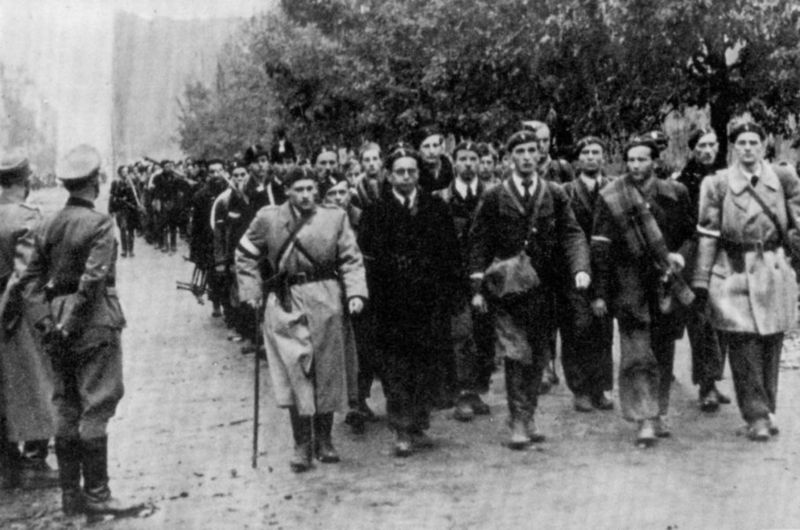
Warsaw Uprising 1944: October 5 POLAND GOES INTO CAPTIVITY

For the second day insurgents have been laying down their armaments and surrendering to the Germans. At about 9:00 this morning the remainder of Polish regiments began leaving Warsaw. The 72nd Infantry Regiment of the AK under the command of Lt. Col. Jan Szczurek-Cergowski “Slawbor” left the district of southern Srodmiescie marching along the pre-determined exit routes - Sniadeckich, 6-go Sierpnia, Sucha and Filtrowa Streets. 


They were followed by members of the Home Army Headquarters, the Command of the 10th Infantry Division, and the National Armed Forces "Sokol" group under the command of Col. Spirydion Koizewski "Topor" as well as the 36th Infantry Regiment under the command of Major Stanislaw Blaszczak "Rog" from northern Srodmiescie. Also falling into line were staff members of the Warsaw District of the Corps and the 28th Infantry division and the Municipal Headquarters marching along Zelazna, Aleje Jerozolimska and Grojecka Streets.  The 15th Infantry Regiment under the command of Lt. Col Franciszek Rataj "Pawel" was the last group to leave Warsaw - the route they took was along Grzybowska, Chlodna and Wolska Streets.  A covering battalion under the command of Lt. Col. Franciszek Pacek “Mscislaw” will remain in Warsaw for the next few days and will be expected to lay down arms only on October 9th, 1944.


German soldiers directed the columns of insurgents to Ozarow from where they were boarded onto freight trrains and transported to Stalag 334 at Lamsdorf (Lambinowice) in Slask Opolski. Once having arrived the insurgents will be registered and sent to POW camps in Germany and Austria.

Home Army Commander-in-Chief General Tadeusz Komorowski “Bor” and five generals: Tadeusz Pelczynski “Grzegorz”, Antoni Chrusciel “Monter”, Tadeusz Kossakowski “Krystynek”, Kazimierz Sawicki “Prut” and Albin Skroczyński “Laszcz” were taken into captivity along with 11,668 soldiers exclusively from the Srodmiescie district.  Meanwhile, General Leopold Okulicki “Niedzwiadek” has left the city together with the civilians. Thenceforth Okulicki has been put in charge of further underground activity.  


(L) General Bor
The remaining civilians were forced to leave the city, although there are reports that many of them have decided not to leave and be sent to POW camps. Among them are a few insurgents who have been designated by the Home Army to remain and continue the struggle.  At least 55,000 civilians will end up in concentration camps, and be categorized as "criminals" by the German Nazi authorities. An additional 150,000 will be transported to Germany for forced labor.


During the two-month Uprising approximately 13,000 Warsaw residents were rounded up and arrested by German troops and deported to Auschwitz concentration camp. Polish prisoners comprised of government officials, professors, physicians, artists, blue-collar workers, pregnant women, the elderly, the sick and injured. Many were transferred to labor camps in Germany and worked to death.  About 550,000 Polish residents from Warsaw were deported to Durchgangslager 121 (Dulag 121) in addition to 100,000 civilians from outlying areas. In the months of August, September and October approximately 650,000 Poles had passed through the Pruszkow transit camp.

Pruszkow transit camp

The Uprising, which was encouraged by Stalin, had given the Polish people renewed hope that Poland would soon be liberated.  British and American promises for military assistance convinced the Poles to continue fighting to the very bitter end.  However, unbeknowst to Prime Minister Mikolajczyk, Churchill and Roosevelt had already ceded Polish territory to Stalin at the Teheran Conference a year before.  For 63 days the Poles fought in vain, waiting for help that would never arrive. A tragedy more brutal than capitulation was the relevation that the Allies aided and abeted Stalin's chicanery.  In a final coup de grace, Prime Minister Churchill sent an official letter today to Polish Prime Minister Mikolajczyk.  The following is an excerpt:

Prime Minister Mikolajczyk
"My Dear Excellency, I received with deep sorrow your letter telling me that resistance had ceased in Warsaw. As you know, we were anxious to do everything in our power to bring assistance to General Komorowski’s forces and nothing but insuperable difficulties of weather and geography prevented our assistance being more effective."


February 15, 2011

SPY WEEK Famous Polish Spies - Witold Pilecki

 WITOLD PILECKI

Code Names: Roman Jezierski, Tomasz Serafiński, Druh, Witold 

Witold Pilecki was a soldier of the Second Polish Republic and founder of the Secret Polish Army (Tajna Armia Polska) a resistance group and a member of the Home Army (Armia Krajowa)

He was the author of the first Intelligence report on Auschwitz, which the Polish government-in-exile used to convince the Allies that the Germans were carrying out genocide of the Jewish people.

Pilecki volunteered to work for a Polish resistance operation in order to get himself arrested and imprisoned in the infamous Auschwitz death camp. Once there he gathered enough information to support his claims. In the meantime he organized a resistance movement among the Jewish inmates.  The Allies were informed as early as 1940 on German atrocities. Three years later, Pilecki escaped and eventually took part in the Warsaw Uprising.

He was executed in 1948 by the Urzad Bezpieczenstwa, Stalin's secret police, on charges of working for "foreign imperialism", a euphemism for MI6. Pilecki's allegiance was for the Polish Government in exile located in London, a factor that led to his execution.

The Polish communist regime had suppressed information about Pilecki's activities until 1989. The Polish government commemorated Pilecki's life by issuing a coin for the 65th anniversary of the liberation of the Auschwitz..

Witold Pilecki was born May 13, 1901 in Olonets (Oloniec),Russia, where his family had been forced to resettle by Tsarist Russian authorities. His grandfather, Jozef had spent seven years in exile in Siberia for having taken part in Poland's Uprising (1863-1864). In 1910, Pilecki moved with his family to Wilno (Vilnius, Lithuania), where he completed Commercial School after which he joined the secret ZHP Scouts organization. He founded a local ZHP group in Orel, Russia where he had relocated in 1916.

During World War I Pilecki joined ZHP Scout section in the Wilno area. When his sector of the front was overrun by the Bolsheviks, his unit resorted to partisan warfare behind enemy lines. He joined the Polish Army and fought in the Polish-Soviet War of 1919–1920, serving under Major Jerzy Dąbrowski. He was part of the cavalry unit defending Grodno (now Belarus) fighting in the Polish retreat from Kiev.

On August 5, 1920, he joined the 211th Uhlan Regiment and fought in the Battle of Warsaw, as well as at Rudniki Forest (Puszcza Rudnicka) and in the liberation of Wilno. He was twice decorated with the Krzyż Walecznych (Cross of Valor) for gallantry.

After the Polish-Soviet War ended in 1921 with the Peace of Riga, Pilecki passed his high-school graduation exams (matura) in Wilno, as well as that of exams for an NCO position in the Polish Army. He also studied at the Stefan Batory University in Wilno, and rebuilt his family estate which had been ruined during the war. He served in the cavalry in 1926, after having completed courses in officer training. While in the reserves he was also active in supporting local paramilitary training activities. He took time to work on the family farm located in the village of Sukurcze, and developed a reputation for being a social work activist and an amateur painter.

He married on April 7, 1931 to Maria Pilecka (b.1906 - d 2002) née Ostrowska. They had two children, Andrzej (January 16, 1932) and Zofia, (March 14, 1933) born in Wilno.

In 1938 Witold Pilecki was decorated with the Silver Cross of Merit for exemplary service in community and social work.


World War II

On August 26, 1939 just before the outbreak of World War II, Pilecki was mobilized as a cavalry-platoon commander in the 19th Infantry Division under the Command of Józef Kwaciszewski (part of Polish Army Prusy). His unit fought heroically against the advancing Germans during the invasion of Poland though they suffered many casualties.  His platoon withdrew southeast toward Lwów (now L'viv, in Ukraine) and the Romanian bridgehead where it was incorporated into the recently formed 41st Infantry Division and where he served as its second-in-command, under Major Jan Wlodarkiewicz.

During the September Campaign Pilecki and his men destroyed seven German tanks, shot down an aircraft and destroyed another two on the ground. When the Soviets invaded eastern Poland on September 17, after heavy fighting on two fronts, Pilecki's division was disbanded five days later, partially surrendering to the enemies. He returned to Warsaw with his commander, Major Wlodarkiewicz.

On November 9, 1939, Pilecki and Wlodarkiewicz founded the Secret Polish Army (Tajna Armia Polska, TAP), which was one of the first underground organizations in Poland. Pilecki became its organizational commander and TAP expanded in many major cities of central Poland, including Warsaw, Siedlce, Radom and  Lublin. By 1940, their ranks numbered about 8,000 men, more than half of them armed. Subsequently the units were incorporated into the "Union for Armed Struggle" (Zwiazek Walki Zbrojnej)which was later renamed to "Home Army" (Armia Krajowa).  As part of the AK, the TAP units comprised the core of the Wachlarz unit.


Auschwitz

In 1940, Witold Pilecki proposed a highly unusual plan to his superiors which would have him enter Auschwitz with the objective of gathering Intelligence of the camp from the inside, and the organization of a resistance movement among camp inmates. It was generally believed, at the time, that Auschwitz was just an internment camp or large prison, rather than a death camp.  The plan was approved and Pilecki was provided with a false identification card in the name of "Tomasz Serafinksi".

On September 19, 1940, Pilecki deliberately went out into the Warsaw streets and allowed himself to be caught in one of the street roundups (lapanka).  He was arrested along with 2,000 other innocent civilians, among whom was also Wladyslaw Bartoszewski and imprisoned in the Wehrmacht barracks where he was tortured for two days. The Germans then sent him to Auschwitz where the number 4859 was tattooed on his forearm.


Photos of Witold Pilecki in Auschwitz, 1941
At Auschwitz, Pilecki was forced to work in various kommandos during which time he was stricken with pneumonia, but survived. He organized an underground Union of Military Organizations (Związek Organizacji Wojskowej, ZOW) as well as many other smaller underground organizations which eventually merged with ZOW. Its objectives were to improve inmate morale, provide them with news from the outside, distribute extra food and clothing to members, set up intelligence networks, and train detachments to take over the camp in the event of a relief attack by the Home Army, arms airdrops, or an airborne landing by the Polish 1st Independent Parachute Brigade, based in Britain.

ZOW provided the Polish underground with invaluable information concerning the internal functioning of the camp. From October 1940 these reports were transmitted to Warsaw, and beginning March 1941, they were forwarded via the Polish resistance to the British government in London. These reports constituted a principal source of Intelligence on Auschwitz  and Pilecki hoped that either the Allies would mobilize and drop arms or troops into the camp, or that the Home Army would organize an assault on it from outside. Unfortunately, though the plans were daring and courageous, they were deemed impossible to carry out. In the meantime, the Germans had increased its efforts to uncover the underground movement, many of whose members were executed. Pilecki decided to escape and use his influence to convince the leaders of the Home Army of the validity of conducting a rescue mission.

He waited until he was assigned to work the night shift at the camp bakery, located just outside the fence. Then he and two other inmates overpowered a guard, cut the phone line and escaped on the night of April 26/27, 1943 - taking with them vital documents which they stole from the Germans.

  
Outside the camp

After several days had passed he contacted Home Army units. On August 25, 1943, Pilecki reached Warsaw and joined the Home Army's intelligence department. The Home Army was of the decision that its units were not sufficiently strong on its own to capture Auschwitz camp and they required Allied help to do so - especially after having lost several of its own operatives, including the Cichociemny commando Stefan Jasienski.  Pilecki's detailed report (Raport Witolda—"Witold's Report") was dismatched to London but British authorities refused to provide air support to assist the Home Army in its Operation to help the inmates escape. The British considered an air raid too risky, and doubted the reports from the Home Army as gross exaggerations about the German camp.   In his report, Pilecki wrote: "During the first 3 years, at Auschwitz there perished 2 million people; in the next 2 years—3 million" the data has been established that the total number of deaths at Auschwitz between 1939 and 1945 was approximately 960,000. (Editors Note: though data varies considerably from various sources, it does not diminish the staggering number of lives lost.)

The Home Army was ill-prepared for a mission of such magnitude, and the Russian army, despite being within attacking distance of the camp, had no interest in joining the Home Army and ZOW in their mission to free the camp. Pilecki was in charge of coordinating ZOW and AK activities, and provided whatever support, though limited, that he could offer to ZOW.

On February 23, 1944 Pilecki was promoted to cavalry captain (rotmistrz) and joined a secret anti-communist organization, NIE ("NO or NIEpodleglosc - independence"),  of the Home Army whose goal it was to prepare resistance against a Soviet occupation.

  
Warsaw Uprising

When the Warsaw Uprising broke out on August 1, 1944, Pilecki volunteered for the Kedyw's Chrobry II group. Initially, he fought in the northern city center and chose to conceal with military rank. During the course of time, as many officers were killed, he finally disclosed his true identity and accepted command. His forces held a fortified area called the "Great Bastion of Warsaw" an area which caused considerable difficulties for German supply lines. The bastion was able to withstand two weeks of constant attacks by the German infantry and armor. When Warsaw capitulated, Pilecki hid some weapons in a private apartment and went into captivity, spending the remainder of the war in German prisoner-of-war camps at Lambinowice and Murnau. 


Communist Poland

On July 9, 1945, Pilecki was liberated from the POW camp, and after which he joined the 2nd Polish Corps,stationed in Italy. There he wrote a monograph on Auschwitz. In September Pilecki accepted orders from General Wladyslaw Anders, the commander of the 2nd Polish Corps to return to Poland under a false identity and gather Intelligence for the Polish government in exile.  (Relations between the Polish government in exile and its rival counterpart, the Polish Committee of National Liberation had been steadily worsening.)

In October 1945, Pilecki returned to Poland in order to organize his intelligence network. However, Poland's fate had already been sealed by the Yalta Conference and there was no hope of obtaining its liberation. By spring of 1946 the Polish government-in-exile ordered all partisans still in the forests to either to return to their normal civilian lives or to escape to the West. In July 1946, Pilecki received communication that his cover was blown and he was ordered to leave. He refused.  In April 1947, he began collecting documentation of Soviet atrocities and on the prosecution of Poles (mostly members of the Home Army and the 2nd Polish Corps) and their executions or imprisonment in Soviet gulags.


Arrest and Execution

Trial of Pilecki

On May 8, 1947, Witold Pilecki was arrested by the Ministry of Public Security. An investigation was headed by Colonel Roman Romkowski during which time Pilecki was subjected to intensive interrogation by Col. Jozef Rozanski, and savage torture at the hands of his lieutenants S. Lyszkowski, W. Krawczynski, J. Kroszel, T. Slowianek, Eugeniusz Chimczak and S. Alaborski. Pilecki revealed no sensitive information, seeking to protect his colleagues.


On March 3, 1948, the Soviets staged a show trial in which Pilecki was condemned by the testimony presented by a future Polish prime minister, Józef Cyrankiewicz, (who was also a survivor of Auschwitz.) Pilecki was accused of illegal crossing of the borders, use of forged documents, not enlisting with the military, carrying illegal arms, participating in espionage for General Władysław Anders (head of the military of the Polish Government-in-Exile), espionage for "foreign imperialism" (thought to be British intelligence) and preparing an assassination on several officials from the Ministry of Public Security of Poland.


Pilecki denied the assassination charges, as well as espionage (although he admitted to passing information to the II Polish Corps of whom he considered himself an officer and thus claimed that he was not breaking any laws); he pleaded guilty to the other charges. He was sentenced to death on May 15, along with three of his comrades.

Ten days later, on May 25, 1948, Pilecki was executed at the Warsaw Mokotów Prison on ulica Rakowiecka street. His executioner by Staff Sergeant Piotr Śmietański, nicknamed by the prisoners the "Butcher of the Mokotow Prison".

Pilecki's conviction was part of a prosecution of Home Army members and others connected with the Polish Government-in-Exile in London. In 2003, the prosecutor, Czeslaw Lapinski, and several others involved in the trial were charged with complicity in Pilecki's murder. Cyrankiewicz escaped similar proceedings, having died; Lapiński died in 2004, before the trial was concluded.

Witold Pilecki and all others sentenced in the staged trial were rehabilitated on October 1, 1990. In 1995, he received posthumously the Order of Polonia Restituta. In 2006, he received the Order of the White Eagle, the highest Polish decoration. His place of burial has never been found. He is thought to have been buried in an unmarked grave near Warsaw's Powązki Cemetery's garbage dump.

Order of Polonia Restituita
 

(corrected image) Order of the White Eagle - Poland


Source: Wikipedia


Editors Note:  FYI:  The images of medals posted here may or may not be the exact version which was awarded to the recipient.  There are several classes for each medal depending on various factors such as type of military (or civilian) service, rank of officer (or soldier), class of award, year in which it was awarded, etc   The lack of sufficient information on the web (or omission) has compounded the difficulty in selecting the correct class of medal. I apologize for any inaccuracies. 

January 27, 2011

A Sacred Duty: Remembering the Holocaust

 
January 27, 1945
   Auschwitz-Birkenau 
was liberated by the Soviet Army, and the world discovered the
Horrors of the Holocaust.

Six million Jews perished in the Holocaust as well as three million Poles plus 2 millions of other nationalities - including the Roma, mentally and physically disabled people, homosexuals, prisoners of war and so many others. The Nazi plan for the "final solution" led to the systematic murder of innocent Jews - men, women and children. They were arrested, tortured, persecuted, starved to death, worked to death, and finally, and horribly, taken to the gas chambers and gassed to death, their remains cremated and discarded. Jews were considered untermenschen, as were various other ethnic groups including the Polish. In fact, the Poles were second in line, the majority to be annihilated with only a small remainder to be forced into slave labor to the Third Reich. Who among the youth of today can fathom that such atrocities really happened. To look at their innocent faces one can see the expression of bewilderment and almost disbelief in their eyes. To them, history is only as long as they can remember events in their own lives. So often they dismiss history as having no relevance. Yet in the past several years, we had only to turn on the television set to watch the horrors of Darfur and Rwanda among many other horrible tragedies. There are no words to express the utter despair to see the world descend into the madness of genocide over and over and over again. If we ignore history, we will be condemned to repeat it again, and again, and again.

In 2005, the United Nations General Assembly designated January 27th as International Holocaust Remembrance Day, a day in which we are all called upon to observe in silence and respect.

Every member nation of the U.N. has an obligation to honor the memory of Holocaust victims and to develop educational programs as part of an international resolve to help prevent future acts of genocide.


The U.N. resolution that created IHRD rejects denial of the Holocaust, and condemns discrimination and violence based on religion or ethnicity.

It is our obligation as well to honor the memory of the many millions of victims who perished in the Holocaust. But we must also learn as much as we can about it.

It is our Sacred duty.


Today on January 27, 2011 there will be a candle-lighting ceremony at the U.S. Holocaust Memorial Museum in Washington, D.C. which will be attended by the diplomatic community, Holocaust survivors, and the general public. The ceremony will take place in the Museum's Hall of Remembrance.

Moreover, the United States Congress established the "Days of Remembrance" as a National commemoration of the Holocaust, and created the United States Holocaust Memorial Museum as a permanent living memorial. This year, Days of Remembrance will be on Sunday, May 1st. The museum has a vital role to play in leading the nation - to commemorate the Days of Remembrance and to encourage as well as sponsoring appropriate observances throughout the United States. Days of Remembrance are observed by state and local governments, military bases, workplaces, schools, churches, synagogues, and civic centers.


Yom Hashoah - Jason Kenney Speaks at Holocaust Memorial (06:47m)


The Holocaust Happened to People Like Us (01:02m)


I most sincerely wish that the world in which we live be free from the threat of a nuclear holocaust and from the ruinous arms race. It is my cherished desire that peace be not separated from freedom which is the right of every nation.
This I desire and for this I pray. 
Lech Walesa  


The Holocaust committed by the Nazis turned this country, where most of the European Jews used to live and where their culture used to flourish, into a massive grave. This is why initiatives to revive Jewish culture in Poland is so important.
Marek Belka 


To forget the Holocaust is to kill twice. 

Elie Wiesel
 
The Holocaust illustrates the consequences of prejudice, racism and stereotyping on a society.

It forces us to examine the responsibilities of citizenship 
and confront the powerful ramifications
of indifference and inaction.
Tim Holden 


There was a taboo as a result of the Holocaust that people respected that anti-Semitism was an ugly thing and should be avoided. Now that taboo seems to have been broken with impunity.
Steven T. Katz 


Yet, nearly 6 decades after the Holocaust concluded,
Anti-Semitism still exists as the scourge of the world. 
Eliot Engel

NEVER AGAIN


Recommended Reading:

United States Holocaust Memorial Museum
The Holocaust and the United Nations Outreach Programme

January 23, 2011

Polish Victims of the Holocaust

The Holocaust was the most horrible of atrocities to have ever occurred in the history of mankind, though there were many cases of genocide before and since.  Nothing parallels that which befell the Jews during World War II.  Though the Jews were the primary victims of Hitler's "Final Solution", they were not the only  targets of the Holocaust.  Six million Jews perished in the ghettos,concentration camps and death camps.  But there were another five million people who were also murdered, among whom were Polish Christians, many other nationalities, the Roma, homosexuals, people with physical and mental disabilities, resistance fighters, and dissident Germans. The Nazis considered the Polish people as  "untermenschen", that is, subhuman.  It was Hitler's plan to destroy Poland, and all Poles, both Jews and Christians, to make room for the so-called aryan race. 

As painful as the memory of the Holocaust is to survivors and their families, the tragedy of the Holocaust is further compounded by the failure of nations to honour the memory of the other victims, in particular the Poles. Millions have been forgotten.  In many articles and books written on the subject of the Holocaust, most have given only fleeting mention, if at all, to Polish losses. The time has come to redress this omission and recognize that Polish Christians were also victims of the Holocaust and to pay due respect to their memory, as well as to all the victims.

Central Poland was delineated by the Nazis as the "General Gouvernment". Though Poles were not interned in ghettos like the Jews, they were nevertheless inmates of what was in essence a vast penal colony. Poles were frequently rounded up and executed by Nazi squads. Many others were interned in concentration camps and death camps. The first inmates at Auschwitz were Polish Christians, though later Jews would make up the majority of its prisoners there and elsewhere.

Auschwitz was one of the largest of the German concentration camps, and was the German name given to the Polish town of Oswiecim. It consisted of a network of adjoining camps which included Auschwitz I (the Stammlager, or base camp), Auschwitz II-Birkenau (Vernichtungslager or exterminaton camp); and Auschwitz III-Monowitz, a labor camp, as well as 45 satellite camps.

Auschwitz I was the original camp which was used as the Nazi administrative center.  At this location there were 16 one-story buildings which had previously been constructed and used as barracks for the Polish Army Artillery.  The Nazis evicted the townspeople, as well as some 1,200 people who were living around the vicinity of the army barracks.  From 1940 to 1941, the Nazis expelled about 17,000 Polish and Jewish residents from western districts of Oswiecim and from the vicinity of the concentration camp. People from the nearby towns were also evicted, namely,  Broszkowice, Babice, Brzezinka, Rajsko, Plawy, Harmeze,  Bor, and Budy rendering the area completely isolated from public scrutiny.  About 300 Jewish residents of Oswiecim were forced to lay foundations for the Camp.

The first inmates were 30 German criminals transferred from the Sachsenhausen camp and who were appointed as functionaries of the camp system. The first shipment of prisoners arrived on June 14, 1940 consisting of 728 Polish prisoners, of which only 20 were Jewish.  From then on the camp population increased rapidly with the addition of thousands of Poland's intelligentsia, dissidents, and members of the Polish Resistance. However, as time went on, Jews comprised 90% of the Auschwitz inmates.

On September 3, 1941, the deputy camp commander Fritzsch began a series of experiments using  highly lethal levels of cyanide-based pesticide, Zyklon B.  The first victims to be gassed were 600 Russian POWs and 250 Polish inmates. They were assembled in the basement of the infamous Block 11 and gassed to death. By 1942, over 60,000 inmates were killed in this way.

Auschwitz II was designed by Heinrich Himmler, and designated as the location to conduct the "final solution of the Jewish question in Europe".  From 1942 to 1944, Jews were deported from all over Nazi-occupied Europe and transported by train to Auschwitz gas chambers.

Rudolph Hoss, the camps first commander, confirmed in his testimony at the Nuremburg Trials that up to 3 million people had died there; 2.5 million were exterminated and 500,000 from disease and starvation. Also deported to Auschwitz were 150,000 Poles, 23,000 Roma and Sinti, 15,000 Soviet POWs  and tens of thousands of other nationals.  70,000- 100,000 Poles died in Auschwitz.
 
Auschwitz III-Monowitz was the largest of the Auschwitz work camps and was developed into an industrial camp by 1943. It initially produced synthetic rubber and liquid fuel at the Buna Werke plant, owned by
IG Farben.  Among the slave laborers, about 7,000 worked at chemical plants and 8,000 in the mines. 
About 40,000 worked in labor camps nearby.  Nazi doctors made regular visits to select the weak and the sick for gas extermination.

Among the 45 satellite camps, prisoners were forced to work in the German armaments industry, nine camps functioned in the capacity of metal works, six camps were located near coal mines, six camps supplied prisoners for chemical plants, and three for the light industry.

Countless numbers of Polish Christians were murdered in Camps such as Auschwitz, Belzec, Chelmno, Sobibor, Treblinka, Majdanek,Stutthof, Plaszow, Gross-Rosen, Dachau, Budzyn, Janowska, Poniatowa, Skarzysko Kammiena, Starachowice,Trawnicki, and many others. When the Germans invaded Poland in September 1939, they captured 400,000 Polish prisoners of war, many of whom were imprisoned in labor camps in Poland and Germany. Their numbers reached well over 1.5 million spread across 440 labor camps.  Many POW camps were also established by the Nazis, the largest at Torun and Lodz.  Among the smaller labor camps located within the General Gouvernment were Stalag 307 (Biala Podlaska and at Deblin), Stalag 315 (Przemysl), Stalag 319 (Chelm),  Stalag 325 (Zamosc and at Rawa Ruska), Stalag 327 (Jaroslaw), Stalag 328 (Lwow),  Stalag 333 (Ostrow-Komorowo), Stalag 359 (Poniatowa), Stalag 366 (Siedlce), Stalag 369 (Krakow and at Kobierzyn).  In areas annexed to Germany there were many more labor camps as follows;

Stalag I B: Hohenstein / Olsztynek
Stalag I F: Sudauen / Suwalk
Stalag 56: Prostken / Prostki
Stalag II B (313): Hammerstein-Schlochau / Czarne Czluchowski
Stalag II D: Stargard Stargard / Szczecinski
Stalag II H: Raderitz Nadarzyce Walecki
Stalag 302 and 323 and Oflag II D: Gross-Born / Borne Szczecinecki
Stalag 351: Berkenbrugge / Brzezinj
Oflag II B: Arnswalde / Choszczno
Oflag II C: Woldenberg / Dobiegniew Strzelecki
Stalag Luft IV: Gross-Tychow / Tychowo
Stalag III C: Alt-Drewitz / Kostrzyn P
Stalag XX A (312): Thorn / Torun
Stalag XX B: Marienburg / Malbork
Stalag XXI A: Schildberg / Ostrzeszow
Stalag XXI B: Thure / Turek
Stalag XXI B, Oflag XXI B and Oflag 64: Schubin / Szubin
Stalag XXI C/H: Wollstein / Wolsztyn
Stalag XXI D: Posen / Poznan
Oflag XXI A and Oflag XXI C: Schokken / Skoki
Oflag XXI C: Schildberg / Ostrzeszow
Oflag XXI C/Z: Grune bei Lissa / Leszno

This is only a small list of what was massive network of camps.That there were about 2,000 concentration camps in Poland is testament to fact that the Nazi planned the annihilation of the Poles - both Christians and Jews.  Sadly, the world knows little or nothing about the Polish Christians who were also  victims of the Holocaust. Few survived. And of those even fewer have given their testimonies. But among those who survived - as well as those who perished, their names read like a list from Who's Who of Polish society.  It is chilling evidence of the determination of the Nazis to try to decapitate Polish government and society and render it completely powerless.

The Holocaust was a tragedy of the Jewish people, and we are behooved to render our deepest respect to their memory.  But so too do we need to remember the "Other Victims" who perished. This is not meant to diminish the enormous calamity that befell the Jewish people nor refute the events of history.

The following is a list of just some of the Polish Christians who died, or by miracle survived the nightmare of Nazi concentration camps,death camps and labor camps. I have included a few, with their names and photos in order to give a tangible and indelible credibility to the fate of so many Polish Christians and lift them out of the din of what has been an eternal obscurity.  Though the names and faces of many Polish victims will never be known, it is certain that they were the second largest group of victims of the Holocaust.

Jan Komski (at left, standing)

Jan Baras-Komski
Polish Painter
He fought in the Polish Resistance. Was sent to Auschwitz. Escaped in 1942 but was captured and sent to Montelupich prison. He was moved to Auschwitz, then to Buchenwald, Gross-Rosen Hersbruck
and Dachau. He survived and after the war immigrated to the United States.
Died July 20, 2002 in Virginia, USA


Norbert Barlicki
Polish Lawyer, Publicist, Politician
Died in Auschwitz, September 27, 1941 


Kazimierz Bartel
Polish Mathematician
Served as Prime Minister of Poland three times (1926-1929)
The Nazis arrested him shortly after invasion of Poland and made him an offer to act as Prime Minister of a Polish Puppet government. He refused and on the order of Himmler, was executed at Brygidki prison on July 26, 1941 (after the mass murder of his colleagues).


Wladyslaw Bartoszewski
Imprisoned in Auschwitz September 22, 1940 to April 8, 1941
Was a member of Armia Krajowa (Polish Home Army) and
Minister of Foreign Affairs of Poland after 1989 (twice)


Tadeusz Borowski
Polish writer
Survived Dachau and Auschwitz.
Died July 1, 1951 


Tadeusz Boy-Zelenski
Polish gynecologist, writer, poet, critic, and translator of over 100 French
literary classics into Polish.  He was arrested by the Nazis in Lwow
and murdered for being a Soviet spy.
Massacre of Lwow Professors July 4, 1941


Antoni Cieszynski
Polish physician, dentist, surgeon.
Murdered by German in Massacre of Lwow Professors.
on July 4, 1941

 
Jozef Cyrankiewicz
Survived Auschwitz
Was Prime Minister of Poland after the war from
February 6, 1947 to November 20, 1952 and again
March 18, 1954 to December 23, 1970.
and Chairman of Polish Council of State 1970-1972.
Died on January 20, 1989


Bronislaw Czech
Polish skier
Polish champion 24 times.
Participated in Winter Olympics of 1928, 1932, and 1936.
He was murdered in Auschwitz 1944.


Wladyslaw Dobrzaniecki
Polish physician and surgeon
Murdered by Germans in Massacre of Lwow Professors
on July 4, 1941


Xawery Dunikowski
Polish sculptor and artist; famous for neo-romantic sculptures
and Auschwitz-inspired art.  He survived Auschwitz
Died January 26, 1964. 


Wladyslaw Fejkiel
Polish prisoner and chief physician for camp infirmary.
Block 20, main camp of Auschwitz 1944.


Stefan Wicenty Frelichowski
Polish priest
imprisoned at Stutthof,  Grenzdorf, Sachsenhausen.
Died at Dachau  February 23, 1945
He was beatified by Pope John Paul II on June 7, 1999

Franciszek Gajowniczek
Polish Army Sergent
Survived Auschwtiz. His life was saved when Maximilian Kolbe took his place.
Died March 13, 1995


Edward (Edek) Galinski
Served in the Polish Army after Invasion of 1939
Was POW at Tarnow Prison and transferred to Auschwitz
On June 24, 1944 Edek escaped wearing a stolen SS uniform together with Mala Zimetbaum (to whom he was romantically linked). The Nazis did not detect their absence until later that evening. They were re-captured on July 6, 1944 as they were trying to cross the border into Slovakia and were transferred to the notorious Block 11 where they were tortured, but neither implicated the other.  In August or September 1944 (date cannot be verified) Edek was publicly hanged together with five other male prisoners.  HIs last words were " Long Live Poland!"

Jozef Garlinski
Survived Auschwitz
He became best selling Polish writer of books about Auschwitz and WWII,
including book, "Fighting Auschwitz"
Died November 28, 2005


Witold Hulewicz
During the Nazi occupation, he was Chief Editor of the underground Polish magazine, Polska Zyje.
He was arrested by the Nazis in 1940. A year later he was executed.
Name of concentration camp is not known.


Stefan Jaracz
Polish actor and theater director
He survived Auschwitz but died of TB on August 11,1945.
A Polish theatre is named after him. The Stefan Jaracz Theatre in Lodz. 

Stanislaw Ketrzynski
Polish historian and diplomat
Survived Auschwitz
Died May 26, 1950 

Antoni Kocjan
Polish glider instructor, and contributed to Polish intelligence
network for the Polish Home Army.
Murdered by Gestapo August 13,1944 in Auschwitz


Maximilian Kolbe
He volunteered to die in the place of a stranger in Auschwitz. on August 14, 1941
He was canonized October 1, 1982 by Pope John Paul II.


Zofia Kossack-Szczucka
Polish writer, and Resistance fighter
Co-founder of Zegota
Was interned at Auschwitz and released through intervention by Polish underground
Died April 9, 1968


Jozef Kowalski

Oldest Military Veteran In The World (born 1900) and the only living veteran
from the Polish Soviet War. He fought in the September Campaign, was
captured by the Nazi and interned in a concentration camp.
He resides in Tursk, near Sulecin in a care home.


Cardinal Adam Kozlowiecki
Survived Auschwitz and Dachau
Archbishop of the Archdiocese of Lusaka in Zambia
In 1937 he was ordained a Jesuit priest; In 1939 he and 24 of his confreres were arrested
and sent to Auschwitz and then to Dachau until the end of the war. Died September 28, 2007


Janusz Kusocinski
Athlete;  1932  Olympic gold medalist Mens athletics
Executed at Palmiry June 21,1940 

Antoni Lomnicki
Polish mathematician
Murdered by Germans during Massacre of Lwow professors
July 4, 1941


Count Bernhard of Lubienski
Polish nobleman
Died 1942 Auschwtiz


Count Mauritz of Potocki
Polish noble
Died 1942 Auschwitz


Jan Mosdorf
Polish right-wing politician
Director of nationalist organization, "All Polish Youth"
Member of political party "National Radical Camp"
Murdered by Gestapo in Auschwitz on October 11,1943 for helping the Jews.


Igor Newerly
Polish novelist and educator
Survived Auschwitz
Died October 18, 1987


Jozef Noji
Polish track and field athlete
Participated in 1936 Summer Olympics in Berlin
Murdered by camp SS guard Auschwitz for allegedly smuggling a letter.
on February 15, 1943


Ignacy Oziewicz
Polish Army Officer
First Commandant of Narodowe Sily Zbrojne
Survived Auschwitz and Flossenberg
Died 1966

Witold Pilecki
Polish soldier
Was the only known person to voluntarily be imprisoned at Auschwitz.
He escaped bringing vital information to the Allies about the atrocities being inflicted upon the Jewish people, but they did not believe him. He was later captured by Soviets and executed May 25,1948.
He was 47

Kazimierz Proszynski
Pioneer of Polish Cinema
improved the cinema projector for Gaumont Company
and invented Aeroscope camera.
Died at Mathausen on March 13,1945 shortly before liberation.


Dawid Przepiorka
Chess player; Chess Olympian
Executed in Palmiry April 1940 (estimated)


Nicolaus Rossini
Famous Polish painter
Executed at Krakow Plaszow in August 1943


Stefan Rowecki
Polish General, journalist, and leader of Armia Krajowa
Imprisoned at Oranienberg. Executed August  2,1944 by order of Himmler


Jan Rubczak
Painter, graphic artist
Murdered on May 27,1942 in Auschwitz

 
Stanislaw Ruziewicz
Polish mathematician
Murdered by Germans at Massacre of Lwow Professors
July 4, 1941 


Roman Rybarski
Polish historian, economist and politician.
Connected with right-wing National Democracy.
Shot on March 6,1942 in Auschwitz

 
  Leon Jerzy Wojciech Schiller
Polish theatre and film director, critic and theortician,
composer, and wrote theatre and radio screenplays.
Survived Auschwtiz
Died: March 25, 1954

 
Wladyslaw Slebodzinski
Polish Mathematician
During WWII he lectured at underground
universities and was imprisoned in several camps.
He survived Auschwitz, Gross-Rosen and Nordhausen.
After the war he became professor at Wroclaw University, and a few
years later, professor at Poznan University of Technology.
Died January 3, 1972

 
Tadeusz Sobolewicz
Polish actor and author
Survivor of six Nazi concentration camps, Gestapo prison and 9 day death march

Sygmund Sobolewski
He was the 88th prisoner of Auschwitz on the first transport on June 14, 1940.
He was imprisoned because of the anti-Nazi activities of his father (who was mayor
of a small Polish town.)  After the war he settled in Alberta, Canada
He is a strong opponent of Holocaust deniers and has often confronted neo-Nazis and
anti-Semites.In 1967 he wore a facsimile of a Holocaust prison uniform and picketed the appearance
of a neo-nazi leader on Canadian television. Years later he did the same to protest Holocaust-denier,
Jim Keegstra, and in 1990 he picketed Aryan Fest (a neo-nazi festival organized by Terry Long in
Alberta, Canada). He has traveled the world making numerous appearances before audiences, recounting his experiences in Auschwitz and warning of the dangers of Holocaust denial.
His life is retold in the book "Prisoner 88: The Man In Stripes" written by Rabbi Roy Tanenbaum.


Stefan Starzynski
Polish politician, economist, statesman, writer
President of Warsaw before and during Siege of Warsaw 1939
At the start of the invasion he refused to leave Warsaw with the other officials and diplomats.
He was a hero and symbol of the Defense of Warsaw and its citizens. His daily radio announcements
are the stuff of legends. He organized the distribution of food, water and supplies and fire fighting brigades, providing shelter for civilian refugees, and maintained the morale of the citizens. On October 27, 1939 he was arrested by the Gestapo and held at Pawiak Prison. It is believed that he was then transferred to Moabit Prison in Berlin and from there to Dachau concentration camp where he died.
His fate is undetermined as is the date: estimated to be October 17, 1943. 


Jozef Szajna
Polish scenery designer, stage director, playwright,
theoretician of the theatre, painter and graphic artist.
Survived Auschwitz and Buchenwald
Died June 25, 2008


Tadeusz Tanski
Polish automobile engineer, and designer of among others
the first Polish car CWS T-1.
Murdered in Auschwitz March 23, 1941


Wlaydslaw Tatarkiewicz
Polish philospher, historian of philosphy and art,
esthetician, ethicist.  He conducted underground lectures
in occupied-Warsaw.
Survived the war. Died April 4, 1980


Count Andreas Pius Cyril of Zoltowski-Romanus
Polish Nobleman
Died in Auschwitz on September 4, 1941. Age 59


"The world rightly knows what happened
to our Jewish brothers and sisters,
but it knows so little about us.  
We should not be forgotten."  

Reverend Jan Januszewski


Sources and Suggested Reading:
Wikipedia List of Inmates and Victims of Auschwitz
Wikipedia List of Holocaust Survivors
Wikipedia Auscwhitz Concentration Camp
Wikipedia List of Victims of Nazism
Wikipedia Nazi Crimes Against Ethnic Poles
Poles - Victims of Nazis (USHMM) (a pdf of booklet for download)