Showing posts with label Lwow. Show all posts

March 27, 2012

GREAT POLISH GENERALS OF WW2: Wladyslaw Sikorski

General Wladyslaw Sikorski

"When the sun is higher, Sikorski is nearer."

Wladyslaw Sikorski was the personification of the hopes
of the Polish people for a free and independent Poland.
The struggle for Poland's liberation had been a very long and arduous one. At the end of WWI Poland finally
regained its independence after having been virtually erased from the map for 123 years. 

Sikorski had been at the forefront of the struggle. With an educational background in engineering and military tactics he became actively involved in a number of Polish underground organizations; in 1907 Sikorski joined the underground Polish Socialist Party; in 1908 he organized the secret Zwiazek Walki Czynnej ( Combat Association) and two years later, the Zwiazek Strzelecki (Rifleman's Association). The objective was to instigate an uprising against the Russian empire, one of the partitioners.  The creation of the latter association while approved by a statute of the Austrian authorities, were Polish paramilitary troops, formed illegally.  At the outbreak of WWI, there were over 8,000 "members" dispersed among 200 groups. Many of them joined the Polish Legions. During WWI Sikorski was the chief head of the military section of the Supreme National Committee and then as commissioner he was responsible for recruitment to the Polish Legions in Krakow, the latter organization created by Jozef Pilsudski.

Związek StrzeleckiRifleman's Association

No sooner had WWI come to an end that the Polish-Soviet war (1919-21) broke out over the tenuous question of Poland's newly established borders. By that time Sikorski had become a high-ranking officer of the Polish army, and had led successful battles capturing the ancient city of Lwow, and Przyemsyl.  The Soviet forces were confident of achieving an easy victory but were very surprised by the
unexpected.  In what has been termed "Miracle at the Vistula", Polish forces under Sikorski's command succeeded in utterly defeating the Bolshevik advance towards Warsaw, giving Pilsudski the time needed to organize a counter-offensive.

Polish Soldiers displaying captured Soviet banners
Aftermath of Battle of Warsaw - Soviet-Polish War

Sikorskis' forces successfully penetrated deep into Latvia and Belarus, heaping further humiliation upon the defeated Russians. General Sikorski was hailed as the beloved hero of Poland and was decorated with Poland's highest honour, the Virtuti Militari Medal.

During the inter-war period Sikorski had succeeded Pilsudski as the Commander-in-Chief of the Polish Armed Forces (April 1921), and also became Chief of the Polish General Staff. For the next several years he rose to very high government ranks. From December 1922 to May 26, 1923 he served as Poland's Prime Minister as well as Minister of Internal Affairs.

Charles de Gaulle WW I
During this period Sikorski garnered immense respect from and support of the Polish people. He established various reforms, and built a viable foreign policy that received international approval through the League of Nations. Moreover, the United Kingdom, France, and the United States all recognized the legitimacy of Poland's new frontiers, won during the Russian-Polish war.

Sikorski had made significant strides in strengthening Polish-French cooperation. It was instrumental in laying the foundations that led to Poland's victory during the Polish Soviet War.  The French Military Mission to Poland provided the military organization and logistical assistance vital to the nascent Polish armies. Among the French officers involved in the mission was the future General Charles de Gaulle. 


Polish Badge KOP
From 1923-24 Sikorski held the position of Chief Inspector of Infantry. And the following year, under Prime Minister Wladyslaw Grabski, Sikorski served as Minister of Military Affairs, guiding the modernization of the Polish military.   He created the Border Protection Corps (Korpus Ochrony Pogranicza) a military formation to defend Polands' eastern borders from attacks of Soviet armies. From 1925-1928 Sikorski became Commander of the Military Corp District VI in Lwow, a city of great historical importance imbued with a rich Polish and Jewish cultural heritage.


Polish soldiers KOP
Despite these contributions, Sikorski was dismissed from public service in 1928 by Pilsudski and was
transferred to the Reserves; (Sikorski had joined the anti-Pilsudski movement and opposed the semi-dictatorial regime of the Sanacja.) For the next few years Sikorski had withdrawn from politics altogether and spent his time in Paris working with officials of the Ecole Superieure de Guerre and writing numerous books and articles about the scale of future warfare. Sikorski was a visionary and a pioneer of the theory of the "blitzkrieg". His publications were carefully scrutinized by several countries, in particular by Soviet Russia.

Nazi Blitzkrieg Sept 1, 1939
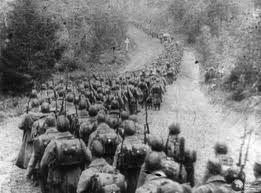
Soviet infantry invading Poland Sept 17, 1939
The rapid militarization by the Nazi Wehrmacht were to bring these theories to fruition. On 1st September 1939 Germany invaded Poland in a "lightning war" overrunning her armies with overwhelming numbers and fire power.  Seventeen days later Soviet armies invaded Poland from the east -  the culmination of a secret pact by Hitler and Stalin to partition Poland and destroy the very foundations of her existence. To the world it appeared that Poland had collapsed.  But Poland was not yet lost. 


Wladylsaw Sikorski had returned to Poland in 1938 ready to be of service however he was refused a military command by then Commander-in-Chief, Marshal Edward Rydz-Smigly (successor to Pilsudski). Thousands of Polish armed forces had escaped the German onslaught. By the end of the month, Sikorski too had evacuated Poland escaping through a perilous route from Romania to Paris.  Sikorski was at once officially installed as the Prime Minister-in-exile and Commander-in-Chief of the Polish forces, joining President-in-exile Wladyslaw Raczkiewicz, and Stanislaw Mikolajczyk.


Despite the fall of Poland, Sikorski was recognized by the West as the legitimate head of the Polish government-in-exile. Through his strong leadership he was instrumental in maintaining the cohesion of the Polish government and Armed Forces, and distinguished himself as Poland's most ardent and outspoken advocate.

But Poland was not without its armies. Though thousands of Polish armed forces had evacuated Poland, they remobilized on French soil. The Polish Highland Brigade was created and immediately deployed to defend French borders. Meanwhile the Polish Air Force was being equipped with 86 aircraft among four squadrons (amid highly questionable logistics controlled by the French authorities); and the Polish Independent Carpathian Brigade was formed in French-mandated Syria. In all there were roughly 80,000 Polish troops in France ready to fight. At the time Poland was the third largest ally.


But with the Fall of France, Polish forces evacuated once again - this time to England. On June 19, 1940 Prime Minister Sikorski met with Winston Churchill, and pledged to provide Polish forces to fight alongside those of Britain. By August, Sikorski and Churchill signed the Polish-British Military Agreement calling for the creation, and training of the Polish Armed Forces.  Most renowned were the Polish pilots who fought in the Battle of Britain the summer of 1940, and whose pilots scored the highest ratio of kills. Most famous was the 303 squadron (the Kosciuszko squadron).  At this juncture, Poland became the second largest ally, with troops stationed in Great Britain and the Middle East.

General Sikorski and Churchill inspecting Polish Troops in Scotland


When Germany invaded the Soviet Union in June 1941 in Operation Barbarossa, the dynamics of the war changed significantly. Churchill had been hoping for just such an outcome to curry favor with the Soviets, an ally upon whom the British relied to win the war against the Nazi scourge. It also presented ominous changes to Poland's relationship with Britain, and especially that with Russia. It came as no surprise to Sikorski. He was a pragmatic strategist and knew what the outcome meant. Seeing no other alternative he succumbed to pressure from the British Foreign Office and opened negotiations with the Russians.


In July 1941 General Sikorski and Ivan Maisky agreed to re-establish diplomatic relations between Poland and Russia and by mid-August, the Sikorsky-Maisky Pact was officially signed.  The Soviets abrogated the Molotov-Ribbentrop Pact of August of 1939 as null and void, and agreed to the release of tens of thousands of Polish prisoners of war on the basis of an "amnesty" , a condition which was an absurdity considering that Soviets were the aggressors. (The evacuation was fraught with numerous obstacles and took place under the most arduous conditions. Thousands of Poles perished. Those who survived and made it to the Middle East were eventually formed into the 2nd Polish Corps under the command of General Wladyslaw Anders.)

Signing of Sikorski-Maisky Agreement July 1941

Amid the huge numbers of incoming Polish refugees, there was a conspicuous void.  Many thousands of Polish officers never showed up, and their absence could not yet be explained.  Sikorski was relentless in his attempt to resolve the mystery, but no avail. Stalin provided only flimsy excuses. He assured Sikorski and Anders that all the Polish soldiers had been released but that the Soviets may have "lost track" of some of them in Manchuria.


L-R General Anders, General Sikorski, Stalin, Kujbyszewie

The horrifying truth was discovered in April 1943 when Nazi German forces found the mass graves in Katyn Forest, twelve miles west of Smolensk, Russia.  Thousands upon thousands of bodies had been exhumed and examined. They were the remains of the Polish Officers who had disappeared and who had been executed by the Soviet NKVD in 1940, upon Stalin's order.

Russian-Polish relations had always been fragile, but now had reached the breaking point. On April 16, General Sikorski fervently demanded an investigation by the International Red Cross. Ten days later Stalin broke off diplomatic ties with Poland, and in a futile attempt to create a smoke screen, accused the Polish government-in-exile of cooperating with Nazi Germany. (Russian governments have since refused to admit Stalin's culpability for the massacre, that is, until the 1990s).

Exhumed bodies of Polish Officers massacred at Katyn Forest, Russia

Another very contentious issue between Russia and Poland dealt with the subject of Polands eastern border. Stalin had long intended that the border be draw along the Curzon Line, which would sever one third of Poland's vast territory.  Sikorski fiercely argued in defense of maintaining Poland's pre-war borders and refused to yield to any pressures. But in the end Poland was betrayed by its closest allies - Great Britain and the United States,  both of whom gave Stalin whatever he wanted in exchange for his alliance. (Read about Yalta Conference)
Crash of Sikorski's Liberator July 4, 1943

On July 4, 1943 the Liberator plane carrying Sikorski and several other passengers plunged into the sea sixteen
seconds after takeoff from Gibraltar. All the passengers except for the pilot were killed. The cause of the crash was attributed to "engine trouble".  However, a Soviet conspiracy has never been ruled out. 


In fact, there were several incidences prior to the fatal crash, in which Sikorski's plane had been tampered with  Sikorski was very outspoken and a threat to the new Anglo-American-Soviet alliance, all the more reason for Stalin to want Sikorski out of the way.  His death marked a turning point not only for Polish-Anglo relations, but the future of the Polish nation and its people.  Sikorski's successor, Stanislaw Mikolajcyzak was considered "persona non grata" and possessed none of the influence nor diplomacy that Sikorski wielded so successfully.  To Churchill and Roosevelt, handing Poland over to Stalin became as easy as childs play.

Sikorski's death came as a terrible blow to a nation which hoped and prayed for freedom and independence. Poland's national newspaper, Biuletyn Informacyjny published the news to a grief-stricken country and set July 15, 1943 as a national day of mourning.

The memory of Sikorski is still very much alive in the soul of the Polish people. Since Sikorski's tragic death, statues and monuments of him have been erected throughout the world to preserve his memory.  Among the many centres and institutes there is also:  the Sikorski Institute, in London, England; a memorial plaque at Gibraltar dedicated to Sikorski; a statue of Sikorski on Portland Place in London, a stone monument on the grounds of Place Polonaise, in Toronto, Canada, and a seated sculpture of Sikorski (as a young man) at Inowroclaw, Poland. Even a film was produced in 1948, entitled, "The Enemy" and in 2003 the Polish Sejm declared the 60th anniversary of Sikorski's death as "Year of General Sikorski".

That Sikorski's name continues to be omitted from Western history is cause for concern.  It is of vital importance for historical accuracy to include the details about Poland, in particular the story of a great man and a great general who had much to teach by example. May the world come to recognize the name Sikorski and understand the true meaning of honour and greatness.

Statue of General Sikorski
Portland Place, London


General Sikorskis' Medals

Order of the White Eagle (awarded posthumously, 1943)
Commander's Cross of the Order of the Virtuti Militari
Grand Cross of the Order of Polonia Restituta
Order of the Cross of Grunwald, 1 Class (awarded posthumously 1946)
Cross of Valour (4x)
Gold Cross of Merit
Grand Officer of the Order of Leopold (Belgium)
Grand Cross of the Order of the White Lion (Czechoslovakia)
Cross of Libery, Class I and II, (Estonia)
Grand Cross of the Legion of Honour (France)
War Cross (Norway - awarded posthumously August 1943)


NEXT
GENERAL WLADYSLAW ANDERS
(click on name)


September 22, 2010

Soviet-German Victory Parade At Brest-Litovsk


September 22, 1939

A joint Russian-German parade took place today in Brest-Litovsk celebrating their victory over Poland. Amid huge crowds military divisions of the Red Army and Werhmacht rolled past the Victory Arches decorated with stars and swastikas. Soviet and German generals were seen paying homage to each other. The parade was intended to display the power of the new Soviet-Nazi alliance. After the parade without undue ceremony, the Germans withdrew to the western bank of the Bug River and the Soviets took control of the city as well as the rest of eastern Poland. General Konstanty Pilsowski, commander of the Polish forces who defended the city from German attack, was arrested by the Soviet NKVD and sent to prison camp at Starobielsk.

Polish General Konstanty Pilsowski

Meanwhile Soviet troops have captured Lwow and Bialystock. Lwow was taken by the Soviets after an act of surrender was signed by Polish General Wladyslaw Langner. The Soviets agreed to all Polish conditions permitting privates and NCOs to leave the city, registering themselves with Soviet authorities before they go home. Polish officers were also told that they were allowed to keep their belongings and go to whatever country accepted them. But In a brutal twist of fate, the Soviets suddenly reneged on their promises. The infamous NKVD began arresting Polish officers and escorted them to Tarnopol from where they were deported to Starobielsk among other gulags in Russia to await their fate.

Soviet Tanks Enter Lwow September 22, 1939

Red Army In Lwow

Polish Prisoners of the Red Army 1939


NKVD Bosses planned  the 1937 Massive Terror Campaign in which 750,000 Poles were executed for being "enemies of the State"
Seated -Center:  Agranov Yakov Deputy head of NKVD 1934-38.Jewish. Executed in 1938 with his wife.
Seated on Left: Nocolay Ezhov 1936-38. Russian. Executed 1940 he was a homosexual as Ernst Rohm

Germans continue to bomb Praga, a suburb of Warsaw. In preparation for storming the city, German units have been shelling Warsaw day and night with heavy artillery and aerial bombardment. Among the weapons used were heavy guns and mortars. Two entire air fleets took part in air raids targeting military and civilians. German units positioned on the eastern bank of the Vistula have been bombing Praga continuously for the past two days. Chancellor Hitler visited the area to observe the shelling of the city. The last lines of communication between Warsaw and Modlin were cut by German forces reaching the Vistula. Polish insurgents continue to launch fierce attacks against German troops, causing heavy casualties.

German Artillery Motorbiike
German POWs arrested by the Polish Army

Reports just received that a high level German officer has been assassinated. Colonel General von Friitsch, a former German Army Commander-in-Chief and an outspoken opponent of the Nazi government was gunned down outside Warsaw, by a Polish sniper.

Sussex: A second meeting of the Allied Supreme War Council convened today.  Although it was intended to be kept secret news of it leaked out drawing huge crowds outside the gates. British Prime Minister Chamberlain, Foreign Secretary Lord Halifax, and Lord Chatfield, the Minister for the Co-ordination of Defense, met with French Premier Daladier, General Gamelin,the Commander-in-Chief of the Western Front, Admiral Darlan, Chief of the French Naval Staff, and M Dautry. A communique was later released outlining the key issues discussed, including munitions supplies.


Link:

September 21, 2010

600,000 JEWS DEPORTED TO CENTRAL POLAND


September 21, 1939

Nazi authorities have conducted widespread arrests rounding up Jews from Danzig and cities throughout western Poland for deportation to central Poland. In a mandate named the Heydrich Plan, the German Chiefs of the Einstazgruppen of the Security Police have been given full authority to deal with the Jews in Occupied territories. While the first step of the Plan is currently underway, there are only inferences concerning the objectives of the Nazi regime, mentioning only that "the final aim will require extended periods of time."

Deportation of Jews


In Lwow, the situation for Polish fighters is hopeless. General Sikorski has decided to surrender to the Soviets. Though the Polish army reserves and war materiel are in good supply, the General stated that further defence of the city was pointless resulting in greater civilian casualties. Surrender talks with the Soviets will begin tomorrow.

German forces continue to bomb key areas of Warsaw today, closing in on pockets of resistance still held by Polish insurgents.  The Armia Krajowa (Home Army) is firmly entrenched and show no signs of weakening, although urgent appeals are being made for ammunition and weapons.

Polish Infantry Soldiers in Action

Some Polish soldiers of Armia Krajowa

Polish Soldiers Defend Warsaw

In Bucharest, the Romanian Prime Minister Armand Calinescu has been assassinated by members of the Iron Guard, a fascist organization.  The assassins blocked the path of his car with a wooden cart and shot the Prime Minister and his bodyguards. After a forced entry into the radio station they broadcast the announcement on air "The death sentence on Calinescu has been executed". In their attempt to escape they were shot where the Prime Minister had been gunned down moments earlier. Romanian Officials declared that the dead bodies of the gunmen are still lying in the street and will not be removed until tomorrow. In a communique sent by the Iron Guard, the assassination was in retaliation for the liberal policy of the Romanian government towards the Polish government and for accepting Polish military and civilian refugees.

Meanwhile the British government has published its Blue Book of pre-war Diplomatic Documents.

In Washington President Roosevelt addressed a special joint session of Congress and urged that the provisions of the Neutrality Act preventing sales to belligerent countries be repealed immediately. He stated that "Our acts must be guided by one single hard-headed thought...keeping America out of this war." He argued that allowing arms to be sold on a "cash-and-carry basis"  would be "better calculated than any other means to keep us out of the war."

Newspaper reports in the US allege that senior officials of the Nazis including Goebbels and Hess have foreign investments worth over $12 million US.

Radio Luxembourg went off the air today after a final broadcast.


Link:
Polish Greatness.com

September 19, 2010

POLISH LOSSES RISING


Adolf Hitler - Gdańsk [1939] WFDiF (00:00:09 sec)


September 19, 1939

Early this morning the first Soviet armoured tanks arrived in the eastern outskirts of the city of Lwow and the suburb of Lyczakow.  After a brief battle the Soviets were pushed back by Polish gunfire. Since then Soviet forces have joined units of the German army and encircled the city during the night.  Polish defence in the area consists of field fortifications and barricades constructed by local residents under the supervision of military engineers. General Sikorski has ordered a defense of the outer city rim as well as inner defences. Early this morning, Soviet envoys arrived and started negotiations with Polish officers.  Colonel Ivanov, commander of the Soviet tank brigade assured the Polish envoy, Colonel Bronislaw Rakowski that the Red Army entered Poland to help it fight the Germans and that his top priority was for Soviet units to enter Lwow.  Following this ruse, the German commander then sent his envoy and demanded that the city be surrendered to Germany.  When the General Sikorski refused he was informed that a general assault would begin on September 21st and the city taken by force.

Soviet tanks enter Lwow

The Soviets captured the town of Wilno today.  Yesterday Polish troops received reports that Soviet forces were approaching rapidly from Oszmiana. Most were armoured scouts who clashed intermittently with Polish units.  Polish Col. Okulicz-Kozaryn ordered his men to fall back towards the Lithuanian border and sent out the more experienced unit, the Korpus Ochrony Pogranicza.  Although the first Soviet attack was repulsed by Polish infantry, Soviets easily advanced into the city and quickly surrounded it. They secured the airport, city, and Rasos Cemetery.  This morning Polish units were defending the bridges in an attempt to delay the Soviet advance but their defence quickly collapsed. Soviet armored units are in control of the city and have been reinforced with infantry and cavalry.  Reports indicate that Polish infantry units have dispersed, or have surrendered, their whereabouts unknown.

Soviet Cavalry in Wilno

Soviet troops have linked up with German Infantry at Brest-Litovsk at which point the Germans promptly handed it's control over to the Soviets in accordance with the provisions of a secret agreement of August 23, 1939. Initially it was called the Molotov-Ribbentrop Pact but the title was changed to Treaty of Non-Aggression between Germany and the Soviet Union.

Soviet and German Officers at Brest Litovsk

The Battle of Bzura that has raged since September 9 ended today with the surrender of 100,000 officers and men of the Polish Pomorze and Poznan Armies. Meanwhile, over 30,000 Polish troops reach Warsaw after fighting their way out of Kutno.  German planes continue to bomb Warsaw striking communication, power, and transportation lines.  In Eastern Poland, Lvov is now surrounded by German armies.

Hitler made a triumphant entry today in Danzig to the wild cheers of people lining the streets. Until Germany's annexation Danzig was a Free City under the terms of the Treaty of Versailles of 1919 and was under the protection of the League of Nations, with reserved special rights to Poland.  In his speech Hitler mocked France and Britain by making an offer of conciliation suggesting that the war could end on the basis of German territorial gains already won. He vowed that Danzig would belong to Germany forever, and would fight to the bitter end if it were necessary.


Link:
Polish Greatness.com

September 14, 2010

German Troops Occupy Danzig


September 14, 1939

Gdynia, Poland's only seaport was occupied by German troops.  Its port includes Gdansk and Sopot. Originally a small German fishing, Gdynia was transferred to Poland after World War I. Since then it was developed into an important rail center including industries producing metal and machinery. It has become a leading Baltic port, main naval base and shipbuilding center for Poland.  German authorities have renamed the port Gotenhafen.

Hitler inspecting his troops on the Bismarck at Gdynia (Gotenhafen)

German forces attacking from East Prussia have reached open country and crossed the Narew River near Modlin. They have swept around Warsaw to begin the process of encircling the Polish capital. The Polish units under General Zulauf which have just reached Warsaw, have been incorporated as the core of the defence forces of the burough of Praga.


Germans taken prisoner by Polish army (Praga)

 
The city of Lwow is now completely cut off by German attacks.  The German 4th Panzer division positioned just outside Warsaw has retreated.  Alerted to a possible threat, General Wladyslaw Bortonowski ordered an immediate retreat of the 26th Infantry division after they had just crossed the Bzura near Lowicz.  The Polish 4th Infantry reached the road linking Lowicz with Glowno while the 16th Infantry crossed the Bzura near Lowicz.

The German 19th Panzer Corp has reached Brest-Litovsk in eastern Poland, where ethnic Ukrainians have begun an uprising in Lwow and Stanislowow, attacking pockets of Polish infantry positioned in the area.

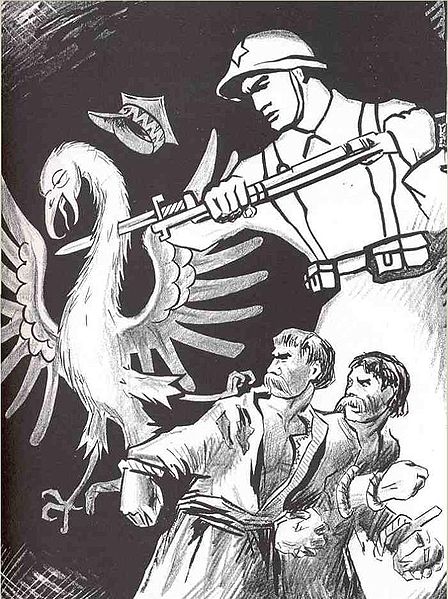
Pravda, the official newspaper of the Russian Community Party, has launched a bitter anti-Polish propaganda campaign with a front-page article deploring the treatment of minorities in Poland.


Russian Propaganda Against Poles
Soviet soldier stabbing symbolic Polish Eagle

There was a close call in the North Atlantic today. While on anti-submarine patrol along the northwestern coast of Ireland, the HMS Ark Royal just barely escaped from a U-39 German submarine attack. Moments later the U-boat was bombed by 3 British destroyers accompanying the carrier. Forth-three German crewman were captured before their ship sank.

Despite internal pressure by Hungarian officials to enter the war, the Hungarian government refrained from declaring its neutrality on the grounds that it is not threatened by Hitler.


Link:
Polish Greatness.com

September 13, 2010

German Bombs Target Polish Civilians


Bombing of Warsaw by Germans WW2 (00:19:29m)


September 13, 1939

US Ambassador to Poland, Anthony J. Drexel Biddle Jr. reported that German bombers are attacking Polish civilians. He stated that  " they (the Germans) are releasing bombs they carry even when they are  in no doubt as to the identity of their objectives."  The German High Command was arrogant in it's response saying that Germany fully intends to carry out bombing raids on civilian targets since the civilians are battling German troops.


German forces of Colonel Schorner arrived at 14:00 hours and broke through the city centre of Lwow. They were driven back by heavy fighting from small Polish infantry units made up of local volunteers and refugees. To reinforce Polish defenses, General Kazimierz Sosnkowski left Lwow and took command of Polish units in Przemysl which was trying to reach Lwow through German lines.  The German Commander had to draw his forces and encircled the city waiting for reinforcements to arrive.  German forces had only limited success. They took control of  Zboiska and surrounding areas. Polish forces have also received additional reinforcements with units withdrawn from central Poland and new volunteer units formed within the city.  The Polish 10th Motorized Brigade under the Command of General Stanislaw Maczek arrived and heavy fighting ensued in the region. The town of Zboiska was recaptured by the Poles though the surrounding hills remain in German hands. The hilltops are providing the German units with a clear vantage point over the city from which they are launching artillery attacks. The Luftwaffe is bombing the city's power plants, waterworks, schools, hospitals and churches.

French Prime Minister Edouard Daladier has assembled a War Cabinet appointing former Foreign Minister Georges Bonnet as Minister of Justice, Raul Dautry as Minister of Armaments, and George Pernod as Minister of Blockade. Daladier has kept the portfolios of War, and National Defense for himself further stating that he hoped that the War Cabinet would fight the war in a spirit of unity and put aside recent divisive.

The French cruiser La Tour d'Auvergne sank from an accidental explosion.  The crew was offloading mines at Casablanca when a mine being disarmed accidentally exploded setting off a chain reaction that blew up and destroyed the ship at anchor.


Link:
Polish Greatness.com

September 7, 2010

Westerplatte Surrenders To Germans


Westerplatte 7 dni chwaly (00:03:56m)


September 7, 1939

At 04:30 Germans opened fire again at Westerplatte while flamethrowers decimated Guardhouse 2 and damaged 1 and 4.  According to Polish Captain Mieczyslaw Slaby the WST Medical Officer, the garrison is running out of water and medical supplies and he is unable to provide medical care to his soldiers.
At 09:45 the white flag appeared. The Polish garrison at Westerplatte has surrendered to the Germans after enduring a week of vicious fighting. Since the initial attack by the Schleswig-Holstein on September 1st a small Polish garrison led by Major Henryk Sucharski were heroic in their ability to repell German attacks and managed to maintain control of Gdansk Post Office enclave for several days before losing it to the Germans. After capitulation the Germans arrested wireless operator Kazimierz Rasinski and interrogated him. He was executed moments later for his refusal to reveal Polish radio codes.

Polish Major Sucharsi (with saber) surrendered to General Eberhardt

Polish POWs

The city of Lwow, an important cultural center located in eastern Poland is in danger of a German assault. Polish General Wladylsaw Langner urgently started plans to defend the city. Initially Polish forces were to defend the Belzec, Rawa Ruska, Magierow line against the advancing Germans. No defence was considered for Lwow, as the Polish Command assumed the city was safe deep behind Polish lines, and that Lwow was too important to be risked in warfare.

After only one day of proclaiming control of the Narew River Polish Command has issued orders for troops to pull out and relocate to the Bug River.

Luftwaffe bombing continues unabated. Polish brigades in Warsaw are suffering losses after a week of fighting the enemy.  Polish forces have only 38 artillery machines left reducing their strength by over 50 percent.

The Schleswig-Holstein has begun bombing the Polish Naval Base at Hela. Over 3,000 soldiers of the Grupa Obrony Wybrzeza (Polish Defense Group) unit under Kapitan Stanislaw Zwartynski, defended the area despite overwhelming odds.

The earliest historical record of the Hel Peninsula can be traced to 1198 when it was a Kashubian village and a prosperous centre for herring trade. By the 13th century Hel became the most important trade center of the area and competed with Gdansk. The coastal town was invaded in 1378 and came under the control of the Teutonic Knights. In 1466 King Casimir IV of Poland granted the town as a fief to the rulers of Gdansk ending a century of struggle for economic domination of the area.  In 1526 Polish King Sigismund/The Old withdrew all the privileges previously granted to Hel and sold the town and the peninsula to the authorities at Gdansk. By the 18th century the town was greatly depopulated after over a century of battles and natural disasters, that virtually destroyed the terrain. In 1872, a newly created German state abolished the city rights granted 600 years before.

Hitler met with Admiral Erich Raeder Commander-in-Chief of the Kriegsmarine, giving him orders "not to provoke neutral countries, the United States in particular (as) it is forbidden to torpedo passenger steamers, even when sailing in convoy. Warfare against French merchant ships and mine-laying off French ports is prohibited."   This comes a week after Germans bombed and sank the SS Athenia.  Concurrently the German government decreed the death penalty for anyone "endangering the defensive power of the German people."

In Britain, General Viscount Gort, VC, has been appointed to the take command of the British Expeditionary Force (BEF). The first British Atlantic convoys have set out with a fleet of escorts however their presence can only be maintained so far as 12.5 degrees west.  Britain asserts that it provides sufficient protection from U-boats. Britain's faster ships as well as the slowest ones are not expected to be part of this convoy.

Eleven divisions of the French army crossed the border into Germany reaching Saarbrucken.(The Saar Offensive). Spread out along a 32 kilometer area the French met with little German resistance. French mobilization was too slow and inflexible, ruling out any larger future offensive.


Link:
Polish Greatness.com