Showing posts with label Praga. Show all posts

August 1, 2011

Warsaw Uprising 1944: August 1 - POLISH HOME ARMY ATTACKS!

At 1:50pm today in Warsaw, Polish insurgents launched an Uprising in Zoliborz in a desperate attempt to liberate the capital city from German hands. Skirmishes broke out simultaneously in various boroughs including City Centre Sector and Wola. Within moments after the first shots were fired, the Poles had broadcast their first radio telegraph message to London stating emphatically “We Are Fighting!”

Plans for the Uprising had been in the works since German and Soviet troops had invaded and partitioned Poland in September 1939. These heroic Polish soldiers have come from every level of society, representing all political ideologies. They are men, women, and even children as young as 8 years old. They share one common goal: to oust the hated Nazi Germans out of Poland. In addition to the Armia Krajowa (the Polish Home Army) there is massive civilian mobilization among Polish engineers, draughtsmen, technicians, scientists, university professors, students, former government officials, artists, priests, manual labourers, and even known criminals. The youngest and the oldest are actively serving as well, albeit doing voluntary guard duty. There are reports of 16 year old insurgents doing guard duty in front buildings. One was bearing only a scythe for a weapon while another young guard was carrying a blunderbuss.

Warsaw 1944: Warsaw Uprising Part I (00:05:28m)


Polish insurgents have been able to destroy one building that was being held by the Germans.  Working in cooperation with the fire-brigade, the insurgents used the motor pumps of the fire-engine to spray flammable liquids on the building, quickly envelopping it in flames. There are no reports on the number of German casualties. Morale among the civilian population and the soldiers of the Armia Krajowa (AK) is at an all-time high. The Polish people of Warsaw have rallied together to assist the AK in building barricades, and anticipate Soviet intervention in a very few short days from now. 

There is every reason to believe that with Soviet assistance, Warsaw will be liberated from the Nazi scourge. Polish fighters launch aggressive attacks against the Germans. Of the major objectives, the insurgents manage to capture the food and uniforms warehouse on Stawki Street, the barracks located in the building of St. Kinga School on Okopowa treet, the Military Geographic Institute on Aleje Jerozolimskie Street, the building of the Municipal Transport Company on the corner of Swietokrzyska and Marszalkowska Streets, the city's highest building, the Prudential, in Napoleon Square, and the Railway Head Office building at Targowa and Wilenska Streets in Praga.  The largest area cleared of enemy forces is the Old Town.  
Unidentified Polish Fighter (Red and White AK armband)

Just days earlier, Radio Moscow had broadcast to Warsaw, calling for a general Uprising. The following is a translation:  
 
Appeal to Warsaw: Fight The Germans!  
 
No doubt Warsaw already hears the guns of the battle which is soon to bring her liberation. Those who have never bowed their heads to the Hitlerite power will again, as in 1939, join battle with the Germans, this time for decisive action. The Polish Army now entering Polish territory, trained in the Soviet Union, is now joined to the People's Army to form the Corps of the Polish Armed Forces, the armed arm of our nation in its struggle for independence. Its ranks will be joined tomorrow by the sons of Warsaw. They will all together, with the Allied Army pursue the enemy westwards, wipe out the Hitlerite vermin from Polish land and strike a mortal blow at the beast of Prussian Imperialism. For Warsaw, which did not yield but fought on, the hour of action has already arrived. The Germans will no doubt try to defend themselves in Warsaw and add new destruction and thousands of victims. Our houses and our parks, our bridges and our railway stations, our factories and public buildings will be turned into defence positions. They will expose the city to ruin and its inhabitants to death. They will try to take away all the most precious possessions and turn into dust all that they have to leave behind. It is, therefore, a hundred times more necessary than ever to remember that in the flood of Hitlerite destruction all is lost that is not saved by active effort; that by direct, active struggle in the streets of Warsaw, in its houses, factories and stores, we not only hasten the moment of final liberation, but also save a Nation's property and the lives of our brothers.  


And at precisely 4:10 this morning the Soviet commander of the Second Armoured Army ordered that by noon today, troops were to take defensive positions outside Praga (a suburb of Warsaw. This occurred an hour before the Poles even fired the first shots.
Polish patriots in Praga District
Soviet plans began as early as July 7, 1944, when the Supreme Headquarters of the Soviet Army had issued an order to Marshal Konstantin Rokossovsky, commander of the First Byelorussian Front. to begin the advance towards Poland from the north and south and to then surround German forces at Brzesc. From there, they were to continue toward Warsaw. However, a new order was issued by the Soviet Supreme HQ on July 28 calling for an attack in the "general direction" of Warsaw, to be followed by occupation of Praga on August 8 at the very latest. Other orders have been dispatched to the other fronts stationed around Polish territories. Nine Soviet armies including the Soviet-backed 1st Polish army are ready to cooperate in the liberation of Poland. The 1st Polish Army, under the command of Major-General Zygmunt Berling, is now just 11 miles south-east of Warsaw in the area between Deblin and Palawy, and has already established two bridgeheads on the western shore of the Vistula, near Magnuszew. The Soviet forces possess 3 times more soldiers and 5 times more artillery and tanks than the Germans. 

Sources indicate that the 6th Soviet Air Army has about 1,465 combat planes in its fleet. Moreover, just the left wing of the Byelorussian Front has 1,750 tanks as well as self-propelled artillery, 7,600 artillery and mortars and 416,000 soldiers. The total strength of the First Byelorussian Front is estimated to be at 1.5 million soldiers. General Tadeusz Komorowski pseudonym “Bor”, Commander-in-Chief of the Armia Krajowa. has issued the order for the Uprising to begin at 5pm today however because of miscommunication among field units, the Uprising started too early. The Commander of the District of Warsaw, General Antoni Chrusciel, pseudonym Monter, while subordinate to General Bor, has complete command over the activities of the AK, including its logistics and intelligence. The Polish forces are confident that with Allied help, victory is within reach.  

 
General Tadeusz Komorowski
The Germans anticipated just such an Uprising, and made plans to link the 9th and 2nd armies in an effort to quash the Polish resistance. The Armia Krajowa is estimated to have between 36,000 to 40,000 soldiers, however only 2,500 of them are properly armed. By contrast, German troops are under-manned but heavily armed: regular German troops number just 5,000, with an additional 2,000 from the Sentry Regiment Warsaw, and 350 men of the SS reconnaissance regiment. There is an additional 4,000 of Luftwaffe personnel, consisting of 1,000 at Okecie airport, 700 at Bielany, 1,000 in Boemerowo, 300 at Sluzewiec, and 1,000 in anti-air artillery stationed throughout Warsaw.     

The Polish Underground has been stockpiling massive quantities of weapons and ammunition long before the Uprising began, and rely on 4 main storage areas. Two in Warsaw and 2 in Praga. But just a couple of weeks ago German soldiers came across two enormous secret caches of weapons hidden in basements, one stockpile containing over 70,000 hand-grenades, and the other had 450 flame-throwers. According to AK Command, this was only a small portion of their supplies, there being an additional 320,000 grenades hidden in numerous other locations throughout Warsaw. German soldiers immediately flooded the basements destroying all weapons and drowning any Polish insurgents that may have been hiding there at the time.    
 
Polish Resistance - Production of Grenades
Five months ago, during a secret meeting of the Polish Council of National Unity, General Bor, when asked about the military preparedness of the Armia Krajowa, replied tentatively, “Ten percent of the membership.” The AK Commanders are faced not only with lack of sufficient number of soldiers, but a severe shortage of weapons and ammunition. Despite these enormous setbacks, the Poles still hope to defeat the Germans in a few days – a week at the most. At the root of this optimism is the knowledge that the allies will be intervening with military support and armaments. Until then, the AK is confident that it can hold out. An estimation of current reserves reveals that there may be only enough to last for two or three days of fighting. While the Polish insurgents are waiting for military assistance from Great Britain and the Soviet Union, they are making due with the following supplies:: 1,000 guns, 1,750 pistols, 300 submachine guns, 60 assault rifles, 7 heavy machine guns, 20 anti-tank guns, 25,000 hand grenades, 35 bullets per pistol, 300 bullets per machine pistol, 190 pieces of ammunition per carbine, 500 rounds of ammunition for light machine gun, 2,300 rounds of ammunition for heavy machine guns and 50 shells for anti-armour cannon - but there is no cannon.  
 
Polish soldiers from Kolegium A - Kedyw on Stawki Street Wola District
Warsaw Uprising - unexploded shell
Despite the overwhelming support by Poles of the Uprising, there is discontent among insurgents about the shortage of ammunition and weapons. In response General Monter has threatened court-martial to any soldier who merely expresses dissatisfaction. Monter has made every effort to encourage insurgents that weapons can be captured in battles won against the enemy, and to resort to any means necessary, sticks and bricks if need be. In order to compensate for the drastic shortfall, the Polish Underground has been producing makeshift weapons: petrol-filled bottles, for launching at German tanks; improvised flame-throwers, and the most common weapon – home made grenades that are being produced by the thousands in secret workshops. The Poles salvaged unexploded German artillery shells and bombs to produce their hand grenades. In one shop alone, the Polish underground manufactured over 20,000 hand grenades.   


September 16, 2010

POLAND TIGHTENS DEFENSE


Heroes of the Sky (Raids and Dogfights of WWII (00:05:56m) NB. Locations cannot be identified.


September 16, 1939

Polish bombers have been intensifying their defense in a desperate attempt to stem the tide of German advancements. With Warsaw surrounded and the refusal of surrender by Polish General Walerian Czuma, German assaults are escalating, leading to greater casualties of Polish infantry and civilians.
On the Eve of the Jewish New Year, fleets of Luftwaffe are dive-bombing over the Jewish quarter of the city of Warsaw, strafing civilians in the street. Colonel General List of the 14th German Army Division is still fighting west of Lwow, where the Polish infantry is standing it's ground. Other German units are advancing north to link with Guderian's forces, who are maintaining their attack along the Bug River.
In a desperate attempt to encircle and destroy Polish units, German Command allocated most of their own 10th Army, including 2 armoured, 1 motorized, and 3 light divisions, escorted by 800 tanks and fleets of Luftwaffe. They have been attacking Polish positions continuously on all sides

Polish PZL bombers and planes


Polish soldier checks PZL aircraft


German General Blaskowitz attempted to capture Praga today but was repelled by Polish counter-attacks. After intense fighting for the Grochow area, the German 23rd Infantry Division was completely annihilated by Polish forces of the 21st "Children of the Warsaw" Infantry Regiment under Col. Stanislaw Sosabowski.

The Polish government received a message from the USSR stating that the Red Army will enter eastern Poland on September 17 to "protect the Ukranian and Belorussian minorities." Reaction is mixed among Poles. The population and diversity of ethnic minorities in Poland is significant. Of the 23 million Poles, Jews account for just over 3 million, while that of Ukranian and Belorussians are 7 million.

The SS Aviemore was torpedoed by a German U-31 today and sank at Land's End, off the coast of Cornwall in the United Kingdom. It is the first ship of the North Atlantic Convoy to be attacked.

The British Government announced the appointment of the Duke of Windsor as liaison officer with the French Army. This has raised eyebrows in many circles if not outrage.  In 1937 the Duke and Duchess met - against the advice of Parliament - with Adolf Hitler at his retreat at Obersalzburg, located 120 kilometers southeast of Munich. The Duke was seen giving Nazi salutes.  In a letter to Hitler, a fellow Nazi Albert Speer wrote, "I am certain that through him permanent friendly relations could have been achieved. If he had stayed everything would have been different. His abdication was a severe loss for us."


Link:
Polish Greatness.com

September 14, 2010

German Troops Occupy Danzig


September 14, 1939

Gdynia, Poland's only seaport was occupied by German troops.  Its port includes Gdansk and Sopot. Originally a small German fishing, Gdynia was transferred to Poland after World War I. Since then it was developed into an important rail center including industries producing metal and machinery. It has become a leading Baltic port, main naval base and shipbuilding center for Poland.  German authorities have renamed the port Gotenhafen.

Hitler inspecting his troops on the Bismarck at Gdynia (Gotenhafen)

German forces attacking from East Prussia have reached open country and crossed the Narew River near Modlin. They have swept around Warsaw to begin the process of encircling the Polish capital. The Polish units under General Zulauf which have just reached Warsaw, have been incorporated as the core of the defence forces of the burough of Praga.


Germans taken prisoner by Polish army (Praga)

 
The city of Lwow is now completely cut off by German attacks.  The German 4th Panzer division positioned just outside Warsaw has retreated.  Alerted to a possible threat, General Wladyslaw Bortonowski ordered an immediate retreat of the 26th Infantry division after they had just crossed the Bzura near Lowicz.  The Polish 4th Infantry reached the road linking Lowicz with Glowno while the 16th Infantry crossed the Bzura near Lowicz.

The German 19th Panzer Corp has reached Brest-Litovsk in eastern Poland, where ethnic Ukrainians have begun an uprising in Lwow and Stanislowow, attacking pockets of Polish infantry positioned in the area.

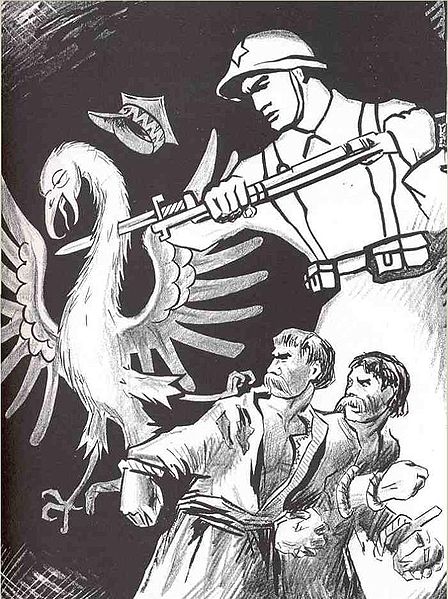
Pravda, the official newspaper of the Russian Community Party, has launched a bitter anti-Polish propaganda campaign with a front-page article deploring the treatment of minorities in Poland.


Russian Propaganda Against Poles
Soviet soldier stabbing symbolic Polish Eagle

There was a close call in the North Atlantic today. While on anti-submarine patrol along the northwestern coast of Ireland, the HMS Ark Royal just barely escaped from a U-39 German submarine attack. Moments later the U-boat was bombed by 3 British destroyers accompanying the carrier. Forth-three German crewman were captured before their ship sank.

Despite internal pressure by Hungarian officials to enter the war, the Hungarian government refrained from declaring its neutrality on the grounds that it is not threatened by Hitler.


Link:
Polish Greatness.com

September 8, 2010

Germans Reach Warsaw


September 8, 1939

German troops reached Wola today in the southwestern part of Warsaw but face strong Polish resistance. In the western section of Warsaw, Polish forces led by General Czuma have received 2 infantry divisions supported by 64 pieces of artillery, 33 tanks, 27 Vickers E 7 T-P and R-35, and 6 TK3  and TKS tankettes.  Commander-in-Chief Edward Rydz-Smigly has ordered the creation of Armia Warszawa (Warsaw Army) under Polish General Juliusz Rommel, consisting of the armed forces which defended Warsaw and Modlin Fortress, as well as all Polish units called in from Narew and Vistula. General Czuma continues to be commander of the Warsaw Defence Force which is now split into two units covering the western and eastern sections of Praga suburb.

Despite the increase of Polish defences, the German XVI Panzer Corps was able to capture the suburbs: Grojec, Radziejowice, Nadarzyn, Raszyn and Piaseczno.  Around 5 pm the Panzer division attempted an assault on Warsaw's western borough of Ochota but met with fierce resistance by Polish infantry and civilians. Germans suffered heavy casualties and lost a considerable number of Panzer I and Panzer II tanks. General Czuma broadcast a defiant Order of the Day to the Germans, saying           " We shall fight to the last ditch!"  Over 100,000 Polish civilians in Warsaw are digging trenches and building barricades in the outskirts of the city.

German Panzer 4th Army Division invading Ochota 1939


Germans hiding from Polish attack Ochota 1939

 
The defence units of Warsaw were joined by additional units from the Prusy Army as well as new units created out of the reserves of the Warsaw-based 8th Polish Infantry Division and 36th Academic Legion Infantry Division. 

The Army Poznan under General Kutrzeba and Army Pomorze under General Bortnowski launched fierce offensive on the left flank of German forces advancing towards Warsaw. In doing so, the Poles were able to buy themselves some time to reorganize their defence of Warsaw. The Germans withdrew the 4th Panzer Division and sent it to counter the Polish positions near Kutno, and replaced the 4th Division with a weakened German 31st Infantry Division.

Meanwhile, the German 10th Army are heavily engaged in Radom about 60 miles south of Warsaw.  German troops have advanced rapidly to the west of Radom, and have completely surrounded the 60,000 Polish troops spread out in the region. The German 14th Army has already reached the San River north and south from the city of Przemysl. Other Panzer Divisions are attacking along the line of the  Bug River just east of Warsaw.

A fleet of 5 Curtiss Hawk fighters of the L'Armée de l'air (French Air Force) spotted 5 Me109 German fighter planes and shot down 2 of them in hot pursuit.

In response to escalating German submarine warfare, the British government announced today the broadening of the blockade. In addition,  protected convoy routes for merchant ships have been revived, 2 from Liverpool, 1 from Thames to the Atlantic, and one from the Thames and the Firth of Fourth (an estuary of Scotland's River Forth, which flows into the North Sea).

U.S. President Roosevelt proclaimed today a "limited national emergency".  He cited the war in Europe "imposes on the United States certain duties with respect to the proper observance, safeguarding, and enforcement of it's neutral status", and ordered for the strengthening of national defense within the limits of peacetime authorizations.  All American military forces have been authorized to increase enlisted manpower strength and to recall reservists to active duty.


Link:
Polish Greatness.com