|
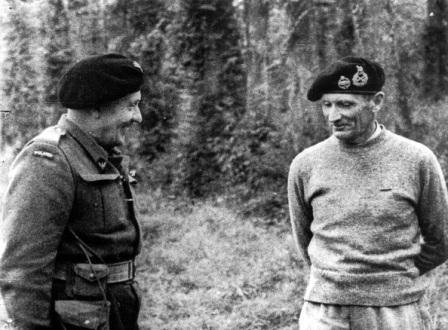
| General Stanislaw Maczek "Baca" |
"Baca" (Shepherd)
Each year the people of Breda in The Netherlands celebrate Liberation Day. It is a solemn event to commemorate the fallen soldiers who sacrificed their lives to liberate them from Nazi occupation in World War II. Among the heroes were also Polish soldiers who served under General Stanislaw Wladyslaw Maczek in the 1st Polish Armoured Division. At the center of the city stands a monument and a museum dedicated to the memory of General Maczek and his men.
General Maczek was one of the most successful Polish commanders of World War II, and greatly respected by Allied Command, as well as by enemy rank and file. Maczek was referred to by his men as "Baca", a Galician name, which translated means "Shepherd". For Maczek the only thing that surpassed his determination to win the war was his great concern for his troops. The feeling was mutual. There was no greater tribute to a General than this.
Stanislaw Maczek was born in Lwow (Lviv) on March 31, 1892. The famous Polish city is now part of the Ukraine, but was then in Austro-Hungarian Galicia. Maczek's roots stem from Croatian extraction, though distant. His cousin was a Croatian politician by the name of Vladko Macek.
Stanislaw Maczek had been attending Lwow University, majoring in Polish Philology but had to interrupt his studies when World War I broke out. He intended to enlist in the Polish Legions and serve under the command of Marshal Jozef Pilsudski, but he was instead drafted into the Austro-Hungarian army. After undergoing a brief period of officer training, he was sent to the Italian Front as NCO of the Tyrolean Regiment of the K.u.K. (kaiserlich und koniglich, which means "Imperial and Royal"). He was promoted twice, first to Second Lieutenant, and by the end of the war, to Lieutenant. Maczek was the only Polish battalion commander in the Austro-Hungarian alpine division - a testament of the degree of his caliber and distinction.
November 11, 1918 marked the end of the World War I, and the re-emergence of Poland as a nation after 123 years of oblivion. Maczek immediately traveled to Krosno (near the southern tip of Poland) where he joined the new Polish army. He was appointed commander of a battalion and launched an offensive against troops of the West Ukrainian People's Republic for control over the city of Lwow. The battle lasted from November 1st, 1918 until May 22, 1919 and escalated into the Polish-Ukrainian War. It end with a Polish victory.
 |
| Polish Supreme Command defending Lwow 1918 |
In spring of 1919 Maczek was given a new commission as commander of the 4th Infantry Division of Lotna Kompania, a unit which he created and organized, modeled after the elite German Sturmbataillone of World War I. Maczek's division was almost completely motorized and armed with heavy machine guns and composed of battle-hardened troops from the Krosno battalion - men whose combat experience exceeded that of other Polish soldiers at the time. They functioned in the capacity of "firefighters" by reinforcing weak spots in the defensive lines, but earned their distinction from winning fierce battles for the cities of Drohobycz, Stanislawow, Buczacz and the capital city, Stryj (now in the Ukraine).
When fighting ended, Maczek had been promoted to rank of major with seniority and assigned to the post of staff officer in the Polish 2nd Army under General Iwazkiewicz' command however the position was ill-suited to his temperament and exceptional abilities. After numerous requests to his superiors, he was finally given a command of a front-line unit. The timing was ill-fated. The Polish-Soviet War had already begun resulting in the defeat of the 2nd Polish Army by Semyon Budyonny's Soviet 1st Cavalry army.
On the heels of this defeat, Maczek immediately formed another battalion composed of new recruits, and despite the lack of sufficient training, led his troops to the front as "firefighters" wherever they were needed. They served as rearguard for the Polish troops at Mosty Wielkie, then joined the 1st Cavalry Division under the command of Polish General Juliusz Rommel, participated in attacks on the city of Warez, conducted a counter-assault on the rear of advancing Cossacks, and ultimately won the Battle of Komarow. (The latter was one of the biggest cavalry battles of the Polish-Soviet war since 1813.) With the signing of the Treaty of Riga, hostilities came to an end. Though Maczek's battalion was disbanded shortly thereafter, it had been officially named after him.
 |
| Emblem 10th Motorized Cavalry Br. |
|
During the interwar period Maczek opted out of university studies and chose to pursue his career in the military. Between 1921 and 1938, he had served as commander over several different divisions, studied at the Higher Military School in Warsaw, and was rapidly promoted thereafter to the rank of Lieutenant-Colonel, and then to Colonel.
Just a year before World War II broke out, Maczek was given the command of Poland's first fully-motorized army, the 10th Motorized Cavalry Brigade, nicknamed the "Black Brigade". In September 1939 his Brigade was attached to the Krakow Army and fought in defense of the voivodeships of Lesser Poland and Silesia. From the very first day of war, his troops went into battle equipped with only light tanks, tankettes and only one artillery battery of only eight heavy cannon.
 |
| Polish Officers with General Maczek - "Black Brigade" 1939 | |
|
|
 |
| Maczek's Polish 10th Motorized Brigade - TKS Tankettes 1939 |
The Battle of Jordanow took place on the second day when Maczek's troops faced the entire German XVII Corps of General Eugen Beyer and succeeded in shielding the southern flank of Polish armed forces along the Beskides (mountain ranges). Maczek's brigade, supported by just a few battalions of Border Guards and troops of National Defence managed to face down three German Panzer Divisions: the 4th Light Division under the command of General Alfred Ritter Von Hubicki, the 2nd Panzer Division under the command of General Rudolf Veiel; and the 3rd Mountain Division under the command of General Eduard Dietl.
Despite the overwhelming power of the Nazi Blitzkrieg, Maczek's Brigade fought against them for five days and succeeded in slowing down the German advance until it came to a virtual crawl. The Germans could not even manage to exceed ten kilometers distance per day, even with their superior numbers and war materiel.
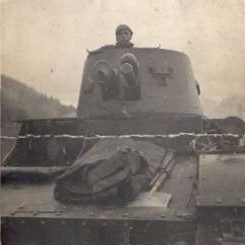 |
| Marian Machocki-Vickers Mark E Type B light tank |
The terrain gave a significant advantage to Maczek and his brigade, who were very experienced and skilled in mountain warfare. Not only did they manage to halt German attacks but they launched some counter-attacks as well. However, German forces eventually succeeded in breaking through the front of the Krakow Army, which was positioned just north of the Brigade's position. Maczek and his troops then had to be pulled out of the front line.
The Brigade defended the bridges and fords in Lesser Poland, and eventually reached Lwow where they rendez-voused with the city's defence forces. They merged to form a mobile reserve which fought in the Battle for Lwow, thus allowing other Polish troops to withdraw towards the Romanian Bridgehead. However, their plans were shattered by the unexpected invasion of Poland on September 17, 1939 by Soviet forces from the east.
After only two days of fighting, Edward Rydz-Smigly, Marshal of Poland, ordered the Maczek and his brigade to cross the border into Hungary but they were immediately interned by the Hungarian government and the Brigade was reduced by half. Nevertheless, the Brigade had the great distinction of having been the only Polish unit not to have lost a single battle in 1939.
Amid many other Polish forces, Maczek and his troops made their way to France where they re-assembled the Polish armies. He was promoted to Brigadier-General and given the command of the Polish military camp at Coetquidan. During this time, Maczek presented the French with a report detailing German Blitkrieg tactics, and containing his recommendations for possible evasive maneuvers. However, the French chose to completely disregard the report.
Maczek sought to preserve the integrity of his Brigade by regrouping them into two separate camps, at Paimpont and at Campeneac in order to prevent the possible conscription of them to other infantry divisions. The soldiers of the Polish 10th Armoured Cavalry Brigade were highly-trained, skilled, and ready to fight, yet they received little by the way of equipment and no more than disdain from French Command.
 |
| Polish 10th Armoured Cavalry Brigade-organized in France |
It wasn't until March of 1940 that the French supplied Maczeks' troops with equipment, albeit obsolete in quality and insufficient in quantity. By May Hitlers' armies invaded France merely by crossing over the Maginot Line. Only then was French Command willing to give Maczek all the equipment that he had asked for, provided that his Brigade enter battle immediately. It was an unreasonable request because the equipment was new and there was no time to train the Polish soldiers to use them properly. Under the circumstances General Maczek chose the best option; he assembled a small force composed of his best soldiers to lead the way, anticipating that the remainder of the troops would follow suit.
On June 6, 1940, Maczek's Brigade was equipped with only one tank battalion, two motorized cavalry squadrons, one anti-tank battery, and one anti-aircraft battery, the sum of which was grossly insufficient to fight against German armoured divisions. The Polish brigade was attached to the French 4th Army positioned near Reims and was given the mission to protect its left flank. The Poles attacked German forces in Champaubert-Montgivroux, but managed to cover only one French infantry division. The Brigade had no choice but to retreat and join the rest of the French troops.
 |
| Polish attack Montbard |
On the night of June 16th, the Poles launched a surprise attack on the town of Montbard over the Burgundy Canal. The Germans were caught completely unprepared, and many were taken prisoner. However, victory was short-lived. The Polish brigade by that time was fighting alone with no French reinforcements whatsoever (French troops had either been routed or were in retreat). The Polish unit was utterly decimated, completely surrounded and without fuel.
Two days later, Maczek destroyed all the machinery that was unusable, and withdrew with his troops on foot. In order to pass through enemy lines, Maczek split his brigade into smaller groups, and traveled a winding path way all the way through Vichy France, North Africa, and Portugal to Great Britain.
Once on British soil, Maczek reassembled the Polish army to be put into active service. But oddly British Command had different ideas. They were intent on sending Polish troops to defend the Scottish coastline between Aberdeen and Edinburgh and between Montrose and Dundee. The notion was impractical and once Maczek and Sikorski intervened, the British abandoned the plan, finally being convinced of the feasibility of a Polish armoured unit.
After years of training and preparation the 1st Polish Armoured Division was formed in February 1942. They were a strong and viable force to contend with, and equipped with state-of-the-art Churchill and M4 Sherman tanks.
 |
| 1st Polish Division |
By the end of July 1944, they were called to fight in one of the greatest battles of World War II - the Battle of Normandy. On August 8 the Polish Division, attached to 1st Canadian Army, launched Operation Totalize. The mission was to break through German defenses south of Caen, and precipitate the complete collapse of the entire German front. This battle was called the Falaise Gap.
In two consecutive incidences, the Polish unit came under friendly fire by Allied aircraft, but still managed to achieve a brilliant victory against the Nazi's - in the battles for Mont Ormel, Hill 262 and the town of Chambois. The 1st Armoured Polish Division, along with the US 385th infantry battalion, and British and Canadian troops, destroyed approximately 570 enemy tanks and other vehicles, 100 guns, and captured 5,500 Germans. Polish Casualties were about 450 KIA and 100 tanks lost.
Field Marshall Montgomery described the battle. In his words,
"Under Falaise we locked the Germans
like they were in a bottle,
and the Polish Armoured Division
was the cork in this bottle."
 |
| General Maczek and General Montgomery |
 |
| General Maczek with General Eisenhower |
Trapped in the Chambois pocket were 14 German Wehrmacht and SS divisions. Maczek and his men were given the vital mission of closing the Chambois pocket to prevent the Germans from using it as an escape route, and successfully destroyed enemy positions.
Following this decisive victory, Maczek's Division spearheaded attacks across the battlefields of France, Belgium, the Netherlands, and at last, Germany. The Polish troops liberated Ypres, Ghent and Passchendale in Belgium.
Maczek led a brilliant outflanking manoeuvre, and after a tough fight, succeeded in freeing the city of Breda. What made it so remarkable is that there were no civilian casualties. (In gratitude, the people of Breda granted General Maczek Dutch citizenship after the war.)
 |
| Polish troops liberated town of Breda Oct 1944 |
Maczek's moment of glory came when his troops captured the German port of
Wilhelmshaven and accepted the surrender of the entire German garrison, including 200 vessels of Hitler's navy, the Kriegsmarine.
 |
| Wilhelmshaven German Base |
Maczek led the 1st Armoured Division to the very end of the war, and was promoted to Major-General in recognition of his outstanding service and leadership. After Germany had capitulated, Maczek took command of the Polish I Corps, followed by a command of all the Polish forces in the UK until 1947, when they were officially demobilized.
After the war, Maczek opted to remain in Britain like many other Polish officers and soldiers. The communist regime in Poland had stripped him of Polish citizenship and declared him to be persona non grata. But more astounding was the fact that the British government treated Maczek with considerable disdain, claiming that he was not considered an "Allied" soldier, and therefore not eligible for combattant rights and a military pension. Consequently, he had no choice but to work as a bartender until the 1960s at an Edinburg hotel.
In 1989 an official public apology was issued by the Prime Minister Mieczyslaw Rakowski, of the Communist Polish government. Maczek was decorated with Poland's highest medal, the Order of the White Eagle.
Lieutenant General Stanislaw Maczek passed away on December 11, 1994 at the age of 102. In accordance with his wishes, he was laid to rest among the graves of his soldiers at the Polish military cemetery at Breda.
HONOURS AND AWARDS
POLAND
Order of the White Eagle (1994)
Gold Cross of the Order of Virtuti Miltari
Silver Cross of the Order of Virtuti Militari
Knight's Cross of the Order of Virtuti Militari
Commander's Cross of the Order of Polonia Restituta
Grand Cross of the Order of Polonia Restituta
Cross of Valour
Gold Cross of Merit with Swords
THE NETHERLANDS
Commander of the Order of Orange-Nassau
BELGIUM
Grand Officer of the Order of the Crown with Palms
Croix de Guerre avec palmes (Belgium)
FRANCE
Medaille commemorative de la guerre 1939-1944
Commandeur de la Legion d'Honneur
Croix de Guerre avec palmes
UNITED KINGDOM
Commander of the Order of the Bath
Companion of the Order of the Bath (military)
Distinguished Service Order
 |
| Dutch Poster Thanking Polish Armies |
NEXT