Showing posts with label Stanislaw Maczek. Show all posts

July 15, 2012

FAMOUS POLISH QUOTATIONS

Great men and women throughout history are remembered for their magnificent oratory, probably much more so than for their valiant, or infamous deeds. Quotations have always captured our attention and fascination. They exquisitely encapsulate in a few words the scope of human understanding, thoughts and ideas and is a skill that is almost tantamount to wizardry. Who among us does not instantly recognize the following quotations, words which will endure for posterity.  Neither shall we forget their names for they have been written into our collective consciousness.


We shall not flag or fail. We shall go on to the end. We shall fight in France, we shall fight on the seas and oceans, we shall fight with growing confidence and growing strength in the air, we shall defend our island, whatever the cost may be. We shall fight on the beaches, we shall fight on the landing grounds, we shall fight in the fields and in the streets, we shall fight in the hills: we shall never surrender.

Let the word go forth from this time and place, to friend and foe alike, that the torch has been passed to a new generation of Americans - born in this century, tempered by war, disciplined by a hard and bitter peace.

Be not afraid.


These are inspiring words but there remain a treasure chest of many other great quotations which have yet to capture our attention. The following are a collection of Polish quotations which I have gathered laboriously from countless sources, from famous writers, musicians, and film makers. I would have included many more, but unfortunately many quotes have not been translated to English. These quotations serve to inspire, amaze, educate, liberate, and sometimes, even amuse. The best quotations, I believe, are those which captured the sentiments of a nation in one moment of history, and thus preserved it for all time. Quotations are the signposts of our society - the good ones inspire us to become better than ourselves, while the bad ones alert us to danger, or alas, lead us astray. In any event quotations invite us to delve deeper to explore its meaning, and to understand its past. That is the mission.
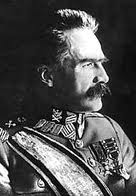

Marshal Jozef Pilsudski - Famous Polish Quotation

To be defeated and not submit, is victory;
to be victorious and rest on one's laurels, is defeat.
Jozef Pilsudski


Leopold Okulicki - Famous Polish Quotation


 In comparison with the NKVD,
the Gestapo methods
are child's play.  
 Leopold Okulicki


Irena Sendler - Famous Polish Quotation


Every child saved with my help and the help of all the wonderful secret messengers, who today are no longer living, is the justification of my existence on this earth, and not a title to glory.          Irena Sendler


Karol Wojtyla - Pope John Paul II - Famous Polish Quotation


Freedom consists not in doing what we like, but in having the right to do what we ought.
  Pope John Paul II


I belong to a nation which over the past centuries has experienced many hardships and reverses. The world reacted with silence or with mere sympathy when Polish frontiers were crossed by invading armies and the sovereign state had to succumb to brutal force.
 Lech Walesa


Zbigniew BrzezinskiBut if Russia is to be part of this larger zone of peace it cannot bring into it its imperial baggage. It cannot bring into it a policy of genocide against the Chechens, and cannot kill journalists, and it cannot repress the mass media.       Zbigniew Brzezinski


Polish General Kazimierz Sosnkowski Warsaw is not waiting for empty words of praise, for expressions of recognition, not for assurances of sympathy. Warsaw is waiting … Warsaw is waiting … for weapons and ammunition.  
  General Kazimierz Sosnkowski


Polish General Stanislaw Maczek

Polish soldiers fight 
for freedom
of other nations 
but dies only
 for Poland. 
General Stanislaw Maczek 


Comrades, I took the red tram of socialism to the stop named Independence, but that's where I got off.
Jozef Pilsudski


This homage has been rendered not to me - for the Polish soil is fertile and does not lack better writers than me - but to the Polish achievement, the Polish genius.         
Henryk Sienkiewicz 


Marek Belka - Famous Polish QuotationThe Holocaust committed by the Nazis turned this country, where most of the European Jews used to live and where their culture used to flourish, into a massive grave. This is why initiatives to revive Jewish culture in Poland is so important.
  Marek Belka


Ludzi coraz więcej, a człowieka coraz mniej -  

There is more and more people in the world, but less and less humanity.
          Edward Stachura


It has been said that Poland is dead, exhausted, enslaved, but here is the proof of her life and triumph. 
 Henryk Sienkiewicz


Bronislaw Geremek

It is often said that Poland is a country where there is anti-semitism and no Jews, which is pathology in its purest state.  Bronislaw Geremek


May God permit us both
to return to a free 
and independent
Poland.
General Wladyslaw Anders


Jan Karski - Famous Polish Quotations


But I am a Christian Jew. I am a practicing Catholic. Although I am not a heretic, still my faith tells me the second original sin has been committed by humanity: through commission, or omission, or self-imposed ignorance, or insensitivity, or self-interest, or hypocrisy, or heartless rationalization....This sin will haunt humanity to the end of time. It does haunt me. And I want it to be so.      Jan Karski 


My most ardent desire is that my country will recapture its historic opportunity for a peaceful evolution and that Poland will prove to the world that even the most complex situations can be solved by a dialogue and not by force.    Lech Walesa


Witold Pilecki - Famous Polish Quotations 
During the first 3 years
at Auschwitz, 
2 million people died; 
over the next 2 years -
3 million.   Witold Pilecki


President Aleksander Kwasniewski 


So I think that I can say, as the President of Poland, we're proud that I am coming from Poland, which is different and what's more important, much better than before. President Aleksander Kwasniewski


There is a fundamental difference between the Polish experience of the state and the Russian experience.  In the Polish experience, the state was always a foreign power. So, to hate the state was a patriotic act.    Ryszard Kapuscinski


Richard Edgar Pipes - Famous Polish Quotations


[Lenin was] merely a psychopath to whom ideas barely mattered and whose only motivation is to dominate and to kill.        Richard  Edgar Pipes 


Copernicus portrait - Famous Polish Quotation
To know that we know what we know, and to know that we do not know what we do not know, that is true knowledge.  Copernicus 


Stanislaw Jerzy Lec - Famous Polish Quotation

The weakest link in the chain is also the strongest. It can break the chain.  Stanislaw Jerzy Lec


Adam Michnik - Famous Polish Quotation


Poland is an ally of the United States of America.  It was our duty to show that we are a reliable, loyal and predictable ally.  America needed our help, and we had to give it.  Adam Michnik


Andrzej Wajda - Famous Polish Quotation 
We expected that people were just waiting for the collapse of the Soviet Union, or at least for its retreat, and they were going to be full of initiative in all areas of life - in culture, in economy and in politics.  Andrzej Wajda


Jozef Wadecki - Famous Polish Quotation

I did the following routine during practice:
round off, whip, whip, whip, whip, whip, flip, double back straight 
with four twists.
Jozef Wadecki


Radek Sikorski - Foreign Minister- Poland - Famous Polish Quotation

When the world is shifting and new competitors arise, standing still is not sufficient. Institutions and procedures that have worked in the past are not enough. Incremental change is not enough. You have to adapt fast enough even to retain your position.  
Mr. Radek Sikorski (Foreign Minister of Poland)


In a democracy, one does not know what the next government will be like. Under fascism there is no next government.    
        Michal Kalecki


It is not so important what I did or how I did it but what is between the notes. That is what matters.  Pope John Paul II said at the beatification of Fra Angelico, "his belief became art, which in turn became faith. The art became a prayer.  You don't have to have a strong belief to make religious art but art and faith follow similar paths.     Henryk Gorecki


All the common people kissed my hands, my feet, my clothes; others only touched me, saying, 'Ah, let us kiss so valiant a hand!

King John III Sobieski (an excerpt from a letter written to his wife, after victory in the Battle of Vienna)


Joseph Conrad  - Famous Polish Quotation


He who wants to persuade should put his trust not in the right argument, but in the right word.  The power of sound has always been greater than the power of sense.     Joseph Conrad


The difference between western and eastern intellectuals is that the former have not been kicked in the ass enough.   Witold Gombrowicz


The Pole listening to Chopin listens to the voice of his whole race.   Ignace Paderewski


All my life through, the new sights of Nature made me rejoice like a child.  Marie Sklodowska (Curie)


Normal love isn't interesting. I assure you that it's incredibly boring.   
Roman Polanski


There are no miracles. There is only what one does oneself,"   Read more at Suite101: Tamara de Lempicka - The Life of an Artist | Suite101.com http://suite101.com/article/tamara-de-lempicka-the-life-of-an-artist-a346971#ixzz20dUCjuA4 


There are no miracles.
There is only what one does oneself.
Tamara de Lempicka


I am the master! I stretch forth my hands, even to the skies! I lay my hands upon the stars, as on the crystal wheels of the harmonica. Now fast, now slow, as my soul wills, I turn the stars. I weave them into rainbows, harmonies. I feel immortality! I create immortality!  
             Adam Mickiewicz


Wladyslaw Stanislaw Reymont - Famous Polish Quotation 
It is only our exactions of life that are terrible. It is only our impossible conceptions of beauty and good and justice that are terrible--because they never are realized, and at the same time they prevent us taking life as it is. That is the real source of all our sorrow and suffering.  
Wladyslaw Stanislaw Reymont


We have to oppose the widespread view that if the Russians are provoking us, we shouldn`t react because that could be perceived as a confirmation of Poland`s alleged Russophobia.  Let`s remember that Russia is not only provoking us but also checking how far it can go.  Recently, it went definitely too far.  We must react when we have to do with obvious nonsense, like the Russian foreign ministry`s recent statement that Yalta resulted in a strong, free, and democratic Poland.  President Lech Kaczynski


Polish President Lech Kaczynski - Famous Polish Quotation
President Lech Kaczynski
December 23, 2005 to April 10, 2010


March 29, 2012

GREAT POLISH GENERALS OF WW2: Stanislaw Wladyslaw Maczek

General Stanislaw Maczek "Baca"

"Baca" (Shepherd)

Each year the people of Breda in The Netherlands celebrate Liberation Day. It is a solemn event to commemorate the fallen soldiers who sacrificed their lives to liberate them from Nazi occupation in World War II. Among the heroes were also Polish soldiers who served under General Stanislaw Wladyslaw Maczek in the 1st Polish Armoured Division. At the center of the city stands a monument and a museum dedicated to the memory of General Maczek and his men.

General Maczek was one of the most successful Polish commanders of World War II, and greatly respected by Allied Command, as well as by enemy rank and file. Maczek was referred to by his men as "Baca", a Galician name, which translated means "Shepherd". For Maczek the only thing that surpassed his determination to win the war was his great concern for his troops. The feeling was mutual. There was no greater tribute to a General than this.

Stanislaw Maczek was born in Lwow (Lviv) on March 31, 1892. The famous Polish city is now part of the Ukraine, but was then in Austro-Hungarian Galicia. Maczek's roots stem from Croatian extraction, though distant. His cousin was a Croatian politician by the name of Vladko Macek.

Stanislaw Maczek had been attending Lwow University, majoring in Polish Philology but had to interrupt his studies when World War I broke out. He intended to enlist in the Polish Legions and serve under the command of Marshal Jozef Pilsudski, but he was instead drafted into the Austro-Hungarian army. After undergoing a brief period of officer training, he was sent to the Italian Front as NCO of the Tyrolean Regiment of the K.u.K. (kaiserlich und koniglich, which means "Imperial and Royal"). He was promoted twice, first to Second Lieutenant, and by the end of the war, to Lieutenant. Maczek was the only Polish battalion commander in the Austro-Hungarian alpine division - a testament of the degree of his caliber and distinction.

November 11, 1918 marked the end of the World War I, and the re-emergence of Poland as a nation after 123 years of oblivion. Maczek immediately traveled to Krosno (near the southern tip of Poland) where he joined the new Polish army. He was appointed commander of a battalion and launched an offensive against troops of the West Ukrainian People's Republic for control over the city of Lwow. The battle lasted from November 1st, 1918 until May 22, 1919 and escalated into the Polish-Ukrainian War. It end with a Polish victory.


Polish Supreme Command defending Lwow 1918

In spring of 1919 Maczek was given a new commission as commander of the 4th Infantry Division of Lotna Kompania, a unit which he created and organized, modeled after the elite German Sturmbataillone of World War I. Maczek's division was almost completely motorized and armed with heavy machine guns and composed of battle-hardened troops from the Krosno battalion - men whose combat experience exceeded that of other Polish soldiers at the time. They functioned in the capacity of "firefighters" by reinforcing weak spots in the defensive lines, but earned their distinction from winning fierce battles for the cities of Drohobycz, Stanislawow, Buczacz and the capital city, Stryj (now in the Ukraine).

When fighting ended, Maczek had been promoted to rank of major with seniority and assigned to the post of staff officer in the Polish 2nd Army under General Iwazkiewicz' command however the position was ill-suited to his temperament and exceptional abilities. After numerous requests to his superiors, he was finally given a command of a front-line unit. The timing was ill-fated. The Polish-Soviet War had already begun resulting in the defeat of the 2nd Polish Army by Semyon Budyonny's Soviet 1st Cavalry army.

On the heels of this defeat, Maczek immediately formed another battalion composed of new recruits, and despite the lack of sufficient training, led his troops to the front as "firefighters" wherever they were needed. They served as rearguard for the Polish troops at Mosty Wielkie, then joined the 1st Cavalry Division under the command of Polish General Juliusz Rommel, participated in attacks on the city of Warez, conducted a counter-assault on the rear of advancing Cossacks, and ultimately won the Battle of Komarow. (The latter was one of the biggest cavalry battles of the Polish-Soviet war since 1813.) With the signing of the Treaty of Riga, hostilities came to an end. Though Maczek's battalion was disbanded shortly thereafter, it had been officially named after him.


Emblem 10th Motorized Cavalry Br.
During the interwar period Maczek opted out of university studies and chose to pursue his career in the military. Between 1921 and 1938, he had served as commander over several different divisions, studied at the Higher Military School in Warsaw, and was rapidly promoted thereafter to the rank of Lieutenant-Colonel, and then to Colonel.

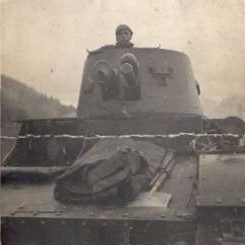
Just a year before World War II broke out, Maczek was given the command of Poland's first fully-motorized army, the 10th Motorized Cavalry Brigade, nicknamed the "Black Brigade". In September 1939 his Brigade was attached to the Krakow Army and fought in defense of the voivodeships of Lesser Poland and Silesia. From the very first day of war, his troops went into battle equipped with only light tanks, tankettes and only one artillery battery of only eight heavy cannon.

  
Polish Officers with General Maczek - "Black Brigade" 1939


Maczek's Polish 10th Motorized Brigade - TKS Tankettes 1939


The Battle of Jordanow took place on the second day when Maczek's troops faced the entire German XVII Corps of General Eugen Beyer and succeeded in shielding the southern flank of Polish armed forces along the Beskides (mountain ranges). Maczek's brigade, supported by just a few battalions of Border Guards and troops of National Defence managed to face down three German Panzer Divisions: the 4th Light Division under the command of General Alfred Ritter Von Hubicki, the 2nd Panzer Division under the command of General Rudolf Veiel; and the 3rd Mountain Division under the command of General Eduard Dietl.

Despite the overwhelming power of the Nazi Blitzkrieg, Maczek's Brigade fought against them for five days and succeeded in slowing down the German advance until it came to a virtual crawl. The Germans could not even manage to exceed ten kilometers distance per day, even with their superior numbers and war materiel.
Marian Machocki-Vickers Mark E Type B light tank

The terrain gave a significant advantage to Maczek and his brigade, who were very experienced and skilled in mountain warfare. Not only did they manage to halt German attacks but they launched some counter-attacks as well. However, German forces eventually succeeded in breaking through the front of the Krakow Army, which was positioned just north of the Brigade's position. Maczek and his troops then had to be pulled out of the front line.

The Brigade defended the bridges and fords in Lesser Poland, and eventually reached Lwow where they rendez-voused with the city's defence forces. They merged to form a mobile reserve which fought in the Battle for Lwow, thus allowing other Polish troops to withdraw towards the Romanian Bridgehead. However, their plans were shattered by the unexpected invasion of Poland on September 17, 1939 by Soviet forces from the east.

After only two days of fighting, Edward Rydz-Smigly, Marshal of Poland, ordered the Maczek and his brigade to cross the border into Hungary but they were immediately interned by the Hungarian government and the Brigade was reduced by half. Nevertheless, the Brigade had the great distinction of having been the only Polish unit not to have lost a single battle in 1939.

Amid many other Polish forces, Maczek and his troops made their way to France where they re-assembled the Polish armies. He was promoted to Brigadier-General and given the command of the Polish military camp at Coetquidan. During this time, Maczek presented the French with a report detailing German Blitkrieg tactics, and containing his recommendations for possible evasive maneuvers. However, the French chose to completely disregard the report.

Maczek sought to preserve the integrity of his Brigade by regrouping them into two separate camps, at Paimpont and at Campeneac in order to prevent the possible conscription of them to other infantry divisions. The soldiers of the Polish 10th Armoured Cavalry Brigade were highly-trained, skilled, and ready to fight, yet they received little by the way of equipment and no more than disdain from French Command.

Polish 10th Armoured Cavalry Brigade-organized in France

It wasn't until March of 1940 that the French supplied Maczeks' troops with equipment, albeit obsolete in quality and insufficient in quantity. By May Hitlers' armies invaded France merely by crossing over the Maginot Line. Only then was French Command willing to give Maczek all the equipment that he had asked for, provided that his Brigade enter battle immediately. It was an unreasonable request because the equipment was new and there was no time to train the Polish soldiers to use them properly. Under the circumstances General Maczek chose the best option; he assembled a small force composed of his best soldiers to lead the way, anticipating that the remainder of the troops would follow suit.

On June 6, 1940, Maczek's Brigade was equipped with only one tank battalion, two motorized cavalry squadrons, one anti-tank battery, and one anti-aircraft battery, the sum of which was grossly insufficient to fight against German armoured divisions. The Polish brigade was attached to the French 4th Army positioned near Reims and was given the mission to protect its left flank. The Poles attacked German forces in Champaubert-Montgivroux, but managed to cover only one French infantry division. The Brigade had no choice but to retreat and join the rest of the French troops.

Polish attack Montbard
On the night of June 16th, the Poles launched a surprise attack on the town of Montbard over the Burgundy Canal. The Germans were caught completely unprepared, and many were taken prisoner. However, victory was short-lived. The Polish brigade by that time was fighting alone with no French reinforcements whatsoever (French troops had either been routed or were in retreat). The Polish unit was utterly decimated, completely surrounded and without fuel.

Two days later, Maczek destroyed all the machinery that was unusable, and withdrew with his troops on foot. In order to pass through enemy lines, Maczek split his brigade into smaller groups, and traveled a winding path way all the way through Vichy France, North Africa, and Portugal to Great Britain.

Once on British soil, Maczek reassembled the Polish army to be put into active service. But oddly British Command had different ideas. They were intent on sending Polish troops to defend the Scottish coastline between Aberdeen and Edinburgh and between Montrose and Dundee. The notion was impractical and once Maczek and Sikorski intervened, the British abandoned the plan, finally being convinced of the feasibility of a Polish armoured unit.

After years of training and preparation the 1st Polish Armoured Division was formed in February 1942. They were a strong and viable force to contend with, and equipped with state-of-the-art Churchill and M4 Sherman tanks.


1st Polish Division
By the end of July 1944, they were called to fight in one of the greatest battles of World War II - the Battle of Normandy. On August 8 the Polish Division, attached to 1st Canadian Army, launched Operation Totalize. The mission was to break through German defenses south of Caen, and precipitate the complete collapse of the entire German front. This battle was called the Falaise Gap.

In two consecutive incidences, the Polish unit came under friendly fire by Allied aircraft, but still managed to achieve a brilliant victory against the Nazi's - in the battles for Mont Ormel, Hill 262 and the town of Chambois. The 1st Armoured Polish Division, along with the US 385th infantry battalion, and British and Canadian troops, destroyed approximately 570 enemy tanks and other vehicles, 100 guns, and captured 5,500 Germans. Polish Casualties were about 450 KIA and 100 tanks lost.

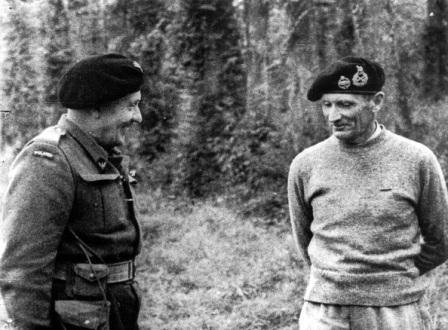
Field Marshall Montgomery described the battle. In his words,


"Under Falaise we locked the Germans
like they were in a bottle,
and the Polish Armoured Division
was the cork in this bottle."


General Maczek and General Montgomery

General Maczek with General Eisenhower


Trapped in the Chambois pocket were 14 German Wehrmacht and SS divisions.  Maczek and his men were given the vital mission of closing the Chambois pocket to prevent the Germans from using it as an escape route, and successfully destroyed enemy positions.

Following this decisive victory, Maczek's Division spearheaded attacks across the battlefields of France, Belgium, the Netherlands, and at last, Germany.  The Polish troops liberated Ypres, Ghent and Passchendale in Belgium.


Maczek led a brilliant outflanking manoeuvre, and after a tough fight, succeeded in freeing the city of Breda. What made it so remarkable is that there were no civilian casualties. (In gratitude, the people of Breda granted General Maczek Dutch citizenship after the war.)

 
Polish troops liberated town of Breda Oct 1944- General Maczek
Polish troops liberated town of Breda Oct 1944

Maczek's moment of glory came when his troops captured the German port of Wilhelmshaven and accepted the surrender of the entire German garrison, including 200 vessels of Hitler's navy, the Kriegsmarine.


Wilhelmshaven German Base


Maczek led the 1st Armoured Division to the very end of the war, and was promoted to Major-General in recognition of his outstanding service and leadership. After Germany had capitulated, Maczek took command of the Polish I Corps, followed by a command of all the Polish forces in the UK until 1947, when they were officially demobilized.

After the war, Maczek opted to remain in Britain like many other Polish officers and soldiers. The communist regime in Poland had stripped him of Polish citizenship and declared him to be persona non grata. But more astounding was the fact that the British government treated Maczek with considerable disdain, claiming that he was not considered an "Allied" soldier, and therefore not eligible for combattant rights and a military pension. Consequently, he had no choice but to work as a bartender until the 1960s at an Edinburg hotel.

In 1989 an official public apology was issued by the Prime Minister Mieczyslaw Rakowski, of the Communist Polish government. Maczek was decorated with Poland's highest medal, the Order of the White Eagle.

Lieutenant General Stanislaw Maczek passed away on December 11, 1994 at the age of 102. In accordance with his wishes, he was laid to rest among the graves of his soldiers at the Polish military cemetery at Breda.


HONOURS AND AWARDS


POLAND


Order of the White Eagle (1994)

Gold Cross of the Order of Virtuti Miltari

Silver Cross of the Order of Virtuti Militari

Knight's Cross of the Order of Virtuti Militari

Commander's Cross of the Order of Polonia Restituta

Grand Cross of the Order of Polonia Restituta

Cross of Valour

Gold Cross of Merit with Swords


THE NETHERLANDS

Commander of the Order of Orange-Nassau


BELGIUM

Grand Officer of the Order of the Crown with Palms

Croix de Guerre avec palmes (Belgium)


FRANCE

Medaille commemorative de la guerre 1939-1944

Commandeur de la Legion d'Honneur

Croix de Guerre avec palmes


UNITED KINGDOM

Commander of the Order of the Bath

Companion of the Order of the Bath (military)

Distinguished Service Order


Dutch Poster Thanking Polish Armies


NEXT