December 13, 2011

Secret Polish Forces of WW2: The "Silent & Dark Ones: PART II: MISSIONS Operation Arsenal

Operation Arsenal (Polish: Akcja pod Arsenalem) code-named "Meksyk II" took place in Warsaw on March 26, 1943 in one of the first major operations undertaken by the Polish Underground Szare Szeregi (Gray Ranks). Their mission was to free their troop leader, Jan Bytnar "Rudy" (Redhead) and his father who had been arrested and imprisoned by the Gestapo. 

Jan Bytnar "Rudy"
A team of 28 scouts were led by the Warsaw Standard Commander, Stanislaw Broniewski "Orsza" in a daring attack against the Warsaw Arsenal.  It was a crucial moment. The inmates had just been loaded onto a prison van which was ready to transport them from Pawiak prison to the Gestapo headquarters at Szucha Avenue.  The  "Attack" Group was under the command of Tadeusz Zawadzki "Zoska" and the "Cover" Group under the command of Władysław Cieplak "Giewont". The mission ended successfully resulting in the release of Jan Bytnar, his father and 24 other prisoners including another Storm Group leader,  Henryk Ostrowski "Henryk",  and 6 women. Sadly, Henryk's wife died in prison.   


COMMANDERS OF OPERATION ARSENAL


Stanislaw Broniewski "Orsza"
Commander of Operation Arsenal

Tadeusz Zawadzki "Zoska"
 Commander of Attack Group

Władysław Cieplak "Giewont"
Commander of Cover Group


ATTACK GROUP


Jan Rodowicz "Anoda"
Commander of Section: "Bottles"

Attack Group Members
Tadeusz Hojko "Bolec"
Henryk Kupis "Heniek"
Stanisław Pomykalski "Stasiek"


Sławomir Maciej Bittner
Commander of Section: STEN I

Sten I Members


Eugeniusz Koecher "Kolczan"
Wiesław Krajewski "Sem"


Jerzy Gawin "Słoń"
Commander of Section: Sten II

Sten II Members
Tadeusz Krzyżewicz "Buzdygan"(died, due to wounds)
"Cielak" Tadeusz Szajnoch
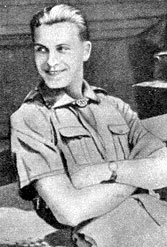

Maciej Aleksy Dawidowski "Alek"
Commander of Section: Grenades
Grenades Members
Hubert Lenk "Hubert"
Jerzy Zapadko "Mirski"


COVER GROUP

Konrad Okolski "Kuba"
Commander of Section: Signalisation
Signalisation Members
Witold Bartnicki "Kadłubek"
Andrzej Wolski "Jur"


Jozef Saski "Katoda"
Commander of Section: Stare Miasto 
Stare Miasto Members
Stanisław Jastrzębski "Kopeć"
Żelisław Olech "Rawicz"


Tytus Trzciński "Tytus"
Commander of Section: Ghetto
(regretfully, no photo could be found)
"Ghetto Section" Members
Feliks Pendelski "Felek"
Józef Pleszczyński "Ziutek"
Jerzy Tabor "Pająk"


Jerzy Zborowski "Jeremi"
Section: Car


Jerzy Pepłowski "Jurek TK"
Section: Car
(regretfully, no photo could be found)


Jan Bytnar was very active in the Warsaw underground resistance. He was a Scoutmaster and was soon promoted to Lieutenant of the Home Army. Before the war he had organized a group of scouts at the school he previously attended, Universal School at 9 Zagorna Street. He then continued his studies at the Gymnasium, Stefan Batory, where he graduated with Honours in 1939.  When war broke out, he escaped Warsaw with the Polish Scouting Association, and went underground. They returned to Warsaw and began what became very high-profile acts of small sabotage - painting symbols and slogans on public buildings and monuments, smashing windows of establishments frequented by Germans. Eventually they progressed to sabotage and armed actions.

Rudy made himself quite well-known among the Nazi German authorities. Nevertheless he continued to carry out many dangerous stunts in defiance of the Nazi occupation, acts that would have been punishable by death had he been caught.  He inscribed offensive slogans as well as drawings on the walls of the many streets; comments like "Only pigs are sitting in the cinema". In another one of his famous inscriptions - his answer to a German poster in front of the main recruiting office on Arbeitstamst Street,  which when translated read as "Go with us to Germany!" whereas he inscribed his reply, "Go Yourselves!"  The most famous of his works was the painted Kotwica (anchor) on the pedestal of the monument, Airman Union of Lublin (na placu Unii Lubelskiej). The symbol remained untouched to the end of the war. It was removed by the Russians after the war.

Kotwica-Airman Union of Lublin
The Polish Anchor, or Kotwica was created in 1942 by the AK Wawer "small sabotage" unit. The PW originally
meant "Pomscimy Wawer" We Will Avenge Wawer.  It was a response to Nazi Germans for the large scale massacre of Polish civilians. The slogan was later shortened to PW and later translated to Polska Walcząca.

On June 27, 1942, in celebration of the city's patron saint, of Polish President Wladyslaw Raczkiewicz and CC Wladyslaw Sikorski, soldiers of the Armia Krajowa (Home Army) stamped 500 copies of a German propaganda newspaper, Nowy Kurier Warszawski (The New Warsaw Courier) with the Kotwica. The following year it increased to 7,000 copies!  Polish General Stefan Rowecki issued an order to the Polish Underground that all sabotage, partisan and terror activities be marked with the sign of the Kotwica. It became a prominent symbol of the Warsaw Uprising.

The Kotwica was of enormous symbolic importance to the Polish Underground, as it not only manifested their resistance to Nazi German occupation but served as a continuous instrument of psychological warfare - to let the enemy know that Poland was not broken but very much alive, and that Poles were ready to Fight!  


Jan Bytnar "Rudy" was interrogated by the Gestapo who subjected him to severe beatings and torture in an effort to obtain the names of his friends and colleagues in the Polish underground. Despite his frail appearance he refused to cooperate. He died four days later from this wounds, on March 30, 1943.  He was posthumously awarded the Cross of Valour. He was 21.

The Nazi Germans responsible for the brutal death of Jan Bytnar were soonafter assassinated.  SS Rottenfuhrer Ewald Lange and SS Obersturmfufrer Herbert Schultz were gunned down by Group Szturmowe of Szare Szeregi. Schultz was killed on May 6, 1943 by Slawomir Maciej Bittner "Maciek", and Eugeniusz Kecher "Kolczan".  Lange was shot dead on May 22, 1943 by Jerzy Zapadko "Dzik"


NEXT:


December 12, 2011

Secret Polish Forces of WW2: The "Silent & Dark Ones" PART II: MISSIONS Operation Ostrama Brama

One of the most sensational battles of World War II was waged between the Polish Home Army and the Nazi German occupiers of Wilno. It was called Operation Ostrama Brama, (Operation Gate of Dawn) and was part of the larger Operation Tempest, the national uprising that lasted from July 7, 1944 to July 14, 1944.

Tadeusz Komorowski "Bor"
General Tadesuz Bor-Komorowski, Commander-in-Chief of the Home Army ordered the Armia Krajowa districts of Wilno and Navahrudak to capture Wilno from German control and maintain control over it before the Soviets could reach it. On June 12, 1944, Bor's orders were put into action. General Aleksander Krzyzanowski "Wilk", Commander of the Home Army District in Wilno (now Vilnius), regrouped all Polish partisan units in the northeastern section of Poland to launch the assault from inside the city as well as from it's perimeter.  Fighting erupted on July 7, 1944. Over 12,500 Home Army (AK) soldiers launched a vicious attack on the German garrison and succeeded in seizing most of the city center. Fighting was extremely fierce and lasted until July 14. Meanwhile in the eastern suburbs of Wilno, AK units were cooperating with reconnaissance groups of Soviet 3rd Belorussian Front.


During the operation, General Krzyzanowski attempted to consolidate all Polish partisan groups into a re-created Polish 19th Infantry Division, but it was too late. On July 15th, the advancing Red Army had already entered the city and the NKVD began to arrest all Polish soldiers and officers. In a strategy typical of Soviet chicanery, officers of the 3rd Belorussian Front extended an cordial invitation to Polish officers to a joint meeting at their headquarters, and then proceeded to arrest them when they arrived. About 5,000 Polish NCO's, soldiers, and officers were deported to a provisional internment camp located in Medininkai, a suburb of Wilno. They were given the "option" of joining the 1st Polish Army (Soviet-backed). The majority of Poles refused to join the Soviet army. They were deported to the wastelands of the USSR.

General Aleksander Krzyzanowski  "Wilk"

A secret NKVD/NKGB report dated July 17, 1944, from Lavrenti Beria to Stalin, Molotov and Antonov, reveal the extent of Soviet conspiracy against Polish forces. The following is an English translation:


July 17, 1944, Moscow

L. Beria to J. Stalin, V. Molotov, and A. Antonov
Forwarding report(s) of [Ivan] Serov and I. Tcherniakovsky
[Concerning] Arrest of Lt. Col. Aleksander Krzyżanowski, and planned disarming of Polish [Armia Krajowa - Home Army] military formations.

Beria and his mentor Stalin

****TOP SECRET****

Following information were received today from Comrade Tcherniakowsky:
The so-called Major-General “Wilk” / Kulczycki was summoned today. Wilk was told that we are interested in the locations of Polish formations, and that it would be prudent that our officers were familiar with them. Wilk agreed, and gave us 6 such locations, where his regiments and brigades are stationed. Additionally, we expressed our interest in his officers’ core, and proposed that he gathers all regimental and brigade commanders, their second in command, and chiefs of staff. “Wilk” also agreed to that, issued the necessary orders, and gave them to his communications officer, who immediately left for his headquarters.

After that, “Wilk” was disarmed [and arrested]; present at the time was a captain – the Chief of Staff who represents [the Polish] Government in London, who attempted to draw his side arm in order to resist, he cocked his gun, but was disarmed [and arrested as well].

Taking under consideration, that we received locations of Polish[Home Army] formations, the following operations’ plan was established:

1) Experienced generals and People’s Commisars for the State Security of NKVD were dispatched in order to approach the Poles and to investigate [further].

2) At the same time, units of the 3rd Belarusian Front were dispatched to disarm the Poles.

3) Today, at 1900-hours, a Border Security unit, as well as the leadership cadre of men and women of the NKVD were dispatched to disarm the [Polish] officers’ cadre.

4) Tomorrow, on 18th July, at 4 o’clock in the morning, units designated to disarm the Poles will be move to their deployment positions, will receive orders, and will begin the operation. They will report about the results of the operation.

AK Headquarters ordered an immediate retreat of all Polish units to Rudininkai Forest. By July 18 approximately 6,000 soldiers had reached the area, joined by an additional 12,000 volunteers. However, Soviet air reconnaissance discovered their locations, and they were subsequently surrounded by Soviet NKVD agents. Polish Command attempted to split their units in an attempt to try to break through to the Bialystok area, but to no avail. Most of the Polish forces were captured and interned.

In a subsequent report issued by Beria to Stalin on July 20, 1944, Soviet troops were reported to have disarmed a total of 6,000 Polish soldiers, among whom were 650 officers and NCO's. In the 2-day crackdown, the Soviets confiscated a large quantity of weapons including 5,100 rifles, 350 machine guns, 230 light and heavy machine guns, 12 light artillery pieces, 27 vehicles, 7 radio transmitters, a substantial cache of of ammunition and grenades, as well as 350 horses.

In the vicinity of Wilno, Lt. Col. Maciej Kalenkiewicz "Kotwicz" and approximately 80 to 100 soldiers remained hidden in the forests but sprung into action on August 21, engaging the NKVD expeditionary forces in battle. But Soviet units were stronger having received additional reinforcements from NKVD Intelligence-Search Unit 3, Battalion 32 (commanded by NKVD's Captain Shulkha, and Capt. Tshikin of the Regional NKVD detachment.)


Major Maciej Kalenkiewicz "Kotwicz"
Major Maciej Kalenkiewicz among his soldiers - 1944

Kalenkiewicz was trained as a Cichociemni and on December 27, 1941 parachuted into Nazi-occupied Poland to assume command of the Nowogrodek Home Army.  Due to pilot error, instead of landing in the area of the General Governement, the plane was landed smack in the middle of territory annexed by the Third Reich. The pilot and crew were arrested as soon as they landed, but later were able to escape from captivity, recapturing their weapons and killing all the Germans. In the meantime, Kalenkiewicz and his team had already reached Warsaw where Kalenkiewicz met with General Stefan Rowecki (Grot) and was accepted into the Association of Armed Struggle, the predecessor to the Home Army.


General Stefan Rowecki "Grot"

Kalenkiewicz was nick-named by the NKVD as the "handless major". He was severely wounded in his right arm during the battle against the Germans at Iwa on June 24, 1944. However he continued to take part in ambush operations against a German transport convoy near the estate of Kwiatkowce, situated about 4 km from Subotnik. (During the battle his unit was also under attack by Soviet troops.) Kalenkiewicz developed gangrene in his wounded arm and on June 29th had to undergo amputation of his hand at Antoniszki, near the Oszmina. Despite his serious condition and very high fever, on July 9th he still reported to General "Wilk" for service but his condition prevented him from taking part in the liberation of Wilno from the Germans. Major Kalenkiewicz and 38 AK soldiers were killed in action during the Battle at Surkonty on August 21, 1944.

To the Poles Operation Ostrama Brama was not a victory though they achieved a tactical victory over the German forces. The destruction of Polish units and subsequent occupation of the city by the Red Army was a bitter defeat to the Polish Home Army who struggled to achieve the goals of Operation Tempest.


NEXT:
PART II MISSIONS:  Operation Arsenal

December 11, 2011

Secret Polish Forces of WW2: The "Silent & Dark Ones" PART II: MISSIONS Operation Kutschera

Operation Kutschera was part of the much bigger mission called "Operation Heads" in which the Polish Resistance successfully eliminated many key Nazi officials. Franz Kutschera was one of the targets taken down by "Agat", a division of the Armia Krajowa's Anti-Gestapo unit. Kutschera was gunned down on February 1, 1944, in a spectacular gun battle that would have made early James Bond films pale in comparison.
Franz Kutschera

On September 25, 1943, the Reich had appointed Franz Kutschera SS-Brigadefuhrer and Generalmajor of Polizei (SS and Police Chief) to a posting in Warsaw. He had previously proven himself as a ruthless officer in the Mogilev District in the Soviet Union, where he demonstrated his unscrupulous measures and earned a reputation for brutality.  He was called the "Executioner of Warsaw".


As soon as Kutschera arrived in Warsaw to assume his command, he wasted no time in inflicting his barbarous measures against the Polish civilians. The rate of public executions and lapanka (round-ups) increased dramatically.  So too did the daily German announcements  which published lists of names of the Polish hostages who would be shot in the event that any German soldier was attacked. These tactics, decreed by Hans Frank were applied with ruthless frequency in the hope that it would quash the Polish resistance, but it had, in reality, quite the opposite effect.  It hardened their resolve to oppose and fight against their German occupiers.


Kutschera was a cunning officer, knowing full well of the dangers of venturing outside one's familiar territory. He was all too well aware of the methods used by Polish intelligence and took steps to conceal not only his whereabouts but his name and identity as well. That the Polish Resistance was still able to locate him was due to sheer coincidence and luck.

Aleksander Kunicki "Rayski"
Aleksander Kunicki, code-named "Rayski" was the Chief of Intelligence of the Agat unit, and was working on Walter Stamm (IV Department Gestapo Director in Warsaw) and Gestapo Command Office, as well as Dr. Ludwig Hahn, the head of that Office. Rayski frequently made visits to the police quarter of Warsaw to survey activity. One day he spotted an Opel Admiral limousine pulling into the driveway of a palace at 23 Aleje Ujazdowskie, the site of the Warsaw District SS and Police Leader. An SS man emerged from the vehicle and just then his black coat opened enough to reveal a general's collar insignia. It was Kutschera. From that day, Polish intelligence agents were posted everywhere closely monitoring his every movement until they discovered his name and address.

"Rayski"' dispatched a report to Kedyw Commander Emil August Fieldorf code-named "Nil". Several days later a reply was sent back by the Special Polish Courts. Nil had issued an order to "liquidate" Kutschera. The plan immediately went into preparation. Commander Adam Borys,"Plug" of Parasol Battalion, chose 1st Platoon to carry out the action. Bronislaw Pietraszewicz "Lot", the Platoon Commander took charge and together with "Plug" studied the intelligence that had been gathered by "Rayski".

Emil August Fieldorf "Nil"

The first attempt occured on January 28, 1944 when "Lot" and his team took their positions and waited for Kutschera. They had waited in vain as Kutschera never showed up. Tragically, in the interim Jan Kordulski "Zbik" was mortally wounded by German patrol units, and had to be replaced by Zbigniew Gesicki "Juno" and Stanislaw Huskowski "Ali"

The next opportunity arose on February 1st, 1944 at 8:50 am. All the members of the execution team were at their places and ready to take action.


"Plug" (Adam Borys)
Plug was the mastermind behind the Parasol Battalion.
He organized attacks on SS and Gestapo officers
 and planned the Kutschera assassination
.

"Lot" (Bronisław Pietraszewicz)
Lot was the commander and 1st executioner.
His weapons: MP 40 submachine gun, Vis gun, Filipinka hand grenades.


"Bruno" (Bronislaw Hellwig)
Opel Kapitan driver (2 Parabellums, grenades)


"Ali" (Stanisław Huskowski)
Second-in-command and security screen (STEN, grenades)


"Kruszynka" (Zdzisław Poradzki)
2nd executioner (STEN, grenades)


"Miś" (Michał Issajewicz)
Adler Trumpf-Junior car driver and 3rd executioner
(Parabellum pistol and grenades)


"Cichy" (Marian Senger)
Cover ( STEN, Parabellum, grenades)

"Olbrzym" (Henryk Humięcki)
Cover (STEN, Parabellum, grenades)


"Juno" (Zbigniew Gesicki)
Cover (STEN, Vis, grenades)


"Sokół" (Kazimierz Sott)
Mercedes 170 V driver (2 Parabellum, grenades)


"Kama" (Maria Stypułkowska-Chojecka)
Signals


"Dewajtis" (Elżbieta Dziębowska)
Signals


"Hanka" (Anna Szarzynska-Rewska)
Signals


At precisely 9:09 am Kama gave the signal to indicate that Kutschera was leaving his house at Aleja Róż 2. Even though SS headquarters was a mere 150 meters from his home, he habitually rode by car.  Just as he neared the gate of SS headquarters, a car swerved to block his path. "Miś" was driving.


HQ of German SS and Police Commander Warsaw District
Ale Ujazdowskie

Area of Franz Kutschera Assassination


At that moment, "Lot" and "Kruszynka" ran to the limousine and opened fire on Kutschera at point blank range. Meanwhile the other members of the team ran to take their places and move in with their vehicles.  The scene turned into a wild gunfight as German guards from the neighbouring Offices of the Gestapo, Schutzpolizei, and garrison club, all converged  in the area, and an intensive firefight ensued. Amid a hail of bullets Miś jumped out of his car, and joined by Kruszynka finished off the wounded Kutschera. They then searched him for documents.

Ali was in charge of the hand grenades but at the crucial moment was unable to open the briefcase in which they were contained. As fate would have it, these were the only weapons at his disposition. He did not receive the other weapons in time, and thus could not support his team, Cichy, Lot and Olbrzym. As a result they were all wounded in a vicious hail of bullets.

Gravely wounded, Lot was unable to call out loud enough to order a withdrawal.  None of the team members heard him and as a result, the shootout was unnecessarily prolonged. They were in extreme danger, caught in the very epicenter of the German office quarter.  Miraculously, they were finally able to get into their get away cars and escape.

What followed was a frantic search for a hospital  that was willing to defy German orders and agree to operate on Cichy and Lot, who were mortally wounded. (The original medvac plan failed.) It took several hours and five attempts before a hospital would finally admit them. But tragically, because of the delay, both men died within the next couple of days.

In the meantime Sokół and Juno, in defiance of AK orders, attempted to return the car to the garage but were intercepted by German troops at Kierbedz bridge. After a short, fateful exchange of gunfire, Sokol and Juno tried to escape by jumping into the Vistula River. They either drowned or were shot.


Franz Kutschera Funeral
The Germans held a funeral ceremony for Kutschera in Bruhl palace. His body was then transported to Berlin on a special train. The  Nazi Germans had demanded 100 million zloty from the City of Warsaw as a retribution. Then the very next day, German troops rounded up and executed 100 Polish civilian hostages.


They were shot in what was the last public execution in Warsaw...until the outbreak of the Warsaw Uprising....


NEXT:
PART II MISSIONS: Operation Ostrama Brama