Showing posts with label Battle of Britain. Show all posts

October 31, 2018

OCTOBER 31 - DAILY CHRONICLES OF HISTORY

OCTOBER 31

1918

During the night of October 31 to November 1, 1918, Captain Dmytro Vitovsky of the Sich Riflemen led a group of Ukrainian officers in a military action to capture the city of Lviv. The following day, the West Ukrainian People's Republic was proclaimed, with Lviv as its capital.  This came as a shock to the Polish ethnic population and administration, as they suddenly found themselves in a Ukrainian state.   Although the majority of the population of the Western-Ukrainian People's Republic were Ukrainians, many urban settlements had Polish majorities.  Because the West Ukrainian People's Republic was not internationally recognized and Poland's boundaries had not yet been defined, the issue of ownership of the disputed territory was reduced to a question of military control. (nb: After the end of WWI, Poland re-emerged as a sovereign nation state, after 123 years of oblivion.)  The Polish Ukrainian War broke out on November 1, 1918 and ended on July 17, 1919 with a Polish victory and annexation of disputed territory.  The Polish–Soviet War was already well under way, having begun in February of the same year. Polish forces battled forces of the Ukrainian People's Republic, Soviet Russia and Soviet Ukraine for control of an area equivalent to today's western Ukraine and parts of modern-day Belarus.


1939

Nazi-Occupied Poland:  Nazi German Hans Frank,  Governor of the General Government, enacted criminal laws which imposed the death penalty to anyone for acts against the Nazi German government, or the unlawful possession of a weapon. Subsequent laws also imposed the death penalty, for example: on January 21, 1940, for economic speculation;  on February 20, 1940, for spreading sexually transmitted diseases;  on July 31, 1940, for any Polish officers who did not register immediately with the German administration (to be taken to prisoner of war camps);  on November 10, 1941, for giving any assistance to the Jews;  on July 11, 1942, for farmers who failed to provide requested contingents of crops; on July 24, 1943, for not joining the forced labor battalions (Baudienst) when ordered.


1940

The Battle of Britain ended on October 31, 1940 with an Allied victory. The Battle was the first major military battle waged entirely by air forces.  The RAF fought the Nazis in defense of  England. Many British towns and cities, including London was bombed by the Luftwaffe. Polish pilots were an integral part of the RAF squadrons and shot down more enemy planes than any other Allied squadrons.  A total of 145 experienced and battle-hardened Polish airmen took to the skies and demonstrated their mastery over the skies. There were Polish airmen in various RAF squadrons, as well as in No. 302 (Polish) Fighter Squadron and in No. 303 (Polish) Fighter Squadron (also called the Kosciuszko Squadron).  The RAF also consisted of pilots from Canada, Australia, New Zealand, South Africa, Belgium and Czechoslovakia.


1941

German U Boat sank American Destroyer.  On October 31, 1941, USS Reuben James was one of five destroyers escorting convoy HX-156,  near the coast of Iceland,  Just as the Reuben James began turning to investigate a strong direction-finder bearing, a torpedo was launched from U-552. It struck her port side and caused an explosion in her forward magazine causing the entire bow section of the destroyer to be blown off as far back as the fourth funnel. The American ship sank immediately but the stern remained afloat for around five minutes before sinking.  The damage was compounded by unsecured depth charges, which began exploding as they sank, killing the survivors in the water.  One hundred and fifteen of her 160-man crew were killed, including all the officers.  The destroyer was the first US Navy warship to be sunk in World War II.


August 31, 2018

AUGUST 31 - DAILY CHRONICLES OF HISTORY

AUGUST 31

1939

On the night of August 30-31, German Foreign Minister Joachim von Ribbentrop read a 16-point German proposal to the British ambassador. When the ambassador requested a copy of the proposals for transmission to the Polish Government in Exile, Ribbentrop refused, on the grounds that the requested Polish representative had failed to arrive by midnight. Later on August 31, Polish Ambassador Lipski went to see Ribbentrop  to confirm that Poland was willing to enter negotiations, but that he did not have the full power to sign, Ribbentrop summarily dismissed him. Germany then broadcast that Poland had rejected Germany's "offer" for negotiations, and talks came to an abrupt end. Hitler issued orders for the invasion of Poland the next day.


Hitler issued Directive No. 1, ordering an attack on Poland to begin September 1: He declared  "Since the situation on Germany's Eastern frontier has become intolerable and all political possibilities of peaceful settlement have been exhausted, I have decided upon a solution by force.  The attack on Poland will be undertaken in accordance with the preparations made for 'Case White', with such variations as may be necessitated by the build-up of the Army which is now virtually complete.  The allocation of tanks and the purpose of the operation remain unchanged.  Date of attack 1st September 1939.   This time also applies to operations at Gdynia, in the Bay of Danzig, and at the Dirschau bridge..... "


Nazi Propaganda at Gleiwitz: Sturmbanfuehrer Alfred Naujocks of the SD led a party of German convicts dressed in Polish uniforms, staging a fake attack on the German radio station at Gleiwitz. The so-called "raiders" burst into the studios, broadcast a patriotic announcement in Polish, fired a few shots and left. Once outside the convicts were executed by the SS and their bodies left there for the local police to find.  Within hours, other German radio stations broadcast the news of the "unprovoked attack on the Reich and falsely accused the Polish Army of the attack. The incident was staged by the Nazis as a pretext for invading Poland. In his testimony at the Nuremberg Trials, Naujocks stated that he organized the incident under orders from Reinhard Heydrich and Heinrich Muller, chief of the Gestapo.


1940

Polish fought in the Battle of Britain:   The No. 303 ("Kościuszko") Polish Fighter Squadron was formed on August 1, 1940 and became operational on August 31, 1940.  The 303 was one of 16 Polish squadrons in the British Royal Air Force (RAF). The PAF in Britain consisted of about 8,000 Polish airmen. The Polish pilots were among the aces in the Battle of Britain, and gained enormous prestige in their valor and skill in aerial combat. Their experience and skill was superior to that of the British pilots, as the Poles were constantly "scanning the skies" for enemy aircraft, and relied on their own quick instincts in battle.  Not only did they hold the highest scores of the Hurricane squadrons during the Battle of Britain, but they achieved the highest ratio of enemy aircraft destroyed and damaged. The Kosciszko squadron was named after General Tadeusz Kosciuszko,  the Polish and United States hero, (who fought in the American War of Independence) and the Polish 7th Air Escadrille founded by Merian C. Cooper, that served Poland in the 1919–1921 Polish-Soviet War.  Sir Archibald Sinclair,  British Air Minister sent a letter to the Polish airmen after WWII, in which he said, "... Our shortage of trained pilots would have made it impossible to defeat the German air force and so win the Battle of Britain if the...airmen of Poland had not leapt into the breach.......[We] do not forget that you were the first to resist the aggressor....neither do...[we] forget that you came after manifold trials to our aid when we most needed your help.  Your valiant squadrons fighting alongside our own were in the forefront in the Battle of Britain and so helped to restore the fortunes of the Allies throughout the years of struggle.  In good times and bad you have stood by us and shared with the RAF their losses and their victories......"


1944

Polish Insurgents Escaped Through Sewers:  Since the beginning of the Warsaw Uprising, Polish insurgents relied heavily on Warsaw's extensive network of sewers as a vital link of communication, and transport between Polish units throughout the city center.  By the end of August, the sewers were used by Polish Home Army soldiers and Polish citizens in an emergency evacuation to flee the increasing German onslaught. The most successful evacuation was of over 5,000 Polish soldiers and citizens from the Old Town district to the City Center and Zoliborz areas. It was only by the end of August that Germans discovered the sewer network and  attempted to destroy the operation by pouring gasoline into the sewers and igniting it, or laying mines and building obstacles.  Despite the horrific dangers, the Poles continued the evacuation until the end of September.


1980

Gdansk Agreement:  The agreement was the direct result of the 21 demands of the Interfactory Strike Committee (MKS),  resulting from the Gdansk strikes.  With wide support of other striking groups, and the citizens, the communist-controlled Polish government finally gave in to their demands. This ushered in democratic changes within a communist political system.  Among their demands were the formation of independent trade unions,  the right to strike, economic decentralisation, freedom of speech and of the press, fair workers compensation and working conditions, among others.  These developments led to the creation and rise of Solidarność (Solidarity), the independent trade union that emerged from the Lenin Shipyard strike, led by Lech Walesa.  It achieved unparalleled power and success of over 10 million Poles across the country.  Solidarosc negotiated for Poland's interests, and led the way to a free, and independent Poland again. (see August 17, 1980)


1982

Solidarity National Wide Demonstrations:  Solidarnosc, organized anti-government street demonstrations to commemorate the second anniversary of the Gdańsk Agreement. The bloodiest protest occurred in southwestern Poland, in the town of Lubin in which three protesters were killed by Communists and an unspecified number of wounded. On the same day, rallies and demonstrations took place in 66 cities across the country.  Street fights were a common sight not only in major urban centers, such as Warsaw, Kraków, Szczecin, Wrocław, Łódź, and Gdańsk, but also in provincial cities (Rzeszów, Koszalin, Kielce, Przemyśl, Częstochowa, Bielsko-Biała, Gorzów Wielkopolski), and towns (Starachowice, Lubin, Konin). In Wrocław, which was one of main centers of underground Solidarity, several thousand people fought against riot police and soldiers for many hours.  One demonstrator, 27-year-old Kazimierz Michałczyk, was killed by a bullet.   Other victims of police brutality were: 32-year-old Piotr Sadowski from Gdańsk, Mieczysław Joniec from Nowa Huta, and Jacek Osmański from Toruń. Stanisław Raczek was severely beaten during a protest in Kielce, and died on September 7. He was 35.


August 30, 2018

AUGUST 30 - DAILY CHRONICLES OF HISTORY

AUGUST 30

1940

RAF 303rd Kosciuszko Squadron began air operations. The pilots had been waiting for weeks and desperate to get into the action. Most of them were veterans and experienced in the strategies of aerial battle.  They had to endure weeks of being trained on bicycles by the British commanders at RAF Northolt. Finally the Polish aces had the chance to fly in combat. They scored their first victory (though officially still non-operational) by shooting down a German Messerschmitt Bf 110 of 4./ZG 76 (initially incorrectly recorded as a Dornier Do 17). The wreck was excavated in 1982. Polish pilot F/O Ludwik Paszkiewicz scored the kill during a so-called training flight. He was already an skilled and accomplished pilot.  After Squadron Leader Kellet's personal recommendation, the squadron was declared officially operational next day by No. 11 Group RAF.


Battle of Britain:  Six of the squadron units Hurricanes took off to carry out a mock attack on 6 Blenheim bombers in the St. Albans area. Polish Officer Ludwik Paskiewicz, described the attack in his official report as follows, "After a while we noticed ahead a number of aircraft carrying out various evaluations… I reported it the Commanding Officer, S/Ldr [Squadron Leader] Kellett, by the R/T (radio-telephone), and, as he did not seem to reply, I opened up the throttle and went in the direction of the enemy…Then I noticed, at my own altitude, a bomber with twin rudders – probably a Dornier – turning in my direction…Then I aimed at the fuselage and opened fire from about 200 yards, later transferring it to the port engine, which I set on fire…The Dornier…dived and then hit the ground without pulling out of the dive and burst into flames. I have been firing at an enemy aircraft for the first time in my life." When he returned to base, Paszkiewicz was reprimanded for disobeying orders, but also congratulated for making the squadrons first kill.  (Note:  Paskiewicz'  aerial attack was immortalised in the famous classic scene, "Repeat, please" scene in the film the Battle of Britain.)


1978

Henryk Zygalski died on August 30, 1978. He was a civilian cryptologist with the Polish General Staff's Biuro Szyfrów (Cipher Bureau), housed in the Saxon Palace in Warsaw. He worked there with fellow Poznań University alumni and Cipher Bureau cryptology-course graduates Marian Rejewski and Jerzy Różycki. Together they developed methods and equipment for breaking Enigma messages.  The Polish Underground captured a German Engima machine, which Rejewski and his colleagues worked on breaking the Enigma Code. Before World War Two broke out the Polish mathematicians had already constructed working replicas of the Enigma machine and gave one each to the authorities in England and France.


August 13, 2018

AUGUST 13 - DAILY CHRONICLES OF HISTORY

AUGUST 13

1940

The Battle of Britain:   Hermann Göring launched the Luftwaffe's all-out air assault on Britain on August 13, 1940. Code-named Adlertag ('Eagle Day'), its objective was to destroy the British RAF in order to achieve air superiority over England. This was to be followed by Operation Sea Lion, a massive invasion of England, according to Hitler's Directive No. 16.  Though the German attacks on August 13 inflicted significant damage and casualties on the ground, they ultimatley failed to achieve their primary goals. Hence, Operation Sea Lion was shelved definitely.  Regardless, the Luftwaffe continued in its campaign against the RAF well into September of 1940.  The Luftwaffe, unable to destroy the RAF, adopted a different strategy - strategic bombing of British coastal towns and cities, and then London itself.  It was called the Blitz.


1948

Black Friday in Berlin:  After the end of WW2,  Germany and Berlin were divided into allied occupation zones, but by 1948, the rising Cold War rhetoric became extremely hostile. The Soviets interfered with road and rail traffic in an attempt to dislodge the British and Americans from their zones of occupation in Western Berlin, and halted ground and water travel to western part of Berlin. US and UK responded by conducting continuous and massive air lifts to Berlin, which on August 13, 1948  turned into a deadly mission. On August 13, 1948,  thick cloud cover and heavy rain over Berlin caused very poor visibility. A  C-54 crashed and burned at the end of the runway, and a second one landing behind it burst its tires while trying to avoid it. A third transport ground looped after mistakenly landing on a runway under construction.  According to the standard of procedure at the time, all incoming flights (approaching every three minutes) were stacked above Berlin from 3,000 feet (910 m) to 12,000 feet (3,700 m). During severe weather, it greatly increased the chances of a mid-air collision. To make matters worse, planes on the tarmac which had just been unloaded were denied permission to take off, which created a backup on the ground.  There was no loss of life, but the complete lack of control and coordination, compounded by the ill-fated weather was cause for embarrassment for traffic control personnel.


1961

Berlin Divided:  Just past midnight on August 13, 1961, East German soldiers began laying down a barrier of barbed wire and bricks between Soviet-controlled East Berlin and the western Berlin. Walter Ulbricht, the Communist leader of East Germany,  received approval from Khrushchev to begin blocking all access between East and West Berlin.  From August 12 to 13,  soldiers had laid more than 100 miles of barbed wire just inside the border of East Berlin. Soon afterwards, the barbed wire was replaced by a six-foot-high wall made of concrete blocks which covered a distance of 96 miles.  The construction was completed with guard towers, machine gun posts and search lights, and were patrolled by East German officers night and day.


1991

Pope John Paul II's fifth visit to Poland:  The Pope celebrated World Youth Day in Jasna Gora, Częstochowa. It was the first time that World Youth Day was held in Eastern Europe, and the first time that the youth from eastern countries went to Poland to celebrate. There was a powerful spiritual connection between the Pope and the youth of the world that was very special. Over 1.6 million attended for the final Mass. An anthem was composed by Jan Góra and Jacek Sykulski, entitled, "Abba, Ojcze". In his homily, the Pope stated, "......As theme of the Sixth World Youth Day, I have chosen the words of St Paul: "You have received a spirit of sonship" (Rom 8:15). These words lead us into the deepest mystery of the Christian vocation: in the divine plan, we are indeed called to become sons and daughters of God in Christ, through the Holy Spirit.....To all of you young people, on the occasion of this World Youth Day, I say: Receive the Holy Spirit and be strong in faith! "God did not give us a spirit of timidity but a spirit of power and love and selfcontrol" (2 Tim 1:7)......"     The Pope also visited Krakow.


July 10, 2018

JULY 10 - DAILY CHRONICLES OF HISTORY

JULY 10

1940

The Battle of Britain began. It was the first major military campaign fought entirely by the air forces of Britain and its Allies against the German Luftwaffe. The Luftwaffe launched their offensive in conjunction with an air and sea blockade.Their targets were centered on British coastal shipping convoys, ports, and shipping centres such as Portsmouth. By mid-August the Luftwaffe began attacking RAF airfields and infrastructure, as well as factories producing aircraft, and strategic infrastructure.  Eventually the Luftwaffe turned their guns on the British civilians and began a massive bombing campaign (The Blitz) on coastal towns and cities. By early September, the city of London became the target. A great part of the city was bombed and left in a mass of smoldering rubble. The Blitz resulted in 43,000 civilians dead and up to 139,000 injured.  The RAF suffered heavy casualties, a situation which was exacerbated by their inexperienced pilots. To offset these losses, the RAF called in reinforcements from their allies, comprising of 145 Poles, 127 New Zealanders, 112 Canadians, 88 Czechoslovaks, 10 Irish, 32 Australians, 28 Belgians, 25 South Africans, 13 French, 9 Americans, 3 Southern Rhodesians.  Despite being outnumbered, the Royal Air Force and its Allies demonstrated their air superiority over the German air force and won the Battle on October 31, 1940. Victory in the Battle was assured largely due to the participation of the Polish Air Forces, in particular the famous No. 303 Polish Fighter Squadron, also called the Kosciuszko Squadron, which contained the largest number of ace pilots in the RAF.  The 303 had the highest RAF kill score in the Battle of Britain.   Commanders Witold Urbanowicz, Jan Zumbach, and Zdzisław Henneberg (just to name a few) were among the many heroic Polish commanders and pilots who fought for Britain.  (Read about the Kosciuszko Squadron)


1941

Jedwabne Pogrom was a massacre of 340 Jews from the village of Jedwabne, Poland.  On this day, a group of at least 40 Polish males were involved, after being summoned in Jedwabne by the order of Mayor Marian Karolak, and German paramilitaries, called Ordnungspolizei. The SS, Gestapo and Einsatzgruppe forces were also complicit. They then rounded up the local Jews as well Jews who sought refuge from the nearby towns of Wizna and Kolno, and took the them to the town square where they were humiliated and beaten. Ultimately, the Jews were forced into a barn, killed and the barn set on fire with them in it. (These are the official findings of the Institute of National Remembrance, which "confirmed by the number of victims in the two graves, according to the estimate of the archeological and anthropological team participating in the exhumation," wrote prosecutor Radosław J. Ignatiew, who headed an investigation in 2000–2003 ordered by the Polish government..)


1942

Himmler gave the order for sterilization experiments at Ravensbrueck:  In a letter from SS-Obersturmbannführer Brandt to Prof. Clauberg, July 10, 1942, read as follows: " Today the Reich Leader SS  (Himmler) charged me with transmitting to you his wish that you go to Ravensbrueck after you have had another talk with SS-Obergruppenführer Pohl and the camp physician of the women's concentration camp Ravensbrueck, in order to perform the sterilization of Jewesses according to your method... (source: Trials of War Criminals Before the Nuremberg Military Tribunals - Washington, U.S Govt. Print. Off., 1949-1953, Vol. I, p. 729)


1945

Augustow Roundup:  The Augustów roundup was a military operation against the Polish anti-communist partisans which occurred following the Soviet takeover of Poland. Soviet forces with the assistance of Polish communist units,  conducted the roundup from July 10 to July 25, 1945 in Suwałki and Augustów region (Podlasie) of northern People's Republic of Poland. Out of 2,000 arrested by the Soviet forces, about 600 disappeared.  They were  presumed to have been executed and buried in an unknown location in Russia or Belarus. The Polish Institute of National Remembrance has declared the 1945 Augustów roundup "the largest crime committed by the Soviets on Polish lands after World War II".  The crime has been called "second Katyn", in reference to the Katyn massacre in 1940, when the Soviet NKVD executed over 16,000 Polish officers, soldiers, and intelligentsia.


December 19, 2017

POLISH GREATNESS BLOG - 2018 DAILY CHRONICLES OF HISTORY SPECIAL SERIES


Polish Greatness (Blog) is pleased to present a Special series called "Daily Chronicles of History."  Beginning January 1, 2018 there will be daily posts throughout the year featuring events from Polish history and World War Two.


This special series will focus on Poland's struggle throughout the cataclysmic years of World War Two, the rise of fascism, the notorious NKVD, Hitler and Stalin's pact, the invasion of Poland by Nazi Germany and the Soviet Union, the murders and treachery perpetrated by Germany and Russia on Polish citizens (upon both Christians and Jews), the Katyn Massacre, the Nazi German concentration camps and death camps, deportations, work camps, pogroms, and most sinister of all, the propaganda created by the Nazis to destroy the very soul of a nation. It is essential, I believe that an understanding of Poland must include some knowledge about its distant history, therefore I also provide some posts about the partitions of Poland, its interwar years, as well as some facts from time to time about its medieval period. There will be a post every day from January 1, 2018 to December 31, 2018.

Unbeknownst to many people, Poland was the fourth greatest ally during the World War Two, and is credited with having made great contributions to the allied war effort -  the Poles were the first to break the Enigma Code, the Polish armed forces fought in almost every battle of World War Two, such as the Battle of Britain, the Battle of Monte Cassino,and the Battle of Berlin. The Poles organized the largest underground resistance in all of Europe, and provided the Allies with the first eye-witness reports about the Warsaw Ghetto, and Nazi German extermination camps. The history of Poland is filled with stories of monumental struggles, great heroism, and courageous Polish men and women who fought against all odds against the Nazi and Soviet war machines during the Warsaw Uprising.

Polish Greatness Daily Chronicles of History consists of informative, yet brief summaries of events of each day, rather than full-scale articles. The stories are intense, shocking, but unforgettable.

Polish Greatness' Daily Chronicles of History is for everybody, from students of history, to researchers, and even seasoned history enthusiasts. You will certainly discover many things you never knew before.

I invite you to follow this special series, or subscribe so that you do not miss any posts. Just click on the subscription box located at the top right-hand side panel and sign up to begin receiving posts every day starting on January 1, 2018.  It is completely free, and there is no obligation whatsoever.

I would like to take this opportunity to thank all my readers for their interest in Polish history, and for following Polish Greatness (Blog).

Wishing you all a Merry Christmas, or Happy Chanuka, or a Happy Kwanza. 

Happy New Year to all for 2018.


Please join Polish Greatness (Blog) as we journey back in time throughout 2018!


P.S.  Several years ago, I posted a series entitled, "The Invasion of Poland (Day by Day)"  which traced the chronological sequence of events, complete with photos and videos. The unique thing about the posts was the use of the present tense in its writing - a factor which contributed to the sense that the reporting was happening as a real time news report! This was followed much later by a series regarding the Warsaw Uprising (Day By Day) which was also met with considerable interest and excitement by my readers.  Below I have provided links to the index of each of these series, so that you can follow the posts at your pace.


 September 1939; Invasion of Poland: - Day by Day: An Index 

 Warsaw Uprising 1944: Complete Index


July 28, 2011

Battle of Britain: Part IV - Legend of the Spitfire

The Spitfire captured the fascination and imagination of generations the world over. It became a legend during the Battle of Britain and was hailed as the best fighter aircraft in the RAF fleet. Although the Hurricane faced a larger proportion of enemy aircraft it was the Spitfire which had a higher ratio of victory to loss. It was the ambition of every pilot to fly it, and the dreams of every young boy to grow up and become a Spitfire pilot!


Those who flew them marveled at its wide-ranging capabilities. It was not only a fighter aircraft, but an interceptor, bomber, and dealt with photo-reconnaissance as well as training. There were numerous variants of the design which featured different wing configurations but also horse power. The Spitfire had its origins at Supermarine Aviation Works and was the brainchild of its chief designer, R.J. Mitchell. After Mitchell`s death from cancer in 1937 one of his colleagues, Joseph Smith carried on as chief designer. The original airframe, powered by a Rolls-Royce Merlin engine, produced 1,030 hp (768kW) and was easily adapted to increasingly more powerful engines, such as the Rolls-Royce Griffon engines that eventually produced 2,035 hp (1,520 kW).


The first Griffon-powered Spitfire DP 845 flown by Jeffrey Quill 1942

The most striking feature of the Spitfire was its sleek elliptical wings which had a thin cross-section allowing a higher top speed than other fighers of its time, including that of the Hawker Hurricane. The Spitfire was built for speed which allowed it to accomplish its mission so successfully against enemy aircraft.


Spitfire, the legend, the facts and its opponent (5 of 5) (00:08:17m)

However, the Spitfire had its growing pains. The British Air Ministry had set specifications for a new fighter aircraft that was capable of 251 mph (404 km/hr) and in 1931 H.J. Mitchell designed the Supermarine Type 224. It was an open cockpit monoplane with bulky gull wings and a large fixed spatted undercarriage powered by a evaporative-cooled Rolls-Royce Goshawk engine of 600 hp (450 kW). It made its virgin flight in February 1934 but without the expected fanfare. It was a big disappointment. Mitchell and his team embarked on refining its design. Among the seven variations, it was the Gloster Gladiator biplane that was accepted for service.

Gloster Gladiator Biplane
His next aircraft was not accepted by the Air Ministry either. It was the Type 300, based on Type 224 but with a retractable undercarriage and its wingspan was reduced by 6 ft (1.8m). The design went through several modifications and incorporated a faired, enclosed cockpit, oxygen-breathing apparatus, smaller and thinner wings and the newly developed and more powerful Rolls-Royce PV-XII-V-12 engine, later christened the "Merlin". Mitchell began refining its design and the final version was completed on December 1, 1934.

In response to a recommendation by Squadron Leader Ralph Sorely of the Operational Requirements section of the Air Ministry, the Spitfire's armament was changed from two .0303 in (7.7 mm) Vickers machine guns in each wing to four .303 Brownings.

A prototype K5054 took its first flight on March 5, 1936 flown by the chief test pilot for Vickers Aviation, Captain Joseph "Mutt" Summers. This flight was made just four months of the maiden flight of the Hurricane.


The K5054 was fitted with a new propeller and taken on a test flight by Summers on March 10, 1936  It was the first time that the undercarriage was retracted.  After the fourth flight, the plane was fitted with a new engine and it was test-flown by Summers' assistants, Jeffrey Quill and George Pickering.  In their assessment, the Spitfire was very good, but not quite perfect. The rudder was too sensitive at speeds of 330 mph (528 km/hr) . In May the design incorporated a new and better shaped wooden propeller, allowing the Spitfire to reach a velocity of 348 mph (557 km/h) in level flight. After Summers had flown the prototype to RAF Martlesham Heath, Ft. Lt. Humphrey Edwardes-Jones took over the prototype for the RAF. He took it on a test flight and gave it a positive report with one recommendation - that the plane be equipped with an undercarriage position indicator. In the span of a week, on June 3, 1936, the Air Ministry had placed an order for 310 Spitfires without so much as looking at an offical report. (Interim reports were later issued).

The Spitfire made its public debut on Saturday, June 27, 1936 at the RAF Hendon air-display. Mass production was supposed to begin immediately but was postponed due to numerous problems that took some time to resolve.It was not until mid-1938 that the first Spitfires (K9787) rolled off the assembly lines at the Supermarine factory at Woolston, Southampton. This delay was attributed to the fact that the production was already working at full capacity filling orders for Walrus and Stranraer flying boats (and particularly due to the reluctance of Vickers-Armstrong (the parent company) in dealing with outside contractors). Consequently, the Air Ministry decided that after the initial order of 310 Spitfires, production should be stopped and henceforth instructed Supermarine to build Bristol Beaufighters. On March 24, 1938 the management teams of Supermarine and Vickers were able to persuade the Air Ministry that the problems could be overcome and thus received orders for 200 Spitfires for the K, L and N prefix serial numbers.

The most famous fighter aircraft in the Battle of Britain were the British Hawker Hurricane and Supermarine Spitfire Mk I and the German Messerschmitt Bf 109 single-engine fighters.  The Spitfire was a more glamorous fighter, even though it was the Hurricanes that tallied the most kills, especially in the early part of the battle. The Spitfire and the Bf 109E were similar in speed and agility yet both were faster than the Hurricane. It is noteworthy that the turn-around time (the amount of time to re-arm and fuel) was 26 minutes for the Spitfire and only 9 minutes for the Hurricane. 

Spitfires in formation

Both the Hurricane and the Spitfire were armed with eight .303 Browning machine guns in the wings, which were set to allow the bullets to converge at a distance.  Although the Brownings had a high rate of fire it was incapable of penetrating the armor plating on Luftwaffe aircraft.   The incendiary round, called the "De Wilde" was chosen as it could do more damage than the standard "ball" rounds.

During battle several Hurricanes flew missions armed with a single Hispano 20mm cannon in a pod under each wing. The experiment was unsatisfactory as the operation of the Hurricane became too slow and sluggish. Several Spitfires (Mk. IBs)  were also modified to carry a Hispano cannon however it experienced problems during combat: the guns often jammed and were unable to fire. But when it did function properly it was a highly effective weapon, capable of easily piercing the armored plating and self-sealing fuel tanks of the Luftwaffe aircraft.  An enemy fighter could be brought down with just three or four hits, or at the very least it would be damaged beyond repair.


No. 315 and No. 317 Polish squadrons flew the Spitfire Mk. Vb BM597 G-MKVB
  
Cockpit of BM597 Spitfire
From about the mid-1940s, the Spitfire had 73 pounds (33 kg) of steel plated armour, 6.5 mm thick for head and back protection on the seat bulkhead (4.5 mm) and covered the forward face of the glycol header tank while the Messerschmitt Bf 109 E-3 had 10mm of extra armour built in behind the pilot`s head and another 8mm armoured plate in the fuselage to protect the tank and the pilot from attacks from behind.

In the mid-1930s aviation design was developing all-metal, low-wing fighter aircraft, such as the French Dewoitine D.520 and the German Messerschmitt Bf 109. The refinements featured all-metal wings, retractable undercarriages, fully enclosed cockpits and low drag. The design of the Spitfire's airframe was a complex skeleton of 19 frames beginning at the main engine bulkhead (frame number one) to the tail unit frame. Five half-frames were built aft of the engine bulkhead to accomodate the fuel tanks and cockpit.  The frames were oval from the seventh frame to the nineteenth, each slightly reduced in size and each incorporating numerous holes drilled through them in order to lessen the weight as much as possible, and not weaken the structure.  Frame 20 was U-shaped and was the last frame of the fuselage proper and the frame to which the tail unit was attached. Frames 21, 22 and 23 formed the fin; frame 22 incorporated the tailwheel opening and frame 23 was the rudder post. Before being attached to the main fuselage, the tail unit frames were held in a jig and the eight horizontal tail formers were riveted to them.  A combination of 14 longitudinal stringers and two main longerons helped form a light but rigid structure to which sheets of alclad stressed skinning were attached. The fuselage plating was 24, 20 and 18 gauge in order of thickness towards the tail, while the fin structure was completed using short longerons from frames 20 to 23, before being covered in 22 gauge plating. There was ample room for camera equipment and fuel tanks which were to be fitted during the Spitfire's operational service life.

Polish Squadron in the Battle of Britain

The skins of the fuselage, wings and tailplane were secured by rivets and in critical areas such as the wing forward of the main spar, with flush rivets, where an uninterrupted airflow was required. The fuselage used standard dome-headed riveting. From February 1943 flush riveting was used on the fuselage, affecting all Spitfire variants.  In some areas, such as the rear of the wing, the top was riveted and the bottom fixed by woodscrews into sections of spruce; later, pop-riveting would be used for these areas. At first the ailerons, elevators and rudder were fabric-covered.  However combat experience demonstratd that fabric-covered ailerons were impossible to use at high speeds therefore fabric was replaced with a light alloy, improving control throughout the speed range.


The Spitfire had detachable wing tips which were fastened by two mounting points at the end of each main wing assembly. When the Spitfire took on a role as a high altitude fighter (Marks VI and VII and some early Mk VIIIs) the standard wing tips were replaced by extended, "pointed" tips which increased the wingspan from 36 ft 10 in (11.23 m) to 40 ft 2 in (12.3 m). The other wing tip variation, used by several Spitfire variants, was the "clipped" wing; the standard wing tips were replaced by wooden fairings which reduced the span to 32 ft 6 in (9.9 m). The wing tips used spruce formers for most of the internal structure with a light alloy skin attached using brass screws.

In late 1943, high diving trials were conducted in Farnoborough to test the handling characteristics of aircraft travelling at speeds near the sound barrier. The Spitfire XI was selected for the trials as it had it highest limiting Mach number of any other aircraft.  A fully feathering Rotol propeller was fitted to prevent overspeeding - due to the high altitudes necessary for these dives.  The EN409, flown by Squadron Leader J.R. Tobin reached 606 mph (975 km/hr, Mach 0.891) in a 45 degree dive. However in another test, the same aircraft suffered engine failure when the propeller and reduction gear broke off. The Squadron Leader who flew it, Anthoy F. Martindale RAFVR, successfully glided the Spitfire for 20 miles (32 km) back to the airfield and landed safely.  Martindale was decorated with the Air Force Cross for his bravery.

The Spitfire was modified by the RAE (Royal Aerospace Establishment)for high speed testing of the stabilator (aka "flying tail"). It was tested by RAE test pilot Eric Brown, in which he successfully reached Mach 0.86 in a dive.

The view from the Spitfire cockpit was considered fair however the curved plexiglass windscreen was poorly constructed and caused severe optical distortion making long-distance visual scanning laborious. The problem was solved when optically true glass was installed. Pilots flying the Hurricane had a better view over the nose than those flying Spitfires as the former had a higher seating position.

Many of the Spitfires used in the Battle of Britain were purchased privately. Money raised by towns, companies, clubs or individuals was used to buy Spitfires for £5,000 each with the purchaser having naming rights. Queen Wilhelmina of the Netherlands donated £215,000 to purchase 43 Spitfires.


The greatest compliment paid to this aircraft was by a German ace during the Battle of Britain. In frustration he turned to his CC and demanded a squadron of Spitfires!!


Specifications (Spitfire Mk Vb)

General Characteristics 
Length: 29 ft 11 in (9.12 m)
Wingspan: 36 ft 10 in (11.23 m)
Height: 11 ft 5 in (3.86 m)
Wing area: 242.1 ft² (22.48 m²)
Airfoil: NACA 2209.4(tip)
Empty weight: 5,090 lb (2,309 kg)
Loaded weight: 6,622 lb (3,000 kg)
Max takeoff weight: 6,770 lb (3,071 kg)
Powerplant: 1 × Rolls-Royce Merlin 45 supercharged V12 engine, 1,470 hp (1,096 kW) at 9,250 ft (2,820 m)

Performance
Maximum speed: 378 mph, (330 kn, 605 km/h)
Combat radius: 410 nmi (470 mi, 760 km)
Ferry range: 991 nmi (1,140 mi, 1,840 km)
Service ceiling: 35,000 ft (11,300 m)
Rate of climb: 3,240 ft/min (13.5 m/s)
Wing loading: 27.35 lb/ft² (133.5 kg/m²)
Power/mass: 0.22 hp/lb (0.36 kW/kg)

Guns:
2 × 20 mm (0.787-in) Hispano Mk II cannon, 60 rpg (drum magazine)
4 × 0.303 in (7.7 mm) Browning machine guns, 350 rpg
Bombs
: 2 × 250 lb (113 kg) bombs


Spitfire MK IIa P7350
The oldest airworthy Spitfire in the world, and the
only one left that had fought in the Battle of Britain

RAF pilots scramble to Spitfires  - Battle of Britain


THIS CONCLUDES THE SPECIAL SERIES ON
THE BATTLE OF BRITAIN
THANK YOU FOR VISITING


Sources and Suggested Links:

Wikipedia
Allied Aircrew in the Battle of Britain (British and other nations)

Untold Battle of Britain - Interview with Witold Urbanowicz

Polish Pilots of Battle of Britain - List of Victories (in Polish)


Ace Pilots

No. 308 Polish Fighter Squadron List


Fighter Ace Pilots of WW2  (Comprehensive List)

Supermarine Spitfire Aviation History

Supermarine Spitfire - Classic Warbirds of WW2

Spitfire Performance Testing

Aviation Gallery - paintings of Spitfires


July 22, 2011

Battle of Britain: Part III - Famous Polish Ace Pilots

Polish Air Force - Battle of Britain
Introduction

When Poland was invaded on September 1st, 1939 by German and Soviet troops thousands of Polish servicemen of the Army, Navy and Air Force evacuated Poland and made a perilous journey through Romania and Hungary to France. Many Polish Squadrons were re-created under the auspices of the French Air Force though in very small groups. However, the largest squadron formed was the Groupe de Chasse Polonaise I/145 stationed at Mions. Nine months later the Polish squadrons were finally equipped with planes, though they were obsolete Caudron C.714 fighters. Reports by Polish pilots indicated that these planes were hopelessly outdated and were no match for the far superior Messerschmitts. A week later French Minister of War M. Guy la Chambre ordered all Caudrons to be removed from service. Irregardless the Poles continued to fly them as there were few replacements available. Other Polish units were flying a somewhat more reliable fighter, the Morane-Saulnier M.S.406.

What is quite remarkable is that despite the limitations of the aircraft Polish pilots were able to chalk up record scores. Between June 8 and June 11, 1940, the Poles scored 12 confirmed kills and 3 unconfirmed kills, with an additional 9 airborne hits and 9 ground hits. Incidentally, the planes shot down were 4 Dornier Do 17 bombers, 3 Messerschmitt Bf 109s, and 5 Messerschmitt Bf 110 fighter planes. During the Battle of France, Polish pilots flew 714 sorties and shot down over 50 enemy aircraft, although they lost 44 planes in either combat or aerial and ground accidents.

Witold Urbanowicz`Hurricane
When France fell to the Germans on May 10, 1940, many of the Polish Squadrons scrambled to evacuate France and made their way to Great Britain to join the RAF. At first Air Marshall Sir Hugh Dowding was "a little doubtful" that the Polish pilots were capable of flying combat. Instead Dowding relegated the Polish airmen to the RAF Volunteer Reserve and obliged them not only to don the British uniforms, fly British flags and take an oath to England's King and Government, but each Polish pilot had to accept a British "counterpart". To add insult to injury these experienced Polish pilots were given the lowest rank for an CO in the RAF, that of "pilot officer". Valuable time was wasted by RAF Command in drilling experienced Polish pilots in the fundamentals of aerial combat, though English language courses were essential prerequisites. In the meantime, the RAF were experiencing particularly heavy losses due to a lack of experienced British pilots.


Finally on June 11, 1940 an agreement was signed by British and Polish governments allowing for the creation of two bomber squadrons and a training centre as part of the RAF. The first Polish squadrons formed were the 300 and 301 bombers, and the 302 and 303 fighters. By August 1940 Polish pilots in the fighter squadrons were the first to see action during the latter phase of the Battle of Britain, and flying their Hawker Hurricanes they proved themselves to be highly skilled and effective combat pilots. (Incidentlaly, the Poles had already demonstrated their expertise in flying skills during the Invasion of Poland. Though their planes were vastly outnumbered and outclassed by those of the Luftwaffe, the Poles flew with such daring as to be considered almost reckless yet they scored many confirmed kills!)

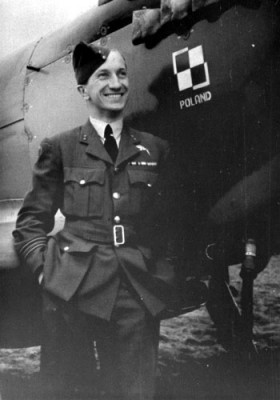
The Polish Squadrons of the RAF were quite superior to the less-experienced British pilots.  In fact, the 303 Squadron, also known by the name of "Kosciuszko Squadron" became the most efficient RAF unit during the Battle of Britain. However many excellent Polish pilots flew in other RAF squadrons as well. Their talent and prestige is evident in the numerous Polish squadrons created by the RAF in subsequent years - the 304 bomber, 305 bomber, 306 fighter, 307 night fighter, 308 fighter, 309 reconnaissance, then fighter; 315 fighter, 316 fighter, 317 fighter, 318 fighter-reconnaissance and 663 air observation and artillery spotting.

303 Squadron Polish Air Force Battle of Britain


Initially the Polish fighter squadrons flew Hurricanes, and then Supermarine Spitfires though some airmen flew North American Mustangs.  The 307 used the night fighter Boulton-Paul Defiant, Bristol Beaufighter and the de Havilland Mosquito. Among the first planes flown by No. 300 Polish bomber squadron were the Fairey Battles, Vickers Wellingtons, followed by the Avro Lancasters; No. 301 flew Handley Page Halifaxs and Consolidated Liberators; No. 305 Squadron flew de Havilland Mosquitos and North American Mitchells; and the 663 flew Auster AOP Mk Vs.

Finally an agreement was reached on April 6, 1944 whereby the Polish Air Forces in England came under Polish Command - without RAF officers. As a result a PAF staff college was established at RAF Weston-super-Mare and continued to operate until April 1946 after which equipment was returned to the British. Due to the political circumstances after the war, few of the pilots returned to Poland choosing instead to remain in exile.

During the Battle of Britain the Polish Squadrons shot down 203 enemy aircraft constituting 12% of the Luftwaffe, and also destroyed 193 V-1 and V-2 German Flying Bombs. Among the non-British aircrew, the Polish Squadrons were the largest contingent of the RAF comprising over 150 pilots.  While few in comparison to RAF numbers, the Poles' contribution was immense. Twenty-nine Polish pilots were killed in action, and many more wounded.  They were fearless and fought with deadly accuracy. 

Bienkowski and Zumbach Displaying War Trophy
The British have not forgotten these amazing heroes.  The Polish Memorial was erected at RAF Northolt to commemorate their great contribution during the Battle of Britain. There is also a large memorial on the floor of the north aisle of the reconstructed Wren church St Clement Danes, London. According to Prime Minister Churchill it was " one of the decisive battles of the war". The Battle of Britain would have been lost were it not for the contribution of the Polish airmen.

King George VI meeting Polish Heroes


In Westminster Cathedral there is a commemorative plaque which reads:

IN MEMORY OF ALL RANKS OF THE POLISH ARMY NAVY AND AIR FORCE WHO GAVE THEIR LIVES FOR POLAND
AND THIS COUNTRY
IN THE SECOND WORLD WAR 1939-1945


Polish War Memorial at Northolt London

Polish airforce memorial, St Clement Danes, London


FAMOUS POLISH ACE PILOTS IN THE BATTLE OF BRITAIN

Caption reads: "Skalski: He was a great commander and a brilliant leader and we would follow him to hell if necessary"
(Newspaper source unknown)

W/Cdr STANISLAW SKALSKI ("Stan")

Stanisław Skalski was the top Polish fighter ace of WW II and the first Allied fighter ace of the war.
 Officially credited with 18 11/12 victories and two probable kills, 4 damaged planes.
Other sources, including Skalski himself, give a number of 22 11/12 victories.
Stanislaw Skalski was decorated with Virtuti Militari Golden Cross, Virtuti Militari Silver Cross, Polonia Restituta Knight's Cross, Cross of Valour(4x), Cross of Grunwald, Distinguished Service Order (UK)Distinguished Flying Cross (UK), 1939-1945 Star, Italy Star


W/Cdr WITOLD URBANOWICZ

17 confirmed kills and 1 probable kill.
Witold Urbanowicz was awarded several decorations, including Virtuti Militari Silver Cross
Cross of Valour (4x), Distinguished Flying Cross (UK).


F/ Sgt JOSEF FRANTISEK

Josef Frantisk was a Czechoslovak pilot who so admired the Poles that he would not fly with any other squadron. He is famous for being the Top Ace Pilot in the Battle of Britain

17 confirmed kills, 1 probable kill
Josef Frantisek was decorated with Virtuti Militari 5th class, Cross of Valor (3x),
Distinguished Flying Medal and Bar (UK) and Croix de Guerre.


S/Ldr EUGENIUSZ HORBACZEWSKI ("Dziubek")

16.5 confirmed kills (16 individual and one shared, 1 probable kill, 1 damaged plane
Eugeniusz Horbaczewski was decorated with several medals including Virtuti Militari IV class (posthumously) and V class, four times Polish Cross of Valour, Distinguished Service Order (posthumously)
and Distinguished Flying Cross (2x)


F/Lt BOLESLAW GLADYCH ("Mike")

17 confirmed kills,  2 probable kills, 1 shared damaged, and 5 ground kills
Boleslaw Gladych was decorated with the Silver Cross of Virtuti Militari, Cross of Valor - Poland (3x),
Distinguished Flying Cross (UK), Silver Star and two clusters (USA),
Distinguished Flying Cross (USA) 2x, Air Medal and three clusters (USA),
 and Croix de Guerre (France)


W/Cdr JAN EUGENIUSZ ZUMBACH

12 (and 2 shared) confirmed kills, five probable kills, 1 damaged plane.
Jan Zumbach was decorated with Virtuti Militari, Polish Cross of Valour (4x)
and Distinguished Flying Cross and Bar.


W/Cdr MARIAN PISAREK

12 confirmed kills, 1 probable kill, 2 damaged planes
Marian Pisarek was decorated with the Gold Cross of Virtuti Militari (posthumously),
Silver Cross of Virtuti Militari, Cross of Valor (4x),  Air Force Medal (1939-1945),
Field Pilot Badge,and Distinguished Flying Cross (UK)


EUGENIUSZ NOWAKIEWICZ

11 confirmed kills
Eugeniusz Nowakiewicz was decorated with Virtuti Militari, Merit Cross of the French Croix de Guerre,
English Cross of Valour,the Medal of the Air Battle of Britain,Aircrew Europe Star,
and Defence and War Medals.


G/Cpt ALEKSANDER GABSZEWICZ

9½ confirmed kills, 1-1/3 probables, 3 damaged planes.

Aleksander Gabszewicz was decorated with the Virtuti Militari Golden Cross, Virtuti Militari Silver Cross,Distinguished Flying Cross, Distinguished Service Order (with bar),Commander's Cross with Star of the Order of Polonia Restituta, and Cross of Valour(4x)


P/O MICHAL MACIEJOWSKI
(Michael "Mickey" Manson "Mickey Mouse")

9.5 confirmed kills , 1 probable and 1 damaged plane
No information available regarding Medals


F/Lt MIROSLAW FERIC

9 confirmed kills, 1 probable kill, 1 damaged plane
Miroslaw Feric was decorated with Virtuti Militari - Silver Cross, Cross of Valor (2x)
and Distinguished Flying Cross (UK)


S/Ldr HENRYK SZCZESNY

9-1/2 confirmed kills, 1 probable kill, 2 damaged planes
Henryk Szczesny was decorated with a Silver Cross of the Order of Military Virtuti Military, English Cross of Valor (4x), and the Distinguished Flying Cross


W/O ALEKSANDER CHUDEK

9 confirmed kills, 1 probable kill, 1 damaged plane
Aleksander Chudek was decorated with Virtuti Militari Silver Cross, Cross of Valour
and British Distinguished Flying Medal (4)


W/Cdr JAN P. FALKOWSKI

9 confirmed kills, 1 probable kill
Jan Falkowski was decorated with many medals including Virtuti Militari and Distinguished Flying Cross. In 1973 he was inducted into Canada's Aviation Hall of Fame, and in 1996 his profile appeared on a $20 commemorative silver coin struck by the Canadian mint.


F/Lt STANISLAW BRZESKI

8.5 confirmed kills, 2 probable kills, 1 damaged
   Stanislaw Brzeski was decorated with the Virtuti Militari, Cross of Valour (4x)
 and the Distinguished Flying Cross


W/Cdr WACLAW KROL

8.5 confirmed kills,1 probable kill, 1/3 damaged plane
Waclaw Krolwas decorated with Virtuti Militari Silver Cross, Polonia Restituta Knights Cross,
Cross of Valour (4x), Croix de Guerre, Distinguished Flying Cross (UK)


S/Ldr ZDZISLAW HENNEBERG

8.5 confirmed kills, 1 probable kill, 1 damaged plane
Zdzislaw Hennenberg was decorated with Virtuti Militari Silver Cross, Cross of Valour English (3x),Distinguished Flying Cross (as one of the first five Poles, 15 December 1940)
and the French Croix de Guerre


S/Ldr ANTONI GLOWACKI

8-1/3 confirmed kills, 3 probable kills, 4 damaged planes.
On August 24,1940 Antoni Glowacki shot down 5 German planes during the Battle of Britain, becoming one of only two pilots who gained "Ace-in-a-day" status during that battle
Antoni Glowacki was decorated with the Virtuti Militari, Cross of Valor, Distinguished Flying Cross,
and Distinguished Flying Medal


F/Lt EUGENIUSZ SZAPOSZNIKOW

8-1/2 confirmed kills, 1 damaged plane

Eugeniusz Szaposznikow was decorated with the Virtuti Militari (5th class), Silver Cross of Merit,
Cross of Valor (4x), and Distinguished Flying Medal


F/Lt ADOLF PIETRASIAK "Archie"

8 confirmed kills, 2 damaged planes
Adolf Pietrasiak was decorated with the Virtuti Militari Silver Cross, Cross of Valor,
and the Distinguished Flying Medal.


S/Ldr WITOLD LOKUCIEWSKI


8 confirmed kills, 3-1/2 probable kills.

Witold Lokuciewski was decorated with Virtuti Militari Silver Cross, Cross of Valour - Poland (3x),
Polonia Restituta Knight's Cross, Polonia Restituta Commander's Cross,
Distinguished Flying Cross (UK), Croix de Guerre (France)


S/Ldr HENRYK J. PIETRZAK

7-1/2 confirmed kills, 1 probable kills, 1 damaged plane, shot 4 V-1 Flying Bombs.
Henryk J. Pietrzak was decorated with the Virtuti Militari Silver Cross, Cross of Valor (4x),
Air Medal for the War 1939-1945, and Distinguished Flying Cross *UK)


S/Ldr JOZEF JEKA

7.5 confirmed kills, 3 damaged planes, and shot down 1 V-1 Flying Bomb.
Jozef Jeka was decorated with many medal including Virtuti Militari Silver Cross,
Silver Cross of Merit (with swords), Cross of Valor (4x), Distinguished Flying Medal, 1939-1945 Star,
Defence Medal,  France and Germany Star, and War Medal 1939-1945


S/Ldr BOLESLAW H. DROBINSKI "Ghandi"

7 confirmed kills, 1-1/3 probable kills
Boleslaw Drobinski was decorated with the Virtuti Militari Silver Cross,Cross of Valourm, Air Force Medal, Distinguished Flying Cross, and many others


P/O MARIAN BELC

7 confirmed kills
Marian Belc was decorated with Virtuti Militari (5th class), Cross of Valour (4x),
Distinguished Flying Cross, and Distinguished Flying Medal Ribbon


Sgt STANISLAW KARUBIN

7 confirmed kills
Stanislaw Karubin was decorated with Virtuti Militari Silver Cross, Cross of Valor (3x),
Field Pilot Bade, and Distinguished Flying Medal


S/Ldr Karol Pniak
 
6-3/4 confirmed kills, 2 probable kills, and 2 damaged planes
Karol Pniak was decorated with Flying Cross (The Netherlands)


S/Ldr WACLAW LAPKOWSKI

6-1/3 confirmed kills, and 1 damaged plane
Waclaw Lapkowski was decorated with the Virtuti Militari (V class).
 KW (total of 3 bars) KW = Kryz Walecznych, and Cross of Valor


W/Cdr STEFAN JANUS

6 confirmed kills, 1 damaged plane
Stefan Janus was decorated with the Virtuti Militari Silver Cross, Cross of Valor (I), Cross of Valor (II),
Cross of Valor (III), Cross of Valor (IV), Air Medal (4), Distinguishe Flying Cross (UK)


F/O LUDWIK WITOLD PASZKIEWICZ
6 confirmed kills
Ludwik Paszkiewicz was decorated with the Virtuti Militari Silver Cross,
Cross of Valor, and Distinguished Flying Cross


W/Cdr KAZIMIERZ RUTKOWSKI

5-1/2 confirmed kills, 2 probable kills, 1 damaged plane
Kazimierz Rutkowski was decorated with the Virtuti Militari (5th class) and
Distinguished Flying Cross


F/Lt CZESLAW GLOWCZYNSKI

5-1/2 confirmed kills, 2 probable kills, 1 damaged plane.
Czeslaw Glowczynski was decorated with the Virtuti Militari Silver Cross, Cross of Valour (4),
and the French Croix de Guerre


F/Lt MICHAL CWYNAR

5-1/2 confirmd kills, 1 probable kill and shot down 1 V-1 flying bomb (and 4 shared)
Michal Cwynar was decorated with the Virtuti Militari Silver Cross, Cross of Valor (4x),
 the Silver Cross of Merit with Swords, and the British Distinguished Flying Cross.


G/Cpt STEFAN WITORZENC

5-1/2 confirmed kills, 2 damaged planes
Stefan Witorzenc was decorated with the Virtuti Militari Silver Cross,
 Polonia Restituta Commanders Cross with Star, Cross of Valour, and
Distinguished Flying Cross


W/Cdr MUMLER MIECZYSLAW

5-1/2 confirmed kills, and 1-1/2 damaged planes
Mieczslaw Mumler was decorated with the Virtuti Militari and Double Cross of Valor


F/O BOLESLAW ANDRZEJ WLASNOWOLSKI

5-1/2 confirmed kills
Boleslaw Wlasnowolski was decorated with the Virtuti Militari (5th class), and the
KW (KW = 'Kryz Walecznych) posthumously in Oct 1947


F/O ADAMEK MIECZYSLAW

5 confirmed kills, 1 probable kill
Adamek Mieczyslaw was decorated with the Virtuti Militari Silver Cross, Cross of Valor (4x)
and the Distinguished Flying Medal (2x)


F/O FRANCISZEK SURMA

5 confirmed kills, 3-1/3 probable kills, 1 damaged plane
Franciszek Surma was decorated with the Virtuti Militari Silver Cross, Cross of Valour (3x)
and the Field Pilot Badge.


F/Lt STANISLAW BLOK

5 confirmed kills, 1 probable kill, 3 damaged planes
Stanislaw Blok was decorated with the Virtuti Militari Silver Cross, Cross of Valor (3x) and
Distinguished Flying Cross (UK)


F/Lt  KAZIMIERZ SPORNY

5 confirmed kills, 1 probable kill, 1 damaged plane
Kazimierz Sporny was decorated with the Virtuti Militari Silver Cross, Cross of Valor (III),
 and Distinguished Flying Cross


F/Lt GRZEGORZ SOLOGUB

5 confirmed kills, 1 probable kill
No Information available regarding Medals


W/O JAKUB BARGIELOWSKI "Kuba"

5 confirmed kills, 3 damaged planes
Jakub Bargielowski was decorated with the Virtuti Militari Silver Cross, Virtuti Militari (V class),
Cross of Valor (3x), Bronze Cross of Merit with Swords, and the Distinguished Flying Medal.


S/Ldr JERZY POPLAWSKI

5 confirmed kills, 2 damaged planes
No information available regarding Medals


NEXT

BATTLE OF BRITAIN: PART IV
LEGEND OF THE SPITFIRE


NB. Sources and Suggested Links will be provided at the end of this series.