 |
| Franz Burkl |
In the action, Burkl was ambushed by five young fighters of the Armia Krajowa armed with Sten submachine guns and Filipinka hand grenades. The attack took place in broad daylight on Marszalkowska Street. The AK group led by 21 year old Jerzy Zborowski, consisted of recruits from the Polish scouting organization called Szare Szeregi.
 |
| (Archive Photo) GERMAN POLICE BARRICADE MARSZALKOWSKA STREET AFTER ASSASSINATION OF BURKL |
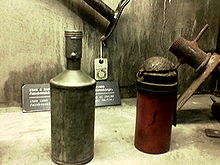 |
| L-R Grenades Sidolowka and Filipinka, manufactured by Armia Krajowa (exhibition in the Museum of Warsaw Uprising) |
 |
| Jerzy Zborowski |
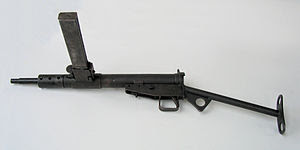 |
| Sten Mk. II (trigger mechanism cover is missing) |
The Operation took all of 90 seconds. In that brief moment, Burkl and seven other German policemen were gunned down and killed. Though Group Agat suffered no losses in the mission, the Nazis carried out reprisals by publicly executing 20 Polish inmates of Pawiak prison.
 |
| Polish Prisoners Hanged at Pawiak Prison |
The British SOE (Special Operation Executive) supplied the Cichociemni, the Secret Polish Resistance forces with various models of Sten sub-machine gun. Approximately 11,000 Sten guns were delivered to the Armia Krajowa between 1942 and 1944. During this time the Polish Underground was manufacturing variations of the Sten guns in secret workshops throughout Poland. Polish replicas were being made in at least 23 underground workshops. The design was simple. Some workshops manufactured copies of the Mark IIs while others produced the Polski Sten and KIS. The Polski Sten was made under command of Ryszard Białostocki and was built from a combination of components that were legally made in official factories. The main body of the machine pistol consisted of hydraulic cylinders that had been produced for hospital equipment. In order to disguise the origin of the production all the pistols were marked in English. Stens' barrels were also used for SMGs produced in Poland under the name Błyskawica.

NEXT:
PART II MISSIONS: Operation Kutschera

