May 3, 2011

POLAND CONSTITUTION DAY MAY 3


Poland enacted its first Constitution on May 3, 1791 - the first European nation and the second nation in the world after the United States to do so. The Act was instigated by the Polish government which was then adopted by the Sejm of the Polish-Lithuanian Commonwealth. Its scope was quite radical for its time - that is, the introduction of political equality between the townspeople and the nobility (szlachta) and protecting the rights of peasants from abuses of serfdom. Most notable was the abolishment of the liberum veto of the parliamentary institutions. By such veto any deputy could easily usurp all legislation passed by the Sejm and create utter havoc and anarchy. The Polish Constitution of May 3rd sought to resolve the chaos and imbalances with the introduction of egalitarian laws and democratic constitutional monarchy.

May 3rd Constitution (painting by Jan Matejko, 1891). King Stanisław August (left, in regal ermine-trimmed cloak), enters St. John's Cathedral, where Sejm deputies will swear to uphold the new Constitution; in background, Warsaw's Royal Castle, where the Constitution has just been adopted.

Ignacy Potocki

The development of these bold reforms provoked considerable animosity and hostility from Polands neighbours, as well as from a cabal of Polish magnates seeking to maintain the status quo. It ultimately led to the Second Partition in 1795 in which Poland was invaded and defeated by Prussia, Russia and Austria.  Despite Poland''s defeat its Constitution was exemplary and influenced other democratic movements in other parts of the world. For the next 123 years the Polish Constitution was a beacon of hope to a nation under siege and struggling to restore its sovereignty. Ignacy Potocki and Hugo Kollataj, the co-authors of the Constitution, referred to it as "the last will and testament of the expiring Fatherland".
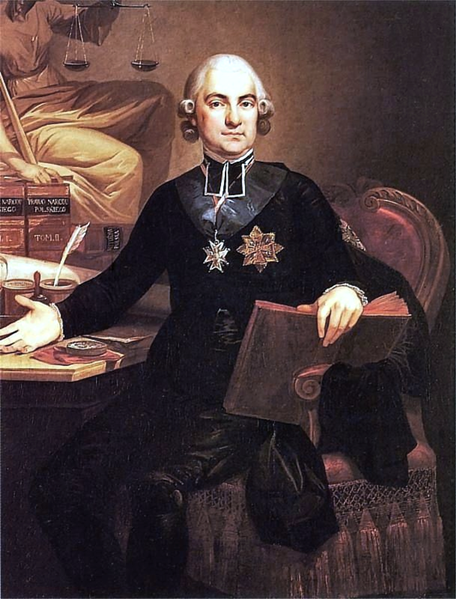
Hugo Kollataj

In fact Poland has had several constitutions in its long and tumultuous history. In the 19th century the Duchy of Warsaw enacted its own
Constitution which was quite liberal for its time. It established a bicameral Sejm consisting of a Senate and a Chamber of Deputies, with an executive body consisting of the Council of Ministers. Although it established Roman Catholicism as the state religion, religious tolerance was also guaranteed. Moreover egalitarian ideals were instituted and serfdom was abolished.

The Constitution of the Kingdom of Poland in 1815 promised freedom of speech and religious tolerance and was considered to be the most liberal of all of Europe.  Its constitution contained 165 articles in seven titles.

The Free City of Krakow, in 1815 was a city-state though not sovereign by any means. It was controlled by Russia, Prussia and Austria until 1846 when it was annexed to the Austrian Empire after the Krakow Uprising was defeated.  However, the Krakow Constitution, enacted in 1815 did provide the city with a significant degree of autonomy.

During the Second Polish Republic there were three Constitutions:  The Small Constitution, adopted on February 20, 1919 declared the Poland government as a parliamentary system, but omitted to declare itself a Republic.  The Chief of State held executive power and could only appoint ministers with the consent of the the Sejm. All were responsible before the Sejm, and did not have the power to dismiss the legislature.  Moreover, all Acts required the signature of the minister relevant to such a portfolio.

This constitution  was supplanted by the March 1921 Constitution, the latter of which was based on the French one and considered very democratic. Foremost were articles which expressly ruled out discrimination on racial or religious grounds. It was amended in 1926 and superseded by the Polish Constitution of 1935.

The 1935 Constitution established a presidential system of government, albeit an authoritarian one. Despite its outright violation of its preceding constitution and the rule of parliament, it was fervently adopted in order to promote national interests rather than democratic ones.(Sanacja).  As a result the President held enormous power and was imbued with the right to handpick members of his government, who in turn would be held responsible to the parliament.  He could also dismiss parliament before the end of its term, appoint a third of the Senators, the Commander-in-Chief of the Polish Army, as well as the General Inspector of the Armed Forces.  In addition, the President could issue decrees and veto acts passed by the Sejm. Most notable was the right given to the President to name his successor in the event of war. This feature was used by the Polish Government-in-exile during World War II tol justify its existence. The Constitution was abolished by the Soviet-back Polish authorities in 1944.  In its place was the restoration of the March Constitution along with many laws based on the Stalinist regime.

During the period of 1945-1989, the Polish Committee of National Liberation issued a Manifesto outlawing the April Constitution (of 1935) as unlawful and fascist.  It held that the March Constitution of 1921 would be in force until it was replaced with the new "Small Constitution of 1947", later supplanted in 1952 by the constitution of the Peoples Republic of Poland.

Finally during the Third Polish Republic (1989 - present) the Small Constitution of 1992, was a major adjustment of the 1952 constitution and established Poland as a democracy with many democratic reforms including the establishment of legislative and executive branches and local self-government.
It was voted by Poland's first democratic government (elected in free elections) since 1928.  In the process, the Stalinist Constitution was annulled, and Poland emerged as a liberal democratic nation with a market economy.

This was replaced by the current constitution of Poland, adopted by the National Assembly on April 2, 1997 and approved by a national referendum on May 25, 1997 and came into effect October 17, 1997.

The Preamble of the current Polish Constitution expresses what is in the heart of the Polish nation and its people.  It speaks volumes. It looks ahead towards a future that is bright and promising for all its citizens, but never forgets at what cost such freedom was finally achieved.  Poland inspires awe and respect for the struggles she has overcome, most notably in rebuilding a great modern nation and forging democratic and international commitments.


PREAMBLE

Having regard for the existence and future of our Homeland which recovered, in 1989, the possibility of a sovereign and democratic determination of its fate, We, the Polish Nation - all citizens of the Republic, Both those who believe in God as the source of truth, justice, good and beauty,
As well as those not sharing such faith but respecting those universal values as arising
from other sources, 

Equal in rights and obligations towards the common good - Poland,
Beholden to our ancestors for their labors, their struggle for independence achieved at great sacrifice, for our culture rooted in the Christian heritage of the Nation and in universal human values,
Recalling the best traditions of the First and the Second Republic,
Obliged to bequeath to future generations all that is valuable
from our over one thousand years' heritage,

Bound in community with our compatriots dispersed throughout the world,
Aware of the need for cooperation with all countries for the good of the Human Family,
Mindful of the bitter experiences of the times when fundamental freedoms and human rights
were violated in our Homeland,
Desiring to guarantee the rights of the citizens for all time, and to ensure diligence and efficiency in the work of public bodies,

Recognizing our responsibility before God or our own consciences,
Hereby establish this Constitution of the Republic of Poland as the basic law for the State, based on respect for freedom and justice, cooperation between the public powers, social dialogue as well as on the principle of subsidiarity in the strengthening the powers of citizens and their communities.
We call upon all those who will apply this Constitution for the good of the Third Republic to do so paying respect to the inherent dignity of the person, his or her right to freedom, the obligation of solidarity with others, and respect for these principles as the unshakeable foundation of the Republic of Poland.


Recommended Links:
Official Website of the President of the Republic of Poland
The Constitution of the Republic of Poland
Polish Constitutions
The Radicalism of May 3rd Constitution
Polish American Journal - 3rd May
The White House, Statement of President Barack Obama

May 2, 2011

CELEBRATION OF POLISH FLAG DAY MAY 2


Polish Flag Day in Poland is a very important celebration, much more so than for any other country in the world. Poland does not take for granted its independence nor freedom - which has been lost and re-won four times in it's long and tumultuous history.

Poland has been partitioned four times in its history, the first in August 1772, between Prussia, Russia, and Austria; the second partition in January 23, 1793, between Russia and Prussia, as well as in 1795. Poland ceased to exist as a nation-state for 123 years and finally regained it's independence in 1918. But within a very few short months, the newly established Second Republic of Poland was embroiled in war with Russia, the latter whose imperialist ambitions were focused on expansionism that is, to recapture Polish territory it had lost as a result of the Treaty of Versailles. The Russians were ultimately crushed by the Polish army, and suffered a humiliating defeat at the Battle of Warsaw - a battle which Poles refer to as the "Miracle at the Vistula".

 Polish Prometheus, 1831 by Horace Vernet as an allegory of fall of November Uprising

On September 1st,1939 the Polish nation was attacked by Germany from the north, west and south, and on the 17th of September by Russia from the east. This was the fourth partition in the history of Poland, and the start of World War II. Hitler and Stalin's objective were not only to conquer Polish territory, but rather to eradicate the Polish nation altogether - Polish Culture, the Polish People, the Polish Language. In fact, the German soldiers shot anybody caught playing Polish music, or even flying the Polish Flag.

The Polish armed forces were the first to fight the German and Soviet invaders, against insurmountable odds. Despite treaties of mutual assistance with Great Britain and France, Poland was abandoned to fight alone. Though the allies won the war, Poland - the 4th largest ally - was betrayed into the hands of Stalin, and languished behind the iron curtain for over four decades.

a Polish Infantry, September 1939

With the growth of the Solidarnosc movement, Lech Walesa breathed life into Poland, raising the hopes and dreams of a battered and weary people. And the blessings of beloved Pope John Paul II, now Blessed John Paul II, deepened the faith that Poland would soon break free of its shackles.


On Polish Flag Day throngs of Poles (in Poland, and around the world) proudly display the Polish colors of red and white. But the Polish flag is more than a symbol of national identity and pride. It is the embodiment of the Polish Soul. It is a commemoration of Poles who lost their lives to defend their beloved motherland.


Polish Soldiers in Afghanistan (or Iraq?)


Throughout Poland's rich history, (one that has spanned over a thousand years), there have been an astounding number of flags representing the changing configuration of Polish statehood. It is indeed a testament to its greatness as a nation, and to the fervent determination and perseverance of a people that Poland fought for its freedom and would not be subdued nor defeated by its enemies.

God Bless Lech Walesa!
God Bless Blessed Karol Wojtyla !
God Bless Poland Forever!


The lyrics of the Rota were written in 1908 by Maria Konopnicka, as a protest against the Prussian, and then German occupation of Poland and the brutal oppression of the Polish people. The music was composed by Feliks Nowowieski two years later.


The Rota was sung publicly for the first time on July 15, 1920 in Krakow, at a patriotic demonstration in commemoration of the 500th Anniversary of the Polish-Lithuanian victory over the Teutonic knights at the Battle of Grunwald. 


The song became wildly popular throughout partitioned Poland and was until 1918 the anthem of the Polish Scouting movement.


Battle of Grunwald oil on canvas 426 x 987cm by Jan Matejko (1878)

On November 11, 1939, during the German occupation of Poland during World War II, the Polish Scouting Association posted the lyrics of this anthem everywhere on the walls of building in Zielonka, a town just outside of Warsaw. In reprisal, German forces executed 9 scouts and other citizens of the town.  A Polish film was produced in 2008 telling the story. (11 Listopada)

The Rota has been played by the Gdansk carillon tower until 2003, and was the theme of two Polish television stations: TVP Poznan and TVP Gdansk. It became the official party anthem of the Polish People's Party after 1989.

In 2010, the Polish Sejm enacted a special resolution honouring the Rota, and the writer of its lyrics, Konopnicka. The Rota also serves as the anthem of the Polish National-Territorial Region.

Polish text: English translation:
Nie rzucim ziemi, skąd nasz ród. We won't forsake the land we came from,
Nie damy pogrześć mowy. We won't let our speech be buried.
Polski my naród, polski lud, We are the Polish nation, the Polish people,
Królewski szczep Piastowy. From the royal line of Piast.
Nie damy, by nas zniemczył wróg. We won't let the foe Germanize us.

Tak nam dopomóż Bóg! So help us God!

Do krwi ostatniej kropli z żył To the last blood drop in our veins
Bronić będziemy Ducha, We will defend our Spirit
Aż się rozpadnie w proch i w pył Till into dust and ash shall fall,
Krzyżacka zawierucha. The Teutonic windstorm.
Twierdzą nam będzie każdy próg. Every house will be a fortress.

Tak nam dopomóż Bóg! So help us God!

Nie będzie Niemiec pluł nam w twarz The German won't spit in our face,
Ni dzieci nam germanił, Nor Germanize our children,
Orężny wstanie hufiec nasz, Our host will arise in arms,
Duch będzie nam hetmanił. Holy Spirit will lead the way.
Pójdziem, gdy zabrzmi złoty róg. We'll set out when the golden horn calls.

Tak nam dopomóż Bóg! So help us God!

Nie damy miana Polski zgnieść We won't have Poland's name defamed,
Nie pójdziem żywo w trumnę. We won't step into a coffin alive.
Na Polski imię, na jej cześć In Poland's name, in its worship
Podnosim czoła dumne, We lift our faces proudly,
Odzyska ziemię dziadów wnuk. A grandson will regain his forefathers' land

Tak nam dopomóż Bóg! So help us God!


Suggested Links:
Polish Flag Day - May 2 (in Polish only. Please use Translator)
Polish Flag Day (in Polish only)
National Symbols (in English)

May 1, 2011

Karol Wojtyla A Man of God: The Beatification of Pope John Paul II

  (Length: 4h 15m) note: actual video begins at 4m 30

"Auctoritate Nostra Apostolica facultates facimus ut Venerabilis Servus Dei Ioannes Paulus II, papa, Beati nomine in posterum appelletur ..."


Karol Wojtyla was the beloved Son of Poland and beloved Man of God to the world. During his pontificate he had visited 129 countries, travelling a total distance of about 1.1 million km (or 725,000 miles). He spoke Latin, English, French, Italian, Spanish, Portugese, Croatian, Esperanto, Ancient Greek, German, Russian, Ukrainian, and his native language, Polish. During his pontificate, he beatified 1,340 people and canonized 483 saints - more than the combined total of his predecessors in the past 500 years!


He was the first Pope to visit the White House (October 1979) where he was welcomed very warmly by then President Jimmy Carter. He was the first Pope to visit the United Kingdom in 1982 and met with Queen Elizabeth II. In 1983 he traveled to Haiti and was met at the airport by thousands of poor Haitians to whom he spoke in Creole.


He was the first Pope to visit Egypt where he met with Coptic Pope, Pope Shenouda and the Greek Orthodox Patriarch of Alexandria. He was the first Pope to visit Syria, where in 2001, he visited and prayed in an Islamic mosque in Damascus, and called on Muslims, Christians and Jews to work together. He visited the Umayyad Mosque, which was formerly a Christian Church, and where it is believed that John the Baptist was interred.


Millions upon millions of Catholic youth all over the world assembled in many cities to celebrate World Youth Day, The largest congregation was in Manilla, Philippines where over 5 million were reported to have gathered.


But foremost among all his visits was his pilgrimage to beloved homeland Poland where his visit in 1979 (and several visits thereafter) was met by millions of ecstatic compatriots. He had given more than hope to the people of Poland. He gave them courage and the fervent belief that they had God behind them to free themselves from the brutal communist regime. A year later the Solidarnosc movement was created. Pope John Paul II was indeed the instrument of God that destroyed the reign of communism in Poland and set off a domino effect that dismantled the iron curtain throughout eastern Europe.

Pope John Paul's visit to Poland 1983
Pope John Paul II and Lech Walesa

He survived a deadly assassination attempt that almost took his life. He attributed his survival and recovery to the intervention of Blessed Mother Mary, to whom he was especially devoted all his life.


Could I forget that the event [Ali Ağca's assassination attempt] in St. Peter’s Square took place on the day and at the hour when the first appearance of the Mother of Christ to the poor little peasants has been remembered for over sixty years at Fátima, Portugal? For in everything that happened to me on that very day, I felt that extraordinary motherly protection and care, which turned out to be stronger than the deadly bullet.
Pope John Paul II -Memory Identity, Weidenfeld & Nicolson, 2005, p.184


In 1983, just two days after Christmas, Pope John Paul II visited his would-be assassin in prison and spoke privately with him for about twenty minutes.  The Pontiff later declined to mention what was discussed, and said, "What we talked about will have to remain a secret between him and me.  I spoke to him as a brother whom I have pardoned and who has my complete trust."

  
On October 27, 1986, Pope John Paul II, traveled to Assisi for World Day of Prayer for Peace, and met with over 120 representatives of many religious faiths and Christian denominations. It was more than a day of fasting and prayer, but a tacit recognition and awareness that we are all the same family under God.

He made improvements in the relations between Catholicism and Judaism. On April 13, 1986 he was the first Pope to make an official visit to a synagogue, the Great Synagogue of Rome. In 1994 he established formal diplomatic relations between the Holy See and the State of Israel and openly acknowledged its centrality in Jewish life and faith. To honor this event, he hosted a Papal Concert to commemorate the Holocaust. The concert was attended by the Chief Rabbi of Rome, the President of Italy, and Holocaust survivors from around the world. Most moving of all was his visit to Jerusalem in March 2001, where he visited Yad Vashem. He was the first Pope to do so, and to visit and pray before the Western Wall. He touched the holy Wall, and placed a letter inside it. The following is an excerpt:

"I assure the Jewish people the Catholic Church ... is deeply saddened by the hatred, acts of persecution and displays of anti-Semitism directed against the Jews by Christians at any time and in any place"....(there are ) "no words strong enough to deplore the terrible tragedy of the Holocaust"

Pope John Paul II places letter in Western Wall, Jerusalem
In January 2005, Pope John Paul II received a priestly blessing from a Rabbi, when Rabbi Benjamin Blech, Barry Dov Schwartz, and Jack Bemporad visited the Pontiff at Clementine Hall in the Apostolic Palace.

With Judaism, therefore, we have a relationship which we do not have with any other religion. You are our dearly beloved brothers, and in a certain way, it could be said that you are our elder brothers.    Pope John Paul II, April 13, 1986


 Pope John Paul II receives a gift from the Grand Rabbi of the Ashkenazis,
In May 1999 Pope John Paul II was invited to visit Romania by Patriarch Teoctist Arapasu of the Romanian Orthodox Church. The first time a Pope had visited an Eastern Orthodox Country since the Great Schism in the year 1054.

On June 23 to 27, 2001, the Pope was visited the Ukraine on the invitation of the President of the Ukraine and the Bishops of the Ukrainian Greek Catholic Church. About 200,000 people attended the liturgy celebrated by the Pope in Kiev, and over 1.5 million in Lviv.

The Dalai Lama visited Pope John Paul II eight times, the two sharing similar beliefs, and experiences, both affected by communist regimes in their respective countries.

Pope John Paul II and Dalai Lama

Pope John Paul II was the greatest man the world had ever known, a friend, a brother to the entire world. He reigned for 26 years and 168 days. Although the second longest pontificate (Pope Pius IX served for 31 years), Pope John Paul II, Karol Wojtyla, had done more for the world than any other man past or present. He was a living saint. And now, the world awaits with baited breath for the much awaited Beatification of Pope John Paul II -  he is just a step away from Sainthood. It is a joy to be a witness to this historic and spiritual event.

Pope John Paul II met with Mother Teresa


Abba Pater by John Paul II ~ Deo Gratias (00:05:49m)