December 10, 2011

Secret Polish Forces of WW2: The "Silent & Dark Ones" PART II: MISSIONS Operation Burkl - Operacja Burkl

Operation Burkl, the second phase of Operation Heads was carried out by the "Anti-Gestapo" Agat unit of the Kedyw Divison of the Armia Krajowa on September 7, 1943.  Their objective was to assassinate specific SS Nazi officers in Warsaw. It was a success.

Franz Burkl
Franz Burkl, a notorious Gestapo officer, was responsible for ordering numerous executions of the Polish people including Polish Jews, and prisoners of the infamous Pawiak prison in Warsaw. Between 1941 and 1943 he personally murdered several dozen people, both in and outside prison installations.  In his trips inside the Warsaw Ghetto, he conducted shootings of people at random. During the Warsaw Ghetto Uprising, a gang of Pawiak criminals under Burkl's command was sent to hunt down and kill the Jewish insurgents.  According to reports, Burkl was alleged to have been addicted to morphine. He was always accompanied by Kastor, his German Shepherd, which he routinely trained to terrorize the Pawiak convicts. He was a deranged sadist and mass murderer.  The Secret Polish Underground Court sentenced him to death by for crimes committed against the Polish nation.

In the action, Burkl was ambushed by five young fighters of the Armia Krajowa armed with Sten submachine guns and Filipinka hand grenades. The attack took place in broad daylight on Marszalkowska Street. The AK group led by 21 year old Jerzy Zborowski, consisted of recruits from the Polish scouting organization called Szare Szeregi.

(Archive Photo) GERMAN POLICE BARRICADE MARSZALKOWSKA STREET AFTER ASSASSINATION OF BURKL
 

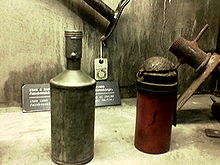
 L-R Grenades Sidolowka and Filipinka,
manufactured by Armia Krajowa
(exhibition in the Museum of Warsaw Uprising)
Jerzy Zborowski

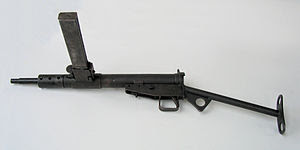
Sten Mk. II (trigger mechanism cover is missing)

The Operation took all of 90 seconds. In that brief moment, Burkl and seven other German policemen were gunned down and killed. Though Group Agat suffered no losses in the mission, the Nazis carried out reprisals by publicly executing 20 Polish inmates of Pawiak prison.

Polish Prisoners Hanged at Pawiak Prison

The British SOE (Special Operation Executive) supplied the Cichociemni, the Secret Polish Resistance forces with various models of Sten sub-machine gun.  Approximately 11,000 Sten guns were delivered to the Armia Krajowa between 1942 and 1944. During this time the Polish Underground was manufacturing variations of the Sten guns in secret workshops throughout Poland. Polish replicas were being made in at least 23 underground workshops. The design was simple. Some workshops manufactured copies of the Mark IIs while others produced the Polski Sten and KIS. The Polski Sten was made under command of Ryszard Białostocki and was built from a combination of components that were legally made in official factories. The main body of the machine pistol consisted of hydraulic cylinders that had been produced for hospital equipment. In order to disguise the origin of the production all the pistols were marked in English. Stens' barrels were also used for SMGs produced in Poland under the name Błyskawica.


NEXT:
PART II MISSIONS:  Operation Kutschera


December 9, 2011

Secret Polish Forces of WW2: The "Silent & Dark Ones" PART II: MISSIONS Operation Heads - Operacja Glowki

OPERATION HEADS - Operacja Glowki

During World War II Nazi-occupied Poland was a veritable hunting ground. German troops were constantly on the rampage, rounding up as many Polish civilians as possible. These daily arrests were referrred to by the Poles as lapanka. Hundreds of Polish men, women, and children were arrested and executed en masse. In Warsaw between 1942 and 1944 over 400 Poles fell victim to the lapanka on a daily basis. Many more perished throughout Poland. By the end of the war tens of thousands of Polish civilians had been murdered in mass executions, including an estimated 37,000 Polish inmates in Pawiak prison, run by the Gestapo. Thousands of Polish civilians and resistance fighters were murdered in the ruins of the Warsaw Ghetto. Many of the executions were made a public spectacle in an effort by the Germans at pacification. The Nazis published lists of names of Polish individuals marked for execution. In retaliation, the Polish Underground also published their own lists naming specific Nazi German officials for assassination, and proceeded to systematically carry out their threats.

Lapanka - German soldiers arresting Polish civilians
Polish Civilians Hanged at the Gallows by Nazi Germans

Operation Heads was the Polish answer to Nazi terror. The Polish Underground targeted key Nazi officials for assassination as recompense for the German crimes perpetrated against the Polish people. The assassinations were legally decreed by the Secret Polish Underground State, and by the Special Courts of the Polish Underground. They named the mission Operation Heads in sarcastic reference to the Totenkopf, which was the symbol prominently displayed on SS Nazi German uniforms and headgear.
Totenkopf

In response to Nazi brutality,  members of the Polish Home Army planned and carried out ambushes, killing 361 gendarmes in 1943, and another 584 in 1944. In Warsaw 10 Germans were killed on a daily basis. From August to December 1942, the Home Army carried out 87 attacks on the German administration and members of the terror regime.  By 1943 the frequency of attacks increased radically. During the first four months of 1943, the Home Army increased the attacks to 514. The Polish underground targeted key figures of the German administration, police, SS, SA, labor office and Gestapo. All were condemned to death by the Polish Underground Court for crimes against the Polish people. Even Poles who were caught collaborating with the Germans were sentenced to death. Retribution was swift and merciless. 

The following list of names are just a few of the Nazi officials that were targeted by the Armia Krajowa for execution. 


TARGETS FOR ASSASSINATION

Anton Hergel
a Nazi commissioner of printers who controlled press and publishers in General Government.  The Polish Resistance fighters wounded him twice,
 in two separate actions 1943.


Franz Bürkl
was an SS-Oberscharführer, Gestapo officer, and commandant of Pawiak.
He was killed in Operation Bürkl on September 7, 1943.


August Kretschmann
was an SS-Hauptscharfuhrer and commandant of prison camp Gesiowka.
He was executed September 24, 1943.


Stephan Klein SS-Scharfuhrer
member of Pawiak prison. He was killed on 1943 by Kedyw baon Battalion Parasol.


Franz Kutschera
was an SS-Brigadeführer and Generalmajor of Polizei, SS and Police Leader of the Warsaw District. He was killed in Operation Kutschera on February 1, 1944.


Ernst Weffels
was an SS-Sturmmann member of Nazi personnel of Pawiak. He was executed on October 1, 1943 for cruelty and executions in the Women's Prison in Pawiak.


Ludwig Fischer
was Governor of the Warsaw District during the occupation General Government. Shots were fired at his car in Operation Hunting in 1944, but he survived. After war, he was caught, sentenced to death, and executed by hanging in Poland.


Albrecht Eitner
was a secret agent working to Abwehr. He was executed on July 1, 1944.


Willi Lubbert
worked at the unemployment office and organizedł apanka (Polish euphemism for rounding up of non-combatants) of Poles to be sent to Nazi labor camps.
He was executed on July 1, 1944.


Wilhelm Koppe – Hohere SS und Polizei Fuhrer
HSSP, SS-Obergruppenfuhrer wounded in "Akcja Koppe" (Action Koppe)
 on 11 July 1944 in Krakow.


Ernst Durrfeld
had shots fired at his car on July 12, 1944, but he escaped.


Willy Leitgeber
was an officer of section Kripo assigned to fight with Polish underground.
He was wounded in one action and killed in second.


Michajlo Poholowko
was a Ukrainian Nazi collaborator from Komitet Ukrainski.
He was killed on March 31, 1944.


Walter Stamm
was an SS-Sturmbannführer, IV Department Gestapo, director in Warsaw Sicherheitsdienst. He escaped from Operation Stamm on May 5, 1944.


Eugen Bollodino
worked in the unemployment office and organized lapanka (Polish euphemism for rounding up on the streets of civilians) of Poles to be sent to Nazi labor camps.
 He was executed on 1944.


Karl Freudenthal Kreishauptmann
of powiat Garwolin responsible for murder of Jews and Poles, and for deportation of local Jewish population to the ghettos


NEXT:
PART II MISSIONS:  Operation Burkl


December 8, 2011

Secret Polish Forces of WW2: The "Silent & Dark Ones" PART II: MISSIONS Operation Belt

OPERATION BELT

One of the largest Polish Operation against the Nazis was Operation Belt. In August 1943 Polish Command gave the order to Kedyw Division of the Armia Krajowa to launch an attack against German border guarding stations located on the frontier between the territory of the German General Government, and the territories annexed by Germany. By February 1943, the Polish secret forces were able to destroy 13 of these German outposts, with minimal losses among Polish units.

The Kedyw Division were specialists in sabotage of all genre, anti-Nazi propaganda, and armed action directed towards Nazi German forces and their collaborators. Most notable among their Operations was the sabotage of rail lines, bridges and roads, burning of trains and fuel depots, and the destruction or damage of German weapons' factories.  They were also instrumental in liberating hundreds of prisoners and hostages held by the Nazis.

Polish Underground derailed trains WW2
Polish Underground WW2 Grenade Production

Most of the members of Kedyw were recruits from Zwiazek Harcerstwa Polskiego, the Polish Scouting and Guiding Association. After the invasion of Poland, the Nazis condemned this group as criminals and executed many of them. They came to be nicknamed "Szare Szeregi" (Gray Ranks).  The Division was grouped into several infantry battalions, most notable among them the famous "Zoska" battalion, the "Parasol" battalion, and the "Miotla" battalion.


Kolegium B unit of Kedyw AK during training in Celestynowski Forest near Warsaw
May 1944: L-R: unknown "Grot", Eugeniusz Domanski "Mis", Zbigniew Mlynarski "Kret", Ryszard Jablonowski "Wawrek", Tadeusz Borek, Jozef Lapinski "Chmura".

The Wachlarz (the "Fan") was another organization among many others which specialized in sabotage behind German-Soviet frontlines. Between January 1, 1941 and June 30, 1944, they derailed 732 trains, set fire to 443 German transports and over 4,000 vehicles, damaged 19,000 train carriages, 6,900 engines, set fire to 1,200 gasoline tanks, blew up 40 railway bridges, destroyed 5 oil shafts, froze 3 blast-furnaces, conducted about 25, 000 sabotage acts in war factories, burnt 130 magazines of weapons and equipment, made 5,700 assassination attempts on various officer ranks of the German Wehrmacht, soldiers and police as well as the Volksdeutschs (Polish citizens of German descent who collaborated with the Nazi Germans.) In addition, the Wachlarz rescued and set free inmates held in 16 prisons. As of 1943 partisan troops began conducting missions - fighting more than 170 battles and in the process killing more than 1,000 Germans. By the start of 1944, there were approximately 60 AK partisan groups in operation, some of them numbering up to a few hundred soldiers  each, and about 200 sabotage squads.


Polish Partisan Troop
Polish Partisans Preparing for Battle
Polish Snipers - 1st Armoured Division 1944


Tadeusz Zawadzki
One of the most notable figures in the Polish Underground,  was Tadeusz Zawadzki, code-named Zoska.  He was a Scoutmaster, resistance activist and second lieutenant of the Armia Krajowa.

During the night of August 20-31, 1943, he was killed during the "Tasma" action - an suprise attack against the Grenzschutzpolizei building in Sieczychy, near Wyszkow. The fight was quick and Polish fighters succeeded in wiping out the Germans. There was only one Polish casualty. It was Tadeusz Zawadzki. He was 22 years of age.


NEXT: